
FREE SHIPPING
within mainland USA
within mainland USA

A useful teak outdoor sofa buying guide should help you distinguish meaningful quality and comfort differences—not simply show you a series of attractive designs. Visually similar sofas can differ in teak grade, construction, hardware, cushion specifications, included components, assembly, and delivery details.
This guide provides a practical sequence for evaluating those differences. By separating essential frame standards from personal comfort and ownership preferences, you can reject unsuitable sofas early and compare the remaining choices more confidently.
Choose the sofa around the way your household will use it most often. A design that looks impressive in a photograph may still be the wrong choice if its posture, seating style, or ownership demands do not match daily life.
 Begin with the people who will use the sofa regularly. Consider whether it will primarily serve adults relaxing outdoors, a family gathering after dinner, guests during larger events, or a combination of these uses.
The buying implication is straightforward: optimize for frequent users first. Occasional entertaining matters, but it should not push you toward a more formal or visually dramatic sofa that is less comfortable for everyday use.
Most outdoor sofas must support more than one activity, but one use usually deserves priority:
An upright frame can suit conversation and polished entertaining, while a deeper, more relaxed design may better serve leisurely afternoons. Neither is automatically superior. The better choice is the one whose intended posture matches your most common use.
Note whether the sofa will sit on an open patio, beneath a roof, inside a screened space, or in another partially protected location. Grade A teak is designed for outdoor conditions, but exposure also affects your experience with cushions, cleaning, appearance, and seasonal routines.
Also decide whether the sofa needs to stand alone or coordinate with club chairs, tables, or an existing outdoor arrangement. If you are still deciding between a sofa, loveseat, or sectional, settle that configuration question before comparing individual sofa models. Configuration determines which products belong on the shortlist; this guide focuses on evaluating the sofas that remain.
The frame is the durable foundation of an outdoor sofa. Cushions can sometimes be replaced or adjusted later, but a questionable frame cannot be corrected as easily. For that reason, frame standards should function as pass-or-fail requirements rather than preferences.
Look for a product page that explicitly identifies the material as real Grade A teak—not merely “teak-colored,” “teak finish,” or unspecified teak wood. Grade A teak has a dense grain structure and naturally occurring oils that help it resist moisture, rot, insects, and warping outdoors.
TeakHQ’s teak sofa frames are made with Grade A, plantation-grown teak rather than composite material or veneer. Some seating products in the broader assortment are primarily wicker with teak armrests and bases, so read the material description carefully if you specifically want a full teak frame.
A credible premium listing should provide enough detail to identify what the sofa is made from and how its important components are assembled. Useful disclosures may address:
Do not infer workmanship from price, brand imagery, or the word “premium.” When a specific construction detail matters to you, verify that it is stated on the listing or confirmed by the seller.
Within TeakHQ’s assortment, Royal Teak and Anderson Teak products use stainless-steel hardware, while Verandis Teak products use brass hardware. That is useful brand-level information, but the individual product listing should remain your final authority for the sofa you are considering.
Before evaluating colors or decorative details, ask:
If a sofa fails an essential requirement—or the seller cannot verify it—remove that model from consideration. This prevents an attractive design or appealing cushion color from distracting you from a weak or uncertain foundation.
Comfort comes from the interaction between the frame and the cushions. A sofa does not become comfortable merely because its cushions look thick, nor is a more upright design necessarily uncomfortable. Your posture and intended use determine which combination works best.
Evaluate the seat, back, and arms as connected parts:
Product photography can reveal the general design, but it cannot fully communicate firmness or body support. When comfort details are not sufficiently described, ask for clarification instead of assuming the sofa will feel the way it looks.
A conversation-oriented sofa should allow guests to sit comfortably without feeling excessively reclined. A sofa intended for long, relaxed sessions may benefit from a more lounge-like posture. Households wanting both should look for a balanced design rather than the most extreme option in either direction.
If different family members prefer different sitting positions, removable back cushions or coordinating lounge pieces may provide flexibility. You can also compare the sofa with the wider range of teak patio seating when a sofa alone will not serve every preferred posture.
Cushion thickness is only one part of comfort. Firmness, internal support, back-cushion shape, upholstery tension, frame geometry, and the user’s proportions all affect the experience.
Instead of asking, “Are the cushions thick?” ask:
For a high-value purchase, unresolved comfort information is not a minor omission. Treat it as something to investigate before placing the order.
Cushions affect comfort, appearance, weather management, and future replacement decisions. Establish your cushion requirements before comparing colors so that the most visible option does not overshadow more important practical differences.
Most—but not all—TeakHQ patio seating pieces include Sunbrella cushions. Some seating uses synthetic rope or built-in sling surfaces instead, and cushions for products that do not include them are usually available as add-ons.
Because inclusion varies, never assume that the cushions shown in a photograph are included in the listed price. Verify:
Where Sunbrella fabric is specified, it provides weather, fade, UV, and water resistance. Still, confirm the fabric on the individual listing because “outdoor cushion” is a broad description and does not establish a particular textile.
If the listing does not identify the fabric, ask. Fabric information affects how confidently you can compare color retention, exposure suitability, and ongoing care across sofas.
Color is not purely decorative. It affects the visual weight of the sofa, how it coordinates with the patio, and how readily everyday marks may be noticed. Royal Teak products generally offer four to five cushion colors, while Anderson Teak products generally offer more than ten. Confirm the current choices for the particular sofa rather than relying on brand-level availability.
Also investigate how replacement cushions can be obtained and whether the cushions require any storage or care routine you are unwilling to follow. If a sofa will be exposed and you prefer minimal cushion handling, that preference may narrow the shortlist even when several designs look equally attractive.
TeakHQ’s outdoor furniture cushion collection can help you understand available cushion options, but compatibility should always be verified for the exact sofa model.
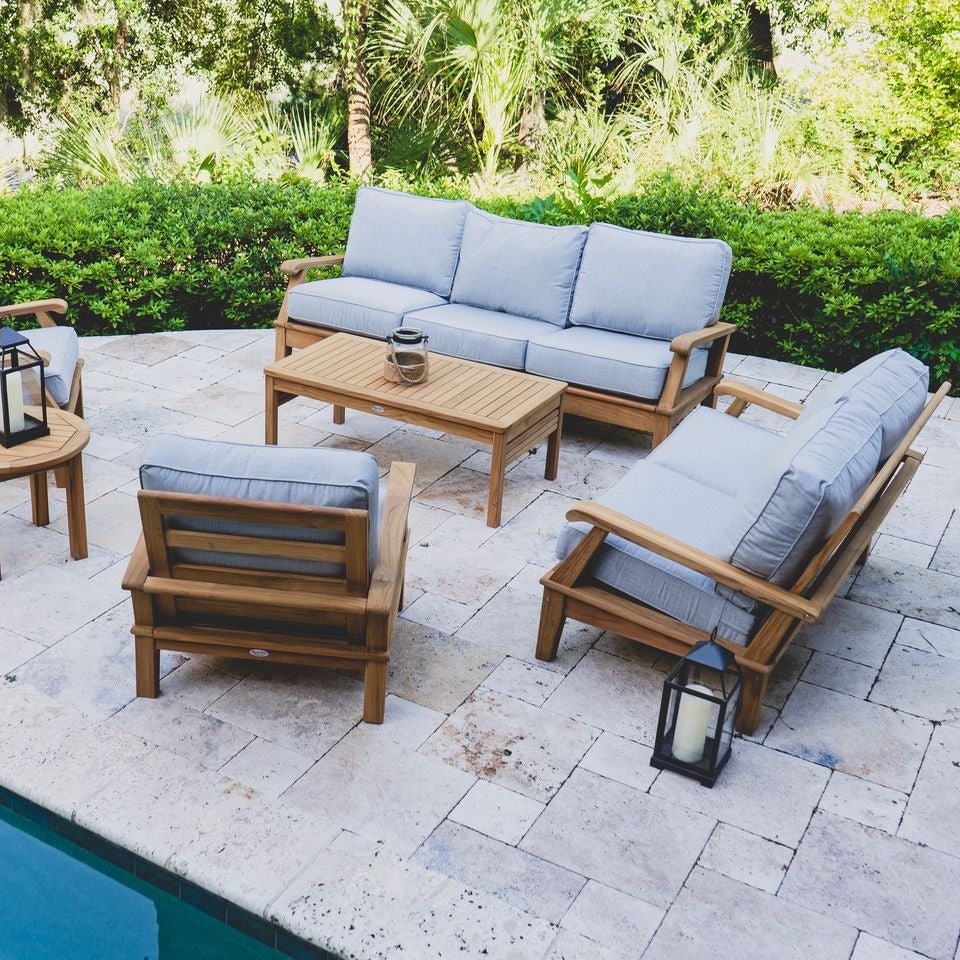 A high-quality teak sofa can support different ownership styles. The important decision is not whether one approach is universally correct, but whether you want the wood to weather naturally or prefer to preserve more of its original golden-brown appearance.
Natural teak weathers to a silver-gray patina when left untreated. This color change is an expected appearance transition rather than evidence that the wood needs an artificial stain for outdoor durability.
Buyers who appreciate naturally weathered wood can choose unfinished teak and allow the appearance to evolve. Buyers who strongly prefer the original color should account for optional sealing or oiling and the continuing attention associated with preserving that look.
This preference should be settled before choosing among finishes. Otherwise, you may select a sofa for its new golden-brown appearance without considering whether you want to maintain that appearance later.
Teak does not need an artificial stain to provide its natural outdoor durability. Appearance-preservation products are therefore an optional ownership choice, not a prerequisite for placing authentic Grade A teak outdoors.
Most TeakHQ pieces are unfinished natural teak. Some Verandis Teak products are finished or oiled when specified in the product details. Confirm the delivered finish because it affects the sofa’s initial appearance and may influence how you approach future care.
Think realistically about what you will do during periods of low use. Will cushions remain outside, move into storage, or be handled according to changing weather? Will the frame stay in place year-round? Are you comfortable with natural weathering, or will visible color change bother you?
The frame’s heavier, sturdier character can be an advantage when you want furniture with a substantial, architectural presence. It may be less convenient if you expect to rearrange or move the sofa frequently. Weight alone is not proof of quality, so treat it as an ownership characteristic after material and construction standards have been verified.
If appearance preservation is an important part of your decision, review available teak care products while remembering that optional care preferences should not be confused with the wood’s basic outdoor suitability.
A product page should be treated as a verification document, not merely a gallery. Once a sofa meets your broad requirements, confirm the specific details that affect what will arrive, how it will fit, and what ownership will involve.
Confirm each of the following on the exact listing:
Supplied brand-level facts can help you narrow the field, but they should not replace product-level confirmation. If a listing conflicts with a general assumption, rely on the listing or request clarification.
Verify the overall width, depth, height, seat dimensions, arm dimensions, and any other measurements relevant to your users and patio. Also consider the space required to approach, use, and visually balance the sofa.
This buying guide does not provide detailed sizing calculations, but dimensions remain a final purchase requirement. Never use the number of seat cushions or the apparent scale of staging objects as a substitute for listed measurements.
Most TeakHQ pieces require some assembly, although some arrive fully assembled. Confirm the status of the specific sofa so you can plan for receiving, moving, and assembling it.
Also verify the current lead time instead of assuming every brand ships on the same schedule. Most Royal Teak and Verandis Teak products have lead times of two to three days, while Anderson Teak products typically have lead times of five to fifteen days. Availability can vary, so the current listing or order confirmation should govern your expectations.
TeakHQ offers free curbside shipping. Curbside delivery is not the same as placement on the patio, unpacking, or assembly. Before ordering a substantial sofa, decide who will move it from the delivery point and complete any required setup.
For each finalist, record the answer to the same questions rather than relying on memory:
| Detail to verify | Why it affects the decision |
|---|---|
| Frame and teak grade | Determines whether the sofa clears your essential material standard |
| Hardware and construction | Provides evidence about the physical product rather than its styling alone |
| Cushions and fabric | Affects comfort, included value, appearance, and ownership routines |
| Finish | Establishes the delivered appearance and future aesthetic expectations |
| Dimensions | Confirms fit for the users and intended location |
| Assembly status | Determines what setup must be planned |
| Lead time | Shows whether the sofa fits your project schedule |
| Delivery terms | Clarifies where seller responsibility ends and your receiving plan begins |
When you are ready to apply this checklist, compare qualifying designs in the TeakHQ teak outdoor sofa collection and open each suitable product page in a separate tab.
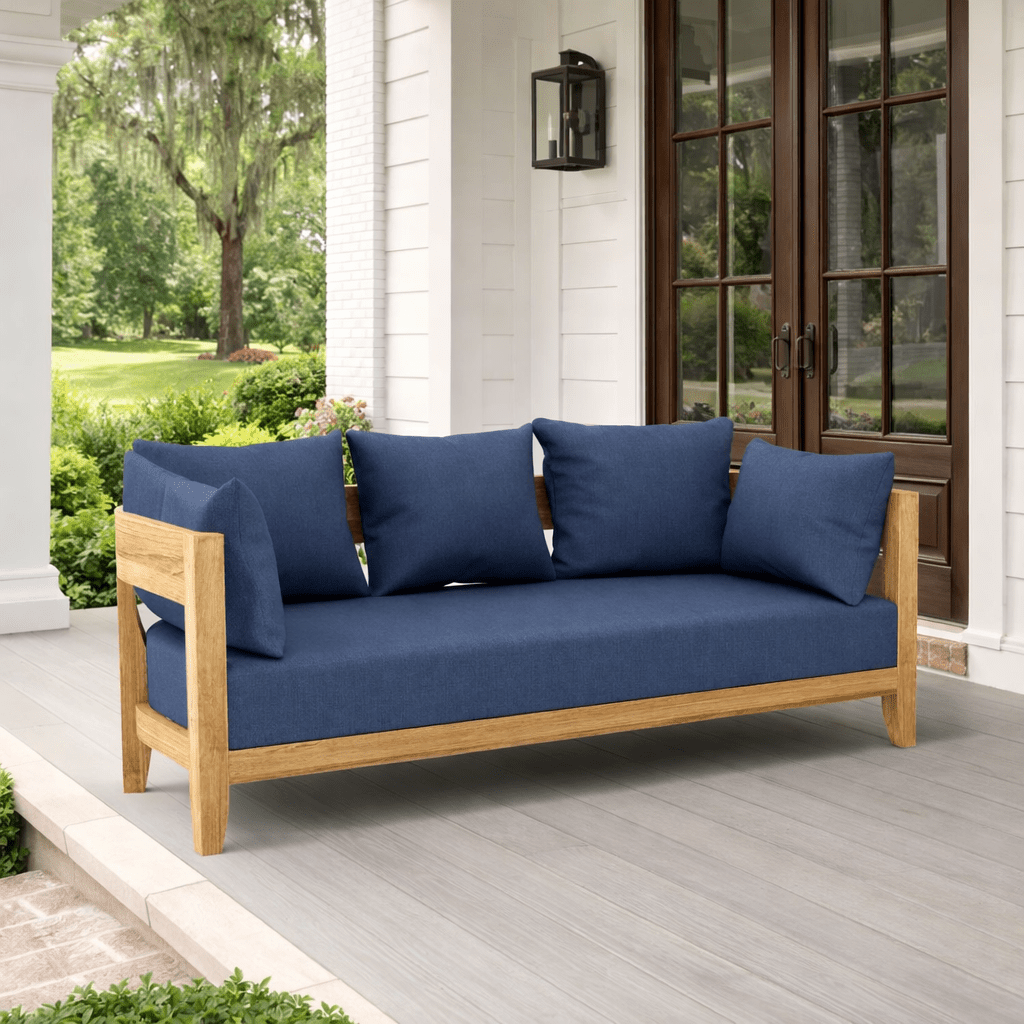 The easiest way to make a disciplined final comparison is to divide every criterion into three tiers. This keeps essential quality requirements from becoming mixed with aesthetic preferences or acceptable compromises.
Must-haves are conditions a sofa must satisfy to remain under consideration. Depending on your priorities, they may include:
Reject a sofa that fails a genuine must-have. Do not compensate for an essential deficiency by giving it extra credit for color or styling.
Preferences rank the sofas that have already passed the essential tests. These may include:
If you want the entire arrangement to coordinate, compare multi-piece teak lounge sets alongside individual sofas. Many pieces are available individually and as part of a set, but exact availability should be confirmed.
Few sofas will lead every category. Document what you are willing to exchange for a stronger priority. For example, you might accept fewer cushion colors for a preferred frame design, some assembly for a sofa that otherwise meets every requirement, or a longer lead time for a particular aesthetic.
A tradeoff is reasonable only when it does not violate a must-have. This distinction prevents the shortlist from becoming a simple contest over which sofa has the most visible features.
After eliminating failures, compare the remaining sofas using a small decision table:
| Decision tier | How to use it |
|---|---|
| Must-have | Pass or fail; reject any sofa that fails |
| Preference | Rank the sofas that pass every must-have |
| Tradeoff | Record what you will accept and what benefit you receive in return |
This sequence produces a shortlist based on evidence and household fit. It also makes it easier to explain the decision when multiple people are choosing the sofa together.
The best teak outdoor sofa is the one that clears verified frame and material standards while fitting the way your household wants to sit, entertain, and care for the space. Establish the nonnegotiables first, assess comfort and cushions as a system, settle your appearance preferences, and verify every important detail on the individual product page.
With those decisions made, you can browse teak couches and sofas with a focused shortlist instead of comparing every design on appearance alone.
Prioritize verified Grade A teak, disclosed frame and hardware materials, suitable seat and back geometry, clear cushion specifications, correct dimensions, and acceptable assembly and delivery terms. Treat these as requirements before comparing colors or decorative details.
Check whether the product description explicitly states that the frame is made from real Grade A teak. Do not assume that “teak finish,” teak-colored material, veneer, or unspecified teak is equivalent. Ask the seller to confirm the material when the listing is unclear.
Many teak outdoor sofas include cushions, but inclusion is not universal. Most TeakHQ patio seating pieces include Sunbrella cushions, while some products use rope or sling seating and others offer cushions separately. Confirm seat cushions, back cushions, fabric, and any add-on cost on the individual listing.
It can be. A heavier sofa may feel more substantial and may be preferable when you do not expect to move it frequently. However, weight is not proof of teak grade or construction quality, and it can be inconvenient when rearranging or storing furniture.
Establish acceptable frame construction first, then use cushion comfort to compare the sofas that pass. Cushions may sometimes be replaced, but they cannot compensate for an unsuitable or poorly documented frame.
No. Authentic Grade A teak does not require an artificial stain for its natural outdoor durability. It can be left untreated to develop a silver-gray patina, while sealing or oiling is an optional choice for buyers who want to preserve more of its original color.
Confirm the teak grade, other frame materials, hardware, construction details, cushion inclusion and fabric, finish, dimensions, assembly status, current lead time, and delivery terms. Also verify whether styling accessories shown in photographs are included.
Yes. Unfinished Grade A teak is a practical premium option for buyers who appreciate natural wood and are comfortable with its gradual silver-gray patina. Buyers who want to retain the original golden-brown appearance should consider the optional care that preference requires.


