
FREE SHIPPING
within mainland USA
within mainland USA
Home ▸ Teak Outdoor Furniture ▸ By Location ▸ Arizona Desert
Arizona's desert homes put outdoor furniture in an unusually demanding setting: intense sunshine, prolonged heat, dry air, blowing dust, monsoon weather, and frequent poolside use. At the same time, patios, courtyards, covered terraces, outdoor kitchens, and resort-style backyards can function as major extensions of the home for much of the year. Choosing furniture here means balancing exposure, comfort, durability, shade, and maintenance. Premium Grade A teak is particularly worth considering because it combines genuine outdoor durability with the warm, natural appearance that complements both contemporary desert architecture and more traditional Southwestern homes.

Arizona's desert climate changes what matters when evaluating outdoor furniture. The challenge is not simply that summers are hot. Furniture may spend months under strong sunlight, sit beside pools and hardscape that reflect additional heat, collect fine desert dust, and then encounter wind and sudden rain during monsoon season. A material that looks impressive in a showroom therefore needs to make sense as an outdoor material first.
For an exposed Arizona patio, we would evaluate sun tolerance before almost anything else. Materials, finishes, fabrics, and cushions all receive substantial solar exposure, particularly on west-facing patios where late-afternoon sun can be punishing. This makes durable outdoor materials and UV-resistant performance fabrics more important than they might be on a heavily shaded patio in a milder climate.
Shade planning also belongs in the furniture conversation. An excellent chair placed in relentless afternoon sun may be used far less than a good chair positioned under a roof, pergola, umbrella, or strategically shaded section of the patio. In Arizona, furniture selection and shade planning should usually happen together.
Desert homeowners often use the same patio very differently across the day and year. During cooler months, open-air dining and lounge areas can become everyday living spaces. During the hottest part of summer, covered patios, shaded seating, pools, and evening use become more important.
That means the best Arizona setup is not necessarily the one that maximizes seating everywhere. It is often better to create distinct zones: a shaded conversation area for daytime use, dining near the house or outdoor kitchen, and dedicated loungers around the pool. This makes each part of the patio useful under different conditions.
Desert dust is one of the most overlooked ownership issues. Fine particles settle on tabletops, chair frames, cushions, and horizontal surfaces even when rain is scarce. Highly intricate furniture can therefore create more routine cleaning than a simpler design with accessible surfaces.
This is one reason we favor outdoor furniture that can tolerate straightforward cleaning rather than requiring delicate finishes. A quick maintenance routine is much more realistic when the patio is used frequently.
Arizona's generally dry reputation can cause homeowners to underestimate occasional rain and wind. Outdoor furniture still needs to function as outdoor furniture when weather changes quickly. Moisture resistance, structural durability, and sensible cushion management matter even in a desert climate.
The more useful question is not, "Will this patio stay dry most of the year?" It is, "What happens to the furniture on the day it doesn't?" Premium materials should be chosen with those less frequent but more demanding conditions in mind.
Premium Grade A teak is particularly well matched to Arizona because its advantages address several different desert challenges at once. It is a dense natural wood with naturally high oil content, resistance to moisture and rotting, and the ability to withstand sun, rain, and temperature fluctuations during year-round outdoor use.
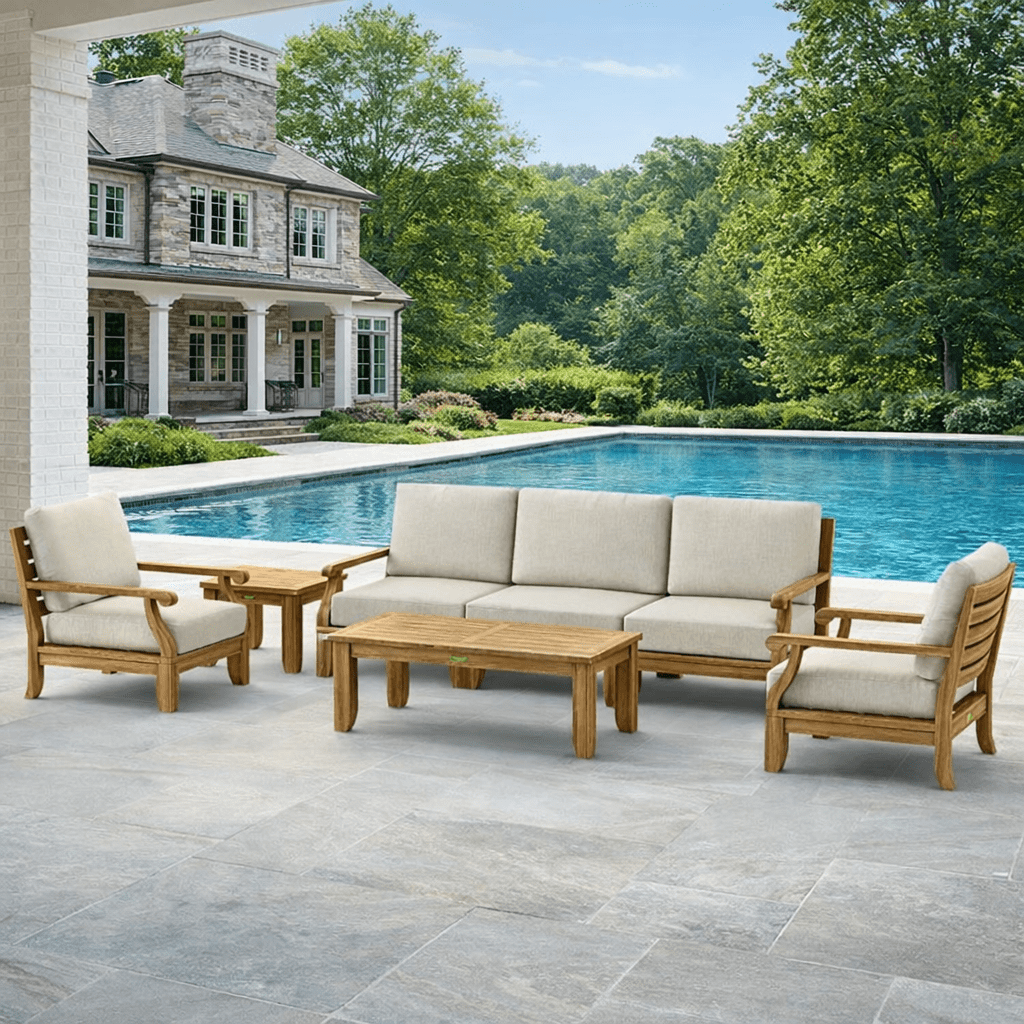 One of teak's most useful characteristics in Arizona is that its outdoor durability does not depend on an artificial stain or painted surface. Most TeakHQ pieces are unfinished natural teak, although some products are offered with an oiled finish.
That matters under strong desert sun because homeowners are not buying a natural wood frame whose basic outdoor suitability depends on repeatedly maintaining a decorative coating. Teak can instead be allowed to weather naturally or maintained for buyers who prefer its original warmer color.
Grade A teak's natural oils and dense grain structure contribute to resistance to moisture, rot, insects, and warping. Those qualities are valuable during Arizona's transition from months of dry weather to sudden rain, as well as through seasonal temperature changes.
This does not mean teak is unaffected by outdoor exposure. Its appearance changes as it ages. Untreated teak gradually develops a silver-gray patina, while owners who prefer the original color can choose optional care products and treatments.
Pool decks are one of the most natural applications for teak loungers and deck chairs. Outdoor furniture around a pool needs to live in a setting where water, sun, and frequent use all occur in the same space. Teak's moisture resistance and outdoor durability make it a practical natural-material option for that environment.
For cushioned pieces, the material strategy extends beyond the frame. Most TeakHQ patio seating includes Sunbrella cushions, which are designed to resist weather, fading, UV exposure, and water. Product details should still be checked because cushion inclusion varies by furniture type and individual item.
Arizona outdoor spaces can receive heavy use because the patio is often treated as another living area rather than a seasonal accessory. That makes longevity especially relevant. Premium teak furniture can last for decades, shifting the buying decision from "What patio set should I replace next?" toward "What layout do I want to live with long term?"
| Arizona Desert Challenge | Why Premium Grade A Teak Performs Well |
|---|---|
| Strong sun exposure | Designed for outdoor sun exposure and may weather naturally without requiring artificial stain for durability. |
| Extreme summer heat | Dense natural teak is designed for year-round outdoor use and temperature fluctuations. |
| Dry conditions | Grade A teak's natural oils and dense grain support long-term outdoor durability. |
| Monsoon rain | Teak naturally resists moisture and rotting. |
| Poolside moisture | Its moisture resistance makes teak well suited to pool-adjacent furniture. |
| Dust and debris | Natural teak can be cleaned without relying on a fragile painted finish. |
| Seasonal weather changes | Teak withstands rain, sun, and temperature fluctuations during outdoor use. |
If we were helping furnish a desert home from scratch, we would begin with how the patio is actually used rather than with a furniture catalog. Where is the dependable shade? Which doors connect the kitchen to the patio? Where do guests naturally gather after dinner? Is the pool the center of the backyard, or is the patio primarily an outdoor living and dining room?
For many larger Phoenix, Scottsdale, and Paradise Valley properties, our first priority would be a covered lounge area. A teak sectional or coordinated deep-seating group creates an outdoor equivalent of the family room and gives guests a natural destination before and after meals.
A sectional is especially useful when the patio has one generous rectangular footprint. Separate sofas and club chairs can be better when architecture, columns, doors, or circulation paths break the patio into smaller zones.
The dining area should normally sit close enough to the indoor or outdoor kitchen that serving does not become a cross-yard project. For households that regularly host extended family, seasonal visitors, or neighborhood gatherings, extendable teak dining tables are worth considering because the table can accommodate everyday life without permanently consuming the footprint required for the largest gathering.
One Arizona-specific mistake is placing a beautiful dining table in the most dramatic open section of the yard without considering afternoon exposure. The better location is often the one that guests will actually want to occupy for two hours.
On a resort-style property, the pool deck should function independently from the main covered patio. A row of chaise lounges with nearby side tables makes the space feel deliberate and prevents pool users from continually pulling chairs out of another seating group.
Leave generous circulation around the water. A pool patio frequently needs more open space than homeowners expect once loungers are reclined and people begin moving between the house, pool, outdoor kitchen, and seating areas.
Some of Arizona's most enjoyable patio time begins as direct sun disappears. We would therefore give evening conversation almost as much weight as daytime shade. Deep seating, swivel chairs, and a teak fire pit table can create a separate destination for cooler nights without forcing the dining table to serve every social purpose.
Start with the activity that anchors your backyard. Pool-centered homes will usually get the most immediate value from chaise lounges and shaded lounge seating, while homeowners who entertain around an outdoor kitchen may begin with dining furniture. Larger resort-style patios often work best as a combination of sectional seating, dining, and pool furniture rather than one oversized matching set trying to serve every purpose.
The defining feature of Arizona outdoor living is not that every hour of every season is comfortable outside. It is that well-designed outdoor spaces can be extraordinarily useful when homeowners plan around sun, shade, season, and time of day. The patio often behaves less like a separate yard and more like a flexible extension of the home's living space.
In many parts of the country, patio furniture is chosen primarily for summer. Arizona often reverses that logic. Cooler months can become the most desirable period for outdoor dining, morning coffee, afternoon lounging, and entertaining visitors.
That makes comfort and layout more important than treating the furniture as occasional seasonal equipment. A dining table, deep-seating group, or pair of swivel chairs may function almost like indoor furniture during the best weather.
During hotter periods, outdoor activity often concentrates around pools, covered patios, mornings, and evenings. This makes movable or distributed seating valuable. Rather than placing every chair in one exposed conversation circle, consider several smaller destinations tied to shade and activity.
A covered sectional, pool loungers, and a small secondary seating area can all be used differently over the course of the day.
Arizona's larger patios frequently place grilling, dining, television viewing, and lounge seating within one connected outdoor room. In these spaces, circulation is crucial. The chef should not need to cross through the main conversation group to reach a serving surface, and guests heading to the pool should not pass between dining chairs and the table.
Second homes, winter visitors, family gatherings, and vacation properties can create longer stretches of outdoor use than a simple weeknight dinner. Seating variety becomes valuable: upright dining chairs for meals, deeper seats for conversation, and loungers for the pool. A well-planned patio gives guests somewhere appropriate to move next instead of keeping everyone around one table all evening.
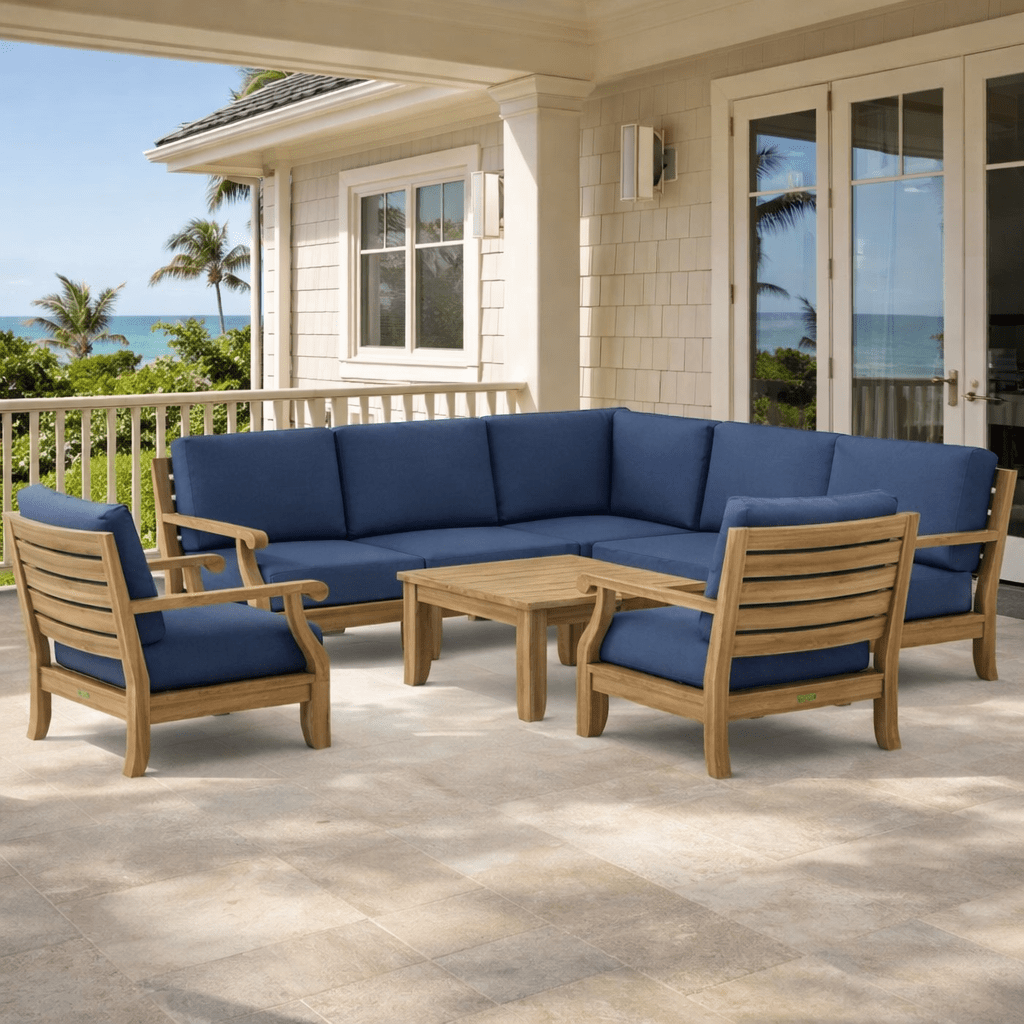 For a covered patio, start with teak patio seating. Larger sectionals work well when the patio is a true outdoor family room, while sofas, loveseats, club chairs, and swivel chairs offer more flexibility around doors, fireplaces, televisions, and architectural columns.
We generally prefer several useful surfaces rather than a single oversized coffee table. Side tables beside chairs make drinks, books, phones, and small plates easier to reach and reduce traffic across the center of the seating area.
A pool-centered backyard benefits from furniture dedicated specifically to swimming and sunbathing. Teak chaise loungers create a defined pool zone, while small side tables give each pair of loungers a practical landing place.
Before buying four or six loungers, measure them in their fully reclined position and preserve walking space behind them. This is a small planning detail that can determine whether a pool deck feels like a resort or a storage area for chairs.
For Arizona homes where meals are a major part of outdoor living, teak outdoor dining furniture can anchor the patio. Six-person sets suit many households, while larger or extendable tables make more sense for homeowners who regularly host family, winter visitors, or neighborhood gatherings.
Round tables can work especially well in courtyards or compact square patios because they soften circulation. Long rectangular tables usually fit better beside linear outdoor kitchens or on elongated covered terraces.
Not every desert home needs a sectional. Walled courtyards, casitas, townhouse patios, and secondary garden spaces may be better served by two lounge chairs, a small dining set, or a bench. Scale matters more than filling every available edge with furniture.
A restrained courtyard can feel more luxurious than an overcrowded one because the paving, landscaping, architecture, and view remain part of the experience.
Arizona's cooler evenings create a strong case for a separate conversation destination away from the pool and dining table. A fire pit table surrounded by lounge chairs can turn an unused edge of the patio into one of the home's most appealing seasonal spaces.
The key is separation. Give the fire area enough identity that it feels like another outdoor room rather than an accessory squeezed into the dining area.
Teak works particularly well in desert landscapes because the natural wood introduces warmth without requiring the entire outdoor design to become rustic. It can bridge modern architecture, stone, stucco, concrete, desert planting, and softer textiles in a way that feels comfortable rather than themed.
Modern Arizona homes often pair broad glass openings with concrete, stucco, stone, steel, and restrained desert landscaping. Natural teak softens those harder architectural materials without fighting their clean lines. Sectionals, streamlined dining tables, and simple lounge chairs are especially effective in these settings.
Traditional desert properties may use warmer stucco, stone, tile, exposed beams, courtyards, and shaded arcades. Teak's natural grain fits easily within that palette, especially when paired with neutral cushions rather than trying to duplicate every warm architectural tone.
Furniture should support the landscape instead of visually replacing it. Around saguaros, desert trees, boulders, gravel, and drought-conscious planting, the warm wood provides contrast while still reading as a natural material.
A useful design rule is to let the architecture establish the lines, the landscape establish the setting, and the furniture provide human scale. That tends to age better than choosing furniture around a short-lived color trend.
 Furniture can look excellent indoors while being poorly suited to months of outdoor exposure. In Arizona, begin with the frame material, finish, fabric, and intended outdoor durability before evaluating decorative details.
Premium Grade A teak is designed for year-round outdoor use and can withstand sun exposure without requiring an artificial stain for durability.
Furniture placement should be planned alongside the shade structure. An expensive west-facing dining set may receive surprisingly little use if guests are uncomfortable during the hours when the patio is otherwise most convenient.
Measure the actual afternoon shade pattern before committing to a layout. Shade can be more important to real-world comfort than adding another furniture piece.
Large Arizona backyards tempt homeowners to buy more seating than the circulation pattern can support. Chaise lounges consume considerably more space when reclined, and dining chairs move outward once occupied.
Plan furniture in its "in use" position, not merely its neat showroom position. This is one of the simplest ways to make a patio feel intentionally designed.
A large dining set does not replace comfortable conversation seating, and a sectional does not replace dedicated pool loungers. Homes with enough space generally function better when dining, lounging, swimming, and evening conversation each receive an appropriate furniture zone.
Untreated teak naturally changes from its original warm color toward a silver-gray patina. Homeowners who are not expecting that change may assume the wood is deteriorating when they are actually seeing its normal weathering process.
Decide before purchasing whether you like weathered teak or want to maintain more of its original color. Either approach can work; the important thing is knowing which ownership experience you prefer.
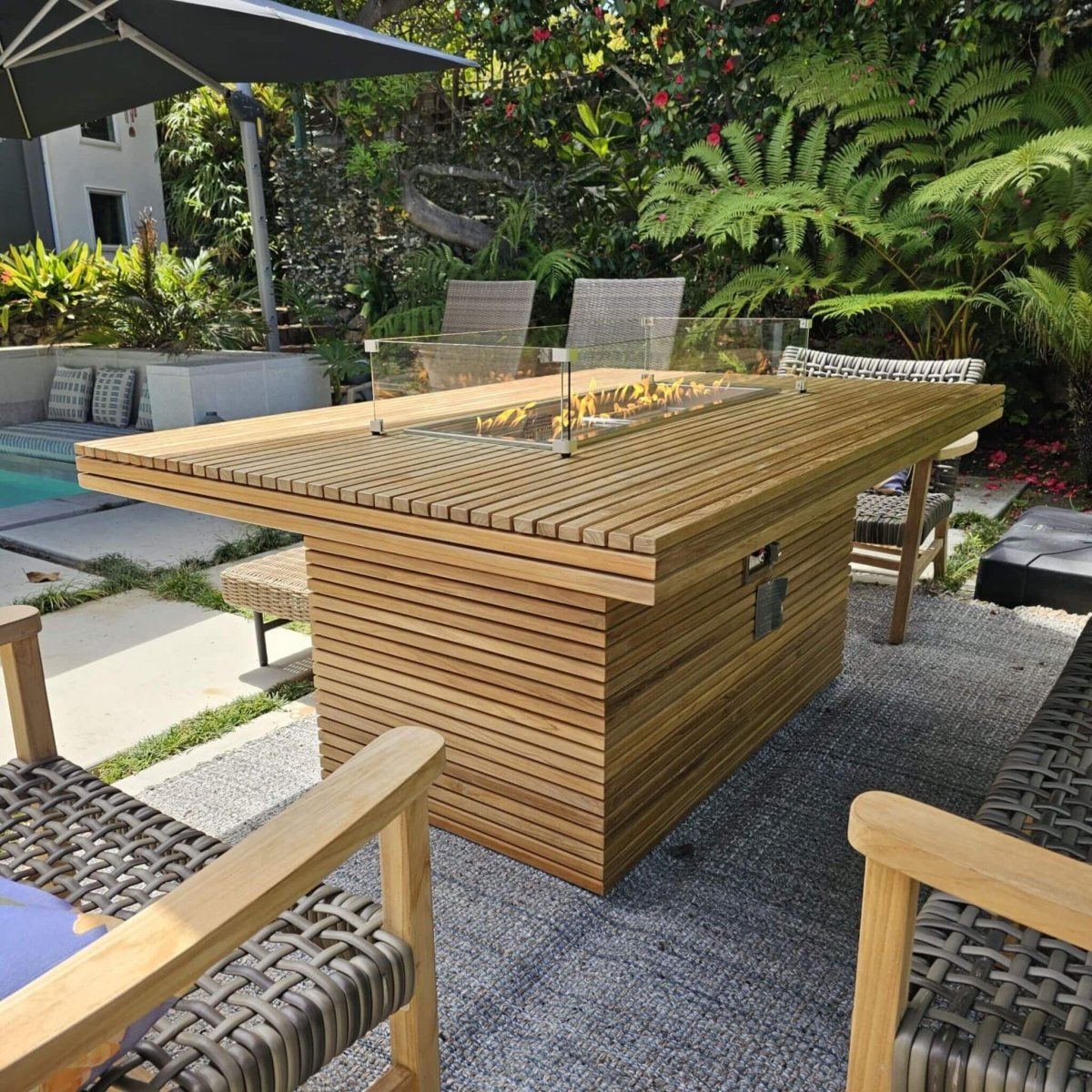 Arizona teak care is generally less about protecting the wood from constant moisture and more about managing sun exposure, dust, occasional storms, and the appearance you want the teak to develop over time.
Fine desert dust can accumulate quickly on horizontal surfaces. Routine cleaning keeps tables, chair arms, and frames pleasant to use and prevents layers of grime from building up. The appropriate frequency depends heavily on exposure, nearby landscaping, wind, and whether the patio is covered.
Teak does not need to be sealed for basic outdoor durability. Left untreated, it naturally develops a silver-gray patina. Homeowners who prefer the original warm teak appearance can use appropriate teak care products or treatments rather than accepting the natural weathered look.
The practical decision is aesthetic rather than structural: decide whether you want to maintain the original color or allow the furniture to age naturally.
Most TeakHQ patio seating includes Sunbrella cushions, although inclusion varies by product. Sunbrella fabric is weather-, fade-, UV-, and water-resistant, but keeping cushions cleaner and drier when they are not being used can still reduce unnecessary exposure to dust and weather.
During dusty periods or approaching storms, cushion storage can save cleaning time even when the furniture frames themselves remain outdoors.
Teak furniture is designed for outdoor exposure and does not require protective covers for basic durability. Covers can still be useful as an optional convenience for homeowners who want to reduce dust and debris accumulation.
If covers are used, choose an outdoor-specific approach rather than trapping moisture against furniture after a storm. Cushions and lightweight patio accessories deserve particular attention when wind is expected.
Unlike climates where outdoor furniture is stored away for months because of prolonged snow and ice, the Arizona desert often enters its most enjoyable patio season as temperatures cool. Premium teak is designed for year-round outdoor use, so homeowners can focus more on cleaning and how they want the wood to age than on seasonal furniture removal.
The strongest Arizona outdoor spaces are designed around real behavior: dependable shade during hot periods, comfortable seating for cooler months, dining near the kitchen, dedicated pool furniture, and conversation areas that become inviting after sunset. Premium Grade A teak fits that strategy because it offers the durability of serious outdoor furniture while retaining the warmth and character of natural wood.
Start with the zone your household uses most, choose furniture at the right scale, and build outward from there. A thoughtfully planned patio will usually outperform a larger collection of furniture purchased without a clear layout.
Look for materials specifically intended for sustained outdoor exposure, strong sun, temperature changes, and occasional rain. Premium Grade A teak is a strong natural-material choice because it is designed for year-round outdoor use and resists moisture, rot, insects, and warping. High-quality aluminum and synthetic materials can also be appropriate depending on the appearance and ownership experience you prefer.
Yes. Grade A teak is naturally high in oils, has a dense grain structure, and withstands sun, rain, moisture, and temperature fluctuations. Those qualities make it particularly well suited to Arizona patios, pools, courtyards, and outdoor living areas.
Dedicated pool furniture usually works better than borrowing chairs from another patio zone. Teak chaise loungers paired with small side tables create a practical poolside setup while keeping dining and conversation furniture available for their intended uses.
Shade is valuable for comfort and can reduce direct solar exposure, but premium outdoor furniture should still be chosen for the environment rather than relying on shade alone. Covered patios, pergolas, and umbrellas are especially useful on west-facing spaces where afternoon exposure is strongest.
No. Teak does not require sealing for outdoor durability. You can leave it untreated and allow it to weather naturally, or use appropriate teak care products if you prefer to maintain more of its original warm color.
Yes. Untreated teak naturally develops a silver-gray patina as it weathers outdoors. This is a normal appearance change rather than an indication that the furniture has failed. Owners who prefer the original teak color can choose optional maintenance treatments.
Yes. The Grade A teak furniture offered by TeakHQ is designed for year-round outdoor use and to withstand sun, rain, and temperature fluctuations. Protective covers are optional rather than required for basic durability.
Choose according to your normal household first and your larger gatherings second. Six-person dining often works well for everyday use, while homeowners who regularly host extended family or seasonal visitors may prefer eight-person sets or extendable dining tables. Always measure the space with the dining chairs pulled out, not tucked under the table.
Each can make sense. Aluminum is lighter and often has a more contemporary feel, while poly furniture offers a synthetic, lower-maintenance approach. Teak is heavier, natural, warmer in appearance, and has the premium character of real wood. The best choice depends on whether you prioritize natural materials, weight, design style, and long-term ownership experience.
There is no single schedule because dust exposure varies considerably by property. Clean furniture when visible desert dust and debris begin accumulating, with more frequent attention after windy weather or storms. Covered patios generally require less routine cleaning than fully exposed pool decks and terraces.


