
FREE SHIPPING
within mainland USA
within mainland USA
Home ▸ Teak Outdoor Furniture ▸ By Location ▸ Beverly Hills, California
Beverly Hills outdoor spaces often function as true extensions of the home: landscaped courtyards, pool terraces, hillside patios and large entertaining areas that may be used through much of the year. Strong Southern California sun, dry stretches between rains and exposed west-facing spaces make material quality and thoughtful placement especially important. Premium Grade A teak is a strong fit because it combines natural weather resistance with the substantial, architectural presence expected in carefully designed outdoor rooms.

Beverly Hills is not a difficult outdoor-furniture environment in the same way that a beachfront property, desert home or snowy mountain residence can be. The challenge is subtler: furniture may spend long periods outdoors in strong sunshine, be used across a long entertaining season, and occupy spaces where appearance matters as much as basic weather resistance. A piece that technically survives outdoors can still be a poor choice if it fades quickly, feels visually undersized or demands more upkeep than the homeowner expected.
The first condition we would evaluate is exposure. A shaded courtyard beside a mature garden presents a very different furniture environment from an open pool deck or a Trousdale terrace facing the afternoon sun. Long-term UV exposure can affect finishes, fabrics and some synthetic materials even when temperatures are comfortable enough for frequent outdoor use.
That makes it useful to distinguish between the furniture frame and everything placed on it. Premium Grade A teak is designed for outdoor sun exposure, while cushions should use outdoor-rated fabrics. Many TeakHQ lounge pieces include Sunbrella cushions, which are designed to resist fading, UV exposure and water. Even so, providing shade where people actually sit improves comfort and can reduce unnecessary exposure of cushions and accessories.
Southern California's long dry stretches sometimes lead homeowners to treat a patio almost like an indoor room. Then seasonal rain arrives, sprinklers overshoot their planting beds, or water collects beneath planters and furniture. Outdoor materials still need to tolerate repeated wetting and drying rather than merely looking attractive in sunshine.
That is one reason natural wood selection matters. Some woods depend heavily on coatings to remain suitable outdoors. Grade A teak contains naturally high levels of oils and has a dense grain structure, giving it inherent resistance to moisture, rotting and warping without requiring an artificial stain for durability.
A pool terrace deserves to be planned independently from a covered dining patio. Chaise lounges sit closer to splash zones, towels and wet swimwear. Furniture is often fully exposed overhead, and surfaces around the pool can receive intense sun for much of the day.
Here, the practical priorities are moisture-tolerant frames, outdoor-rated textiles, useful side tables and enough circulation room to move around loungers without constantly shifting furniture. Teak's outdoor durability makes it particularly appropriate for this role.
The overlooked Beverly Hills furniture problem is often not weather at all—it is proportion. A five-piece set that looks substantial in a showroom can disappear visually on a broad stone terrace behind a large estate. Conversely, filling every available square foot with furniture can make even an expansive property feel cluttered.
We recommend treating large outdoor areas as a sequence of rooms rather than one giant patio: dining near the kitchen, conversation seating around a focal point, loungers near the pool and quieter seating farther into the landscape. This approach usually produces a more intentional result than simply buying a larger version of one furniture set.
Several premium materials can work well here. Quality aluminum can be attractive for very contemporary homes, particularly when a light visual profile is desired. High-end synthetic materials can also make sense for owners who prioritize minimal material care. Teak becomes especially compelling when the goal is to combine outdoor durability with the warmth and visual substance of real wood.
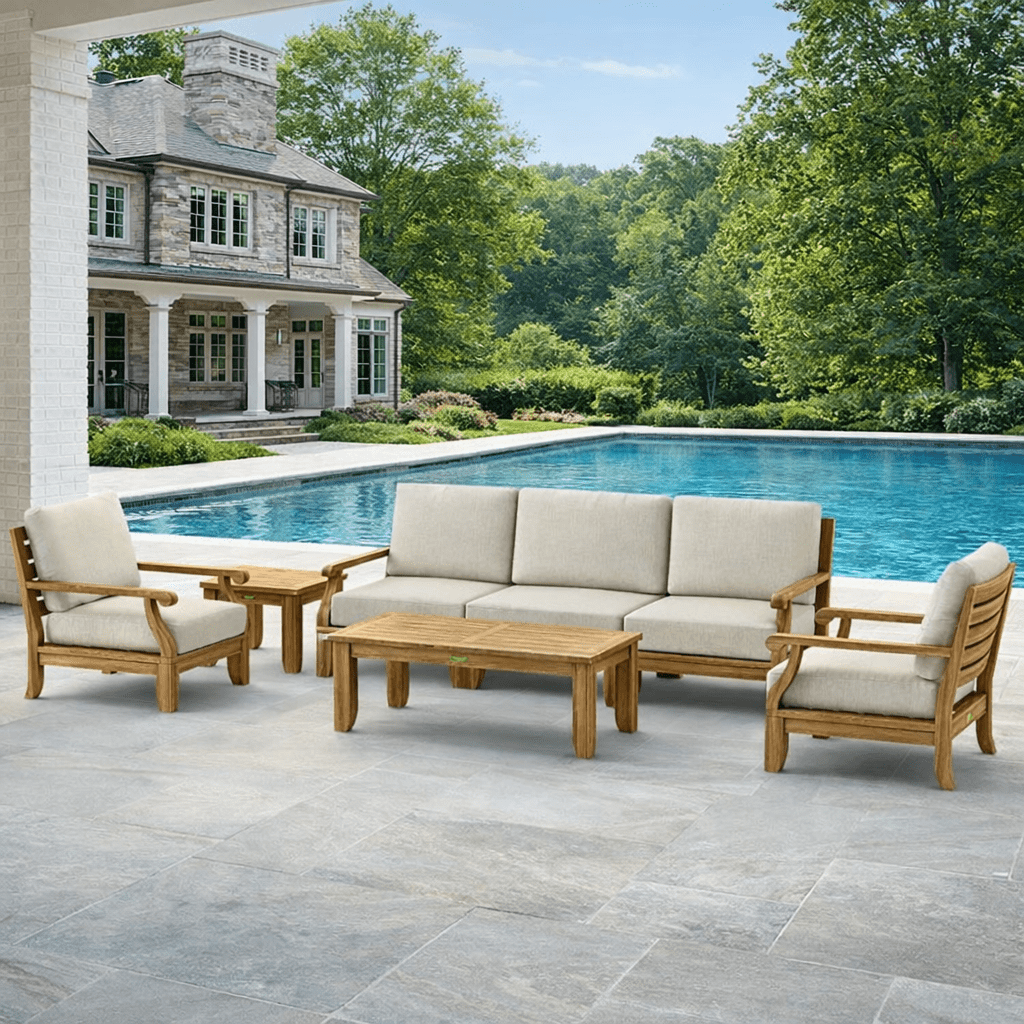 Grade A teak's dense grain and naturally high oil content help it resist moisture, rot, insects and warping. In Beverly Hills, that matters because furniture may spend most or all of the year outside while alternating between prolonged dry conditions, irrigation or pool exposure, and seasonal rain.
The practical advantage is flexibility. Teak does not require paint or an artificial stain to remain durable outdoors. Owners can focus on the appearance they want rather than maintaining a protective decorative coating simply to keep the furniture serviceable.
Natural teak begins with a warm golden-brown appearance and gradually develops a silver-gray patina when left untreated outdoors. That weathering is normal and does not mean the furniture has failed. This distinction is important on sunny Southern California properties, where the visual change can occur as furniture remains continuously exposed.
Homeowners who like the aged look can allow it to develop naturally. Those who prefer the original color can use appropriate teak care products or sealers. The decision is primarily aesthetic rather than a requirement for basic outdoor durability.
Premium outdoor furniture experiences more than rain. It cycles through direct sun, cooler evenings, wet surfaces and temperature changes. Grade A teak's density and natural properties make it resistant to warping and suitable for year-round outdoor use. That is particularly valuable for large dining tables, sectional components and other pieces where dimensional stability affects how the furniture looks and functions over time.
Premium teak carries a higher initial cost than many mass-market outdoor materials. The appropriate comparison, however, is not simply purchase price. Teak furniture can last for decades, so homeowners planning a permanent outdoor environment may reasonably evaluate cost across the expected life of the space.
That logic fits Beverly Hills particularly well. On properties where hardscape, landscaping, pools and architecture are designed as long-term investments, repeatedly replacing temporary patio furniture can feel inconsistent with the rest of the project. A durable natural material allows the furniture to become part of the property's long-range outdoor design.
| Beverly Hills Challenge | Why Premium Grade A Teak Performs Well |
|---|---|
| Strong sun exposure | Designed for outdoor sun and naturally weathers rather than requiring paint for protection. |
| Long dry periods | Natural teak can remain outdoors without continual finish maintenance. |
| Seasonal rain | Dense grain and natural oils provide strong moisture and rot resistance. |
| Poolside moisture | Teak is naturally resistant to moisture and appropriate for outdoor use. |
| Temperature fluctuations | Grade A teak is resistant to warping and designed for changing outdoor conditions. |
| Year-round exposure | Premium teak is designed for year-round outdoor use and can last for decades. |
| High-design properties | Natural wood complements modern, Mediterranean, traditional and transitional architecture. |
We would start with the architecture and the way you actually use the property—not with a furniture catalog. A formal estate south of Sunset may call for a different layout from a glass-walled Trousdale home, even if both have similar square footage. The goal is to establish a few strong outdoor destinations and give each one a clear purpose.
On a generously sized property, we would usually resist the urge to distribute small seating groups everywhere. First establish one compelling primary gathering space. For many homes, that means a substantial teak sectional oriented toward a view, fireplace, pool or architectural feature.
Sectionals are particularly useful on broad terraces because their scale visually anchors the space. Club chairs or swivel chairs can then soften the geometry and allow the seating arrangement to work for both an intimate evening and a larger gathering.
Beverly Hills entertaining can range from dinner for the household to a much larger gathering, so the ideal dining table is not always the largest one the patio can physically accommodate. An extendable teak dining table can preserve everyday circulation while providing additional seating when needed.
We would position the dining zone near the indoor kitchen or outdoor cooking area rather than choosing the most dramatic point on the property simply because it has the view. Repeated trips with serving dishes matter more in daily use than they do on a landscape plan.
A pool should not merely inherit whatever space is left after dining and lounge furniture are placed. We would create a dedicated sun-and-rest zone with teak chaise loungers, side tables and nearby shade.
Leave generous circulation around the chairs. The memorable planning rule is simple: design the pool deck for loungers in their fully reclined position, not their upright catalog position. That one measurement prevents many cramped pool layouts.
On properties with established gardens, hedges, specimen trees or tiered landscaping, a bench can create a destination without competing with the main entertaining areas. A strategically placed teak garden bench works especially well along a garden axis, beneath mature foliage or at a quieter viewpoint away from the pool.
This is one area where less is often more. A single substantial bench can contribute more to a formal landscape than several small accessory chairs scattered throughout it.
Begin with the space that carries the most responsibility. Frequent entertainers should start with dining sets or extendable tables; homeowners whose patio functions primarily as an outdoor living room should begin with sectionals or multi-piece lounge seating. Pool-focused properties should establish the chaise layout early, while larger estates can add serving furniture, fire features and garden seating after the main zones are settled.
Outdoor furniture here often supports more than occasional weekend use. The combination of large residential properties, pools, landscaped grounds and a long usable outdoor season encourages spaces that function much like furnished rooms inside the house. The best layouts therefore accommodate different levels of activity rather than assuming everyone will gather around one table.
For larger gatherings, circulation becomes part of the furniture plan. Guests should be able to move naturally from drinks and conversation to dining and then back to lounge seating without squeezing between chairs or crossing the working side of an outdoor kitchen.
A teak serving or buffet table can be especially useful between the kitchen and dining zone. It provides a landing place for dishes, drinks and serving pieces and helps keep a large dining table available for guests rather than turning one end into a staging area.
On a well-designed Beverly Hills property, a pool terrace often remains active long after anyone has finished swimming. Chaise lounges serve the sunny portion of the deck, while deeper seating under shade becomes the place for conversation, reading or drinks later in the day.
That argues for complementary furniture rather than a single pool collection. Think loungers near the water, lounge seating slightly removed from splash traffic, and side tables distributed wherever someone might reasonably set down a glass or phone.
In Trousdale Estates, Beverly Crest and nearby hillside areas, the view can dominate every design decision. Yet pointing every chair in exactly the same direction can make conversation awkward. A better solution is often a loose U- or L-shaped grouping that preserves the principal sightline while allowing guests to face one another.
Swivel chairs can be particularly effective in these spaces because users can turn toward conversation and then rotate toward the view without rearranging the entire grouping.
A patio that is spectacular at 3 p.m. can feel strangely empty after sunset if the view was its only focal point. Evening spaces benefit from a closer visual anchor such as a coffee table or teak fire pit table. That creates a reason for the seating group to feel cohesive even after the distant landscape disappears into darkness.
The right furniture category depends more on the role of each outdoor room than on a single Beverly Hills aesthetic. We would choose the configuration first, then select a style whose lines and proportions work with the architecture.
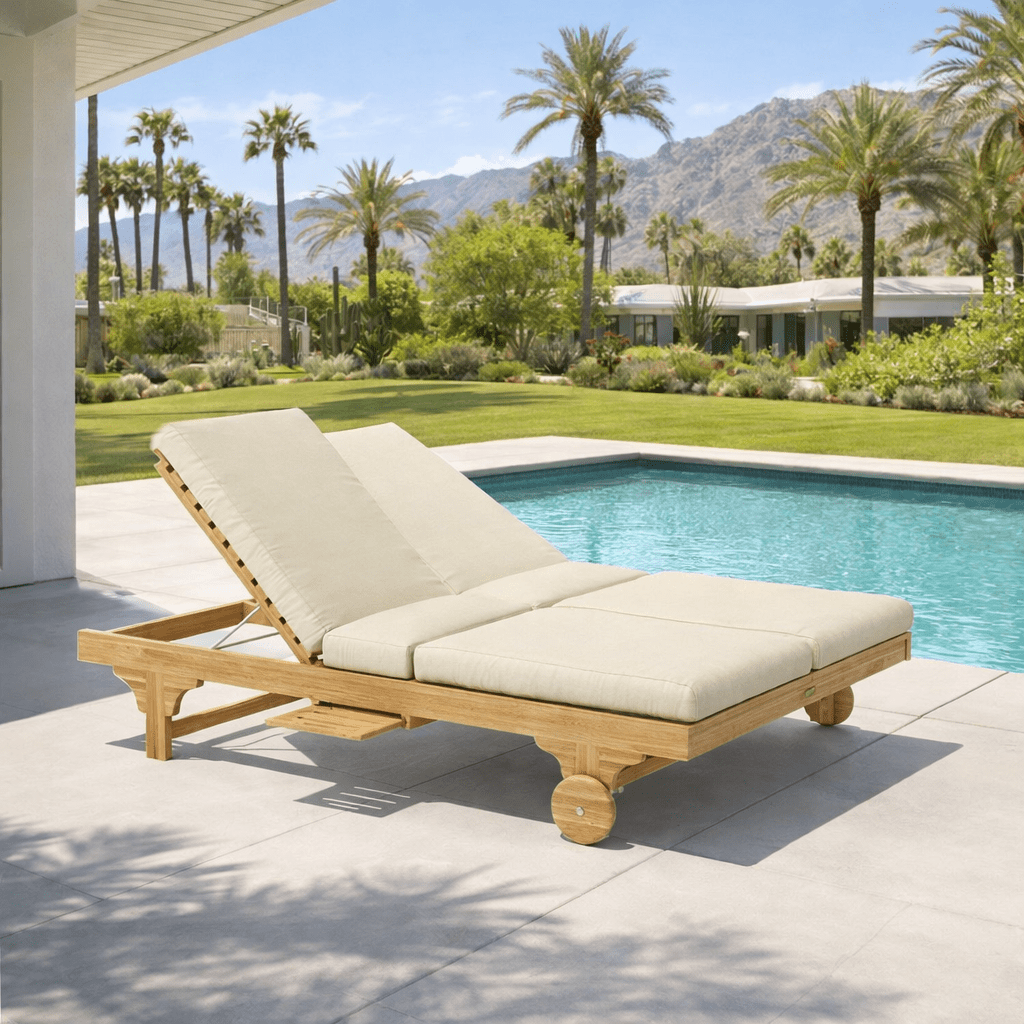 For a substantial pool deck, start with chaise loungers rather than occasional chairs. Four loungers often establish a stronger visual rhythm than an assortment of mismatched seats and make the space feel intentionally planned. Add compact side tables between selected loungers rather than beside every chair if maintaining open circulation is important.
Where the deck has both sun and shade, place the chaises in the stronger sun zone and reserve the covered area for upholstered lounge seating. That gives the pool terrace two distinct reasons to be used rather than duplicating the same experience twice.
For broad terraces, multi-piece teak lounge sets or sectionals typically provide the visual mass the architecture requires. A sofa-and-chair arrangement gives more freedom to reconfigure the patio; a sectional creates a stronger architectural anchor.
We would pair either arrangement with a substantial coffee table plus smaller side tables. The important point is reach: a beautiful oversized seating group becomes frustrating when half the guests have nowhere convenient to place a drink.
Dining areas should be sized from the occupied chairs outward. Allow room for guests to pull chairs back and for others to walk behind them. This is more important than fitting the longest possible table onto a terrace.
For households that entertain at different scales, the teak outdoor dining furniture category offers a more practical starting point than choosing by table dimensions alone. Determine typical seating first, maximum guest count second and storage or extension needs third.
Smaller courtyards usually benefit from restraint. A pair of lounge chairs with a table may suit a quiet garden better than a complete sofa arrangement. Formal landscaping can support a bench as a visual endpoint, while more private planted courtyards may call for an intimate conversation group.
Natural teak is particularly versatile in these settings because its appearance can sit comfortably beside stone, stucco, plaster, brick, concrete and dense planting without demanding that every surrounding finish match it.
The most useful furniture may be adjacent to the cooking area rather than directly in it. Allow working space around grills, counters and appliances, then locate dining or bar seating outside that circulation path. A nearby serving table can connect preparation and dining without forcing guests into the cooking zone.
Beverly Hills does not have one architectural vocabulary. Formal Mediterranean and traditional estates coexist with contemporary renovations and the low, view-oriented modernism strongly associated with Trousdale Estates. Teak works across that range because the material brings warmth without prescribing one particular decorative style.
Low-profile furniture generally works best where architecture is horizontal and views are important. Deep seating with restrained lines can complement large expanses of glass and concrete without creating a visual barrier between the interior and the skyline.
In these homes, teak also provides useful contrast. Warm natural wood can soften a palette dominated by glass, stone and metal while maintaining the clean geometry expected of a contemporary outdoor space.
Courtyards, stone terraces, stucco walls, tiled roofs and formal gardens can support furniture with a little more visual weight. Rectangular or oval dining tables, substantial armchairs and benches feel at home in these settings without requiring overly ornate detailing.
Allowing teak to weather naturally can produce a quieter silver-gray appearance, while maintaining more of its original golden tone creates a warmer contrast against pale stone and stucco.
Many remodeled homes sit between traditional and modern design. Here we would keep the furniture simple and let upholstery, planters and accessories handle most of the decorative direction. Teak's natural character makes it easier to bridge an older exterior architecture with a cleaner contemporary landscape renovation.
Dense hedges, mature trees and layered planting can make furniture feel more intimate, but they also affect actual usable dimensions. Measure the patio as it will function—not simply from wall to wall. Leave room for plant growth, planter edges, doors, pool gates and circulation paths before choosing furniture scale.
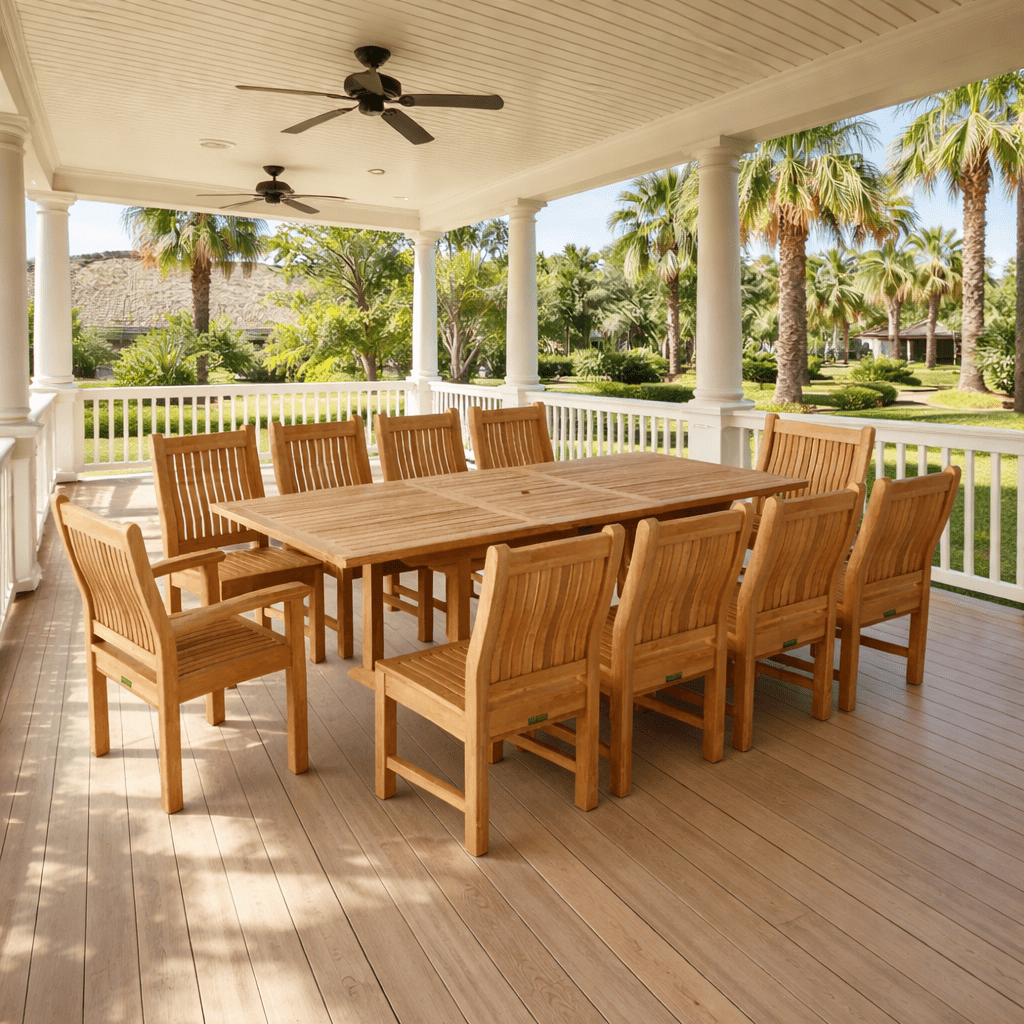 Large patios can make normal furniture dimensions look unexpectedly slight. Homeowners sometimes compensate by adding more unrelated pieces, which creates clutter rather than presence. Start with appropriately scaled anchor furniture—a sectional, sofa group or substantial dining table—and add secondary pieces only after the primary zone feels resolved.
A table's published length and width are not the dimensions of the dining area. Chairs extend outward when occupied, and guests need room to walk behind them. Similarly, chaise loungers require much more deck length when fully reclined. Plan using furniture in use, not furniture pushed into its most compact position.
A beautiful west-facing terrace can be unpleasant during the hours when homeowners most want to use it. Premium furniture does not eliminate the need for shade. Evaluate sun angles before finalizing the layout and use umbrellas, architectural shade or covered zones where appropriate.
Outdoor-rated fabrics are designed for demanding conditions, but they still benefit from sensible ownership habits. Avoid treating cushions as permanently maintenance-free simply because the frame can remain outdoors. Keep them clean, allow wet cushions to dry properly and follow the care instructions for the specific fabric.
Large properties tempt owners to fill a broad terrace with one oversized arrangement. The result can actually be less useful than several defined outdoor rooms. Separate dining, lounging and poolside functions while preserving clear paths between them. Teak collections make it possible to maintain material continuity without making every zone identical.
Teak ownership here can be relatively straightforward. The key decision is whether you want the wood to age naturally or prefer to maintain more of its original warm color. Once that choice is made, the maintenance plan becomes much easier to understand.
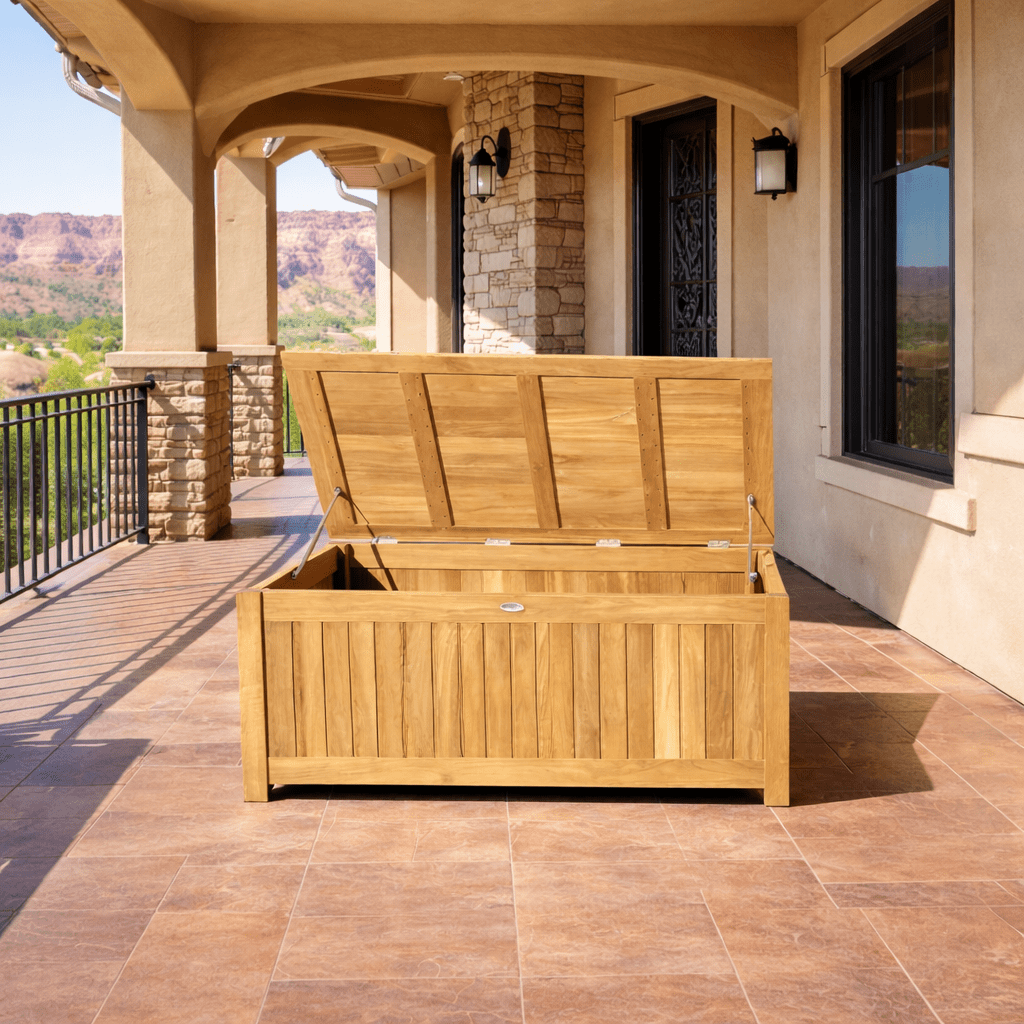 Clean outdoor furniture when dust, pollen, food residue or general outdoor grime becomes noticeable rather than following an unnecessarily aggressive schedule. Mild routine care is preferable to treating natural weathering as damage.
Poolside pieces may need attention more often because towels, sunscreen, food, drinks and splashed water make those spaces higher-use environments than a quiet garden bench.
Untreated teak naturally develops a silver-gray patina outdoors. Homeowners who prefer that appearance can allow the process to occur without sealing the furniture for durability. Those who want to retain more of the original golden color can use appropriate teak cleaners and sealers according to product directions.
Do not confuse color change with structural deterioration. Decide which appearance suits the architecture and landscape, then maintain toward that objective.
Beverly Hills does not require the kind of seasonal furniture shutdown associated with snowy climates. Teak is designed for year-round outdoor use and naturally resists moisture and rot. After wet weather, however, good airflow around furniture and cushions remains sensible.
Avoid creating unnecessary moisture traps with planters, debris or poorly ventilated covers. If furniture is covered, use a properly fitted outdoor cover designed for the purpose rather than wrapping it so tightly that moisture cannot escape.
Frames and soft goods do not need to have identical care routines. Even where furniture stays outdoors, storing cushions or accessories when they will not be used for an extended period can keep the patio cleaner and reduce exposure. A deck box can be helpful when the property does not have convenient nearby storage.
There is generally no need to treat teak furniture as seasonal inventory that must be moved indoors every winter. Premium Grade A teak is designed for year-round outdoor use and can withstand rain, sun and temperature fluctuations. Covers are optional rather than required for basic durability.
The most successful Beverly Hills patios are not simply filled with premium furniture; they are planned around the property. Start with the zone you use most, choose furniture with the appropriate scale, and then connect dining, lounging, poolside and garden areas into a coherent outdoor environment. Premium Grade A teak offers a durable natural foundation that can remain relevant as landscaping, upholstery and design preferences evolve around it.
Several premium materials can work well, including quality aluminum and high-end synthetic products. Grade A teak is especially attractive when you want real wood, substantial construction, natural moisture and weather resistance, and furniture designed to remain outdoors year-round.
Furniture specifically designed for year-round outdoor use can. Premium Grade A teak is made to withstand sun exposure, rain and temperature fluctuations, so it does not need to be moved indoors for a traditional winter storage season.
Yes. Teak's natural resistance to moisture, rot and warping makes it well suited to poolside environments. Teak chaise loungers are particularly useful where homeowners want durable natural wood rather than a lightweight synthetic look.
Begin with one properly scaled anchor zone rather than scattering small furniture groups around the patio. A sectional or substantial lounge set works well for conversation areas, while a large or extendable dining table can establish a separate entertaining zone.
Keep principal sightlines open and avoid unnecessarily tall furniture. An L- or U-shaped conversation group can preserve the view while allowing guests to face one another. Swivel chairs are useful when seating needs to alternate between conversation and the panorama.
No. Teak does not require sealing for basic outdoor durability. Sealing is primarily an appearance decision for homeowners who want to retain more of teak's original golden-brown color rather than allowing it to weather naturally.
Yes. Natural untreated teak gradually develops a silver-gray patina with outdoor exposure. That color change is normal. If you prefer the original warmer appearance, appropriate teak care products can be used to manage its appearance.
Not automatically. Aluminum is lighter and can suit an especially minimal modern design. Teak is warmer, heavier and more organic. On glass, stone or concrete-heavy properties, natural teak can provide useful visual warmth while still working with contemporary architecture.
Size the table around your normal household first and your realistic maximum guest count second. If those numbers differ substantially, an extendable teak dining table can provide entertaining capacity without permanently consuming the patio.
No. Covers are optional for premium Grade A teak rather than required for basic durability. If you do use covers, choose outdoor covers that fit properly and avoid trapping moisture around the furniture.


