
FREE SHIPPING
within mainland USA
within mainland USA
Home ▸ Teak Outdoor Furniture ▸ By Location ▸ California Central Coast
California's Central Coast asks outdoor furniture to work across two closely connected but different settings: cool, marine-influenced coastal properties and sunnier patios tucked into inland hills and wine country. Ocean air, morning fog, seasonal rain, afternoon sun, and breezy exposed terraces all influence what works well outdoors. From Carmel and Monterey to San Luis Obispo and Santa Barbara, premium Grade A teak is a particularly practical option for homeowners who want natural furniture that can remain outdoors while fitting comfortably into both coastal and Mediterranean-inspired spaces.

California's Central Coast is not one uniform outdoor-furniture environment. The narrow coastal belt is strongly influenced by the Pacific, while properties only a short drive inland can experience sunnier, warmer, and drier afternoons. That distinction matters: a Carmel ocean-view terrace, a Paso Robles entertaining patio, and a Santa Barbara hillside courtyard may share a regional identity without placing the same demands on furniture.
One of the easiest mistakes is treating the Central Coast like either Southern California or a humid subtropical coastline. It is neither. Immediate coastal properties regularly encounter cool marine air, fog, dew, and occasional salt exposure, even during a season when meaningful rainfall may be limited.
For furniture, that means moisture exposure is not limited to rainy days. A deck in Pacific Grove, Cambria, or near the Santa Barbara waterfront can repeatedly become damp from marine conditions. Materials and construction intended only for dry, sheltered patios deserve more scrutiny here.
The region's microclimates should influence your buying decision more than the words "Central Coast" alone. Along the water, we would prioritize moisture tolerance and straightforward cleaning. Move inland toward Paso Robles, Santa Ynez, or protected valleys and hillsides, and sun exposure becomes a larger consideration.
This is a useful purchasing principle: choose furniture for the microclimate of your patio, not the climate reputation of your ZIP code. A west-facing hillside terrace and a shaded oceanfront deck can require different ownership strategies even when they are relatively close geographically.
The region's predominantly dry outdoor season is interrupted by a wetter winter pattern. Furniture that remains outside therefore needs to handle both extended dry periods and recurring wet weather rather than being optimized for only one condition.
Premium outdoor materials such as teak, quality aluminum, and well-designed synthetic products can all make sense. The distinction is often less about surviving one storm and more about how much maintenance, covering, moving, or refinishing you want to build into ownership.
Ocean views and elevated sites often come with exposure. Afternoon breezes are part of the Central Coast environment, particularly near the shoreline, across open decks, and on hillside properties. Lightweight furniture can therefore be less convenient than it first appears.
Furniture weight is an overlooked specification. Teak's heavier, more architectural feel can be attractive on exposed patios, although no outdoor furniture should be assumed secure during unusually strong winds.
Premium Grade A teak fits this region because its strengths align unusually well with the Central Coast's combination of marine moisture, sunshine, seasonal rain, and long periods of outdoor use. The advantage is not that teak is the only viable premium material. Rather, it offers an uncommon combination of natural appearance, outdoor durability, and flexible maintenance.
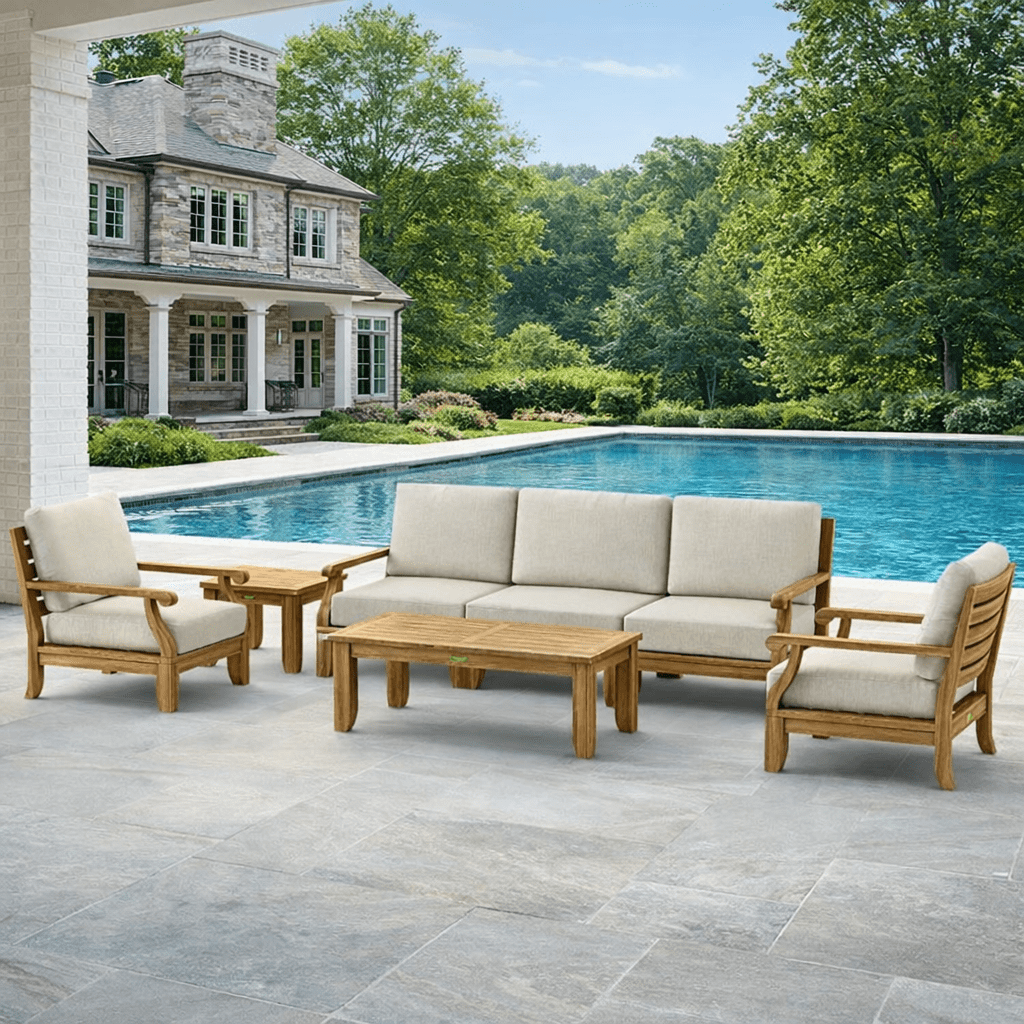 Grade A teak has naturally high oil content and a dense grain structure, helping it resist moisture, rot, insects, and warping. Those properties are especially useful on patios that cycle between foggy mornings, dry afternoons, seasonal rain, and periods of direct sun.
This is different from claiming that wood requires no care. Dirt, organic debris, and coastal residue still warrant cleaning. The important distinction is that teak does not depend on an artificial stain for outdoor durability.
Teak is designed for year-round outdoor use and withstands sun exposure, rain, and temperature fluctuations. That gives Central Coast homeowners flexibility when a patio is used across much of the year rather than furnished and emptied every season.
Untreated teak will gradually weather toward a silver-gray patina. Some homeowners actively prefer that look on weathered coastal architecture; others want the warmer original teak color. Either approach can work, provided the appearance decision is made intentionally.
Alternating moisture and dry weather can be challenging for lesser outdoor woods. Grade A teak's dense structure and resistance to warping make it better suited to those changing conditions. This is particularly relevant when furniture occupies an uncovered terrace rather than a protected porch.
Teak furniture costs more upfront than many mass-market alternatives, so the right comparison is not simply today's purchase price. Premium teak can last for decades, making lifetime ownership a more useful measure for homeowners furnishing a permanent outdoor living space.
That is especially relevant for established coastal homes, second homes, and extensively landscaped properties where owners would rather furnish the space once with a durable material than repeatedly rethink the patio.
| Central Coast Challenge | Why Premium Grade A Teak Performs Well |
|---|---|
| Marine moisture | Natural oils and dense grain help resist moisture and rot. |
| Fog and damp mornings | Teak is designed for outdoor exposure and resists warping. |
| Seasonal winter rain | Grade A teak withstands rain without requiring paint or artificial stain. |
| Summer sun | Teak withstands sun exposure and can weather naturally outdoors. |
| Coastal salt residue | Durable teak can remain outdoors; routine cleaning removes accumulated residue. |
| Changing conditions | Dense teak offers strong structural stability through temperature and moisture fluctuations. |
| Long outdoor season | Year-round outdoor suitability reduces the need for seasonal furniture moving. |
We would begin with how the property is actually used—not with a furniture catalog. On the Central Coast, the best outdoor spaces often have multiple purposes: dinner near the house, conversation positioned toward a view, and smaller seating placed where the landscape gives you a reason to stop.
For a Santa Ynez Valley property, Paso Robles home, or spacious Santa Barbara terrace, we would usually establish the dining zone first. Outdoor meals can become the organizing activity around which the rest of the patio functions. A teak outdoor dining collection provides options ranging from intimate tables to large entertaining configurations.
If guest counts fluctuate, an extendable teak dining table can be smarter than permanently dedicating the patio to the largest gathering you host. You preserve circulation and views most days, then create additional seating capacity when family or guests arrive.
A common design mistake on scenic properties is making every chair face another chair. If you paid for an ocean, canyon, vineyard, or hillside view, at least one furniture grouping should acknowledge it.
We would often place a deep-seating group perpendicular to the house so people can converse without turning their backs completely to the landscape. On larger patios, teak sectional seating can define that second outdoor room without requiring walls or built-in construction.
Large properties benefit from furniture beyond the main patio. A bench beneath a mature tree, two chairs near a garden, or loungers on a sunny terrace give people reasons to use more of the landscape.
This is especially effective on Central Coast properties where topography, gardens, mature landscaping, and views may create several distinct outdoor experiences. The goal is not to fill every open area; it is to furnish the places where someone would naturally want to linger.
Sunny afternoons can give way to cooler evenings, particularly near the water. Rather than oversizing the entire patio around midday use, we would create one comfortable evening conversation area. Deep seating around a low table or fire feature can make that zone feel intentionally different from the dining space.
Start with the activity that anchors your outdoor space. Frequent hosts and wine-country properties will often get the most value from dining and extendable-table collections; larger patios may then add deep seating, while pool properties can prioritize chaise loungers. Smaller coastal decks usually benefit from fewer, carefully scaled pieces rather than trying to reproduce a large resort-style layout.
Outdoor living here is closely tied to the landscape. The region stretches through coastal towns, rolling hills, agricultural valleys, and wine country, so patios are often less about creating an escape from the surroundings and more about creating a comfortable place from which to enjoy them.
From Santa Maria-style backyard grilling to wine-country dinners, food has a natural place in Central Coast outdoor living. For homeowners who entertain regularly, we would prioritize a genuinely comfortable dining setup over decorative patio pieces that receive little use.
The useful question is not "How large is my patio?" but "How many people do I regularly want seated together?" A six-person household that hosts ten several times each season may be better served by an expandable table than by a permanently oversized dining footprint.
On a view property, furniture orientation deserves the same attention as furniture style. Determine where people naturally look in the final hour of daylight and arrange at least one seating group around that experience.
This sounds obvious, but many patios are furnished symmetrically around the architecture rather than around the way the property is actually enjoyed. On the Central Coast, the best axis for furniture may be toward the Pacific, a vineyard, coastal hills, or a garden rather than directly toward the house.
Vacation and second-home owners should place extra weight on ease of ownership. Furniture that requires a complicated routine every time the property sits vacant can become a burden. Grade A teak can be left outdoors and allowed to weather naturally, making it particularly appealing when maintaining a pristine original wood color is not the priority.
The outdoor day does not necessarily end when temperatures ease. Comfortable lounge seating, a fire-table gathering area, or chairs positioned away from the windiest exposure can make an evening space more inviting. This is where designing multiple zones often works better than trying to make one furniture group perform every function.
The most useful collection depends on where the furniture will live. We would choose differently for a compact Carmel deck than for a Paso Robles estate or a Santa Barbara pool terrace.
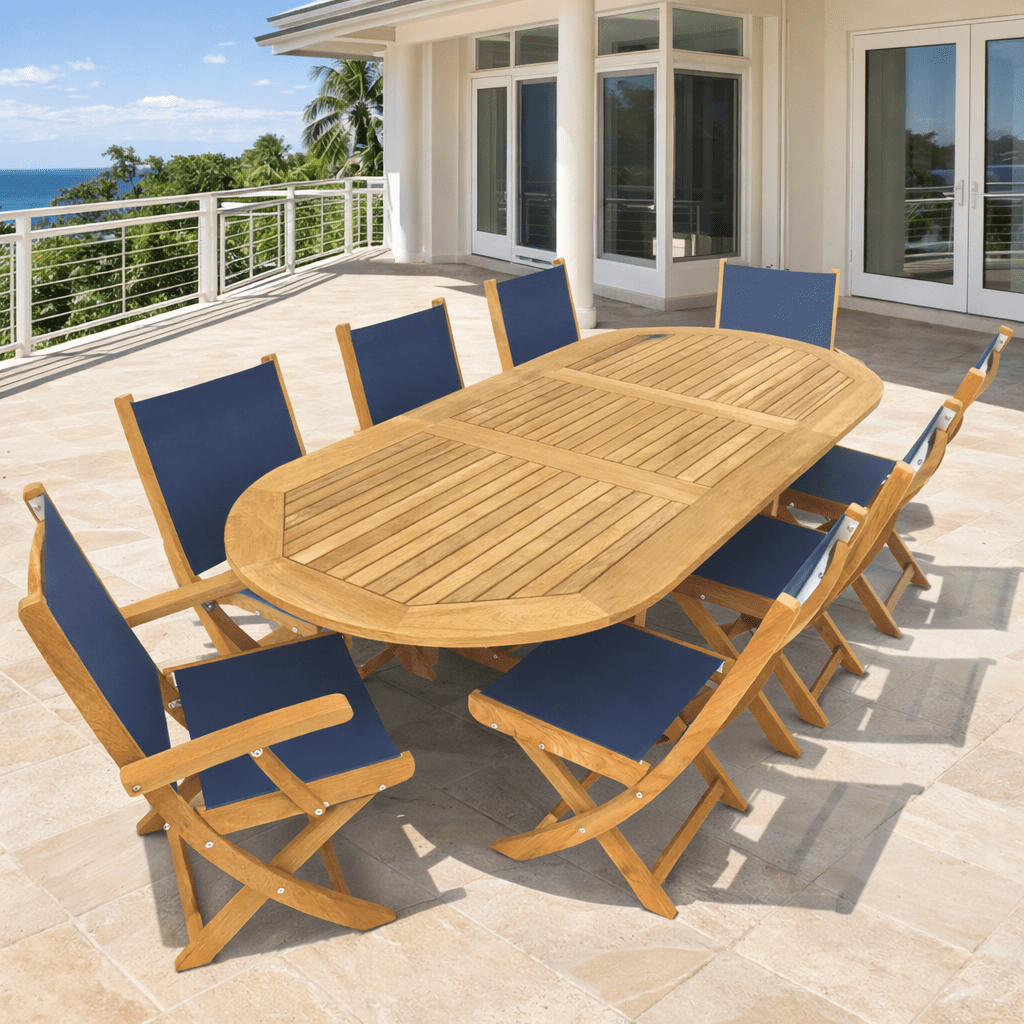 For generous patios, complete teak dining sets provide a straightforward foundation. Position the dining area close enough to the kitchen or grill that carrying food and dishes does not become a chore, but avoid allowing the table to consume the primary circulation route.
On a large entertaining terrace, leave enough room around occupied chairs for people to move behind them. That circulation space often matters more to everyday comfort than squeezing in one additional chair.
For Monterey, Carmel, Cambria, Pismo Beach, and other coastal settings, consider lower-profile lounge seating that preserves sightlines. A sofa or loveseat with club chairs can create a flexible conversation group without visually dominating the deck.
When the view spans a broad horizon, swivel seating can also be useful because guests can move naturally between conversation and scenery. The teak patio seating collection is a useful starting point for these mixed lounge configurations.
Pool areas call for a different hierarchy. Begin with loungers where people actually spend time in the sun, then add small tables for drinks, books, and phones. Teak chaise loungers work naturally in this role and can be paired with compact side tables rather than another full seating group.
A teak garden bench can be more valuable than another chair pair when the objective is to create a quiet destination within a landscaped property. Place it where there is a reason to sit: beneath a tree, overlooking plantings, at the end of a path, or facing a distant view.
That approach works especially well with the region's garden-oriented cottages, estates, and properties where the landscape is part of the home's identity.
For evening-focused spaces, deep seating arranged around a coffee table or fire feature creates a more intimate scale than a dining table. Leave the dining zone oriented toward meals and give evening conversation its own center of gravity.
Teak's visual advantage here is versatility. Natural wood can sit comfortably beside coastal architecture, Spanish and Mediterranean influences, ranch-inspired homes, contemporary residences, cottages, and wine-country estates without requiring the entire patio to follow one narrow theme.
On coastal properties, restraint usually works better than overt nautical styling. Natural teak, neutral performance cushions, simple forms, and an uncluttered layout allow the ocean and landscape to provide most of the visual character.
If teak is allowed to develop its silver-gray patina, it can become even quieter visually. Maintaining the warmer original color creates a stronger contrast against pale stucco, stone, and coastal landscaping. Neither approach is inherently better.
Santa Barbara and surrounding communities include many homes where courtyards, stucco, tile, masonry, and Mediterranean-inspired landscaping shape the outdoor environment. Teak's warm natural character pairs easily with these materials without competing with architectural detail.
In courtyards, we would generally favor a strong central dining or conversation grouping rather than scattering small pieces around the perimeter.
In Paso Robles and the Santa Ynez Valley, outdoor furniture can take on a more relaxed, substantial character. Large dining tables, benches, deep seating, and serving pieces work well where outdoor meals and guests are central to the property's use.
The landscape is already visually complex, so furniture does not need to be. Simple teak forms can provide structure while letting vineyards, oaks, hills, and planting beds remain dominant.
Teak is not limited to traditional homes. Clean-lined teak furniture can soften concrete, steel, glass, and modern hardscape with natural material and texture. For contemporary patios, keep furniture groupings deliberate and allow open space between zones rather than filling the entire terrace.
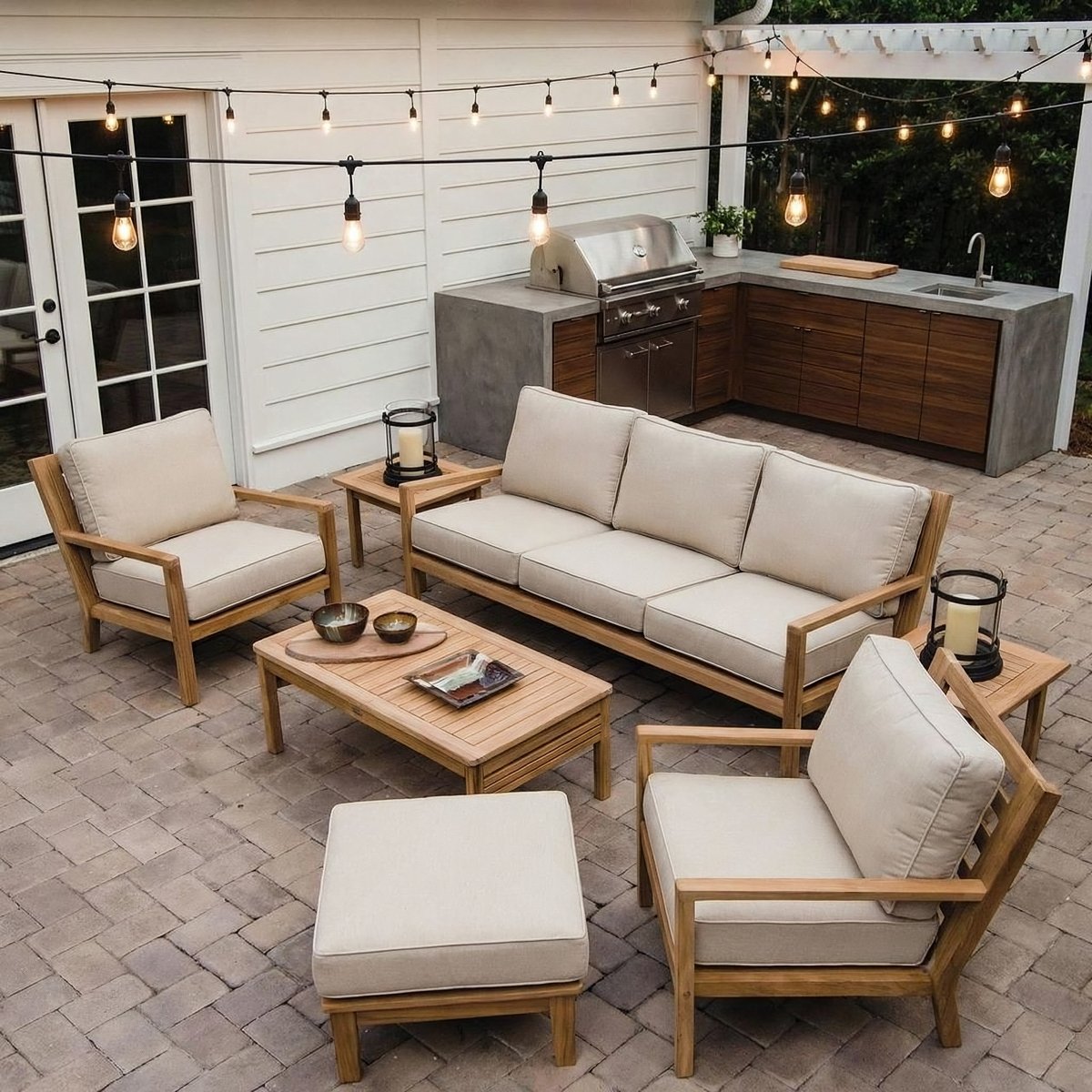 The biggest Central Coast mistake may be assuming every local patio experiences the same conditions. A fog-prone ocean deck and a sunny inland terrace require different priorities. Evaluate direct sun, morning dampness, wind exposure, shade, and proximity to the ocean at the actual furniture location before choosing materials or cushions.
Homeowners sometimes plan around rainfall while overlooking recurring fog, dew, and damp mornings. On exposed coastal patios, choose furniture intended for genuine outdoor use rather than pieces whose durability depends on remaining consistently dry.
Grade A teak's moisture and rot resistance makes it well suited to these repeated wet-dry cycles.
A patio sized permanently for the biggest gathering of the year can feel awkward the other 350 days. Extendable dining tables and movable chairs let the space respond to guests without sacrificing everyday circulation.
We would rather see eight people comfortably gathered around an appropriately scaled table than ten seats squeezed into a patio that no longer functions well.
Large sectionals can be excellent on generous patios, but they are not automatically right for scenic properties. Measure seated and standing sightlines before choosing high-backed or visually substantial furniture. Sometimes a sofa plus movable chairs creates a better relationship with the landscape.
Furnishing only for sunny afternoons misses an important part of Central Coast living. Consider where people will sit after dinner, how wind exposure changes later in the day, and whether a dedicated conversation or fire-table zone would extend the usefulness of the patio.
Teak furniture and cushions have different care needs. Many TeakHQ lounge products include weather-resistant Sunbrella cushions, but "weather resistant" does not mean every cushion benefits from unlimited exposure to moisture and debris. Follow the individual product's care guidance and protect or store soft goods when conditions warrant it.
Central Coast teak care can be quite simple, particularly if you are comfortable allowing the wood to weather naturally. The main objective is to keep surfaces clean and address the conditions of your particular patio rather than following an unnecessarily aggressive maintenance schedule.
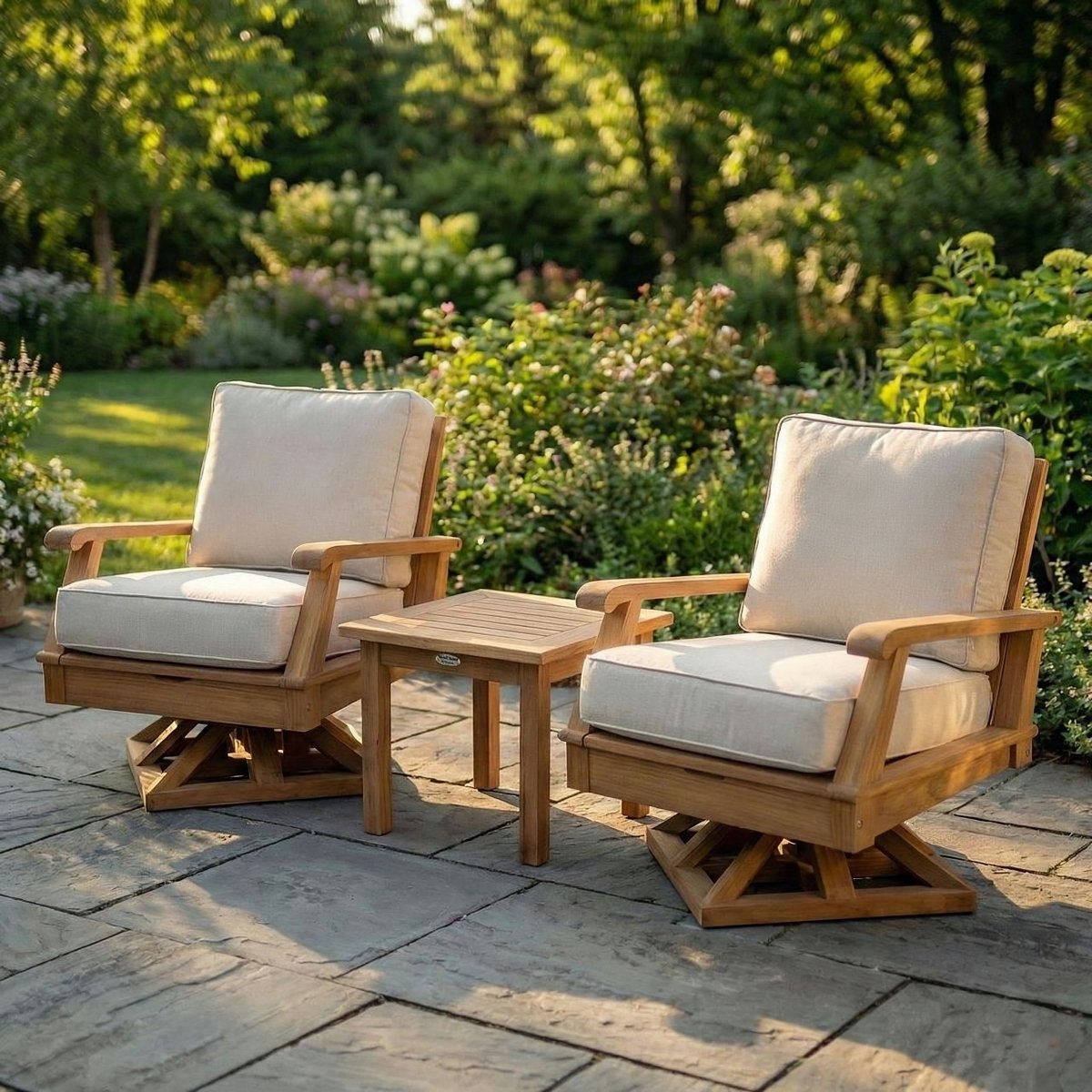 There is no useful one-size-fits-all cleaning calendar for this region. An uncovered oceanfront deck exposed to salt residue and fog may need attention more frequently than a protected inland courtyard.
Clean when you see accumulated dirt, coastal residue, pollen, leaves, bird debris, or other organic material rather than cleaning simply because a fixed number of weeks has passed.
Properties close to the ocean should periodically remove accumulated salt and grime from furniture surfaces. In shaded or frequently damp areas, avoid allowing leaves and other organic debris to remain trapped against furniture for long periods.
The wood's natural moisture and rot resistance reduces maintenance demands, but basic cleaning remains part of good outdoor-furniture ownership.
Untreated teak naturally develops a silver-gray patina. If that relaxed weathered appearance suits your coastal home, you can allow the process to occur naturally. If you prefer teak's original warmer color, appropriate teak care products can be used according to their instructions.
The key point is that maintaining the original color is an aesthetic choice rather than a requirement for the wood's durability.
Grade A teak is designed for year-round outdoor use, so Central Coast homeowners generally do not need to move the furniture indoors simply because the wetter season arrives. That is particularly valuable with substantial dining sets and deep seating that would otherwise require considerable storage space.
Protective covers are optional rather than required for the teak itself. Homeowners may still choose them to reduce dirt and cleaning, and cushions or other soft goods should be handled according to their specific care requirements.
The best Central Coast outdoor space starts with three decisions: understand the microclimate of the actual patio, decide how you genuinely use the space, and choose furniture scaled to that lifestyle. Premium Grade A teak is especially well suited to homeowners who want natural materials, long-term outdoor durability, and the freedom to either maintain a warm teak appearance or let the wood weather gracefully with the coast.
Premium teak, quality aluminum, and well-made synthetic outdoor materials can all be appropriate. Grade A teak is particularly attractive for homeowners who want natural wood because its oils and dense grain help it resist moisture, rot, insects, and warping while handling sun, rain, and temperature changes.
Choose furniture designed for genuine outdoor exposure and consider moisture, salt residue, wind, and recurring fog rather than rainfall alone. Grade A teak is a strong natural-material choice for coastal patios because of its moisture resistance and outdoor durability.
Grade A teak is naturally resistant to moisture and designed for year-round outdoor use. Fog and damp mornings do not mean the furniture needs to be brought inside, although routine cleaning is sensible where moisture combines with salt, dirt, or organic debris.
Yes. TeakHQ's Grade A teak furniture is designed for year-round outdoor use and withstands rain, sun exposure, and temperature fluctuations. Protective covers can reduce cleaning but are not required for the teak's durability.
Potentially. Immediate coastal properties may place greater emphasis on marine moisture, fog, and wind, while inland Central Coast patios can receive stronger sun and warmer, drier conditions. Evaluate the microclimate of the actual patio rather than choosing solely by city or region.
Preserve the view first. Lower-profile sofas, loveseats, movable club chairs, and swivel chairs can create conversation seating without making every guest turn away from the scenery. Avoid automatically filling a scenic deck with the largest sectional that fits.
Choose around your normal gathering size rather than your largest annual event. For households that occasionally host larger dinners, extendable teak dining tables can add capacity without permanently consuming valuable patio space.
Yes. Untreated teak naturally weathers toward a silver-gray patina over time. That change is cosmetic rather than a sign that the wood has failed. Homeowners who prefer the original warm teak color can maintain it with appropriate care products.
Both can be premium outdoor-furniture materials. Teak has a warmer, more natural appearance and a heavier, more architectural feel, while aluminum is lighter and often more modern in character. Teak's additional weight can be appealing on breezy patios, but furniture should still be secured or protected when unusually strong winds are expected.
No. Grade A teak does not require sealing or artificial stain for durability. You can leave it untreated and allow a silver-gray patina to develop, or use appropriate teak care products when maintaining the original color is important to you.


