
FREE SHIPPING
within mainland USA
within mainland USA
Home ▸ Teak Outdoor Furniture ▸ By Location ▸ Charleston, South Carolina
Charleston outdoor spaces have to balance beauty with a demanding coastal environment. Humidity, frequent rain, strong sun, salt exposure near the water, and long outdoor-living seasons all influence which furniture materials make sense. At the same time, piazzas, screened porches, garden courtyards, pool patios, and waterfront decks call for furniture that complements rather than overwhelms the architecture. Premium Grade A teak is especially well suited to that combination because it offers natural weather resistance, substantial construction, and a look that works comfortably in both historic and contemporary Lowcountry settings.

Choosing outdoor furniture in Charleston is less about finding something labeled “outdoor” and more about understanding what the material will experience every week of the year. Heat and strong sun matter, but the more defining issue is the combination of moisture, humidity, rainfall, coastal exposure, and a relatively long season of outdoor use. Furniture may spend months in warm, damp air rather than alternating between a short summer season and dry indoor winter storage.
Humidity is one of the first things we would consider when furnishing a Charleston patio. Materials that repeatedly absorb moisture and dry unevenly can demand more attention than homeowners expect. The issue becomes especially noticeable on covered porches and shaded courtyards, where furniture may be protected from direct rain but can remain damp longer after humid nights or summer showers.
This is one reason material quality matters more here than it does in a dry inland climate. Premium outdoor woods need to tolerate moisture exposure without depending on a decorative surface coating for their basic durability. Grade A teak's dense grain and natural oils make it resistant to moisture, rot, and warping, which makes it a strong candidate for Charleston's environment.
Not every Charleston-area home experiences the same amount of salt exposure. A protected backyard in West Ashley is a different furniture environment from a deck on Sullivan's Island, Isle of Palms, Kiawah Island, or a home directly on Charleston Harbor. The closer a property is to open water and salt spray, the more carefully we would evaluate materials, hardware, and maintenance expectations.
Teak is particularly attractive for coastal properties because its weather resistance comes from the wood itself rather than from paint or an artificial exterior finish. Royal Teak and Anderson Teak pieces use stainless-steel hardware, while Verandis Teak uses brass hardware. As with any outdoor furniture near salt water, periodic cleaning is still sensible.
Charleston homeowners often focus on whether furniture can “get wet.” A better question is what happens after it gets wet. Furniture that sits in a poorly drained corner, under dense shade, or against a wall with little airflow experiences a different environment from the same furniture on an open patio.
That leads to one of the most useful Charleston-specific planning rules: choose the furniture material and the furniture location together. Even a premium material benefits from good drainage and airflow. Avoid creating permanent damp zones under furniture, keep organic debris from collecting around legs and joints, and give cushions an opportunity to dry after storms.
Charleston buyers should also think about what they will do with furniture when a tropical storm or hurricane threatens. Heavy furniture can feel reassuring in everyday breezes, and teak generally has a more substantial, architectural feel than lightweight outdoor furniture. That does not mean any patio furniture should simply be left unsecured during severe weather.
Before buying a large dining set or sectional, decide where cushions, accessories, umbrellas, and movable pieces can go when a storm approaches. On elevated decks, rooftop spaces, and exposed waterfront patios, that plan is especially important.
Charleston is a particularly good environment for evaluating outdoor furniture materials honestly. Aluminum can be a sensible choice when low weight and a contemporary appearance are priorities. Poly lumber appeals to homeowners who prefer a synthetic material and minimal aesthetic change. Premium Grade A teak makes the strongest case when the priorities are natural material, substantial construction, long service life, and the ability to live outdoors without relying on paint or stain for durability.
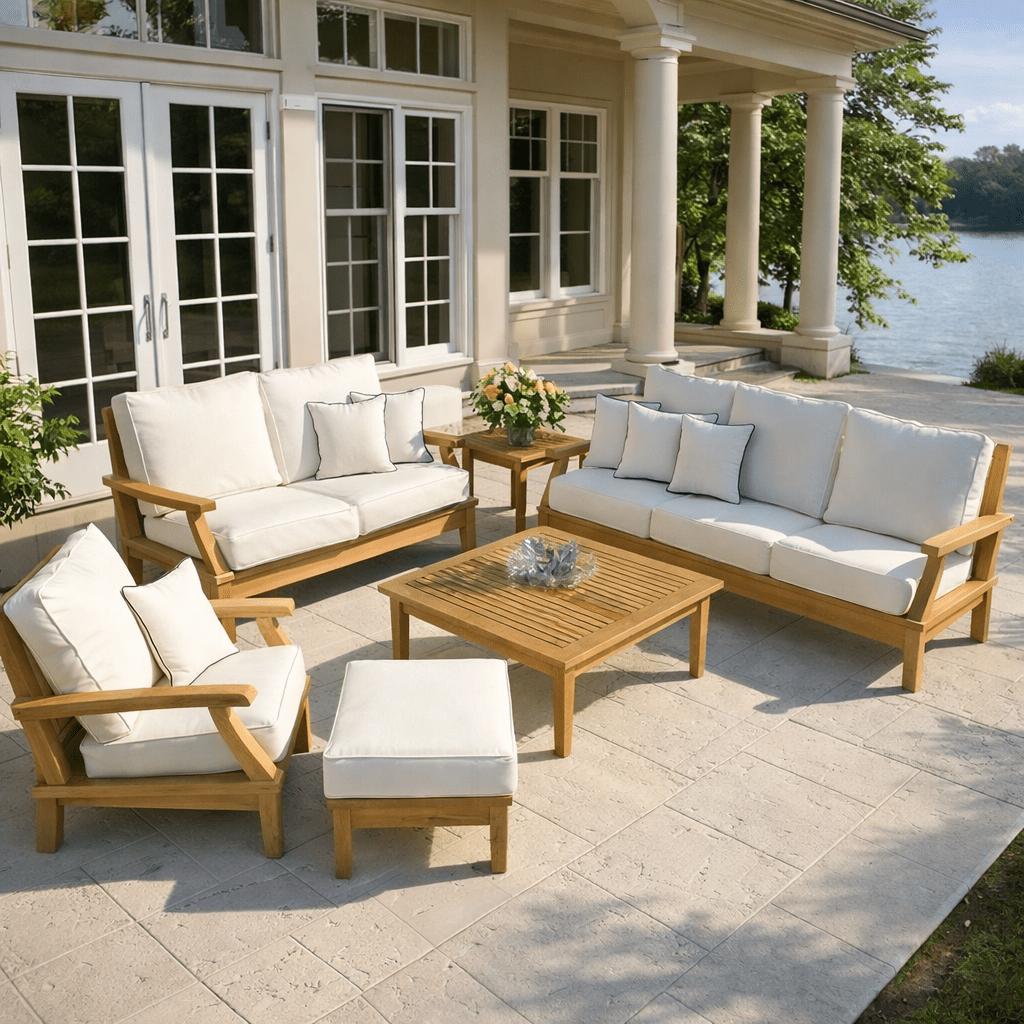 Grade A teak is naturally high in oils and has a dense grain structure. Those properties help it resist moisture, rotting, insects, and warping. In Charleston, that matters because the furniture may move repeatedly through rain, humidity, strong sunshine, and temperature changes rather than spending half the year protected indoors.
That natural resistance also changes the maintenance decision. Teak does not need paint, artificial stain, or sealing in order to remain durable outdoors. Owners can maintain its warmer original appearance if they prefer, or allow the wood to weather naturally.
Natural teak changes color outdoors. Left untreated, it gradually develops a silver-gray patina. That change is cosmetic rather than a sign that the furniture has reached the end of its useful life. For Charleston homeowners, this creates a useful design choice: preserve a warmer teak color to contrast with light-colored porches and masonry, or let the furniture mature toward gray for a softer coastal look.
This flexibility works particularly well in the Lowcountry because both appearances can complement local architecture. Fresh natural teak adds warmth to crisp painted exteriors, while weathered teak can sit quietly within coastal gardens, oyster-shell tones, masonry, and muted waterfront palettes.
Premium outdoor furniture is expensive enough that homeowners should evaluate it on a multi-year or multi-decade horizon, not simply on how it looks during its first summer. Teak is valued in part because it is resistant to warping and designed for year-round outdoor use. That makes it well suited to a climate where patios and porches may be used across much of the calendar.
The heavier, sturdier feel of teak is also appropriate for large Charleston outdoor rooms. Substantial dining tables, sofas, club chairs, and sectionals visually hold their own against broad porches, brick terraces, mature landscaping, and larger waterfront properties.
One of teak's strongest practical advantages is that maintenance is optional in a way many buyers do not initially expect. You can clean it periodically and let it age naturally, or use appropriate teak-care products if retaining the original color is important to you. The wood does not need an artificial stain for basic outdoor durability.
That distinction is worth considering before purchase. If you enjoy the look of silver-gray teak, ownership can be quite straightforward. If you want the furniture to remain closer to its original golden tone, expect more cosmetic care. Neither approach is inherently better.
| Charleston Challenge | Why Premium Grade A Teak Performs Well |
|---|---|
| High humidity | Natural oils and dense grain help resist moisture, rot, and warping. |
| Frequent rain | Grade A teak is designed for year-round outdoor exposure. |
| Strong sun | Teak withstands sun exposure and can weather naturally to silver-gray. |
| Coastal conditions | The wood's durability does not depend on paint or an exterior coating. |
| Temperature changes | Teak is suited to outdoor temperature fluctuations. |
| Long outdoor season | Long service life makes teak appropriate for heavily used outdoor rooms. |
| Insects and rot | Grade A teak is naturally resistant to insects and rotting. |
| Storm preparation | Its substantial construction suits permanent outdoor spaces, although furniture still requires storm planning. |
If we were helping furnish a Charleston home, we would begin with the architecture and the way the family actually uses the property—not with a furniture catalog. A peninsula piazza, a Mount Pleasant backyard, a Daniel Island porch, and a Kiawah waterfront terrace may all benefit from teak, but they should not be furnished the same way.
In Charleston, the porch is often not leftover space; it is one of the home's most useful rooms. On a narrow or historic-style porch, we would resist the temptation to fill every linear foot with furniture. Circulation matters. A pair of teak rockers, club chairs, or a porch swing can create a more inviting space than an oversized lounge set that turns the porch into an obstacle course.
For long piazzas, think in zones. A smaller conversation area can sit toward one end, with a garden bench, console, or pair of chairs farther down. The result feels more architectural and better respects the rhythm of columns, doors, and windows.
For many larger Charleston-area homes, we would make outdoor dining the anchor. A six- or eight-person teak dining set handles everyday family meals while leaving enough capacity for weekend guests. If entertaining size changes frequently, an extendable teak dining table can be more useful than permanently dedicating the patio to a very large table.
Place the table reasonably close to the kitchen or outdoor cooking area. A beautiful dining area that requires carrying every plate and glass across the entire yard gets used less than one integrated into the home's natural traffic pattern.
Where the patio is large enough, dining and lounging should usually be treated as different activities. Deep seating encourages people to stay outside after dinner rather than crowding around upright dining chairs. A multi-piece teak lounge set or sectional paired with a coffee table gives the space a second purpose.
A useful Charleston layout is dining nearer the house, conversation seating slightly farther into the garden or toward the best view, and pool seating beyond that. The zones can be visually connected without forcing one furniture group to perform every job.
Waterfront and marsh-view properties deserve a different approach. Before choosing the largest sectional that fits, identify where people naturally look. A pair of swivel chairs, chaise lounges, or smaller conversation group can sometimes preserve sightlines better than one large sofa facing inward.
This is especially important on raised decks. The most expensive furniture arrangement can still be the wrong arrangement if chair backs and tall tables interrupt the very view that makes the property special.
Start with the collection that serves the activity you use most often. Frequent hosts should begin with dining sets or extendable tables; porch-oriented homes may get more daily value from rockers and swings; larger backyards can support a dedicated lounge set or sectional; and pool or waterfront properties often benefit from chaise lounges. Once the primary zone is established, add complementary pieces rather than trying to furnish every part of the property at once.
Charleston outdoor living is unusually tied to the architecture of the home. Porches, piazzas, screened rooms, courtyards, pools, gardens, decks, and waterfront terraces are often extensions of daily living rather than occasional-use spaces. That makes comfort and furniture placement just as important as weather resistance.
The classic Charleston idea of the porch is practical, not merely decorative. Shade, airflow, and protection from passing showers can make a covered outdoor area more usable than an exposed patio during the hottest part of the day. Furniture for these spaces should therefore be selected for frequent use.
We would prioritize comfortable chairs with a nearby side table, a swing or rocker where the architecture supports it, and enough open floor area for movement. On a screened porch, deep seating becomes especially appealing because the room can function almost like an outdoor den.
Charleston's long outdoor season makes a permanent dining setup worthwhile for homeowners who entertain. Six-person tables are versatile for families, while eight- and ten-person configurations make sense for homes that routinely host relatives, neighbors, or visiting friends.
The memorable insight here is that the right table size should be based on your second-most-common gathering, not your largest gathering of the year. Buying a twelve-seat table for one annual party can make an otherwise comfortable terrace feel oversized every other weekend. An extendable table often solves that problem more elegantly.
On Charleston Harbor, tidal creeks, marshes, and barrier-island properties, furniture should support the view rather than compete with it. Swivel chairs are useful where people alternate between conversation and scenery. Chaise lounges suit sun-oriented decks and pool areas, while smaller lounge groupings can keep railings and horizons visually open.
For exposed spaces, also think through wind and storm preparation. Umbrellas, loose cushions, serving pieces, and lightweight accessories need a storage plan even when the main teak furniture remains outdoors in ordinary weather.
For Kiawah, Seabrook, Isle of Palms, Folly Beach, and other second-home or rental-oriented properties, we would generally favor fewer, better-defined furniture zones. A complete dining set, one cohesive lounge group, and practical pool or deck seating are easier for owners and guests to understand than many unrelated pieces scattered around the property.
Choose layouts that are intuitive enough that guests naturally return furniture to the right place. Durable materials help, but good ownership also depends on reducing the number of things that need constant rearranging.
Charleston's range of property types means there is no single ideal teak setup. The strongest choices usually come from matching furniture scale and function to the outdoor room first, then choosing the specific style.
 For a primary backyard patio, a six- or eight-person teak outdoor dining collection is usually the most versatile starting point. It supports everyday meals without assuming that every dinner is a major event. Larger properties with frequent entertaining can move comfortably into eight- or ten-plus-person sets.
Round tables can work especially well in square patios or garden settings where circulation occurs around all sides. Rectangular and oval tables generally make better use of long terraces and porches. If the household alternates between family meals and larger gatherings, extendable tables deserve serious consideration.
Screened porches and covered patios are natural locations for teak patio seating. Sofas, loveseats, club chairs, swivel chairs, and sectionals allow the room to function more like an interior living area while still using furniture designed for outdoor conditions.
For most homes, we prefer a mixed grouping over automatically choosing the largest sectional available. A sofa with two lounge chairs creates more flexible conversation and can be easier to fit around doors, columns, and irregular porch dimensions. A sectional becomes more compelling when there is a large uninterrupted wall or corner and the goal is maximum group seating.
Charleston is one of the rare markets where teak swings, rockers, gliders, and benches can feel as relevant as contemporary lounge furniture. They fit naturally on traditional porches and can add useful seating without creating the visual mass of deep upholstered pieces.
For a narrower porch, a pair of rockers with a compact side table may be all that is needed. On a larger porch, a swing can anchor one end while club chairs or a loveseat create a second seating zone.
Pool patios, sunny terraces, and waterfront decks are good candidates for teak chaise lounges. Two may be enough for a private retreat; four or more make sense when the pool is a social center.
Leave more circulation room than the furniture dimensions alone suggest. Loungers change position, people walk around them wet, and side tables appear once the space is actually used. Planning only to the exact footprint almost always makes a pool deck feel tighter than expected.
Charleston's outdoor spaces range from historic peninsula properties to new coastal construction, but they often share an emphasis on porches, shade, gardens, natural materials, and a strong relationship between indoor and outdoor rooms. Teak fits that range because it can look traditional, transitional, coastal, or contemporary depending on the furniture design and surrounding materials.
On historic-inspired homes, the goal is usually restraint. Straightforward teak dining furniture, benches, rockers, and swings can complement columns, brickwork, shutters, painted siding, and traditional porches without trying to imitate the architecture.
Natural teak introduces warmth against pale exterior finishes. If allowed to weather gray, it becomes quieter and can blend especially well with older masonry, stone, coastal landscaping, and muted exterior colors.
Smaller courtyards reward furniture with clearly defined purpose. Instead of treating a compact garden as a reduced-size patio, consider a round dining table, a garden bench at a focal point, or two lounge chairs arranged around planting and shade.
A teak garden bench can be particularly effective because it adds seating without requiring the visual and physical footprint of a full conversation set. It also works well at the end of a path, against a garden wall, or under mature tree cover.
Newer waterfront construction often benefits from cleaner-lined teak pieces paired with restrained cushions and open sightlines. Teak's warmth can soften extensive glass, metal railings, pale stone, concrete, and other contemporary surfaces without making the setting feel rustic.
In these homes, repetition usually looks better than variety. Using the same teak family for the dining area and nearby lounge zone creates continuity while still allowing each area to serve a different purpose.
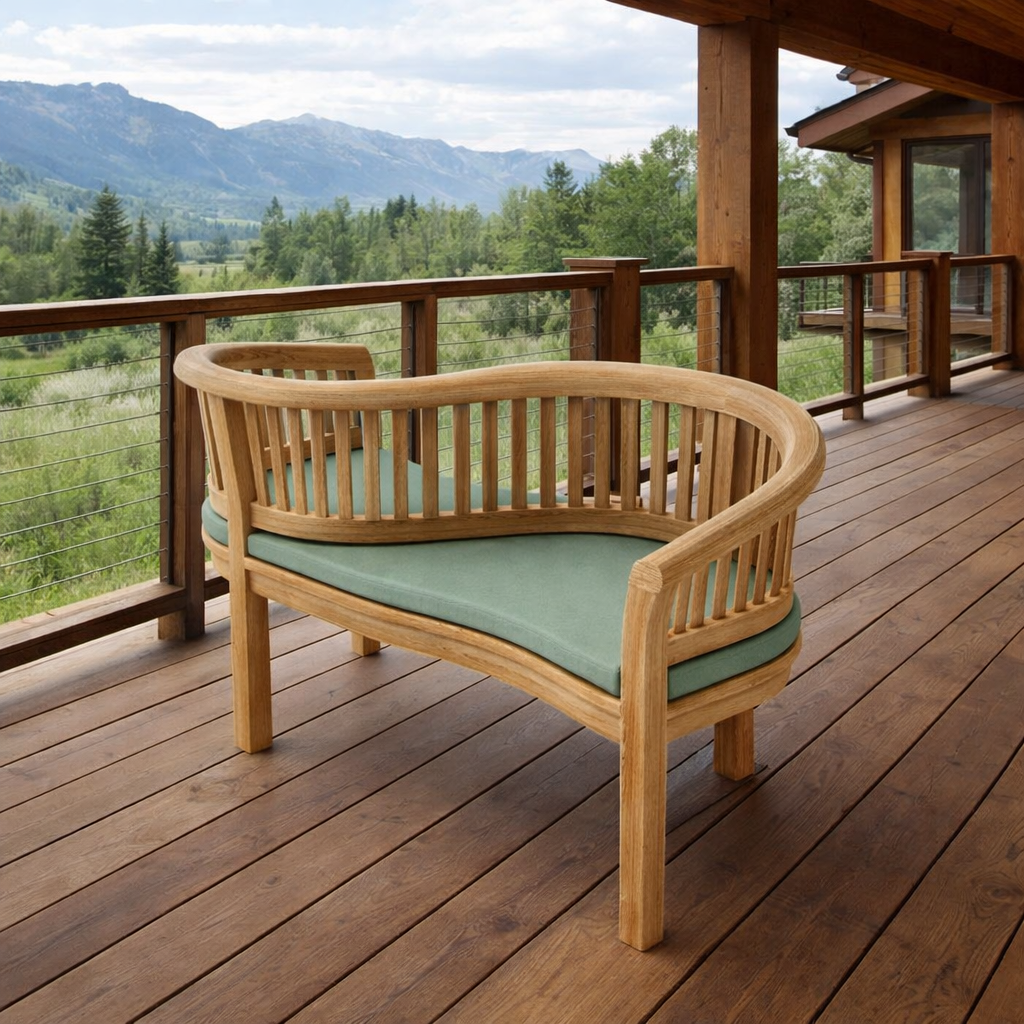 A homeowner may assume a covered porch eliminates weather concerns because the furniture rarely gets directly rained on. In Charleston, that overlooks humidity. Moist air reaches covered spaces easily, and shaded areas can dry slowly.
Choose outdoor materials for the environment around the furniture, not simply for direct rainfall. Grade A teak's moisture and rot resistance makes it particularly appropriate for these semi-protected outdoor rooms.
One of the easiest ways to make a beautiful Charleston porch less useful is to fill it with too much furniture. Columns, doors, stairs, and circulation routes already divide the floor plan. Oversized sets can turn a graceful outdoor room into a narrow pathway between furniture pieces.
Measure the usable floor area rather than the total porch dimensions. Then protect the circulation path first. A smaller teak loveseat and two chairs can outperform a sectional if people can move through the room comfortably.
Large Lowcountry gatherings are part of the appeal of outdoor living, but furnishing permanently for the largest event of the year can waste valuable patio space. A giant fixed dining table may dominate the yard during the other 360-plus days.
Consider an extendable table, movable dining chairs, benches, or secondary porch seating instead. Flexibility usually serves a Charleston entertaining space better than permanently maximizing seat count.
Outdoor cushions can be weather resistant without being something you should treat as indestructible. Many TeakHQ lounge pieces include Sunbrella cushions, which are weather-resistant, fade-resistant, UV-resistant, and water-resistant, but owners should still allow cushions to dry and protect them when severe weather approaches.
Before purchasing a large cushioned set, decide where cushions will go during extended storms or hurricane preparation. A nearby storage area is more useful than discovering afterward that twelve bulky cushions have nowhere convenient to go.
Salt exposure is not uniform across the Charleston area. A waterfront or barrier-island property requires more attention to routine cleaning than a protected inland patio. Furniture selection should reflect that difference rather than treating “Charleston weather” as one identical environment.
For the wood itself, Grade A teak is a sensible coastal choice because its durability does not depend on paint or stain. Hardware and other furniture components still deserve inspection and cleaning as part of coastal ownership.
Teak care in Charleston should be driven by exposure rather than by an arbitrary calendar. A shaded garden bench, covered piazza sofa, and ocean-facing dining set do not experience the same environment, even when they are only a few miles apart.
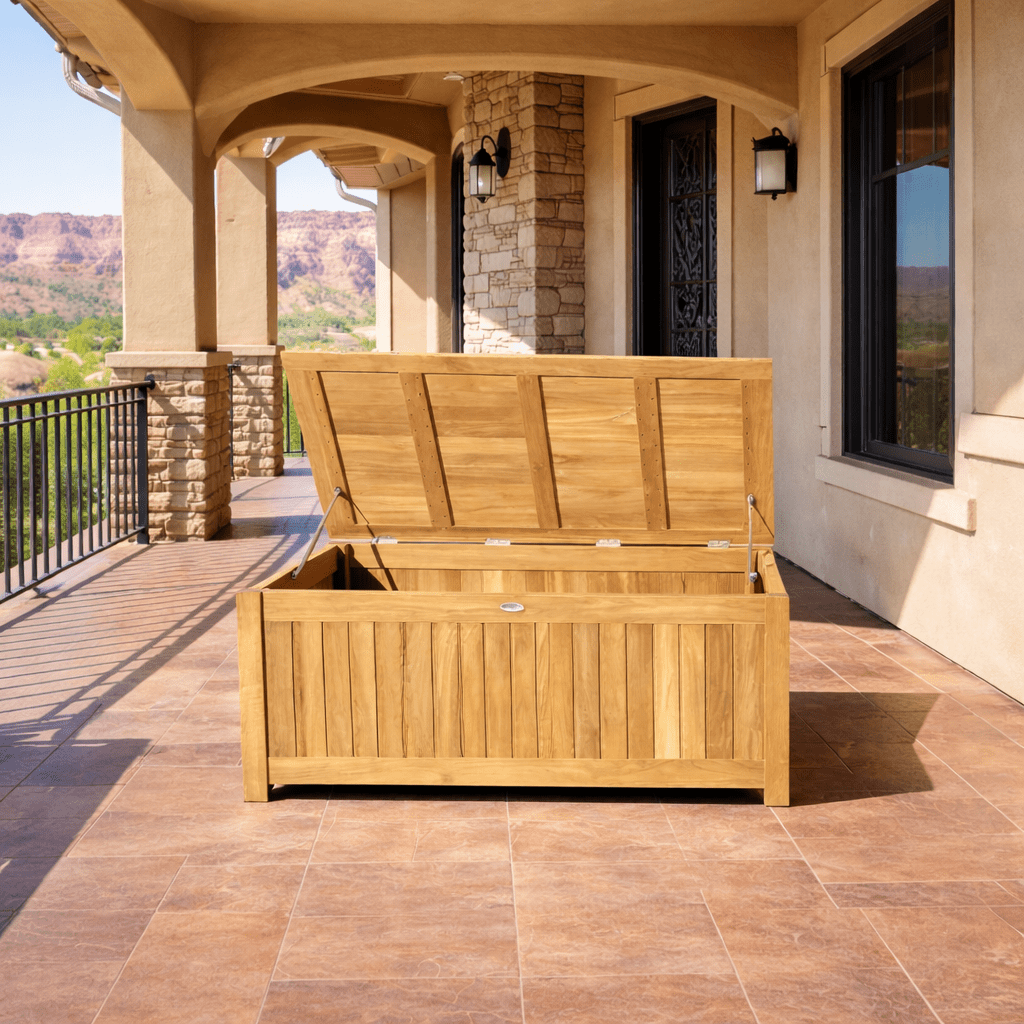 Inspect outdoor furniture periodically and clean when pollen, dirt, leaves, salt residue, or other debris begins to accumulate. Waterfront furniture generally deserves more frequent attention than furniture on a protected inland porch.
Avoid allowing organic debris to remain packed into joints, underneath furniture, or against legs. Charleston's humidity makes basic housekeeping around the furniture more important than it would be in a consistently dry climate.
After prolonged rain, help the space dry naturally. Keep drainage paths open, avoid standing water around furniture feet, and allow cushions to dry before enclosing them in storage.
On covered and screened porches, remember that protection from rainfall can also mean less direct sun and airflow. Those spaces can stay damp longer, so occasional inspection matters even when the furniture appears sheltered.
Untreated teak naturally weathers to a silver-gray patina. If you like that appearance, there is no requirement to continually restore the original color for the sake of durability. The weathered look can be particularly attractive in Charleston's coastal and garden settings.
If you prefer the warmer original teak appearance, use appropriate teak-care products and follow the specific product instructions. Think of this as an appearance decision rather than a requirement for the wood to survive outdoors.
Grade A teak is designed for year-round outdoor use, so Charleston homeowners do not need to put the furniture into seasonal storage simply because winter arrives. Severe storms are different. When tropical weather threatens, follow local emergency guidance and secure or relocate outdoor objects as appropriate.
Have a practical plan for cushions, umbrellas, trays, small tables, and other accessories. Protective covers can also be useful when chosen and used correctly, but covers should not become a way to trap persistent moisture around furniture.
The strongest Charleston outdoor spaces are not the ones with the most furniture. They are the ones where the material, scale, layout, and maintenance expectations fit the property. Premium Grade A teak is particularly compelling here because it combines natural weather resistance, long-term durability, substantial construction, and a look that belongs comfortably on everything from a traditional piazza to a modern waterfront terrace.
Start with the part of your outdoor space you use most—dining, conversation seating, porch sitting, or poolside lounging—then build outward from there. TeakHQ offers premium Grade A teak collections from Royal Teak, Verandis Teak, and Anderson Teak for creating those spaces one well-considered zone at a time.
Look for materials designed for prolonged outdoor moisture exposure rather than simply occasional rain. Premium Grade A teak is a strong choice because its natural oils and dense grain make it resistant to moisture, rot, insects, and warping. High-quality aluminum and synthetic materials can also be appropriate depending on the desired look and ownership priorities.
Yes. Grade A teak is well suited to Charleston because it is designed for year-round outdoor use and withstands rain, sun exposure, moisture, and temperature changes. Coastal furniture should still be cleaned periodically, especially where salt residue is common.
For narrower porches, prioritize circulation with rockers, club chairs, a loveseat, garden bench, or porch swing rather than an oversized sectional. Larger screened porches can support a full deep-seating arrangement with sofas, chairs, coffee tables, and side tables.
Yes. TeakHQ's Grade A teak furniture is designed for year-round outdoor use. It does not need to be moved indoors for ordinary seasonal weather, although homeowners should still make appropriate preparations when severe tropical weather or hurricanes threaten.
No. Teak does not need to be sealed for durability. It can be left untreated and allowed to develop a silver-gray patina. Homeowners who prefer the original warmer teak color can use suitable teak-care products as an optional appearance treatment.
Choose for the number of people you host regularly rather than the largest gathering you might have once a year. Six- and eight-person tables work well for many households, while an extendable dining table provides extra capacity without permanently occupying the patio with an oversized table.
Yes. Grade A teak's moisture resistance and outdoor durability make it a strong material for coastal homes. Properties with greater salt exposure should plan on periodic cleaning of furniture and hardware rather than assuming any outdoor material is completely unaffected by the marine environment.
There is no single schedule that fits every property. Clean according to exposure: waterfront furniture may need attention more often because of salt residue, while shaded patios may need more frequent removal of pollen, leaves, and organic debris. Inspecting the furniture periodically is more useful than following a rigid calendar.
Yes. Untreated teak naturally weathers toward a silver-gray patina when exposed outdoors. The color change is expected and does not mean the teak has lost its outdoor durability. Owners who prefer the original color can maintain it with appropriate teak-care products.
It depends on what you value. Aluminum is lighter and often has a more contemporary appearance, while poly lumber is synthetic and typically chosen for low-maintenance ownership. Teak offers real natural wood, a warmer and more substantial feel, natural weather resistance, and the potential to last for decades. For homeowners who prioritize authentic material and long-term value, teak is particularly compelling.


