
FREE SHIPPING
within mainland USA
within mainland USA
Home ▸ Teak Outdoor Furniture ▸ By Location ▸ Coral Gables, Florida
Outdoor furniture in Coral Gables has to fit more than a beautiful patio. High humidity, frequent rain, strong sun, tropical landscaping, pool exposure, and seasonal storms all influence which materials and layouts make sense, while waterfront properties add saltier conditions to the equation. At the same time, Mediterranean-inspired courtyards, covered terraces, garden spaces, and generous pool patios reward furniture that feels substantial and architectural. Premium Grade A teak is especially worth considering because it combines natural outdoor durability with a warm material character that fits these spaces naturally.

Coral Gables is a demanding outdoor furniture environment for reasons that are easy to underestimate. The challenge is not one dramatic weather condition acting alone. It is the combination of warmth, humidity, frequent wetting and drying, sun exposure, lush landscaping, swimming pools, and seasonal storms. In waterfront sections of the city, proximity to canals and Biscayne Bay can add more salt exposure as well.
A useful way to approach the buying decision is to stop thinking of the entire backyard as one environment. A covered courtyard beside a Mediterranean Revival home, a sunny pool deck, and a dockside terrace in Gables Estates can sit only yards apart yet expose furniture to very different conditions.
Humidity matters because outdoor furniture in South Florida may spend long periods in moist air even when it is not actively raining. Materials, joints, finishes, fabrics, and storage practices all need to be evaluated with that environment in mind. Furniture that performs adequately in a drier inland climate can create considerably more ownership work when continually exposed to moisture.
That does not mean every premium material is unsuitable. Well-designed aluminum can be a practical choice, especially for homeowners who prefer a light, contemporary appearance. Quality synthetic materials can also reduce some maintenance concerns. Natural Grade A teak, however, has an important advantage for homeowners who want real wood: its dense grain and naturally high oil content make it resistant to moisture, rot, insects, and warping without relying on an artificial stain for durability.
Outdoor furniture here frequently moves between wet and dry conditions. A passing downpour may soak an exposed patio before sunshine returns, while irrigation, pool activity, and dense landscaping can keep other parts of a property damp longer.
When comparing furniture, look beyond a simple “weather resistant” label. Consider how much of the piece depends on coatings, whether water can drain rather than collect, how quickly cushions can dry, and whether the underlying material is appropriate for repeated outdoor exposure. Premium Grade A teak is designed for year-round outdoor use and can withstand rain, sun exposure, and temperature fluctuations.
One of the most useful distinctions for a Coral Gables homeowner is waterfront versus inland exposure. Coral Gables includes extensive waterways and more than 40 miles of shoreline, but a protected patio near the Biltmore area does not face precisely the same environment as furniture near a canal or Biscayne Bay.
For waterfront properties in Cocoplum, Gables Estates, Gables by the Sea, or similar settings, pay more attention to salt residue on hardware, fabrics, and furniture surfaces. Royal Teak and Anderson Teak pieces use stainless-steel hardware, while Verandis Teak uses brass hardware. Regardless of material, periodic rinsing and cleaning are sensible when furniture receives direct salt spray.
Do not confuse everyday weather durability with hurricane preparedness. Furniture suitable for year-round South Florida weather still needs a storm plan. Before threatening weather, loose furniture, umbrellas, cushions, accessories, and other movable objects may need to be secured or moved according to local emergency guidance.
Teak's substantial feel is appealing in an upscale outdoor space, but furniture weight should never be treated as hurricane protection. When planning a patio, also plan where pieces can be moved and where cushions and smaller accessories can be stored.
 The reason teak deserves serious consideration in Coral Gables begins inside the wood itself. Grade A teak has naturally high oil content and a dense grain structure. Those characteristics contribute to its resistance to moisture, rot, insects, and warping.
That is particularly useful in a climate where furniture may remain outdoors through humid weather, sudden rain, strong sunshine, and repeated changes in surface moisture. Unlike a less durable outdoor wood that depends heavily on a protective surface treatment, teak does not require an artificial stain for basic outdoor durability.
Homeowners sometimes interpret any visible weathering as material failure. Teak is different. Natural unfinished teak gradually develops a silver-gray patina when exposed to the outdoors. That color change is normal and can be allowed to occur without compromising the basic reason teak was chosen.
If you prefer the warmer golden-brown appearance of newer teak, maintenance products can be used to preserve or restore that look. If you like the softer gray appearance often seen in established tropical and coastal landscapes, the wood can simply be allowed to age naturally.
This distinction is useful on Coral Gables properties because the design choice can follow the house. Golden teak can provide warmth against pale stucco, coral stone, terracotta, and shaded greenery, while weathered gray teak can work particularly well with restrained contemporary renovations and waterfront settings.
South Florida outdoor furniture experiences repeated changes in moisture and sun exposure. Grade A teak's dense grain and resistance to warping make it well suited to that pattern. This matters most on larger furniture—dining tables, sectionals, sofas, benches, and other pieces where long-term structural stability is more important than saving a few pounds of weight.
Teak also feels more substantial and architectural than lightweight furniture. In Coral Gables, that character often makes sense visually. Many patios are extensions of masonry-heavy homes, courtyards, tiled terraces, pool decks, garden walls, arcades, and loggias rather than temporary decks that call for easily moved furniture.
One reason premium teak works well for long-term homeowners is that care is flexible. You can leave unfinished teak untreated and allow it to acquire its natural silver-gray patina, or use appropriate teak care products when preserving the original color is important to you.
Protective covers are optional rather than required for the wood itself. In a humid climate, that flexibility can be valuable because a poorly ventilated cover can sometimes create its own moisture-management problem. Many owners are better served by routine cleaning, sensible cushion care, and good airflow than by constantly covering and uncovering every piece.
Teak generally costs more initially than many common patio furniture materials. The economic case therefore depends on how long you expect to own the furniture. Premium teak is a long-term purchase designed to last decades rather than a few seasons.
That makes the strongest case for homeowners who have already invested substantially in a permanent outdoor environment—a remodeled pool, outdoor kitchen, covered terrace, landscaped courtyard, or waterfront entertaining area. The more permanent the space, the less sense it makes to furnish it around a short replacement cycle.
| Coral Gables Challenge | Why Premium Grade A Teak Performs Well |
|---|---|
| High humidity | Natural oils and dense grain help resist moisture, rot, and warping. |
| Frequent rain | Grade A teak is designed for year-round outdoor exposure. |
| Strong sunshine | Teak tolerates sun exposure and can naturally weather to a silver-gray patina. |
| Wet-dry cycles | Dense teak has strong structural stability and resistance to warping. |
| Poolside exposure | Its natural moisture resistance makes teak practical around outdoor wet areas. |
| Waterfront settings | Teak is naturally suited to moist outdoor environments; exposed furniture should still be periodically cleaned of salt residue. |
| Long outdoor season | Furniture can remain outdoors year-round rather than being treated as seasonal furniture. |
| Long-term ownership | Premium teak can last for decades when appropriately used and cared for. |
If we were walking a Coral Gables property with you, we would not begin by choosing a sofa or table. We would begin by mapping exposure. Which area gets afternoon sun? Which section sits beneath a roof or loggia? Where does irrigation reach the patio? Where will wet swimmers sit? Which furniture is closest to a waterway? And where do guests naturally move between the house, kitchen, pool, and garden?
That exposure map is often more useful than the floor plan. Two seating areas with identical dimensions may need very different furniture simply because one sits protected under an arcade and the other occupies an open pool deck.
For many larger homes, we would divide the main outdoor area into two destinations: a dining zone and a lounge zone. Combining everything into one oversized furniture grouping often looks impressive in photographs but works less naturally in real life. Someone cooking outdoors may want a table nearby while other guests stay seated around a sofa and coffee table.
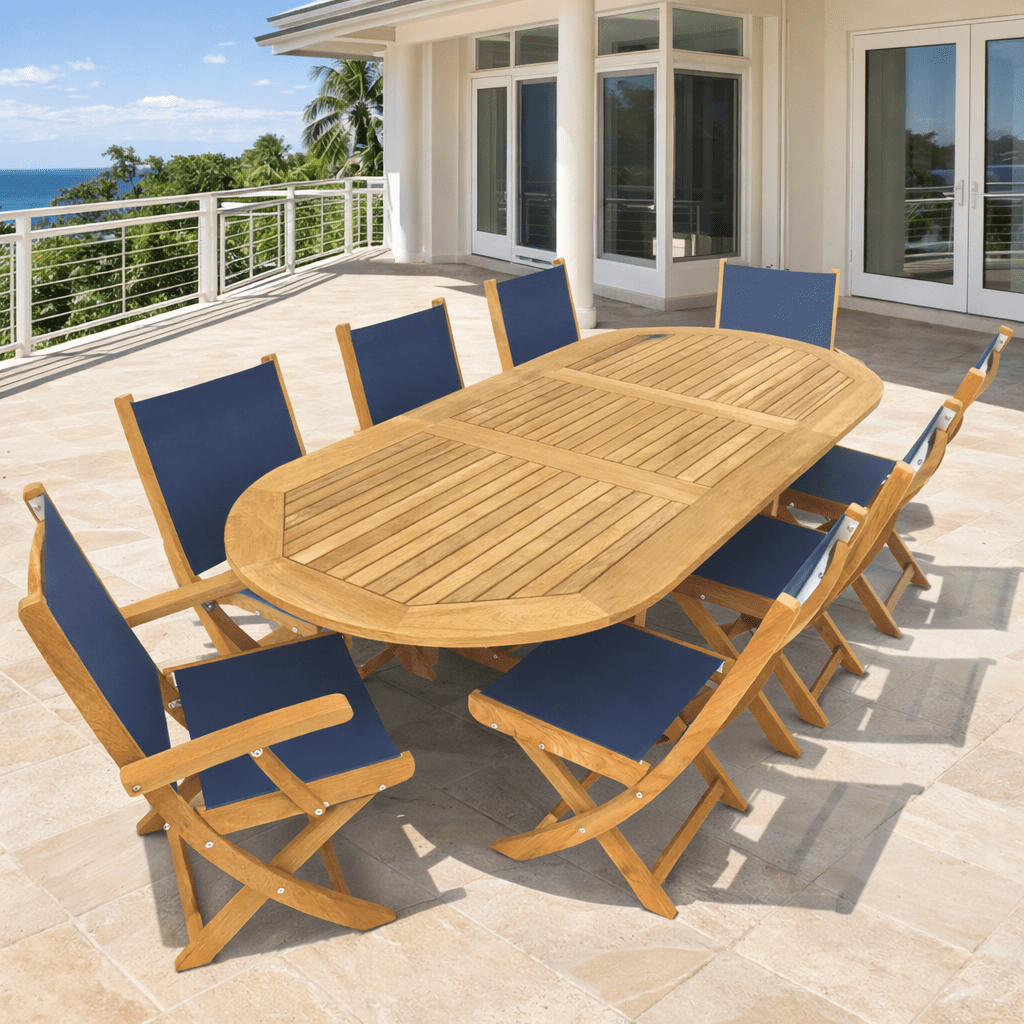
A substantial teak outdoor dining set is a logical anchor when the terrace connects directly to the kitchen or outdoor cooking area. For homeowners who usually seat six but host larger family dinners, an extendable teak dining table can be a better use of space than permanently dedicating the patio to a ten- or twelve-seat table.
Coral Gables' Mediterranean design tradition makes courtyards, loggias, arcades, terraces, porches, and garden rooms especially relevant. These spaces are often better furnished as distinct outdoor rooms instead of one continuous patio.
In a courtyard, for example, a medium dining table may make more sense than a massive sectional because circulation around doors, fountains, planters, and masonry edges matters. Under a deeper covered terrace, lounge seating can take advantage of the shelter and become the outdoor equivalent of a living room.
Natural teak is particularly adaptable aesthetically because it works with traditional Mediterranean architecture without requiring ornate furniture, yet also looks appropriate beside contemporary glass, stone, and stucco additions.
A pool area should be furnished for what actually happens there. If people regularly swim, sunbathe, read, or supervise children, give the water its own seating rather than expecting the dining chairs to do every job.
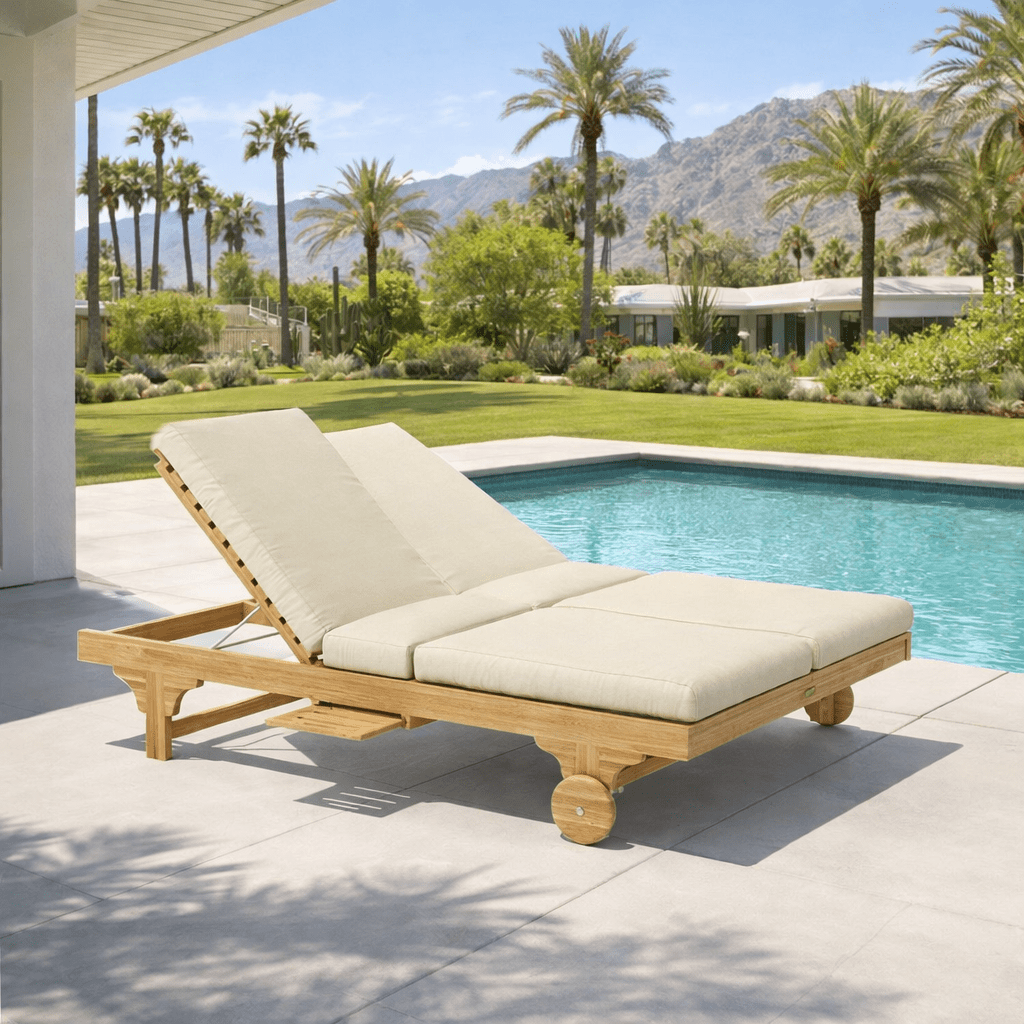
A row or pair of teak chaise loungers establishes a genuine pool zone. Add side tables where a drink, book, sunglasses, or phone can be set down without forcing guests to reach across another lounger.
Where the pool deck is visually prominent from inside the house, consistency also matters. Repeating teak across loungers, tables, and the adjacent lounge area can make several functional zones read as one intentional landscape.
One of the most common mistakes in luxury outdoor design is furnishing for an imagined lifestyle instead of the household's actual patterns. A twelve-person dining table is useful if twelve people regularly sit down together. If most evenings involve four to six people and larger gatherings are occasional, flexibility is usually more valuable.
Think about three numbers: your normal household group, your frequent guest count, and your maximum event count. Permanent furniture should handle the first two comfortably. The rare largest gathering can often be accommodated with flexible seating rather than making every day revolve around the biggest party of the year.
Start with the activity that defines your outdoor space. Homes centered on dinners and family gatherings will usually benefit most from dining sets or extendable tables, while pool-oriented properties should prioritize loungers before adding secondary pieces. If your covered terrace functions as an outdoor living room, begin with sectional or multi-piece lounge seating and build outward with tables, dining, and pool furniture as the property requires.
Outdoor living in Coral Gables is closely tied to the home's architecture and landscape. The city was deliberately planned around lush avenues and Mediterranean influences, and many properties continue that relationship between indoor rooms, courtyards, terraces, gardens, and pools. Furniture works best when it reinforces those distinct spaces rather than simply filling an open slab.
South Florida's long outdoor-use season makes an exterior dining area much more than occasional overflow seating. On a well-designed property, it can function as a second dining room for breakfasts, weekend meals, family gatherings, and evening entertaining.
This is why we would usually give dining a defined location rather than squeezing a table into whatever space remains after the lounge furniture arrives. Proximity to the indoor kitchen or outdoor kitchen reduces traffic across the pool deck and makes the space easier to use casually, not just when guests arrive.
Coral Gables has a stronger courtyard tradition than many newer South Florida communities. In these spaces, circulation and proportion matter more than raw seating capacity. A compact dining group, two club chairs with a side table, or a garden bench can sometimes serve the architecture better than a large all-purpose patio set.
The key is preserving the elements that make a courtyard appealing in the first place: views through arches and doors, landscaping, fountains, masonry details, and a sense of enclosure. Furniture should create a reason to stay in the courtyard without overpowering it.
Poolside living usually involves at least three activities: active swimming, reclining, and socializing. Trying to serve all three with one furniture type leads to compromises.
Chaise lounges belong in the best sun or view positions. A shaded conversation area can use deeper seating. Dining belongs far enough from splashing and foot traffic to remain comfortable but close enough that the pool still feels connected to the gathering.
Coral Gables' extensive canals and waterfront neighborhoods create outdoor environments that are not identical to inland properties. Before furnishing a waterfront terrace, identify where furniture receives actual salt spray or wind-driven moisture rather than assuming the entire property has equal exposure.
This can influence cleaning frequency, cushion management, hardware inspection, and placement. A protected loggia facing a canal may require less attention than an uncovered seating area close to the water even though both belong to the same house.
 The strongest furniture plan is usually a collection of purpose-built zones rather than one giant matching set. Choose each category according to what happens in that part of the property, then use teak as the visual material that ties those areas together.
For a traditional courtyard or covered terrace, proportion comes first. If the space is primarily conversational, teak club chairs, a loveseat, or a compact sofa grouping can maintain circulation better than a sprawling sectional.
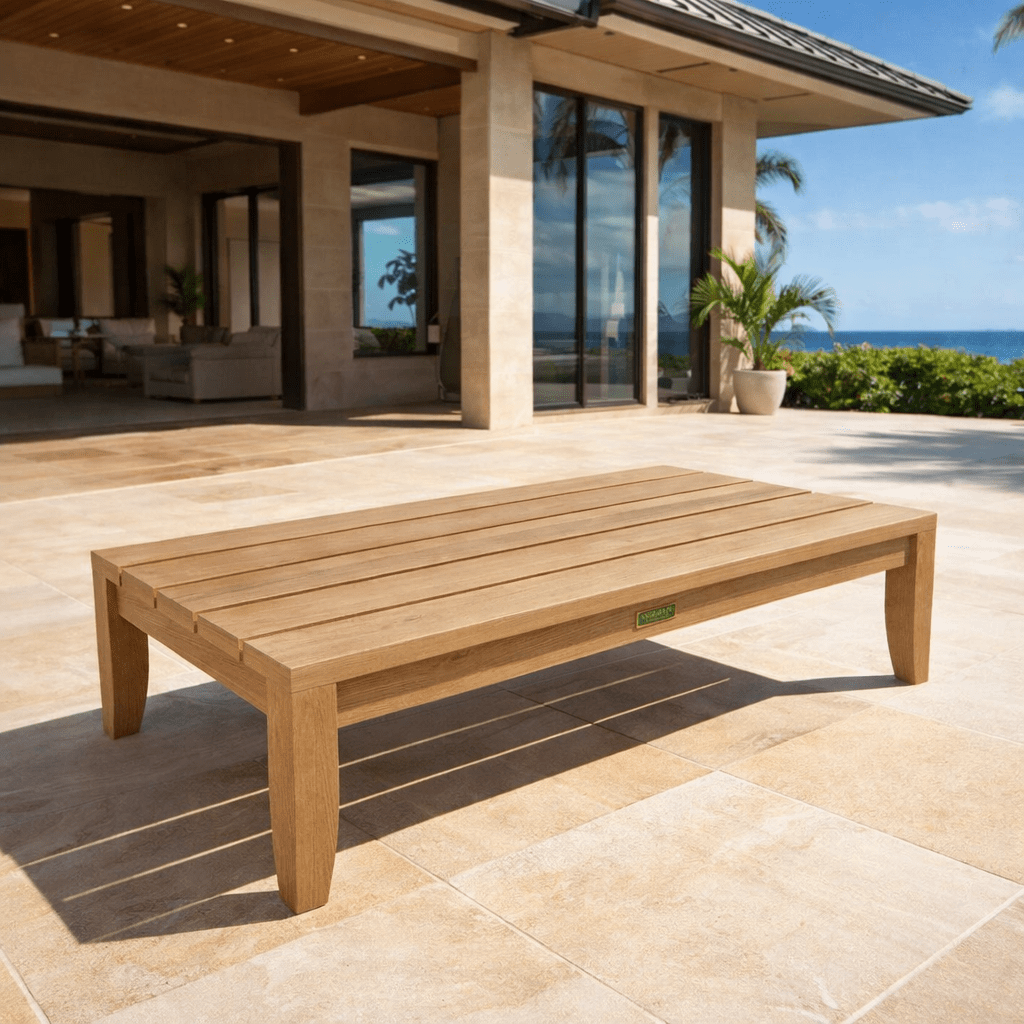
Pair seating with coffee or side tables and preserve clear walking paths to French doors, garden paths, and adjacent rooms. Covered locations are also good candidates for cushion-heavy seating because the overhead protection can reduce direct rain exposure, although humidity and wind-driven rain still need to be considered.
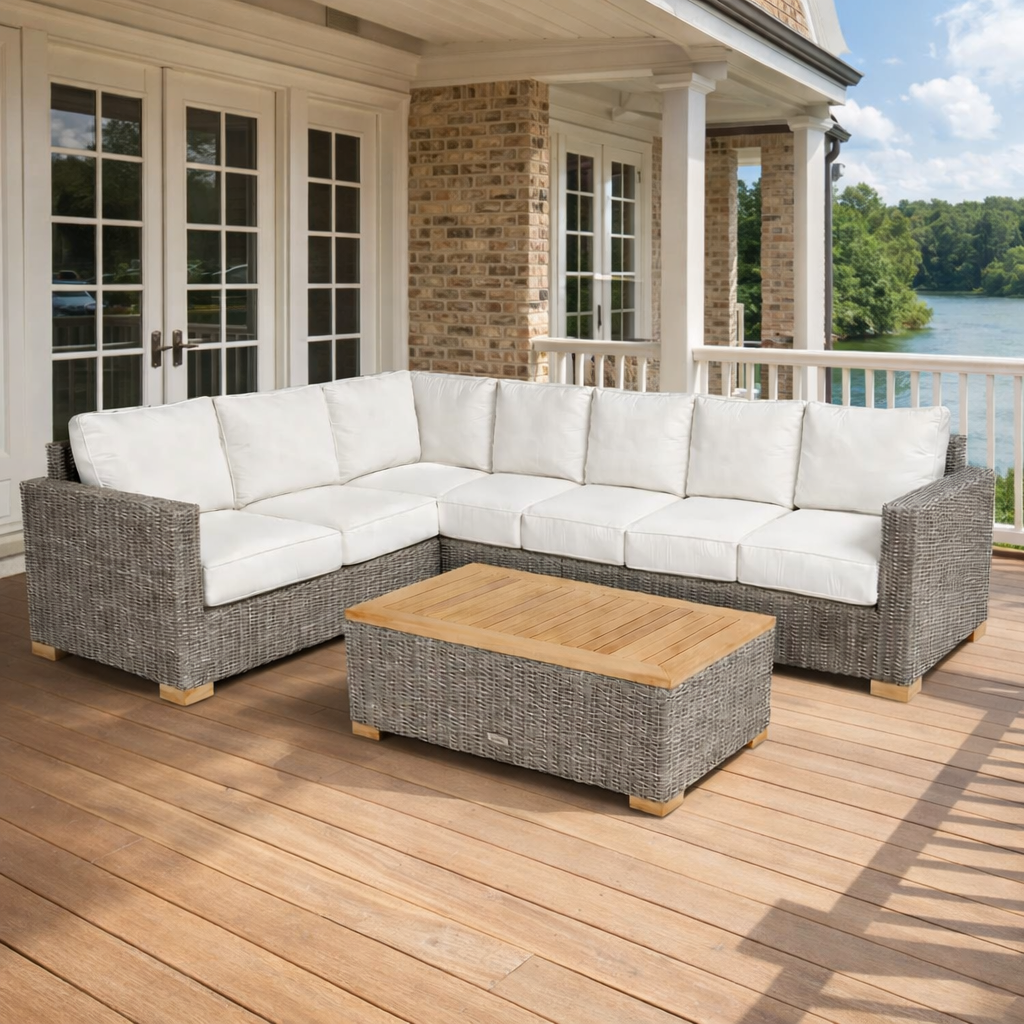
When the patio is genuinely large enough, a teak sectional can establish a substantial outdoor living room. It is especially useful when the seating zone is separated from dining and has a clear focal direction toward a garden, pool, television, fireplace, or conversation center.
Do not buy the sectional first and measure later. Mark its footprint on the patio, then allow room for coffee tables, side tables, access behind chairs, and the paths guests will use between the house and pool. Large furniture looks much larger after people begin moving around it.
Chaise lounges are the natural first choice for homeowners who genuinely use the pool for relaxation. The ideal number is not determined by pool size alone. Think about how many people regularly lounge at one time and whether the chairs can remain in useful positions without blocking circulation.
Pair loungers with small tables, then place a separate conversation group nearby when space permits. This gives swimmers somewhere to sit upright without occupying the dining area and keeps wet pool use from dictating every other seating decision.
Homes with serious outdoor kitchens should treat dining capacity as an operational decision. A fixed table works well when guest counts are predictable. An extendable table makes more sense when the same patio needs to feel comfortable for an ordinary family dinner and still adapt for holidays or weekend guests.
For the broadest selection, teak outdoor dining furniture can be configured around dining sets, individual tables, dining chairs, benches, and bar-height seating. Match the configuration to the kitchen and patio rather than trying to make one table serve every possible gathering.
Not every outdoor seat needs to belong to the main entertaining patio. Coral Gables' lush landscaping creates opportunities for quieter furniture placements—a bench along a garden path, two chairs beneath tree cover, or a small seating group looking back toward the house.
These secondary destinations can make a large property feel more intentional because they encourage people to use parts of the landscape that would otherwise remain purely decorative.
Coral Gables is unusually rich in architectural identity. Mediterranean Revival remains one of the city's defining influences, with historic examples incorporating courtyards, arcades, porches, arches, clay tile, coral rock, decorative masonry, and landscaped outdoor spaces. The city also contains distinct historic villages and newer contemporary residences, so outdoor furniture needs to bridge traditional and modern settings rather than conform to a single decorative style.
Against stucco walls, terracotta roofs, coral stone, wrought iron, arches, and dense tropical planting, natural teak adds another warm material without competing with the architecture. Straightforward teak designs are often more effective than furniture that tries too hard to imitate historic ornament.
The goal should be compatibility rather than imitation. Let the house provide the Mediterranean detail and allow the furniture to provide texture, warmth, and function.
Courtyards are strongest when the center of the space does not become visually congested. Round dining tables, compact lounge groups, benches, and movable chairs can preserve views across the courtyard and keep pathways open.
When selecting a table, look at its footprint with chairs pulled out—not merely the tabletop dimensions. That distinction is especially important in enclosed spaces bounded by walls, columns, planters, or doors.
Lush planting can provide shade and make teak look particularly natural, but vegetation also introduces leaves, pollen, moisture, and other organic debris. Avoid pushing large upholstered pieces so tightly into planting beds that cleaning behind them becomes difficult.
A small maintenance gap between furniture and dense landscaping can be almost invisible visually while making routine cleaning considerably easier.
Teak does not need a traditional house to look appropriate. On remodeled properties with large glass openings, simplified paving, modern pools, and restrained landscaping, cleaner-lined teak seating can soften hard architectural surfaces without introducing synthetic-looking color or texture.
This is one reason the material works particularly well in Coral Gables: the same natural wood can move from a 1920s-inspired courtyard to a contemporary pool terrace without requiring the entire outdoor space to adopt a nautical or overtly tropical theme.
 The biggest planning mistake is assuming one climate description explains the entire property. A covered courtyard, sunny pool deck, irrigated garden edge, and waterfront terrace experience different combinations of rain, sun, moisture, and salt.
Before buying, make a simple exposure map. Premium Grade A teak gives you considerable flexibility because it is designed for outdoor use and naturally resists moisture and warping, but fabrics, cushions, hardware, and accessories still benefit from placement appropriate to their exposure.
A huge dining table or sectional may accommodate an annual celebration while making the patio less comfortable the other 364 days of the year. Furnish first for the number of people who use the space regularly, then add flexibility for larger gatherings.
Extendable dining tables, movable chairs, benches, and separate lounge areas can often handle changing guest counts more elegantly than permanently filling the patio with maximum-capacity furniture.
In a humid, rainy environment, furniture placement should allow water to drain and air to move. Continually damp corners, dense planting, and badly fitted covers can make maintenance more difficult even when the furniture material itself is outdoor appropriate.
Teak's moisture resistance helps address the wood component of the problem, but good patio design still matters. Avoid creating places where wet cushions, organic debris, or standing moisture remain trapped unnecessarily.
The wood frame and the cushion are two separate maintenance systems. Many TeakHQ lounge pieces include Sunbrella cushions, which are designed with weather-, fade-, UV-, and water-resistant fabric, but cushions still need sensible care in a humid outdoor environment.
Give them an opportunity to dry, clean them as appropriate, and have a plan for storing loose cushions before severe storms. Do not assume the outdoor durability of the teak frame means every soft furnishing should be managed identically.
Substantial furniture can feel reassuring compared with very lightweight patio pieces, but no outdoor furniture should be treated as storm protection simply because it is heavy.
Plan ahead for severe-weather preparation. Know which pieces can be moved, where umbrellas and cushions go, and how movable items will be secured when local officials recommend storm preparations.
 Teak care in Coral Gables should be based on exposure rather than a rigid calendar. A table under a deep roof may require less frequent attention than loungers beneath trees or furniture beside a pool or waterway. The goal is not constant maintenance; it is preventing dirt, organic material, salt residue, and unnecessary trapped moisture from accumulating.
Inspect furniture periodically and clean it when visible dirt, pollen, leaves, food residue, or other buildup appears. Furniture beneath dense landscaping may need attention more frequently than a protected terrace because wet organic material can remain against the surface.
Teak itself does not need an artificial stain for durability. Cleaning and preserving the original golden color are separate decisions.
If a piece receives direct salt spray or noticeable salt residue, periodic fresh-water rinsing and cleaning are sensible. Pay attention not only to the teak but also to hardware, cushions, and adjoining accessories.
This is another reason not to use a citywide maintenance schedule. An inland courtyard near downtown Coral Gables and an exposed waterfront terrace should not automatically receive identical care merely because they share a ZIP code.
After substantial rain or pool use, allow furniture and cushions to dry with adequate airflow. Remove leaves or other material that collects in corners instead of allowing it to remain wet against surfaces.
Protective covers are optional for teak, not a requirement. If you choose to cover furniture, use an appropriate outdoor cover and avoid creating a continually damp, poorly ventilated environment beneath it.
Natural teak gradually weathers to silver gray. That is an appearance change homeowners can intentionally accept rather than a maintenance emergency.
If you want to preserve a warmer teak color, appropriate sealing or oiling can be incorporated into your care routine. If you prefer the natural weathered appearance, the furniture can be left untreated. Decide which look you want before beginning a maintenance program so you are not doing unnecessary work simply because the wood has changed color normally.
Coral Gables does not require the same winter-storage routine as a northern climate. The more important seasonal issue is severe-weather preparation. Maintain a practical location for removable cushions, umbrellas, small tables, décor, and other loose objects when tropical weather threatens.
The teak furniture itself is intended for year-round outdoor use, but follow local storm guidance and secure or relocate outdoor items when conditions warrant. Furniture durability and storm safety are different questions.
The best outdoor furniture plan starts with your property rather than a catalog: identify the spaces you actually use, map their exposure, decide how many people you normally entertain, and give dining, lounging, and pool activity the room each deserves. Premium Grade A teak is especially well matched to homeowners seeking natural materials, long-term outdoor durability, and furniture substantial enough to feel at home beside Coral Gables' courtyards, terraces, pools, gardens, and waterfront landscapes. Explore the teak patio seating collection or begin with the category that best matches the way you already live outdoors.
Look for materials designed for prolonged outdoor exposure to humidity, rain, sun, and repeated wet-dry cycles. High-quality aluminum and premium synthetic materials can be appropriate, while Grade A teak is an especially strong choice for homeowners who want natural wood because it naturally resists moisture, rot, insects, and warping.
Yes. Grade A teak's naturally high oil content and dense grain make it resistant to moisture, rot, and warping, which makes it well suited to humid South Florida outdoor environments.
Yes. TeakHQ's Grade A teak furniture is designed for year-round outdoor use and can withstand rain, sun exposure, and temperature fluctuations. Severe-storm preparation is a separate safety issue, so follow local guidance when tropical weather threatens.
Start with purpose-built pool seating such as chaise loungers, then add side tables and a separate conversation area if space allows. This keeps wet pool activity from taking over the dining area and gives the patio distinct zones for reclining, talking, and eating.
Furniture receiving direct salt spray or visible salt residue should be periodically rinsed or cleaned. Waterfront exposure varies considerably by placement, so furniture close to a canal or Biscayne Bay may need more frequent attention than pieces protected beneath a covered terrace.
Yes. Natural unfinished teak gradually develops a silver-gray patina outdoors. That is a normal appearance change rather than an indication that the wood has failed. Owners who prefer the original warmer color can use appropriate teak care products.
No. Protective covers are optional for TeakHQ's Grade A teak rather than required for the wood's outdoor durability. If you do use covers in humid weather, choose appropriate outdoor covers and avoid trapping persistent moisture beneath them.
Size the permanent table for your normal household plus the number of guests you entertain regularly, not the largest party you might host once a year. An extendable dining table can be especially useful when you want everyday patio space without giving up capacity for larger dinners.
Both can be appropriate premium choices. Aluminum is lighter and often suits a distinctly modern aesthetic. Teak is natural, warmer in appearance, heavier, and has a more substantial architectural feel. The better choice depends on your design preferences, desired furniture weight, and whether you prefer natural wood or metal.
Do not assume that outdoor durability or furniture weight makes a piece hurricane-safe. Before severe weather, follow local emergency guidance and have a plan for securing or relocating movable furniture, umbrellas, cushions, décor, and other outdoor objects.


