
FREE SHIPPING
within mainland USA
within mainland USA
Home ▸ Teak Outdoor Furniture ▸ By Location ▸ Florida Atlantic Coast
Florida's Atlantic coast asks more of outdoor furniture than appearance alone. Salt-laden air near the ocean, persistent humidity, frequent rain, strong sun, pools, and an outdoor lifestyle that extends through much of the year all influence what works well on a patio, lanai, balcony, or waterfront terrace. Premium Grade A teak is especially worth considering here because its dense grain and natural oils suit outdoor exposure while providing the substantial, natural look many coastal homes call for.

Outdoor furniture along Florida's Atlantic coast lives in a demanding combination of moisture, sun, salt exposure, and frequent use. The exact balance changes by property: an oceanfront terrace in Palm Beach faces a different level of salt exposure than a covered patio several miles inland, while a Jacksonville home experiences more seasonal temperature variation than one in Miami. That distinction matters. "Florida-proof" is too broad a standard; furniture should be chosen for the home's actual exposure.
Distance from the ocean matters, but so do wind direction, elevation, screening, and whether a patio faces open water. Furniture on an exposed oceanfront balcony may receive repeated salt-laden moisture, while a sheltered courtyard in the same community can experience considerably less. Salt is particularly relevant when evaluating hardware and mixed-material furniture because exposed metal components deserve as much scrutiny as the visible frame.
TeakHQ's Royal Teak and Anderson Teak furniture uses stainless-steel hardware, while Verandis Teak uses brass hardware. That construction detail is worth checking when comparing premium outdoor furniture for coastal properties rather than focusing only on the main frame material.
Florida humidity changes the ownership experience even when rain is not falling. Shaded corners, furniture pushed tightly against walls, and cushions left damp can remain moist longer than homeowners expect. Air circulation therefore matters almost as much as material selection. Leave breathing room around large lounge groups, avoid creating permanently damp pockets beneath accessories, and give wet cushions an opportunity to dry.
This is also why a covered lanai is not automatically a low-exposure environment. It reduces direct rain and sun, but a screened or covered space can still spend long periods in humid air.
Afternoon showers, pool splash, wet swimsuits, sprinklers, and condensation all add moisture to a coastal patio. Furniture that depends on a delicate surface coating to remain serviceable deserves closer scrutiny than materials intended for outdoor exposure. Premium Grade A teak is designed for year-round outdoor use and naturally resists moisture and rot, making it particularly practical where furniture is repeatedly wet and dry.
No outdoor furniture material eliminates hurricane preparation. Even substantial furniture should be incorporated into a property's storm plan rather than treated as permanent ballast. Homeowners should think before purchase about where loose cushions, umbrellas, side tables, accessories, and smaller pieces can be moved or secured when a storm approaches.
A useful planning rule is to design the patio for ordinary days but make sure it can be simplified quickly for extraordinary ones. That often argues for fewer, better furniture groupings rather than a patio crowded with lightweight accessories.
Teak earns consideration here because several of its natural characteristics address the coast's most persistent challenges at the same time. It is not the only premium outdoor material that can work in Florida—quality aluminum and synthetic products can also make sense—but Grade A teak combines weather resistance with the weight, warmth, and natural appearance many coastal homeowners prefer.
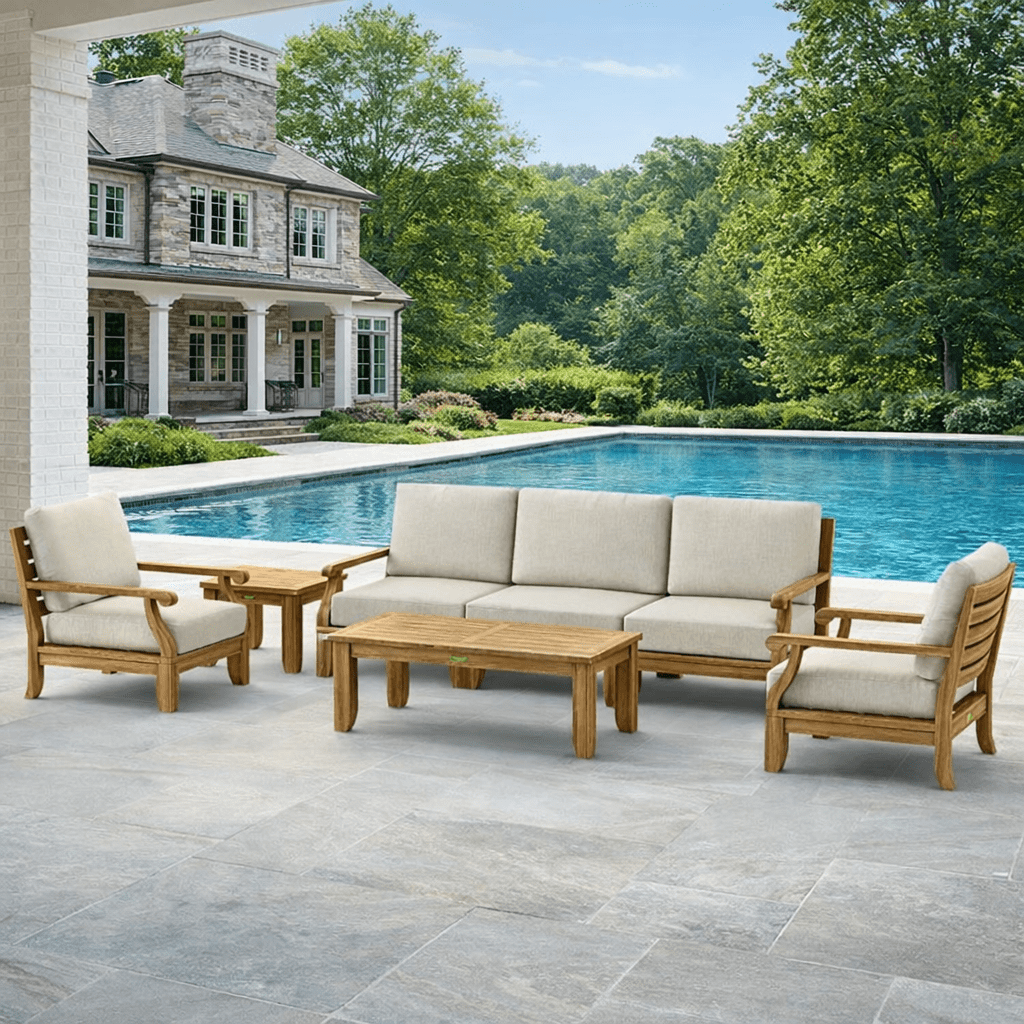 Grade A teak has a dense grain structure and naturally high oil content. Those characteristics help it resist moisture, rotting, insects, and warping without requiring an artificial stain for durability. Along a humid coastline, that means the wood itself—not merely a decorative surface treatment—is suited to outdoor exposure.
This distinction becomes especially useful on pool patios, ocean-view terraces, and lanais where furniture can move repeatedly between intense sun, rain, and damp air.
Natural teak changes appearance outdoors. If left untreated, the warm golden-brown color gradually develops a silver-gray patina. That is an aesthetic change rather than an indication that the teak has stopped performing outdoors.
For Atlantic-coast homes, both approaches can work. The silver-gray look pairs naturally with many beach and contemporary coastal settings; owners who prefer the original color can use appropriate teak care products to help maintain it. The important decision is choosing the appearance you want rather than assuming teak must continually look new to remain durable.
On the Florida coast, moisture resistance is not simply preparation for major storms. It matters after routine rain, around swimming pools, during muggy weather, and anywhere ocean air keeps surfaces damp. Teak's natural resistance to moisture and rot makes it well suited to that repeated exposure.
That does not make cleaning unnecessary. Organic debris and surface grime can still accumulate, and mildew can form on dirt or residue in a humid environment. Teak's advantage is that homeowners can clean it without making continual sealing a prerequisite for outdoor durability.
Teak also has a practical characteristic that is easy to overlook until you furnish an exposed patio: it feels substantial. Compared with lightweight outdoor furniture, solid teak provides a heavier, more architectural presence. That can be appealing on expansive terraces where undersized furniture visually disappears or feels temporary.
It should not be interpreted as a substitute for storm preparation. Rather, it allows everyday outdoor spaces to feel more permanent and integrated with the home.
| Florida Atlantic Coast Challenge | Why Premium Grade A Teak Performs Well |
|---|---|
| High humidity | Dense Grade A teak naturally resists moisture and rot. |
| Frequent rain | Designed for year-round outdoor exposure without required paint or stain. |
| Strong sun | Handles outdoor sun exposure and can weather naturally to a silver-gray patina. |
| Poolside moisture | Natural oils and dense grain suit repeated wet-and-dry conditions. |
| Coastal exposure | Real Grade A teak provides a naturally weather-resistant wood structure. |
| Temperature changes | Teak is designed to withstand outdoor temperature fluctuations. |
| Insects and decay | Grade A teak naturally resists insects and rotting. |
| Long outdoor seasons | Teak is intended for year-round outdoor use and can last for decades. |
We would start with the way you actually use the property, not with a furniture catalog. A family home built around a pool needs a different plan than an oceanfront condo terrace, and a Palm Beach entertaining space may need a different seating capacity than a quiet Vero Beach retreat.
For most single-family coastal homes, we would furnish the covered lanai or primary terrace first. This is usually the zone people use for morning coffee, casual conversation, reading, and entertaining whether or not anyone enters the pool. A multi-piece teak lounge set works well when you want a coordinated conversation area; a sofa with separate club or swivel chairs gives you more freedom to orient seating toward both guests and a water or garden view.
One of the most useful Florida planning ideas is to resist automatically pointing every chair toward the pool. A pool is visually attractive but conversation often works better when at least some seating faces inward. Position the furniture so the pool becomes the backdrop rather than the only focal point.
A pool deck deserves a separate function rather than becoming leftover space around the main lounge group. Place teak chaise loungers where users can comfortably move between sun and shade without blocking the primary walking route between the home and pool.
If the terrace is large, four loungers often create a more intentional resort-like zone than two isolated chairs. Add side tables between loungers rather than forcing every drink, book, or phone onto the ground.
Florida outdoor kitchens and grills make outdoor dining especially useful, but distance matters. We would place the primary teak dining area close enough to the kitchen or outdoor cooking zone that carrying plates and drinks does not become inconvenient.
For homeowners who entertain sometimes but not constantly, an extendable table can be more useful than permanently dedicating the patio to a very large table. You preserve circulation on normal days while gaining capacity for visiting family, snowbird guests, holiday gatherings, and weekend dinners.
Oceanfront and Intracoastal properties naturally tempt homeowners to push every piece toward the water's edge. Before doing that, spend time observing where breezes are strongest, where late-day sun enters, and which locations remain comfortable after a shower.
The most photogenic position is not always the position people will actually use. A slightly more sheltered conversation group with a framed water view may outperform a fully exposed arrangement directly at the edge of the terrace.
Start with the activity that defines your outdoor space. Pool-centered homes should usually begin with chaise loungers and a comfortable conversation area; frequent hosts may get more value from dining furniture or an extendable table first. Larger waterfront properties can support separate dining, lounge, and pool zones, while condo terraces benefit from fewer carefully scaled pieces with strong everyday utility.
The Atlantic side of Florida contains several different outdoor-living markets, but a common thread runs through many of them: the patio is treated as usable living space rather than a decorative afterthought. Pools, covered lanais, waterfront terraces, outdoor kitchens, balconies, and screened spaces often need to serve multiple purposes over a long season.
Along much of the coast, the pool deck functions as an outdoor family room. People move between swimming, eating, talking, watching television under a covered patio, and relaxing with guests. That makes zoning especially important. A pool patio works better when loungers, conversation seating, and dining each have a recognizable place rather than forming one oversized furniture cluster.
Ocean and Intracoastal homes often have an obvious view-facing orientation, but the best spaces accommodate both scenery and conversation. Swivel seating is particularly useful where homeowners want to turn toward the water when relaxing and back toward the group when entertaining.
Docks and water edges may also create secondary seating opportunities. A small bench or pair of chairs can be more appropriate there than duplicating the primary patio furniture.
Many Florida households alternate between quieter everyday use and periods with visiting family or seasonal guests. Instead of sizing every area for maximum occupancy, let one feature absorb the change. An extendable dining table, movable club chairs, or ottomans that can become occasional seating can add flexibility without making the patio feel crowded all year.
A roof or screen enclosure improves comfort but does not turn outdoor furniture into indoor furniture. Humidity, wind-driven rain, damp bathing suits, pollen, and general outdoor grime can still reach covered spaces. Furniture selected for a lanai should therefore be chosen with the same basic durability mindset as furniture on an open patio, even if exposure is less severe.
Think in zones rather than individual pieces. The most successful Florida patios usually make it obvious where to dine, where to talk, and where to relax by the pool. Premium teak can carry the same material language through all three areas without requiring every piece to belong to a single matching set.
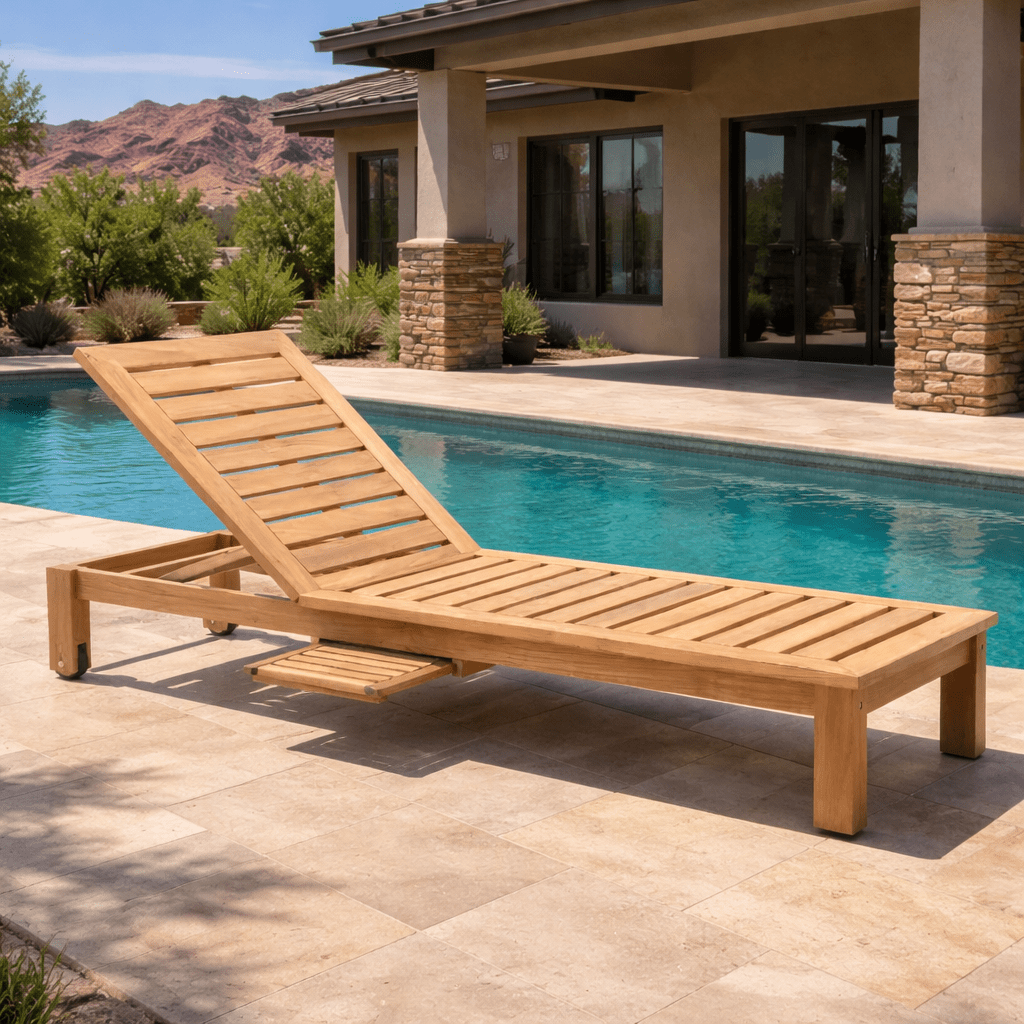 For a dedicated pool deck, begin with teak loungers and deck chairs. Chaise loungers give swimmers a place to dry off, read, or relax without occupying the main conversation furniture. On a broad pool terrace, symmetrical pairs or groups of four usually create a calmer visual plan than scattering individual loungers around the deck.
Allow enough clearance that someone can recline the chair without narrowing the route around the pool. That sounds elementary, but oversized loungers can consume far more depth in the reclined position than homeowners anticipate when measuring an empty terrace.
The covered lanai is where we would usually spend the largest share of the lounge-furniture budget because it tends to receive the most daily use. A sofa or loveseat with two chairs creates a flexible conversation area, while a larger teak sectional makes sense when the patio has enough depth and the household regularly gathers in one large group.
Many TeakHQ patio seating pieces include Sunbrella cushions, though cushion inclusion varies by product. Sunbrella fabric is weather-, fade-, UV-, and water-resistant, which is useful for Florida outdoor seating. Regardless of fabric, cushion storage and drying habits still matter in persistently humid weather.
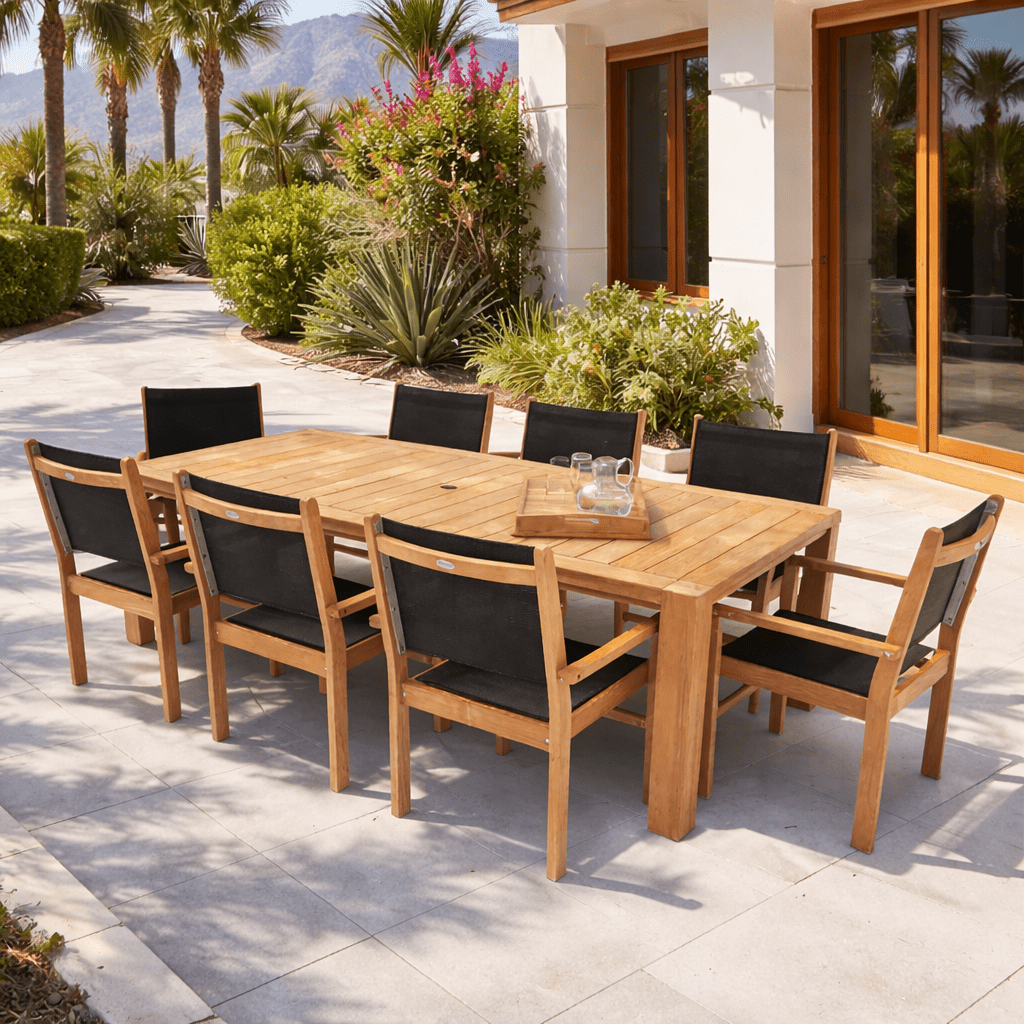
Dining furniture should be sized around both household size and circulation. A couple who regularly hosts eight people may be better served by an extendable teak dining table than by a permanently oversized table. Homes with generous covered patios can accommodate larger fixed dining sets more easily.
Place the dining area close to food preparation but not in the cook's primary traffic lane. If guests must repeatedly move their chairs for someone to reach the grill or refrigerator, the layout is too tight regardless of how attractive it looks.
On Intracoastal, canal, river, and ocean-view properties, we often prefer a sofa facing perpendicular to the water with movable or swivel chairs completing the group. That preserves the view without turning every gathering into a row of people facing away from one another.
Add coffee and side tables based on reach, not symmetry. Every primary seat should have somewhere convenient to place a drink. This small detail often determines whether an outdoor room feels genuinely livable.
Coastal condo balconies require stricter editing. Measure usable depth after allowing for door swing, rail clearance, and the main walking path. A compact dining set or two lounge chairs with a small table may provide more everyday value than squeezing in a full sofa group.
High-rise balconies also require particular attention to building rules and wind exposure. Follow condominium requirements for outdoor furnishings and remove or secure loose items whenever severe weather threatens.
There is no single Atlantic-coast style. Historic St. Augustine, contemporary South Florida waterfront homes, Palm Beach estates, laid-back beach houses, and high-rise Miami terraces can look dramatically different. Teak works across that range because the material can read as traditional, coastal, tropical, transitional, or modern depending on the furniture design around it.
Contemporary coastal homes often combine large areas of glass, light stone, pools, lush planting, and strong indoor-outdoor connections. Clean-lined teak furniture adds natural warmth without fighting the architecture. Here, simpler lounge silhouettes and substantial sectional or sofa groupings generally make more sense than highly decorative furniture.
Teak is equally compatible with porches, courtyards, coastal cottages, Mediterranean-influenced homes, and more traditional estates. Slatted chairs, classic dining sets, benches, and rockers can reinforce the home's architecture without turning the patio into a themed beach space.
Palms, sea grape, broad-leaf tropical planting, hedges, and dense garden beds create a strong natural backdrop. Teak's warm wood tone generally sits comfortably among that greenery, while naturally weathered silver-gray teak can create a softer look alongside pale stone and coastal hardscaping.
The most expensive mistake in a waterfront design can be visual clutter. A strong ocean or Intracoastal view rarely needs furniture competing for attention. We would generally use fewer substantial pieces, preserve long sight lines, and let cushions or small accessories provide the easier-to-change color.
 An oceanfront balcony, Intracoastal patio, screened lanai, and inland backyard are not the same furniture environment. Buying based on a vague "Florida weather" label can cause homeowners to overlook salt exposure, wind, shade, drainage, or the amount of direct sun their particular space receives.
Evaluate the microclimate first. Teak is versatile across these settings, but placement and care should still reflect the home's actual exposure.
Large Florida patios can tempt homeowners to buy too much furniture. The result is often worse circulation between the house, pool, outdoor kitchen, and lawn. Empty space is functional space: it allows wet swimmers to pass, dining chairs to slide back, and groups to move naturally during parties.
Choose a few complete zones rather than trying to furnish every corner.
Weather-resistant cushions are not an invitation to ignore prolonged dampness. After heavy rain, cushions benefit from airflow and drying. During severe weather, loose cushions should be brought into an appropriate protected location rather than left outside.
Homeowners who dislike handling cushions should consider how much cushioned seating they genuinely want before purchase, not after the patio is furnished.
Light furniture is easy to rearrange, which can be a real advantage. On exposed coastal properties, however, extremely lightweight pieces may demand more attention during windy conditions. Teak's heavier, sturdier character often feels better suited to a substantial outdoor room, although it still requires sensible storm preparation.
Some buyers become concerned when natural teak begins losing its original golden color. Silver-gray weathering is expected when teak is left untreated. Decide before purchase whether you prefer that natural evolution or want to maintain a warmer appearance, because the two choices involve different ownership expectations.
Florida care is less about protecting teak from being outdoors and more about keeping surfaces clean in a humid, active environment. Grade A teak can remain outside year-round; homeowners can choose to let it weather naturally or maintain more of its original color.
 There is no useful one-size-fits-all cleaning calendar. Oceanfront furniture exposed to salt and airborne residue may need attention more often than furniture inside a sheltered lanai. Inspect surfaces periodically and clean when salt film, dirt, pollen, food residue, or organic debris becomes noticeable.
Keeping furniture clean also helps reduce the surface grime on which mildew can develop in humid environments.
Homes receiving noticeable salt spray or salt-laden moisture should periodically rinse away residue rather than allowing repeated deposits to accumulate. Pay attention not only to the teak but also to hardware and adjoining surfaces.
This is particularly relevant for furniture close to the ocean, an open inlet, or other highly exposed waterfront locations.
After heavy rain, allow cushions and surrounding surfaces to dry thoroughly. Avoid leaving wet towels or bathing suits piled on seating for extended periods. If cushions become saturated, position them so air can circulate rather than trapping moisture against the furniture.
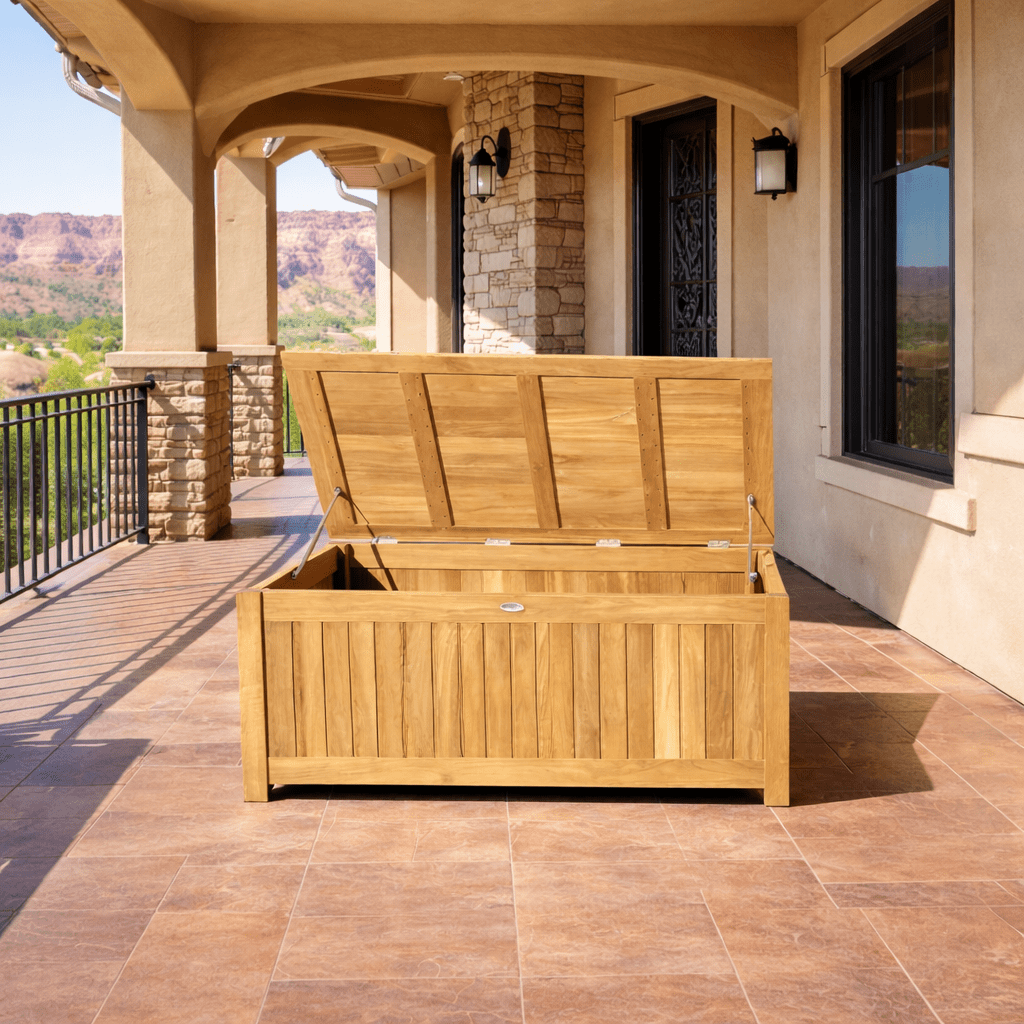
A teak deck box can be useful for everyday organization when appropriate for the item being stored, but follow product-specific guidance and make sure anything placed inside is dry enough for storage.
If you like the silver-gray appearance, teak may be left untreated. If you prefer the original golden tone, suitable teak care products can be used to help preserve that appearance. Neither approach should be confused with structural necessity: TeakHQ's Grade A teak does not require artificial stain for outdoor durability.
Most Atlantic-coast homeowners do not need a traditional northern-style winter storage routine for the teak frame itself. Storm preparation is much more relevant. Before severe weather, follow local guidance and your property's plan for moving or securing outdoor items, especially cushions, umbrellas, small tables, décor, and other loose objects.
Protective furniture covers are optional rather than required for teak durability. If you use covers, choose and manage them so moisture is not unnecessarily trapped around damp furniture.
The right Florida Atlantic Coast outdoor space should work on ordinary mornings, pool afternoons, waterfront dinners, and the weekends when every seat suddenly matters. Start with your home's actual exposure and the way your household uses the patio, then choose furniture that can live comfortably within those conditions for years. Premium Grade A teak is especially compelling when you want a natural material, substantial construction, flexible maintenance, and furniture intended for long-term outdoor use.
Several premium materials can work, including quality aluminum, synthetics, and Grade A teak. Teak is particularly attractive for coastal homeowners who want real wood because its natural oils and dense grain help it resist moisture, rot, insects, and outdoor weather exposure.
Grade A teak is well suited to coastal outdoor use because it naturally resists moisture and weathering. On properties receiving direct salt spray, periodically cleaning salt residue from the furniture and its hardware is still sensible.
Start with furniture designed for repeated outdoor exposure and build separate zones for swimming, lounging, conversation, and dining. Teak chaise loungers are useful directly beside the pool, while deeper lounge seating works better under a covered lanai or in a dedicated conversation area.
Yes. TeakHQ's Grade A teak furniture is designed for year-round outdoor use and withstands rain, sun exposure, moisture, and temperature fluctuations. Severe-weather preparation is still important for loose cushions, umbrellas, smaller pieces, and accessories.
Grade A teak naturally resists moisture and rotting, which is one reason it is well suited to humid climates. Furniture should still be kept reasonably clean, and wet cushions or debris should not be allowed to remain against surfaces unnecessarily.
Untreated teak naturally develops a silver-gray patina over time. This is normal weathering rather than a sign of failure. Homeowners who prefer the original warmer teak color can use appropriate teak care products to help maintain it.
No. Protective covers are optional rather than required for teak's durability. If you do use a cover, avoid trapping unnecessary moisture around wet furniture and follow the cover manufacturer's ventilation guidance.
Prioritize scale, wind exposure, building rules, and circulation. Compact dining furniture or a small lounge arrangement often works better than a large sectional. Always follow condominium requirements and move or secure loose outdoor items when severe weather threatens.
Follow local emergency guidance and your property's storm plan. Move or secure outdoor items as appropriate, paying particular attention to cushions, umbrellas, décor, side tables, and other pieces that could become windborne. Furniture weight should never replace proper hurricane preparation.
It depends on your priorities. Aluminum is lighter and often more contemporary, while poly furniture offers a synthetic, lower-maintenance alternative. Teak provides real natural wood, a warmer and more substantial feel, and long-term outdoor durability. For buyers who value authentic wood and are comfortable letting it weather naturally or maintaining its color, teak is a strong coastal choice.


