
FREE SHIPPING
within mainland USA
within mainland USA
Home ▸ Teak Outdoor Furniture ▸ By Location ▸ Great Lakes Region
Outdoor furniture around the Great Lakes has to bridge two very different seasons: warm-weather months built around decks, docks, dining, and the water, followed by cold winters that can bring snow, ice, moisture, and repeated temperature changes. Lakefront exposure can add wind and driving rain, while wooded properties bring shade, leaves, pollen, and organic debris. That makes material quality and year-round ownership especially important. Premium Grade A teak is a strong fit for homeowners who want natural furniture that can handle changing outdoor conditions without requiring a highly intensive maintenance routine.

“Great Lakes weather” is not one uniform condition. A protected patio outside Detroit, a wooded cottage near Traverse City, a bluff overlooking Lake Michigan, and a home in a lake-effect snow belt near Buffalo can expose furniture to very different combinations of moisture, wind, sun, snow, and winter weather. The useful question is not simply whether furniture is rated for outdoor use. It is whether its material and construction make sense across the conditions your particular property experiences.
Summer is when Great Lakes homeowners use outdoor furniture most, but winter is often what separates an easy-to-own material from a troublesome one. Outdoor pieces may encounter freezing temperatures, snow accumulation, meltwater, and large temperature swings before patio season returns.
This matters particularly for homeowners who do not want to move an entire furniture collection indoors every fall. Furniture intended to remain outside should be made from a material suited to year-round exposure rather than merely looking appropriate beside the lake in July.
One of the easiest mistakes is treating distance north or south as the only meaningful climate variable. Proximity to a Great Lake can modify local conditions, and lake-effect snowfall can be dramatically greater in certain downwind snow belts than in nearby areas. A home close to Lake Superior or Lake Ontario can therefore have a very different ownership environment from a property farther inland.
Waterfront sites can also be more exposed. An open deck facing the water may receive wind-driven rain and weather from directions that a sheltered suburban courtyard rarely experiences. In these settings, we would prioritize substantial furniture and straightforward year-round durability over lightweight pieces chosen primarily for easy rearranging.
The other half of the equation is that Great Lakes summers can make outdoor spaces central to daily life. Furniture may move from months of limited use to frequent dining, lounging, grilling, and entertaining. Uncovered decks receive sun and rain, while shaded patios beneath mature trees collect pollen, leaves, sap, and other debris.
That seasonal contrast is important. Instead of optimizing exclusively for summer appearance or exclusively for winter survival, choose furniture that makes sense through the entire ownership cycle.
Several premium materials can work here. Quality aluminum can be practical for homeowners who prefer lighter furniture and a contemporary appearance, while synthetic poly furniture appeals to people who prioritize a manufactured, lower-maintenance material. Premium Grade A teak makes a different case: it combines the character of real wood with properties that make teak particularly well suited to changing outdoor conditions.
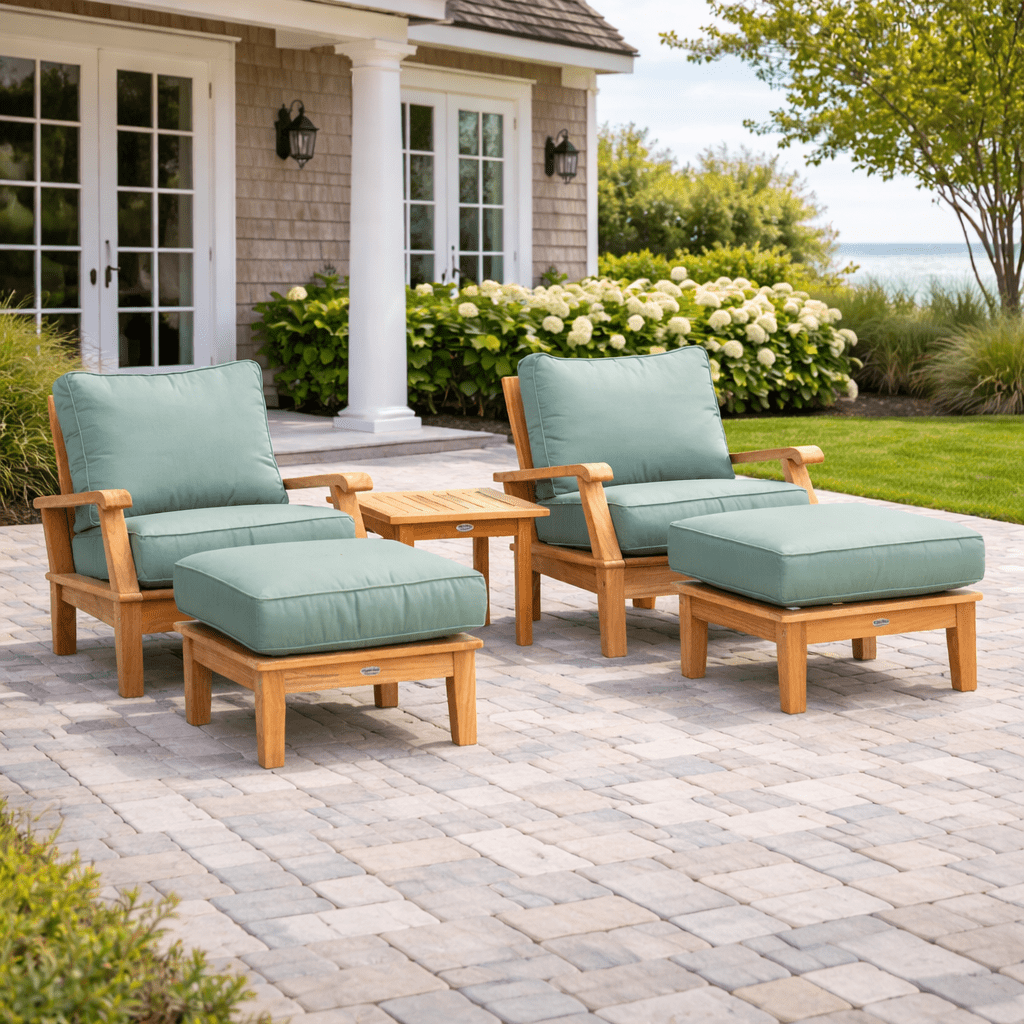 Grade A teak is naturally high in oils and has a dense grain structure. Those characteristics contribute to its resistance to moisture, rotting, insects, and warping. In a region where furniture can move through rain, summer sun, cold weather, snow, and substantial seasonal temperature changes, that versatility matters more than performance under any single condition.
The advantage is especially practical for a lake or cottage property. You do not have to choose natural wood for its appearance and then accept that it was fundamentally designed for a protected indoor environment. Teak is intended for outdoor use.
Premium Grade A teak can withstand rain, sun exposure, and temperature fluctuations and is designed for year-round outdoor use. That makes it particularly relevant for substantial dining tables, benches, and seating groups that homeowners may reasonably prefer not to relocate every autumn.
This does not mean winter becomes irrelevant. Removing excessive debris, keeping furniture appropriately situated, and managing cushions separately are still sensible. The distinction is that the teak itself does not require seasonal indoor storage simply to remain outdoor furniture.
Natural teak gradually weathers to a silver-gray patina when left untreated. For many lake homes and cottages, that weathered appearance works beautifully with stone, cedar, weathered siding, and natural landscapes. Homeowners who prefer teak's warmer original color can instead choose appropriate care products and maintain that appearance.
That creates useful flexibility: maintenance can largely be an aesthetic decision rather than a requirement to artificially stain the wood for durability.
Premium teak carries a higher upfront price than many mass-market outdoor materials, so it makes the most sense for owners thinking beyond a few seasons. Proper teak furniture can last for decades. On a long-held lake house, primary residence, or family cottage, the relevant comparison is therefore not simply today's purchase price; it is how often you expect to replace the outdoor furniture over the years you own the property.
| Great Lakes Challenge | Why Premium Grade A Teak Performs Well |
|---|---|
| Rain and moisture | Natural oils and dense grain contribute to moisture and rot resistance. |
| Snowy winters | Designed for year-round outdoor use. |
| Temperature fluctuations | Teak withstands changing outdoor temperatures and resists warping. |
| Summer sun | Suitable for sun exposure; untreated teak naturally develops a silver-gray patina. |
| Seasonal exposure | Weather resistance reduces the need to move the wood furniture indoors each winter. |
| Insects | Teak is naturally resistant to insects. |
| Damp organic debris | Rot resistance is useful, while routine cleaning still prevents accumulated grime. |
We would begin with how you actually use the property between late spring and fall. Great Lakes outdoor spaces often need to do several jobs at once: family meals, afternoons by the water, casual conversation, and evenings that continue after temperatures begin to cool. The strongest plan usually creates distinct zones instead of filling one large deck with a single oversized furniture group.
For many Great Lakes properties, we would make dining the anchor. Summer weekends, visiting family, grilling, and longer daylight hours naturally create occasions when an outdoor table becomes one of the most-used pieces on the property. A complete teak outdoor dining set is the simplest starting point when the space has a predictable capacity.
For homes that alternate between quiet weekdays and crowded weekends, an extendable teak dining table can be more useful than permanently buying for the largest possible gathering. That distinction matters at cottages and second homes: design for the way the property functions most days, then build in expansion for guests.
On a larger deck, patio, or lawn terrace, we would resist the temptation to use every available square foot for dining. A separate teak patio seating area gives people somewhere to move after dinner and makes the space useful when nobody is eating.
Deep seating can work particularly well near an outdoor fireplace, beneath a covered portion of the patio, or where the property has a lake view worth lingering over. Most TeakHQ patio seating includes Sunbrella cushions, although inclusion varies by piece, so individual product details should determine your cushion plan.
Waterfront furniture should not automatically face the house simply because that is the conventional patio arrangement. If the lake is the reason the property is special, orient at least one seating zone toward it. Adirondack chairs, swivel chairs, a bench, or paired loungers can create a secondary destination without competing with the primary dining area.
This is one of the most useful Great Lakes planning principles: the best waterfront layout often has two centers rather than one — a functional center near the house for food and entertaining, and a quieter center oriented toward the water. Trying to make one furniture group perform both roles often compromises both.
The furniture and the soft goods do not need identical winter strategies. Grade A teak can remain outdoors year-round, but homeowners may reasonably choose to store or protect cushions during long periods of non-use. Treating the frame and cushions as separate maintenance decisions can dramatically simplify seasonal planning.
Start with the activity that defines your outdoor space. Frequent hosts should usually begin with dining sets or an extendable table; large decks benefit from a separate lounge group or sectional; waterfront and fire-pit areas are natural places for Adirondack chairs; and sunny pool or lake-facing terraces can justify dedicated chaise lounges. Build outward from the primary use rather than purchasing isolated pieces simply because the patio has room for them.
The Great Lakes outdoor season has a particular rhythm. Warm-weather months make decks, patios, docks, porches, and backyards valuable living space, while cooler evenings and shoulder seasons reward furniture arrangements that work for both active entertaining and relaxed conversation. Lake homes and cottages add another dynamic: guest counts can change dramatically from an ordinary weekday to a summer weekend.
Outdoor dining can become the social center of a Great Lakes home during warm weather. A six-person table may be sufficient for everyday family use, but lake properties that regularly attract children, grandchildren, friends, or weekend guests often benefit from expandable capacity rather than a permanently enormous table.
That is why we would think in terms of normal capacity plus guest capacity. The distinction helps prevent both undersized entertaining areas and giant tables that dominate the deck during most of the season.
Second homes and family cottages often operate differently from primary residences. Occupancy expands and contracts, outdoor areas may serve several generations at once, and owners generally do not want furniture ownership to create another lengthy arrival-and-departure chore.
Flexible dining, separate conversation seating, and smaller movable accent pieces can make more sense than one rigid arrangement. Furniture that can remain outdoors also reduces the amount of seasonal furniture moving required.
A Great Lakes patio can remain appealing after dinner even when the air becomes cooler. Fire pit areas, Adirondack seating, rockers, and deep-seating conversation groups provide a natural second destination once people leave the table.
A teak fire pit table can make the fire feature part of the furniture plan rather than an unrelated object placed at the edge of the patio. Leave appropriate circulation space and always follow the product's placement and operating requirements.
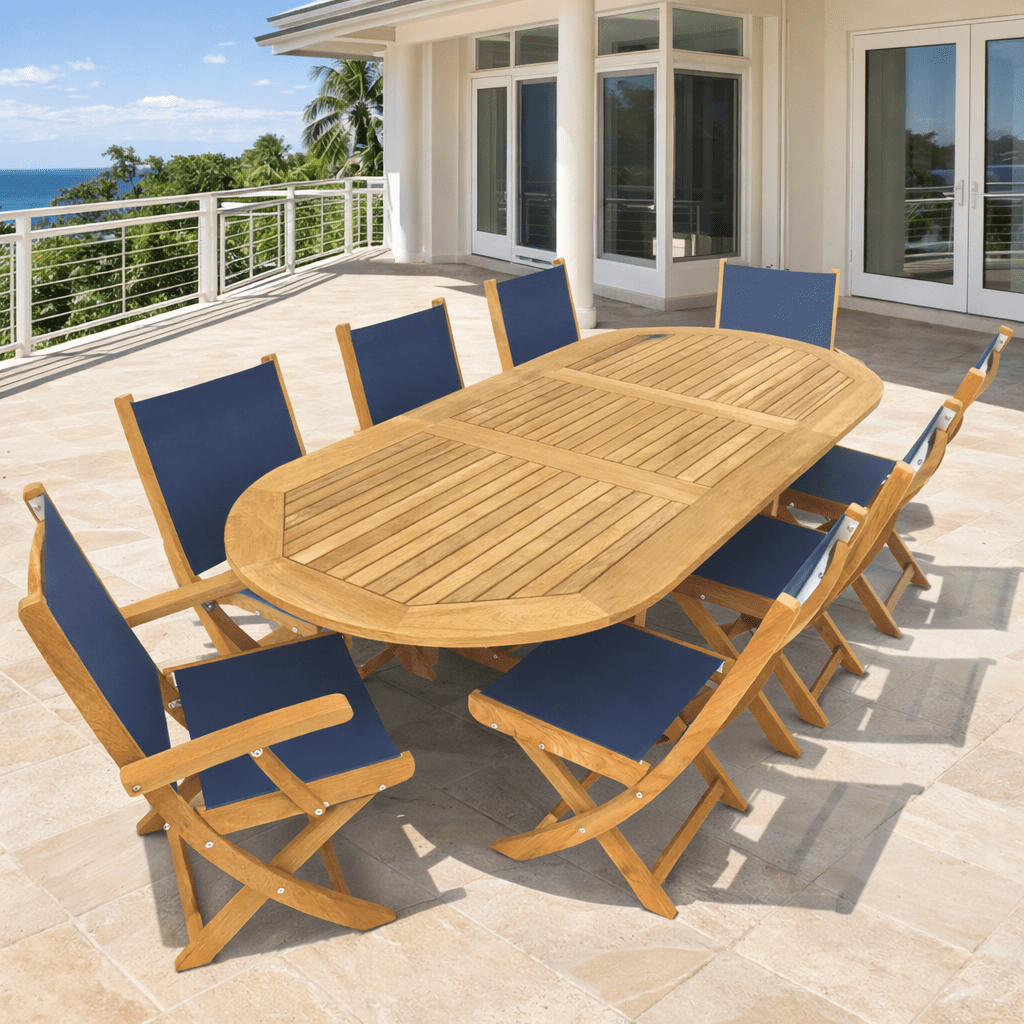 Furniture selection should follow the property's zones. A lakefront estate with a broad terrace has different needs from a wooded cottage with a modest deck, and a suburban home near Chicago, Detroit, Cleveland, or Milwaukee may emphasize backyard entertaining rather than direct waterfront use.
On a main deck, prioritize dining first when meals and entertaining are central to the household. Six- and eight-person configurations cover many family settings, while larger properties can accommodate 10-person or larger tables. An extendable design is especially useful when guest counts fluctuate.
Measure more than the tabletop. Account for chairs when occupied, the space behind seated guests, and the route between the house, grill, and table. On a busy summer deck, circulation space can matter as much as seating capacity.
A sofa-and-chair grouping works when the space is used socially, while a teak sectional can efficiently define a larger conversation zone. Swivel chairs deserve particular consideration where people alternate between facing companions and looking toward the water.
Coffee and side tables complete these areas. They are not merely decorative: drinks, books, phones, and serving pieces need a landing place, and a lounge arrangement without enough table surface often proves less functional than it looked in a rendering.
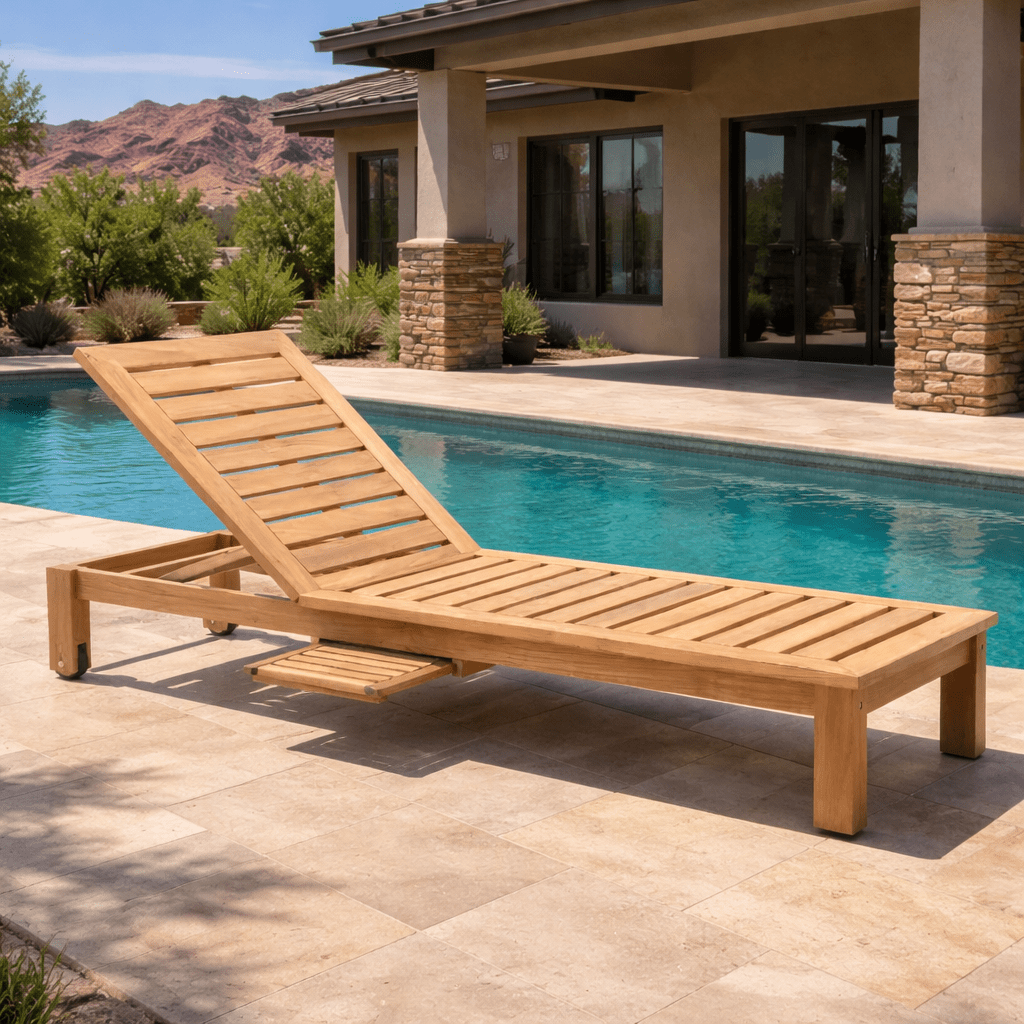 Where sunbathing or relaxed waterfront use is important, teak chaise loungers create a dedicated reclined seating zone rather than forcing dining chairs to serve every purpose.
Pair loungers with side tables and consider the sun path before deciding their permanent orientation. A waterfront view is valuable, but the most attractive direction at breakfast may be uncomfortable in strong afternoon sun.
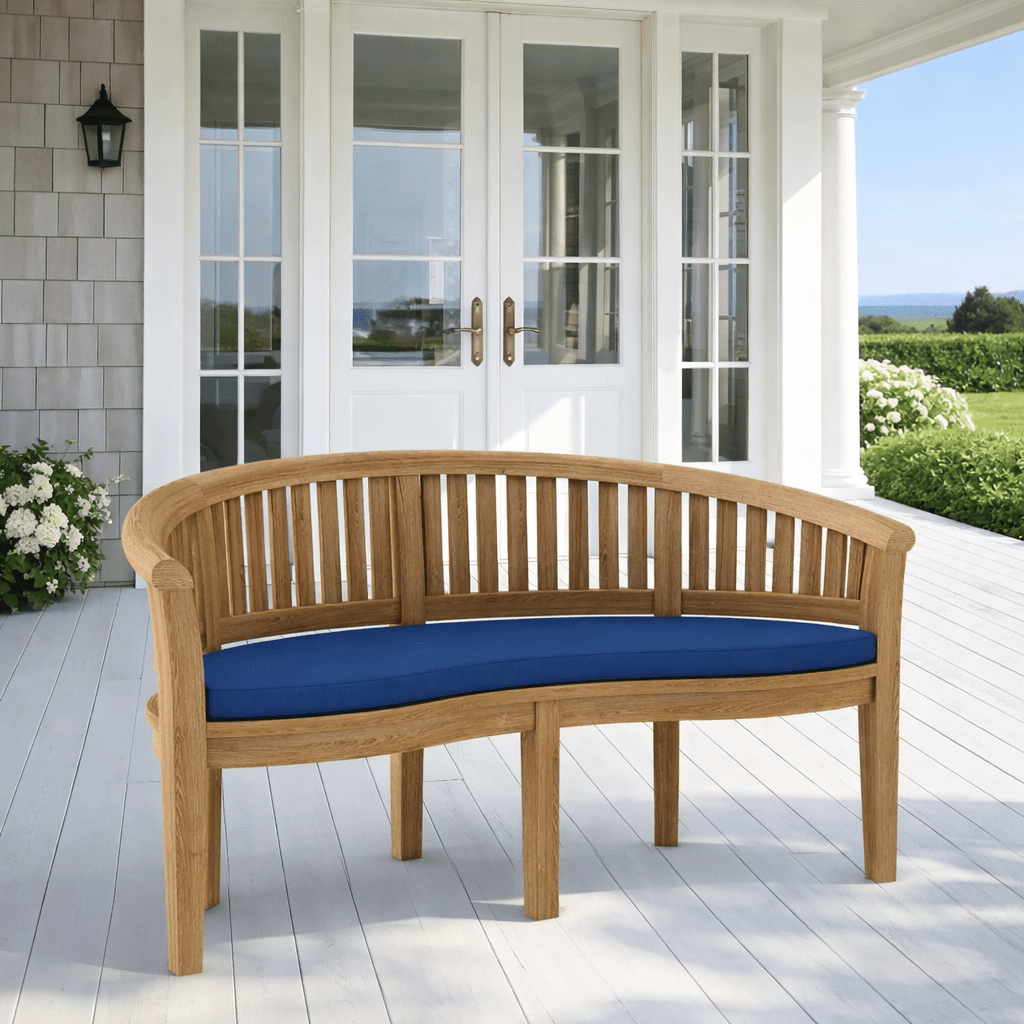
For informal seating near a fire feature or lake view, teak Adirondack chairs fit the relaxed character of cottages, cabins, and waterfront homes particularly well. Garden benches can serve quieter paths, landscaped areas, or overlooks where a full conversation set would feel excessive.
These secondary seating areas are often what make a large property feel fully usable. They give people a reason to occupy the shoreline, garden, lawn, or overlook instead of concentrating every activity immediately outside the back door.
There is no single Great Lakes architectural style. The region includes historic city homes, traditional lake cottages, cedar cabins, contemporary waterfront architecture, substantial suburban properties, and resort-style second homes. Teak's advantage aesthetically is its ability to work across traditional, transitional, coastal-inspired, and modern settings without depending on an artificial finish for its identity.
Natural teak works comfortably with stone, shingle, cedar, painted siding, and established landscaping. Classic dining chairs, benches, Adirondack chairs, and straightforward lounge silhouettes can reinforce the relaxed permanence of a cottage without making the patio feel overly formal.
Modern homes can take teak in a cleaner direction. Simple profiles, restrained cushion colors, sectional arrangements, and uncluttered dining tables introduce natural warmth beside glass, steel, concrete, and contemporary architecture. Homeowners who like aluminum's clean visual language but prefer real wood may find this combination especially appealing.
In a wooded setting, teak integrates naturally with the landscape, but placement deserves extra thought. Avoid creating areas where leaves and organic debris remain trapped against furniture for long periods. Garden benches and small seating groups are most useful when positioned at places people genuinely pause: a shoreline view, garden edge, path junction, or sheltered corner.
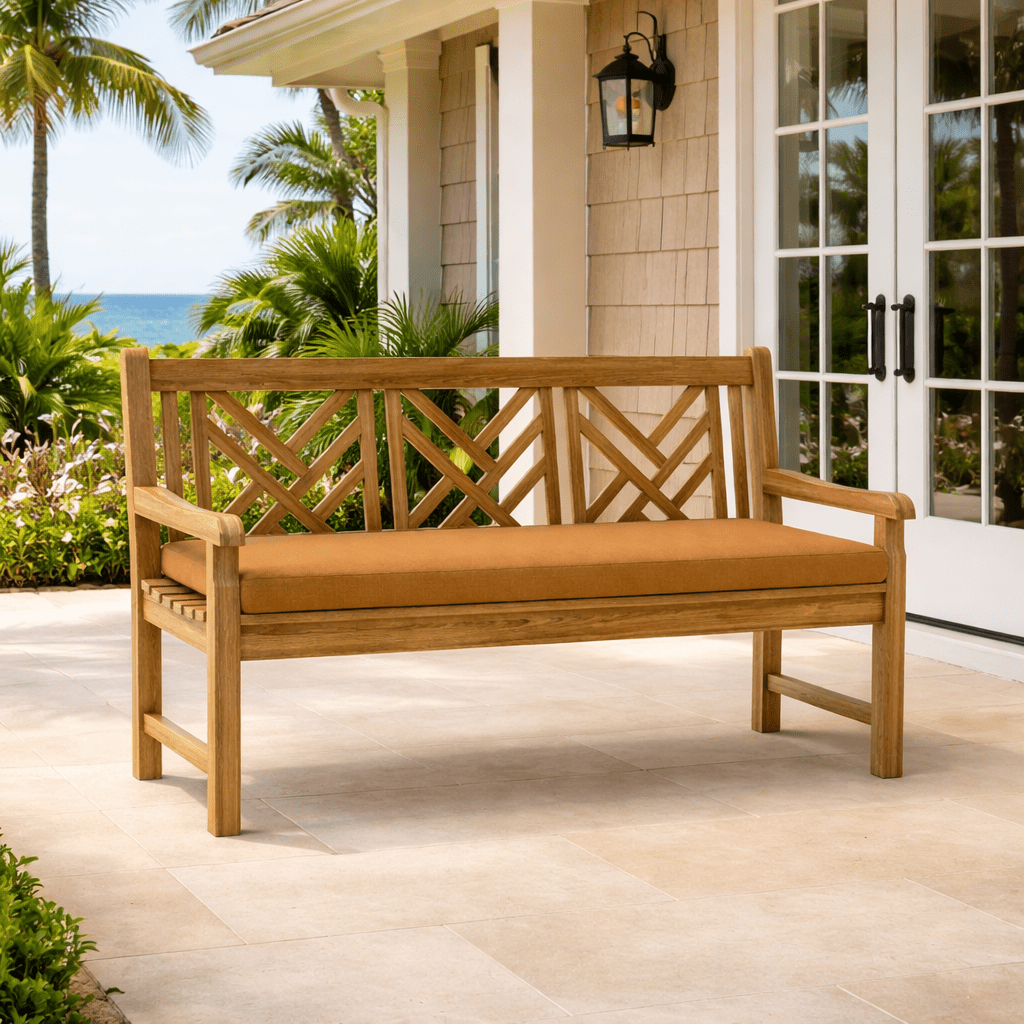 A furniture set can look perfect during a warm July afternoon yet create problems when November arrives. Before purchasing, decide what remains outside, what moves under cover, and what needs indoor storage. Grade A teak simplifies the frame side of that equation because it is designed for year-round outdoor use.
A protected courtyard and an exposed lakefront deck should not be planned identically. Likewise, homeowners in heavy lake-effect snow areas face different winter conditions from many locations on the opposite side of the same lake. Evaluate wind exposure, shade, drainage, tree cover, winter conditions, and sun at the actual furniture location.
Lake and vacation properties often have misleading “household size.” A couple may occupy the property most of the time but routinely host eight people on summer weekends. Instead of filling the deck permanently for peak occupancy, consider an extendable table, additional stackable or foldable chairs, or secondary seating that can participate in larger gatherings.
Weather-resistant cushions still benefit from sensible ownership habits. Most TeakHQ lounge seating includes Sunbrella cushions, but inclusion varies. Before buying a large cushioned arrangement, decide where soft goods will go during extended periods of non-use or severe winter weather. A beautiful sectional becomes less convenient if cushion storage was never considered.
Waterfront owners understandably want furniture facing the lake, but placing too much furniture along the view edge can obstruct sightlines and circulation. Keep the primary traffic path clear and create one deliberately oriented viewing area rather than lining every available edge with chairs.
Great Lakes teak care is less about preparing the wood to survive each season and more about keeping it clean and choosing the appearance you prefer. Grade A teak can remain outdoors year-round and does not require sealing or artificial stain for durability.
 There is no useful universal cleaning calendar because a sunny open terrace and a shaded deck beneath mature trees accumulate debris differently. Clean when pollen, dirt, leaves, bird residue, or other organic material begins to build up rather than following an arbitrary monthly schedule.
Pay particular attention to shaded areas and places where debris can remain damp. Teak is naturally resistant to moisture and rot, but keeping furniture clean still improves its appearance and prevents grime from becoming an unnecessary maintenance project.
Untreated teak naturally weathers toward silver-gray. That is not evidence that the furniture has failed; it is the expected appearance of naturally aging teak. Many Great Lakes homeowners may actually prefer that patina on a cottage, waterfront deck, or garden terrace.
If you prefer the warmer original teak color, maintenance products can help preserve that appearance. Think of this primarily as a design choice: maintain the golden-brown look because you want it, not because the wood requires an artificial stain to function outdoors.
Teak furniture itself can stay outdoors year-round. Before winter, clean away accumulated organic debris and place furniture where it will not interfere with snow removal or drainage. Avoid creating a layout that makes shoveling, plowing, or accessing doors unnecessarily difficult.
That last point is easy to overlook: winterize the patio layout, not just the furniture. A dining table that is perfectly positioned in July may sit directly in the path where snow needs to be moved in January. A small seasonal rearrangement can be more useful than moving an entire teak collection indoors.
Sunbrella cushions are weather-, fade-, UV-, and water-resistant, but that does not mean there is a benefit to leaving every cushion exposed through months when nobody is using it. For long off-season periods, protected storage can reduce needless exposure and keep the patio easier to reopen in spring.
Protective furniture covers are optional rather than required for teak durability. If you use them, follow the cover manufacturer's directions and keep the furniture clean before extended covering.
Start with the way your property is actually used: everyday family meals, crowded cottage weekends, lake-view lounging, fireside evenings, or a combination of several. Then choose furniture zones and capacities around those activities. TeakHQ's premium Grade A teak collections provide a natural, long-term option for homeowners who want outdoor furniture suited to four-season conditions without giving up the warmth and character of real wood.
Look for materials suited to rain, sun, cold weather, moisture, and significant seasonal temperature changes. Quality aluminum and synthetic poly furniture can both be legitimate options. Premium Grade A teak is especially compelling for homeowners who want real wood because its natural oils and dense grain contribute to resistance to moisture, rot, insects, and warping, and it is designed for year-round outdoor use.
It depends on the material and manufacturer. TeakHQ's Grade A teak is designed for year-round outdoor use and can remain outside through winter. Cushions and other soft goods should be managed separately according to their product instructions and the homeowner's storage preferences.
No. Protective covers are optional rather than required for teak durability. Grade A teak can remain outdoors year-round. Homeowners may still choose covers for cleanliness or convenience, particularly on furniture that will not be used for several months.
Yes. Premium Grade A teak is a strong choice for lakefront patios and decks because it is naturally resistant to moisture, rot, insects, and warping and withstands rain, sun, and temperature fluctuations. Its heavier, sturdier character can also be appealing on exposed waterfront properties.
Prioritize how the cottage changes between ordinary days and busy weekends. An outdoor dining area with flexible capacity, a separate conversation zone, and Adirondack chairs or loungers near the water creates more versatility than one oversized furniture group.
It often makes sense when guest counts fluctuate. An extendable dining table lets a smaller household keep a more comfortable everyday layout while adding capacity for summer weekends, visiting family, and larger gatherings.
Yes, untreated natural teak gradually develops a silver-gray patina with outdoor exposure. This is normal weathering rather than a sign that the wood is deteriorating. Homeowners who prefer teak's original warmer color can maintain it with appropriate teak care products.
Use exposure rather than a rigid calendar as your guide. Furniture beneath trees or in shaded, damp areas may collect leaves, pollen, sap, and organic debris faster than furniture on an open sunny patio. Clean accumulated dirt and debris as needed, with particular attention before long periods of seasonal non-use.
Each has advantages. Aluminum is lighter and can suit a modern aesthetic, while poly is synthetic and can appeal to buyers prioritizing lower maintenance. Teak offers real natural wood, a warmer and heavier feel, weather resistance, and decades-long longevity. The better choice depends on whether you prioritize low weight, synthetic convenience, or the character and long-term value of natural wood.
Remove dirt, leaves, and accumulated organic debris, then consider whether its summer position interferes with snow removal, doors, or winter drainage. The Grade A teak itself does not require indoor winter storage. Store or protect cushions separately when appropriate for your property and expected period of non-use.


