
FREE SHIPPING
within mainland USA
within mainland USA
Home ▸ Teak Outdoor Furniture ▸ By Location ▸ Jacksonville, Florida
Jacksonville outdoor spaces have to handle more than warm-weather entertaining. Humidity, frequent rain, strong sun, coastal exposure near the Beaches, and the realities of tropical weather all influence which furniture makes sense for patios, pools, porches, and waterfront properties. From Atlantic Beach to riverfront Mandarin, the best choice is furniture that can live outdoors comfortably without demanding constant attention. Premium Grade A teak is particularly well suited to that combination of moisture, sunshine, and year-round use.

Jacksonville is not one uniform outdoor-furniture environment. A patio near Jacksonville Beach faces a different mix of exposure than a shaded backyard in Mandarin or a covered terrace overlooking the St. Johns River. The common thread is moisture: humid air, wet summer weather, damp mornings, poolside splash, and—in coastal areas—salt carried inland from the ocean. Good outdoor furniture therefore needs to tolerate repeated exposure rather than merely survive an occasional rain shower.
In a dry climate, homeowners can focus heavily on sun exposure. In Jacksonville, moisture deserves equal attention. Furniture may dry slowly after rain when placed beneath covered patios, beneath mature live oaks, or in landscaped areas with limited airflow. Materials that depend heavily on protective surface finishes deserve closer scrutiny because outdoor furniture here is routinely exposed to changing moisture levels.
This is one reason dense, naturally oil-rich woods such as Grade A teak are appealing. Teak is naturally resistant to moisture and rot and does not require an artificial stain or protective coating simply to remain suitable for outdoor use.
The Beaches create another layer of concern. Atlantic Beach, Neptune Beach, Jacksonville Beach, and nearby Ponte Vedra properties experience more direct exposure to marine air than inland neighborhoods. Salt can settle on furniture surfaces, hardware, cushions, and nearby glass. Outdoor furniture near the ocean benefits from simple designs and materials that can be periodically rinsed and cleaned without making ownership complicated.
Move inland toward San Marco, Ortega, Mandarin, or Julington Creek and direct salt exposure becomes less important. There, homeowners are more likely to contend with tree pollen, leaves, shaded moisture, and debris collecting after afternoon storms. The ideal material may be the same, but the maintenance priorities change.
Outdoor furniture is often marketed as “weather resistant,” but Jacksonville homeowners should ask a more useful question: What happens after the rain stops? Water that drains quickly from an open pool deck is different from moisture trapped beneath cushions or organic debris sitting on a shaded surface for days.
Furniture placement therefore matters almost as much as material selection. Allow circulation around lounge furniture, avoid creating pockets where wet leaves continually collect, and give cushions an opportunity to dry. On covered porches, remember that protection from direct rain does not eliminate humidity.
One of the most important distinctions for Northeast Florida homeowners is that durable outdoor furniture is not hurricane equipment. Heavy, substantial furniture can feel reassuring during ordinary summer storms, but no patio set should be assumed safe to leave unsecured when tropical-storm or hurricane conditions threaten.
This is an overlooked planning issue when furnishing large pool decks and waterfront patios: decide where furniture can be moved or secured before you buy it. A beautiful eight-piece lounge arrangement is less practical if there is nowhere to put it during serious storm preparation.
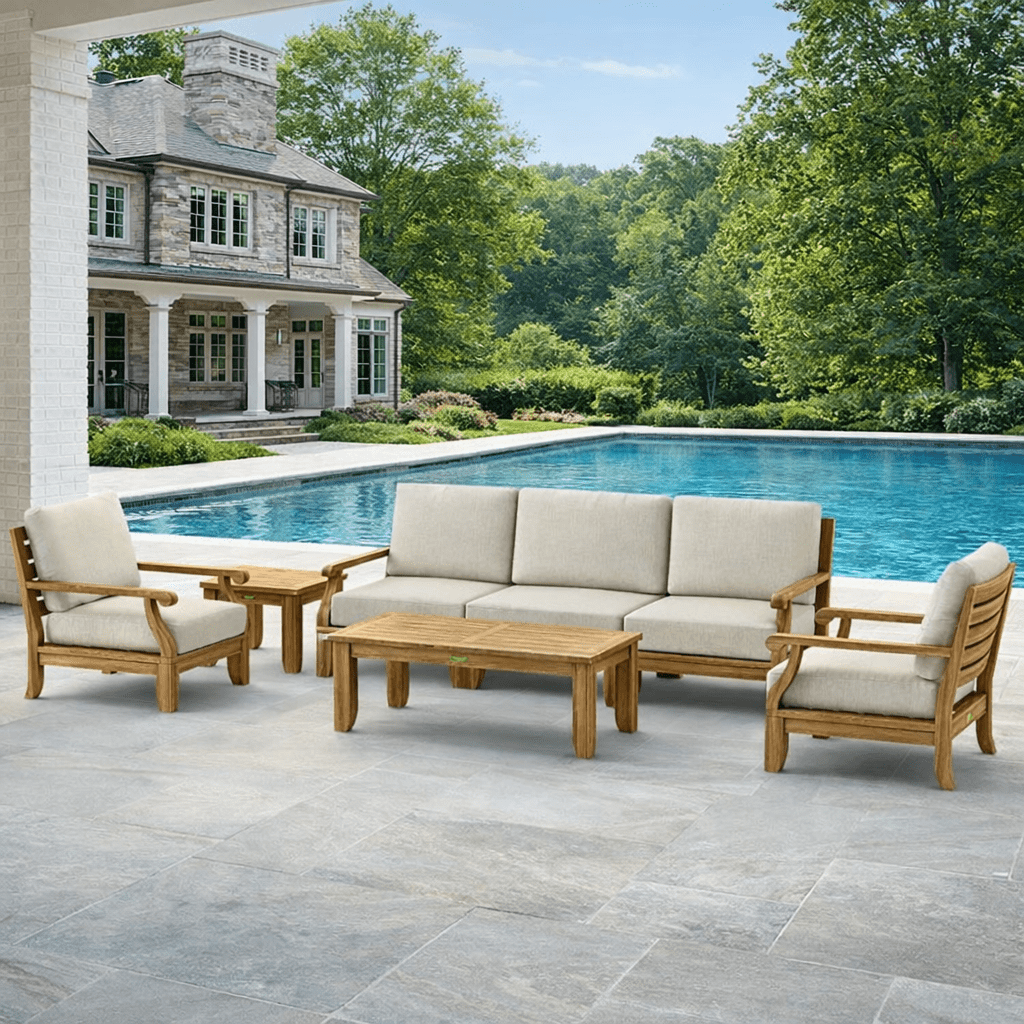 Premium Grade A teak has a dense grain structure and naturally high oil content. Those characteristics help make teak resistant to moisture, rotting, insects, and warping—advantages that are particularly useful in Jacksonville's humid, frequently wet outdoor environment.
That does not mean teak should be treated as indestructible or ignored indefinitely. It means the wood itself is naturally suited to outdoor exposure rather than relying on paint or an artificial stain to provide its basic durability.
Jacksonville patios can move rapidly between intense sunshine and heavy rain. Grade A teak is designed for year-round outdoor use and can withstand sun, rain, and temperature fluctuations. Its appearance will change, however. Untreated teak gradually develops the familiar silver-gray patina associated with weathered teak.
Some homeowners prefer that softer coastal appearance, particularly around beach houses and traditional riverfront properties. Others prefer teak's original golden-brown tone and choose to use an appropriate teak-care product to maintain it. Neither approach is required for the structural durability of the wood.
Repeated wetting and drying can be demanding on natural materials. Premium Grade A teak's density, oils, and resistance to warping make it particularly appropriate for exposed dining tables, lounge furniture, benches, and other pieces that remain outdoors for extended periods.
This is especially valuable for homeowners who are furnishing substantial outdoor living spaces rather than buying furniture they expect to carry indoors after every rainstorm.
Teak's initial price is higher than many mass-market alternatives, but the comparison makes more sense over the full ownership period. Quality teak furniture can last for decades rather than a few seasons. For homeowners investing in permanent pool areas, outdoor kitchens, custom landscaping, or waterfront terraces, buying furniture on a similar long-term horizon can make sense.
The maintenance flexibility is equally useful. Owners can allow teak to weather naturally or maintain its warmer original color according to their aesthetic preference.
| Jacksonville Challenge | Why Premium Grade A Teak Performs Well |
|---|---|
| High humidity | Natural oils and dense grain help resist moisture and rot. |
| Frequent rain | Designed for year-round outdoor exposure to rain and changing weather. |
| Strong sunshine | Handles outdoor sun exposure and can weather naturally to a silver-gray patina. |
| Coastal conditions | Natural teak does not depend on painted or artificial surface finishes for durability. |
| Repeated wet/dry cycles | Grade A teak is naturally resistant to warping. |
| Outdoor insects | Teak's natural characteristics provide resistance to insects. |
| Year-round use | Quality teak is designed to remain outdoors through changing seasons. |
We would begin with the way you actually use the property rather than choosing individual pieces first. Jacksonville homes often have several distinct outdoor zones—a covered porch or lanai, an open pool deck, a grilling area, and sometimes a second space facing the river, Intracoastal Waterway, garden, or backyard. The strongest layouts give each zone a clear purpose instead of filling every available surface with furniture.
For a larger Jacksonville backyard, we would usually establish a primary conversation area first. A multi-piece teak lounge set works well on a covered patio, beneath a pergola, or alongside a pool because it creates a defined outdoor room without forcing every gathering to happen around a dining table.
If the patio has generous dimensions, sectionals can create more continuous seating. On narrower porches or terraces, a sofa or loveseat with separate club chairs is often easier to arrange and preserves circulation paths.
Outdoor meals are common enough in Northeast Florida that dining furniture should usually be planned as a permanent part of the layout rather than occasional overflow seating. We would position the table near the indoor kitchen or outdoor cooking area while keeping enough separation from lounge furniture that people can move comfortably between the two zones.
For households that entertain at different scales, extendable teak dining tables are particularly useful. The table can remain reasonably proportioned for everyday meals and expand when relatives, neighbors, or weekend guests arrive.
One of the most common layout mistakes around Jacksonville pools is trying to make a single seating group do everything. Dining chairs are not pool loungers, and deep seating placed too close to the water can make the deck feel crowded.
We prefer a dedicated row or pair of teak chaise loungers in the sunniest usable portion of the deck, with conversation seating located farther back. That separation makes the space function better whether the pool is full of children or the adults are using the patio for an evening gathering.
Riverfront and Intracoastal properties deserve a slightly different approach. Furniture should face the feature people came outside to enjoy. Swivel chairs are valuable when the seating also needs to participate in a conversation group because occupants can turn toward the water without rearranging furniture.
In garden-oriented neighborhoods such as Mandarin, Riverside, Avondale, and Ortega, a secondary bench or pair of chairs can create a quieter destination away from the main patio. The goal is not to maximize the number of seats; it is to give people more than one reason to use the yard.
Begin with the activity that anchors your outdoor space. Large households and frequent hosts will usually get the most value from dining sets, extendable tables, and substantial lounge seating; pool-oriented properties should prioritize chaise loungers and shade; waterfront homes often benefit from flexible conversation seating such as sectionals and swivel chairs. Porch swings and smaller accent pieces make more sense as secondary additions once the main dining and lounging zones are established.
Jacksonville's outdoor lifestyle is shaped as much by water and property layout as by temperature. The metropolitan area stretches from oceanfront communities to St. Johns River neighborhoods, newer master-planned communities, historic districts, and large suburban yards. That creates noticeably different ways of using outdoor furniture within the same market.
For homes near the Atlantic, Intracoastal Waterway, creeks, or St. Johns River, the outdoor room frequently has a visual focal point before any furniture arrives. The best arrangement protects that sightline. Instead of lining every chair against the house, orient at least part of the seating toward the water and use smaller side tables where a large central table would interrupt the view.
That principle also works around pools. The pool is not merely something furniture surrounds; it is usually the visual center of the yard. Dining, lounging, and conversation furniture should complement it rather than create one continuous ring of seating.
Covered patios, porches, and lanais are valuable in Jacksonville because they create usable shade and shelter from passing rain. They are natural locations for deep seating, dining furniture, and televisions. But the roof does not turn the area into an indoor room. Humidity and wind-driven moisture still matter, so furniture chosen for these areas should remain genuinely outdoor appropriate.
Backyard gatherings here often move between the kitchen, grill, pool, lawn, and covered seating. That favors several useful furniture groups rather than one oversized formal arrangement. A six- or eight-person dining table, lounge seating for conversation, and separate pool chairs usually provide more flexibility than putting the entire budget into one enormous set.
During football season, the covered lounge area may become the most-used zone on the property. During warmer weekends, the pool deck takes over. Planning both uses from the beginning creates a patio that works beyond a single season or occasion.
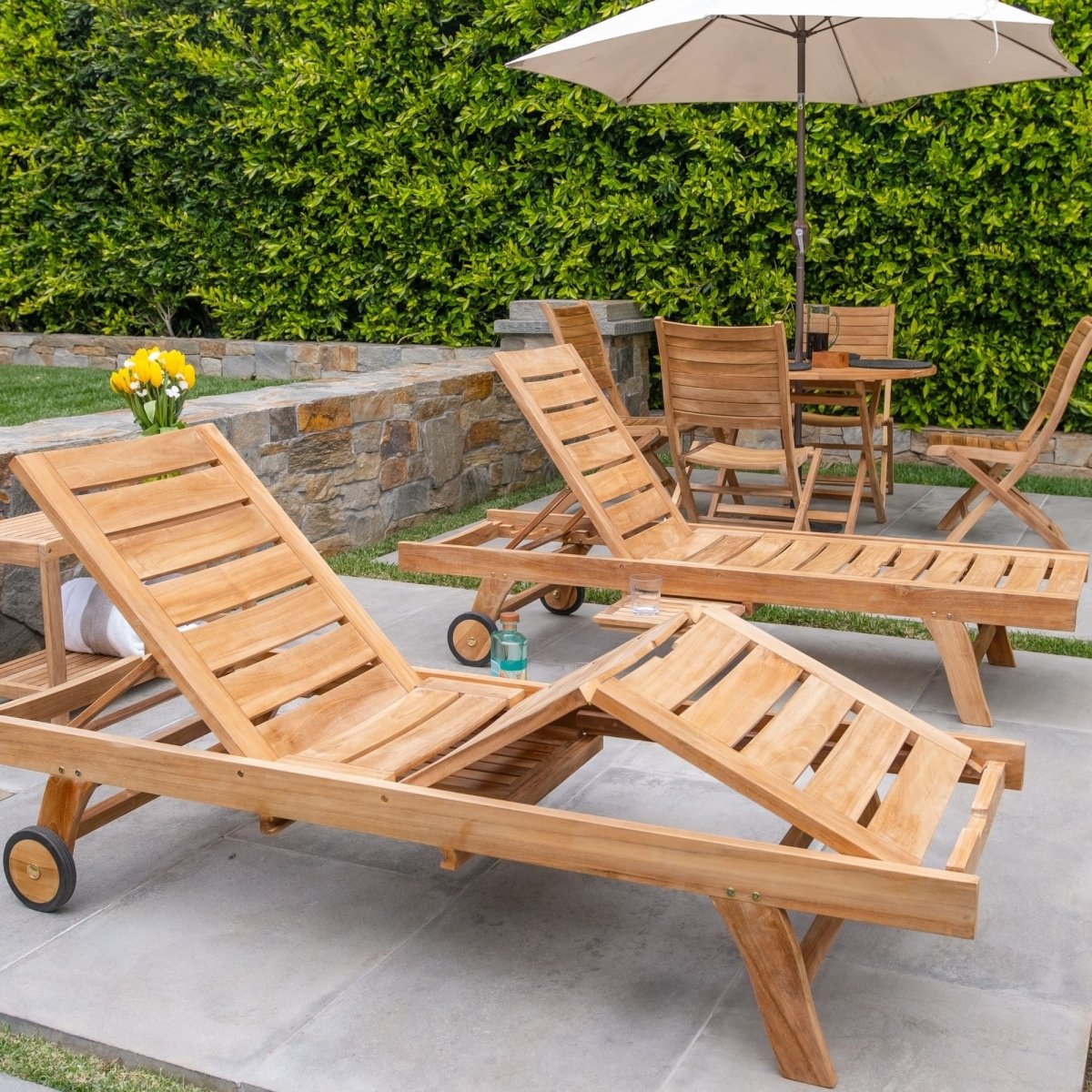 For a pool-focused property, we would start with adjustable chaise loungers and small side tables rather than trying to place a full lounge set immediately beside the water. Chaise seating accommodates swimming, sunbathing, reading, and casual conversation while keeping the traffic pattern around the pool open.
If the deck has enough depth, position a separate teak patio seating area farther from the pool edge. This creates a dry conversation zone where guests can sit comfortably without competing with swimmers for deck space.
Covered spaces are excellent locations for sofas, club chairs, sectionals, and coffee tables. For a large lanai, a sectional can make the area feel like a true outdoor room. Where the architecture creates several doorways or narrow circulation paths, individual pieces are often easier to place.
Most TeakHQ patio seating includes Sunbrella cushions, although specifications vary by product. Sunbrella's weather-, fade-, UV-, and water-resistant qualities are useful for spaces that are protected overhead but still exposed to humid outdoor air and occasional wind-driven rain.
Dining furniture should be sized around normal household use first and maximum entertaining capacity second. A family of four that occasionally hosts twelve people does not necessarily need a twelve-person table occupying the patio every day. An extendable table is often the better answer.
For households that regularly host larger gatherings, explore teak outdoor dining sets with seating capacities that match real usage. Place the table close enough to the grill or outdoor kitchen that serving is convenient, but keep it outside the cook's main circulation zone.
Waterfront homeowners should place seating around the view before worrying about perfect symmetry. A pair of teak swivel chairs can bridge two functions especially well: face inward during conversation, then rotate toward the river, canal, or Intracoastal view.
Console and side tables are useful here because drinks, phones, and serving pieces need a landing place without creating another large visual obstruction. This is a good example of why a complete outdoor room is usually more functional than buying only the largest furniture pieces.
Historic and traditionally styled properties in Riverside, Avondale, Ortega, San Marco, and Mandarin can support quieter furniture categories that might feel secondary on a resort-style pool deck. Rockers, garden benches, and teak porch swings complement covered porches, mature landscaping, and shaded garden spaces particularly well.
Jacksonville gives homeowners unusual design freedom because its residential architecture ranges from relaxed beach houses and newer coastal homes to Mediterranean-influenced residences, traditional riverfront properties, historic bungalows, and contemporary suburban construction. Natural teak works across those environments because its appearance can be shaped more by the surrounding materials and upholstery than by the wood itself.
At the Beaches, teak's natural grain works easily with pale stone, white or muted exterior finishes, woven textures, and coastal landscaping. Allowing the wood to weather toward silver-gray can create a relaxed look, while maintaining the warmer original teak color produces a more polished contrast.
The more useful design lesson is restraint. A coastal patio does not need anchors, nautical stripes, and overt beach themes to feel appropriate. Natural wood, durable outdoor fabrics, shade, and an unobstructed connection to the landscape usually establish the setting more convincingly.
In neighborhoods with older architecture and mature trees, traditional teak dining furniture, benches, rockers, and deep seating can complement the home without appearing temporary. Warm wood also provides a natural transition between brick, stucco, masonry terraces, lawns, and established landscaping.
For newer homes in communities such as Nocatee and throughout Jacksonville's expanding suburbs, cleaner-lined teak sectionals, sling seating, and streamlined dining furniture can soften hardscape-heavy pool areas. Teak also pairs comfortably with contemporary pavers, glass, neutral upholstery, and simple outdoor kitchens.
 A furniture label that says it can get wet does not tell you how pleasant the ownership experience will be in a damp environment. Jacksonville patios can remain humid long after the surface rain has disappeared. Choose genuinely outdoor-rated materials, maintain airflow, and do not leave wet cushions or piles of leaves sitting against furniture indefinitely.
Grade A teak addresses the structural side of that concern because it is naturally resistant to moisture, rot, and warping.
Beachfront, riverfront, tree-covered, and suburban pool properties have different maintenance priorities. A Jacksonville Beach homeowner may need to rinse away salt deposits more frequently, while an inland shaded patio may require more attention to pollen, leaves, and organic buildup.
Buy for the exposure your furniture will actually experience rather than for a generic idea of “Florida weather.”
Large Florida patios tempt homeowners to purchase too much furniture. The result is often a pool deck with plenty of seats but poor circulation. Preserve clear paths between the house, pool, grill, and yard before deciding how many pieces fit.
Separate chaise loungers from conversation furniture whenever space permits. The patio will usually feel larger and function better.
Do not confuse substantial furniture with furniture that can simply be ignored during a tropical storm or hurricane. Before buying a large set, identify where pieces can be moved or how they will be secured when severe weather threatens.
This is particularly important for exposed waterfront properties. Teak's ability to withstand outdoor weather does not eliminate the need for responsible storm preparation.
Some homeowners enjoy periodically maintaining teak's golden color. Others would rather let it weather naturally. Both approaches are legitimate. Problems arise when shoppers buy natural wood expecting it to remain visually unchanged without understanding the patina process.
If you prefer minimal cosmetic maintenance, embrace the silver-gray look. If you prefer warmer teak color, plan for the appropriate care routine from the beginning.
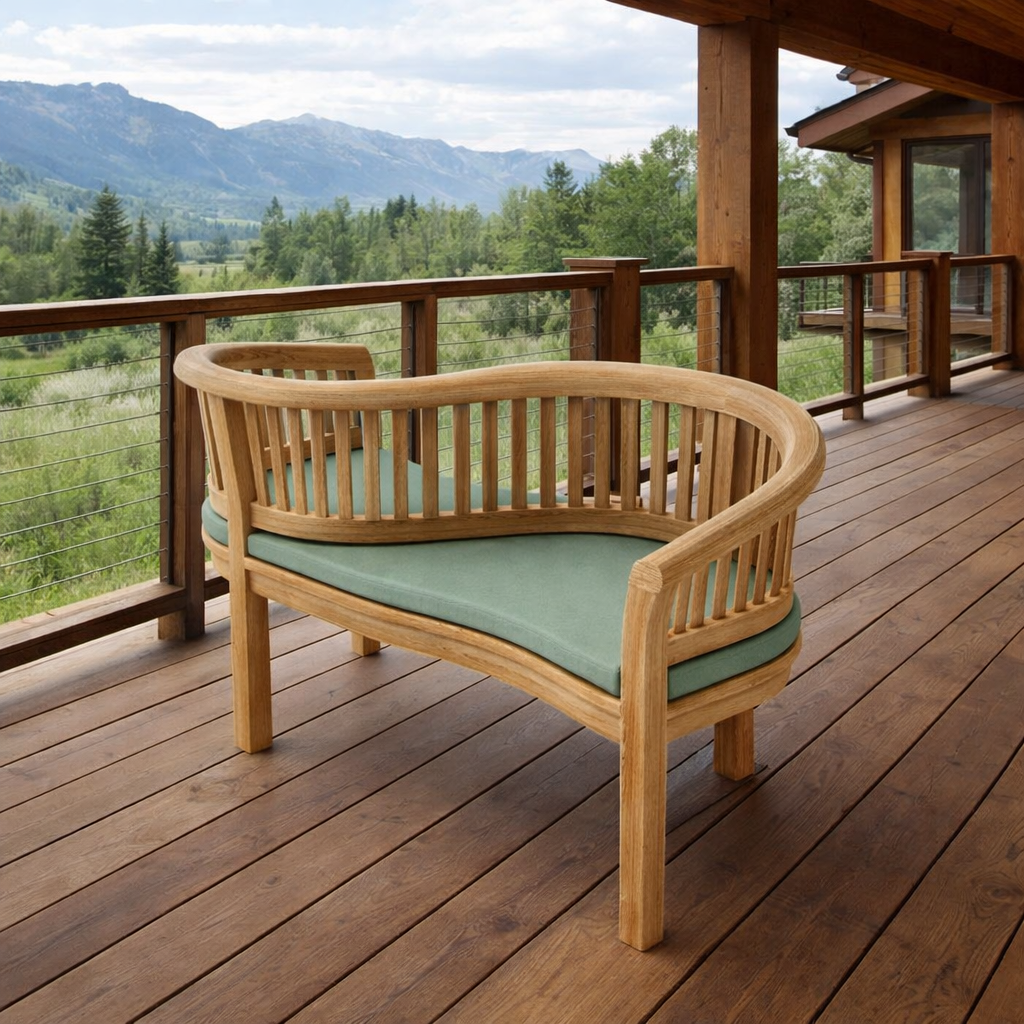 There is no single Jacksonville cleaning schedule that fits every property. An uncovered table beneath oak trees may collect pollen and organic debris much faster than a dining set under a screened or covered patio. Inspect the furniture periodically and clean it when surface buildup becomes noticeable rather than relying solely on the calendar.
Keeping leaves, pollen, food residue, and other debris from sitting on damp furniture for long periods is especially sensible in humid, shaded areas.
Homes closer to the Atlantic should periodically rinse furniture when salt film becomes noticeable. The same practical habit can be used for nearby hard surfaces and outdoor accessories. Pay attention to hardware and joints while cleaning rather than focusing only on the broad wood surfaces.
Royal Teak and Anderson Teak products use stainless-steel hardware, while Verandis Teak products use brass hardware.
Wood and cushions have different care needs. Most TeakHQ lounge seating includes Sunbrella cushions, but not every product does, so confirm the individual specifications. Even weather-resistant outdoor fabric benefits from drying completely after saturation and from being protected or moved when major storms are approaching.
If cushions will be stored frequently, plan storage while designing the patio rather than treating it as an afterthought. A nearby deck box or protected storage area is far more convenient than carrying cushions across the house every time weather changes.
Natural teak can remain untreated and gradually weather to silver-gray. This change is cosmetic rather than a sign that the furniture has stopped being suitable for outdoor use. Homeowners who prefer the original appearance can use appropriate teak-care products according to the desired finish.
Do not assume frequent oiling or sealing is required for durability. One of teak's advantages is the freedom to maintain the appearance you prefer without relying on an artificial stain for the wood's basic outdoor performance.
Premium Grade A teak is designed for year-round outdoor use, so Jacksonville homeowners generally do not need seasonal indoor storage simply because winter arrives. Protective covers are optional rather than structurally required.
If you do use covers, make sure the furniture and cushions are appropriately dry before prolonged covering. In a humid climate, good airflow and sensible moisture management remain valuable even when the underlying material is well suited to outdoor exposure.
The best Jacksonville patio is not the one with the most furniture. It is the one planned around your actual exposure, views, pool or waterfront layout, entertaining habits, and willingness to maintain it. Premium Grade A teak gives homeowners a durable natural material that can remain outdoors, age gracefully, and work across coastal, traditional, and contemporary properties. Start with the furniture zone you will use most, then build the rest of the outdoor space around it.
Look for materials designed for prolonged outdoor exposure rather than occasional rain. Premium Grade A teak is a strong choice because its natural oils and dense grain make it resistant to moisture, rot, insects, and warping. High-quality aluminum and synthetic outdoor materials can also be appropriate depending on the look and ownership experience you prefer.
Yes. Grade A teak is well suited to outdoor moisture, sun, and year-round exposure, making it a practical option for coastal properties. Beach homeowners should still periodically clean or rinse away salt and surface buildup as part of normal exterior maintenance.
Begin with dedicated chaise loungers for the immediate pool area, then place conversation seating farther from the water when space permits. This separates wet and dry activities and helps preserve circulation around the pool. Browse teak chaise loungers for poolside configurations.
Yes. Premium Grade A teak is designed for year-round outdoor use and can withstand rain, sun exposure, and temperature fluctuations. Seasonal indoor storage is not required for the wood's basic durability.
No. Teak does not require sealing for durability. It can be left untreated and allowed to develop a silver-gray patina. Homeowners who prefer the original warmer teak color may choose appropriate teak-care products to help maintain that appearance.
Yes. Untreated natural teak gradually weathers to a silver-gray patina when exposed outdoors. This is a normal cosmetic change. If you prefer the original golden-brown appearance, you can maintain it with suitable teak-care products.
Periodically remove salt film, sand, pollen, and other deposits and inspect hardware and cushions while cleaning. Furniture immediately near Jacksonville Beach, Atlantic Beach, Neptune Beach, or Ponte Vedra Beach generally deserves more attention to salt exposure than furniture farther inland.
Do not rely on a furniture cover as hurricane protection. When tropical-storm or hurricane conditions threaten, follow local emergency guidance and move or properly secure outdoor furniture and other loose exterior objects. Weather-resistant furniture still requires storm preparation.
All three can serve outdoor spaces differently. Aluminum is lighter and often has a more contemporary appearance, while poly lumber offers a synthetic, lower-maintenance approach. Teak provides real natural wood, a heavier and more architectural feel, long service life, and the option to let the material weather naturally. The better choice depends on whether you prioritize low weight, synthetic convenience, or the look and longevity of natural wood.
Size the table for everyday use before occasional maximum capacity. If your household usually seats four to six people but frequently hosts larger groups, an extendable teak dining table can preserve patio space while giving you additional seating when needed.


