
FREE SHIPPING
within mainland USA
within mainland USA
Home ▸ Teak Outdoor Furniture ▸ By Location ▸ Laguna Beach, California
Laguna Beach outdoor spaces ask more of furniture than their mild climate might suggest. Ocean exposure, bright sun, marine moisture, sloped properties, and patios designed around Pacific views all influence what works well long term. From compact decks above the coast to expansive terraces and pool areas, furniture also needs to suit the city's unusually varied architecture and indoor-outdoor lifestyle. Premium Grade A teak is a particularly strong option because it combines natural weather resistance with the substantial, adaptable character these spaces often need.

Laguna Beach has a relatively forgiving outdoor-living climate, but “mild” should not be confused with “easy on furniture.” The most important factors are the home's proximity to the Pacific, exposure to sun and ocean breezes, periods of marine moisture, and the way many properties sit on slopes, bluffs, or canyon edges. Those conditions create a different furniture environment from inland Orange County, where salt exposure and persistent coastal moisture are usually less important.
For homes close to the ocean, the first question should not simply be whether furniture is labeled “outdoor.” Salt carried inland on ocean air can settle on furniture, hardware, cushions, glass, and surrounding surfaces. The effect varies considerably by site: an open bluff or beachfront patio can experience much more direct exposure than a protected courtyard several streets inland.
This makes material quality and hardware especially important. Premium Grade A teak is well suited to moisture-prone outdoor settings because its dense grain and naturally high oil content provide resistance to moisture and rot. TeakHQ's Royal Teak and Anderson Teak furniture also uses stainless-steel hardware, while Verandis Teak uses brass hardware.
Coastal mornings can feel cool and damp while an exposed terrace becomes bright and sunny later in the day. Furniture therefore needs to tolerate repeated outdoor exposure rather than being optimized for only one condition. Materials and finishes that depend heavily on pristine surface coatings can require a different ownership routine than naturally weather-resistant materials.
Grade A teak is designed for year-round outdoor use and can withstand rain, sun exposure, and temperature fluctuations. Its appearance does change: unfinished teak naturally progresses from its original golden-brown color toward a silver-gray patina. That weathering is primarily an aesthetic change, not a requirement to replace or refinish the furniture.
One of the most useful Laguna Beach buying insights is that the city should not be treated as one uniform coastal environment. An ocean-facing deck in North Laguna, an enclosed garden in Woods Cove, and a terrace high in Mystic Hills may all experience different combinations of wind, shade, moisture, and direct sun.
Before selecting furniture, spend a day observing the actual site. Note where the strongest afternoon sun lands, which areas stay damp longest after a cool morning or rain, where wind funnels through the property, and which furniture positions preserve rather than obstruct the view. In Laguna Beach, site exposure often matters more than the ZIP code.
Furniture weight is easy to overlook until pieces are placed on an exposed upper deck or terrace. Teak has a naturally heavier, sturdier feel than lightweight aluminum furniture. Weight alone does not eliminate the need to secure or protect furniture during unusually strong winds, but substantial furniture can feel better suited to exposed outdoor rooms where homeowners do not want pieces that feel temporary or easily displaced.
The case for teak here is not that other premium outdoor materials cannot work. High-quality aluminum, synthetic materials, and carefully maintained specialty woods can all be appropriate. Teak becomes especially compelling when a homeowner wants natural wood, year-round outdoor capability, minimal dependence on protective finishes, and an appearance compatible with both contemporary and traditional coastal architecture.
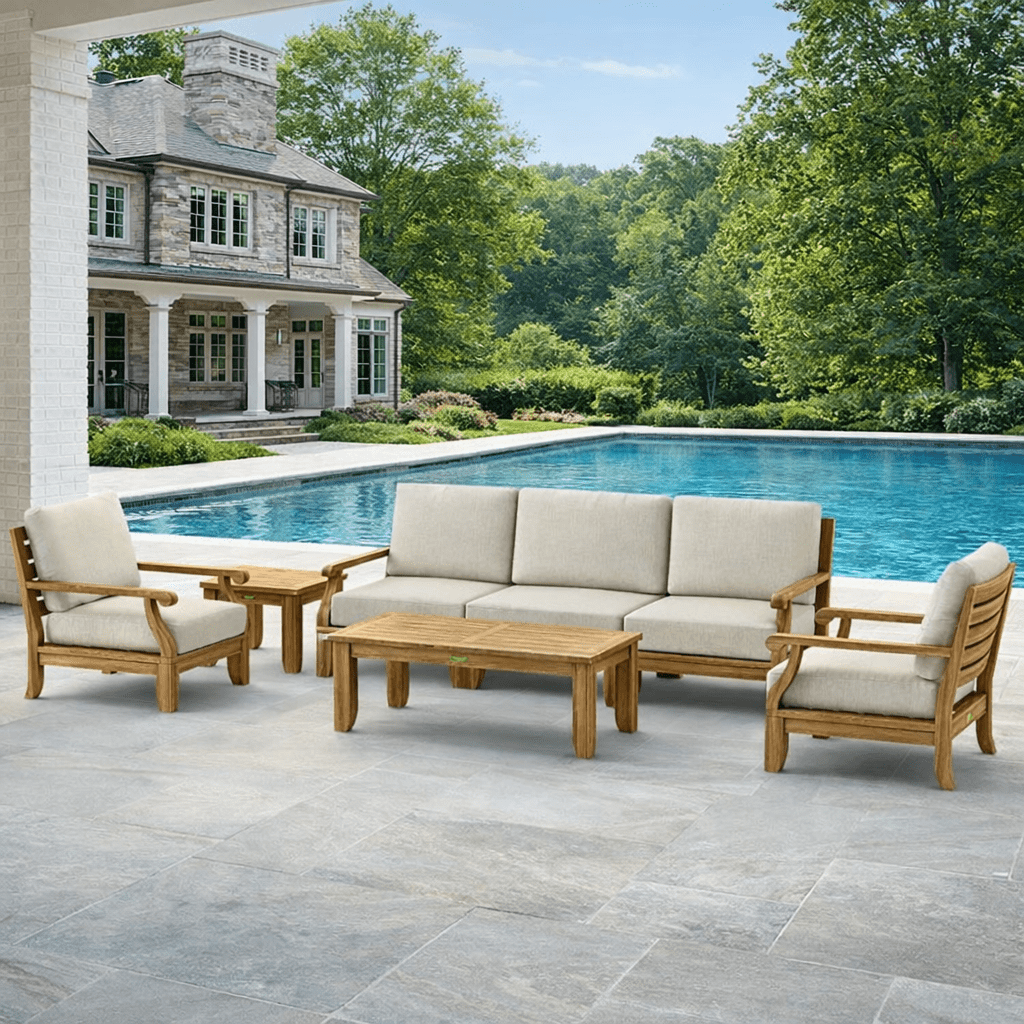 Grade A teak contains naturally high levels of oil and has a dense grain structure. Those characteristics contribute to its resistance to moisture, rotting, insects, and warping. On a coastal property where furniture may encounter damp mornings, rain, ocean air, and strong sunshine without being moved indoors each evening, that built-in resilience is useful.
Unlike wood furniture whose outdoor durability depends primarily on an artificial stain or painted coating, teak does not require an artificial stain for durability. Owners can instead decide how much maintenance they want to perform based largely on the appearance they prefer.
Outdoor furniture in Laguna Beach may move repeatedly between damp and dry conditions. Premium teak's structural stability makes it appropriate for this type of exposure, particularly compared with lower-quality woods more prone to deterioration or movement outdoors.
That does not mean teak is immune to dirt, surface mildew, salt residue, or normal weathering. It means the underlying wood is naturally suited to outdoor use, so routine care can focus more on cleanliness and appearance than on constantly maintaining a protective coating.
Teak's relationship with sunlight is different from that of furniture whose appearance depends on preserving a factory-applied surface color indefinitely. Untreated teak gradually develops a silver-gray patina outdoors. Some Laguna Beach homeowners deliberately choose that look because it complements pale stone, stucco, concrete, coastal landscaping, and weathered architectural finishes.
Homeowners who prefer the original golden teak color can use appropriate teak care products or sealers. The important distinction is that preserving the golden appearance is an aesthetic choice rather than a requirement for outdoor durability.
Premium Grade A teak costs more upfront than many mass-market patio materials, so it makes the most sense when the homeowner is furnishing a space for the long term. Properly made teak furniture can last for decades rather than seasons. That is particularly relevant on carefully designed Laguna Beach properties where outdoor furniture functions more like part of the home's architecture than temporary seasonal equipment.
| Laguna Beach Challenge | Why Premium Grade A Teak Performs Well |
|---|---|
| Coastal moisture | Natural oils and dense grain help resist moisture and rot. |
| Salt-air exposure | Teak is naturally suited to outdoor moisture; quality metal hardware supports coastal use. |
| Bright sun | Teak withstands sun exposure and can weather naturally to silver-gray. |
| Rain | Designed for year-round outdoor use without required artificial stain. |
| Damp-to-dry cycles | Grade A teak offers strong structural stability outdoors. |
| Exposed terraces | Its heavier, sturdier character suits substantial outdoor spaces. |
| Long ownership horizon | Quality teak furniture can last for decades with appropriate care. |
We would start with the property rather than the furniture catalog. Laguna Beach lots can be unusually individual: a narrow deck may command an exceptional ocean view, while a larger hillside property might offer several separate terraces at different elevations. The goal is to identify which outdoor area deserves to become the primary living space and then keep secondary spaces deliberately simpler.
In many cities, designers begin with the largest furniture grouping that fits. In Laguna Beach, we would often reverse that process: establish the important view corridors first, then furnish around them. A spectacular terrace can feel smaller if chair backs, umbrellas, or a bulky sectional interrupt the sightline from inside the house.
Low-profile teak patio seating works especially well when the view is the focal point. Position sofas or loveseats perpendicular to the ocean when possible, or use individual chairs that can be angled toward both conversation and scenery.
On a larger bluff, canyon, or hillside property, one enormous furniture arrangement is often less useful than two or three defined zones. We might place dining near the kitchen, deep seating in a sheltered conversation area, and two loungers at the sunniest edge of the terrace. Each space gets a clear purpose without requiring an oversized patio.
For the primary conversation area, a coordinated multi-piece teak lounge set is an efficient starting point. On very large terraces, a sectional can define an outdoor room while maintaining open circulation around it.
A common mistake in luxury outdoor design is furnishing for the largest party of the year instead of the way the home is used most weeks. If four to six people usually dine outside but larger groups visit occasionally, an extendable teak dining table can be more practical than permanently devoting the terrace to a ten- or twelve-person footprint.
For homes that frequently host family and friends, a full six- or eight-seat dining set is often the better anchor. The deciding factor should be circulation: leave comfortable paths between the dining chairs, house doors, grill or outdoor kitchen, and the route toward the view or pool.
Laguna Beach's irregular lots make small pieces unusually valuable. Side tables, compact dining tables, individual club chairs, and benches can turn corners and secondary decks into usable places without visually filling them.
This is especially useful on vertically organized hillside homes where several modest terraces may be more valuable than one enormous patio. Furnish the primary level comprehensively, then give secondary levels one clear purpose instead of repeating the same full furniture arrangement everywhere.
Start with the area where you spend the most outdoor time. Frequent hosts should usually begin with dining or deep seating; homes built around a pool or panoramic sun terrace may get more value from loungers first. Smaller decks benefit from individual chairs and flexible tables, while expansive estates can combine dining, lounge seating, and dedicated pool furniture into distinct outdoor rooms.
Outdoor living here is closely tied to the setting. The most successful spaces do not merely move an indoor living-room layout outside; they use the home's elevation, views, protected courtyards, beach access, and mild coastal conditions to create places for specific moments of the day.
On west-facing properties, the late-day view may be the outdoor space's greatest asset and its strongest source of glare. Furniture planning should anticipate both. Orient lounge seating so people can enjoy the horizon without requiring every chair to face straight into the afternoon sun, and provide adjustable shade where needed.
This is one reason swivel chairs can be useful on view-oriented patios. A guest can turn toward the conversation, ocean, fire feature, or house without physically dragging the chair to a new position.
Laguna Beach homes range from intimate cottages to substantial modern estates, but outdoor meals often benefit from layouts that feel less formal than an interior dining room. A six-person table can handle everyday family use, brunch, and dinner with friends without dominating a medium-size terrace.
For homes where gatherings expand and contract, flexibility matters more than maximum capacity. Foldable or extendable tables can preserve open space during ordinary use while providing additional seating when visitors arrive.
Furniture near a beach-access route can encounter wet towels, sunscreen, bare feet, sand, and people moving between the house and ocean. That argues for straightforward layouts with open circulation rather than tightly packed decorative arrangements. It also favors outdoor materials that owners are comfortable actually using rather than constantly protecting.
A hillside home's upper deck may be ideal for sunset but exposed to wind; a lower courtyard may be calmer and better for a long dinner. A sunny pool terrace may work beautifully in the afternoon while a shaded garden nook becomes the preferred morning spot. Laguna Beach properties reward this kind of time-of-day planning.
Instead of trying to make every outdoor space equally multifunctional, assign each one a job. The result usually feels more intentional and requires less furniture.
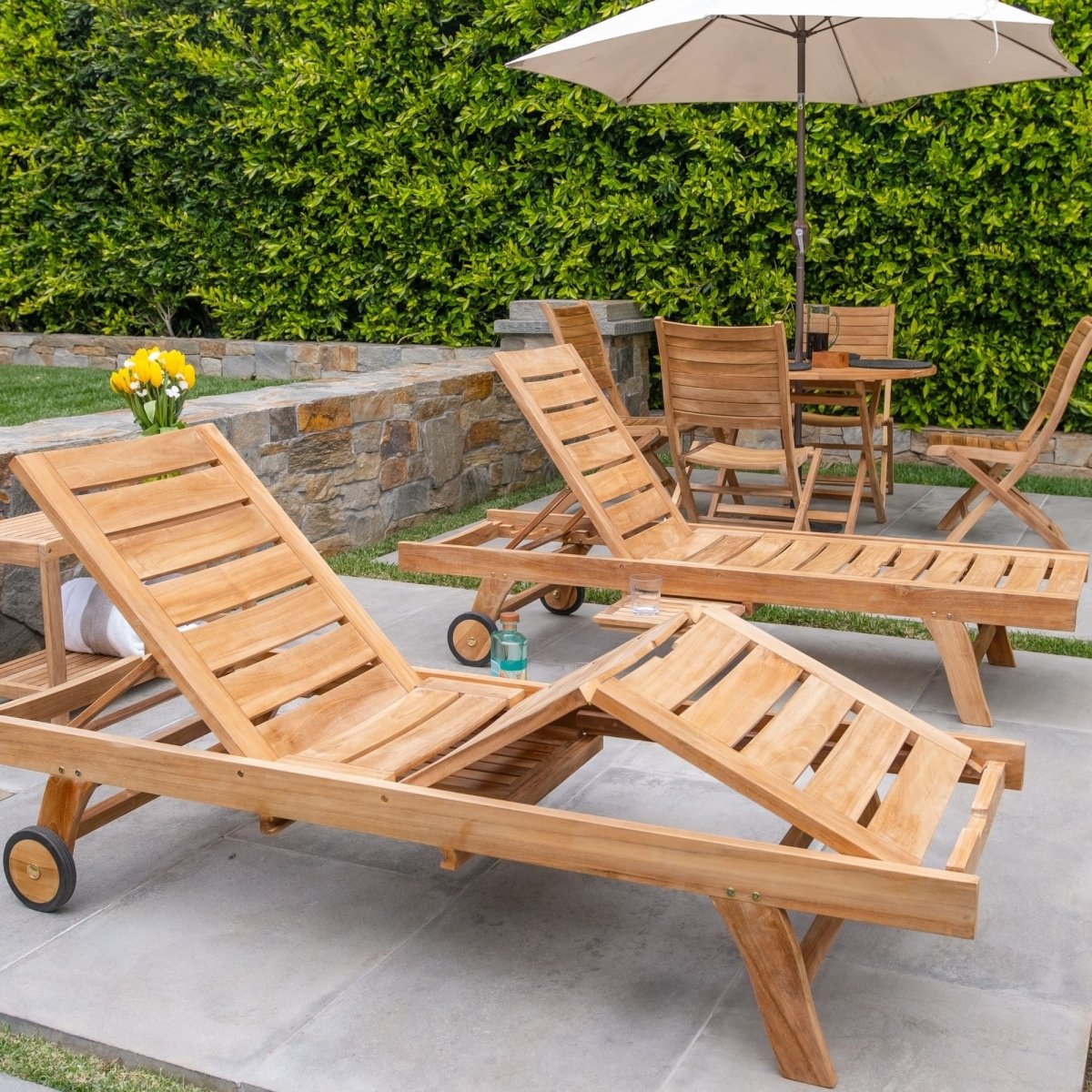 The best furniture mix depends less on the home's total square footage than on how its usable outdoor areas are distributed. Oceanfront and hillside homes may have relatively constrained terraces despite high property values, while other properties offer generous pools, courtyards, or several outdoor levels. Scale each grouping to the specific surface it occupies.
For an open view terrace, we would prioritize comfortable lounge seating with a relatively simple visual profile. A loveseat or pair of club chairs with a coffee table can create a complete conversation area without overwhelming the horizon. Larger spaces can support teak sectional seating, but measure carefully before committing to the footprint.
Side tables deserve more attention than they usually receive. On a dedicated view terrace, every lounge chair should ideally have somewhere to place a drink, book, or phone without requiring the user to lean toward a central coffee table.
Where a pool or sun terrace is central to the property, teak chaise loungers are a natural fit. Two loungers work well for a private master-suite or compact view deck; four or more make sense when the area regularly serves family and guests.
Leave enough space between loungers for side tables and walking paths. A tightly packed row may maximize seating on paper but can make an expensive pool deck feel more like a commercial facility than a private home.
For many households, a six-person teak outdoor dining set is the practical middle ground. It handles family meals comfortably and accommodates a small group of guests without requiring a huge permanent footprint.
For larger entertaining areas, eight- and ten-plus-person sets can be appropriate, especially where the outdoor kitchen and dining terrace are deliberately designed as the home's social center. On narrow terraces, pay particular attention to chair pullback depth rather than considering table dimensions alone.
Compact courtyards benefit from furniture that preserves negative space. Two club chairs with a small table may be more comfortable and useful than squeezing in a loveseat. A round four-person dining table can also ease circulation where paths converge around several doors.
When the furniture does not need to accommodate every possible activity, the architecture and landscaping remain more visible—a worthwhile priority in Laguna Beach's many individually designed homes.
If an outdoor kitchen already includes fixed counter seating, avoid duplicating that function with an oversized formal dining area unless the household frequently hosts large groups. Instead, pair the kitchen with a moderate dining table and devote the remaining space to a conversation grouping.
Bar- or counter-height teak seating can also work well where the elevated position improves a view across a railing, low wall, or pool edge. In those locations, furniture height is not just a style decision; it can materially affect what seated guests can see.
Laguna Beach does not have one dominant residential look. Its housing includes historic cottages, eclectic custom homes, contemporary glass-and-stone residences, coastal houses, and architecture shaped tightly around steep terrain. That variety makes natural teak useful from a design standpoint because it can read as warm and traditional in one setting and clean and architectural in another.
Contemporary Laguna Beach homes often use large areas of glass, pale stone, stucco, concrete, and broad openings between indoor and outdoor rooms. In these settings, teak introduces warmth without requiring elaborate ornament. Straight-lined lounge furniture and dining tables can reinforce the architecture while keeping the material palette natural.
For a restrained modern terrace, limit the number of furniture types and repeat finishes rather than filling every edge. One cohesive dining group plus one lounge group generally looks stronger than several unrelated seating styles.
Older and more eclectic homes can support traditional teak forms particularly well. Garden benches, classic dining chairs, steamers, and smaller tables have enough character to sit comfortably beside textured stucco, mature landscaping, stone paving, and cottage-scale architecture.
The goal should not be to make the outdoor furniture look “beach themed.” Natural materials, appropriate proportions, and restrained fabrics usually create a more durable connection to the setting than overt nautical motifs.
Homes above the immediate shoreline often engage with canyon vegetation, steep slopes, and long-distance views as much as with the ocean itself. Natural teak can bridge architectural materials and planting because it remains visibly wood rather than imitating wood through a synthetic surface.
On multi-level sites, repeat the same material across different furniture categories to create continuity. For example, teak dining on the primary terrace, teak loungers by the pool, and a bench on a garden landing can feel connected without being identical.
There are two legitimate design directions with teak. Maintain the warmer original color when it complements wood doors, warm stone, or interior finishes, or allow it to develop a silver-gray patina that relates naturally to concrete, limestone, coastal tones, and weathered landscapes.
Decide which appearance you prefer before establishing a maintenance routine. Treating gray teak as a failure to maintain the furniture creates unnecessary work if the weathered look actually suits the home.
 A beautiful showroom finish tells you little about how a material will behave after repeated outdoor exposure near the coast. Before buying, understand whether durability depends on a coating, how hardware handles moisture, and what the expected aging process looks like.
Grade A teak offers a simpler proposition: it is naturally weather resistant and can be left unfinished outdoors, with the expectation that its color will gradually weather.
Large sectionals and tall-backed furniture can look appropriately luxurious online yet overwhelm a narrow terrace. In a view-driven market, furniture should support the scenery rather than become the scenery.
Before ordering, sit at the approximate seat height and evaluate the horizon from both indoors and outdoors. Sometimes two chaise loungers, a loveseat, or four individual chairs create a better luxury experience than the largest possible furniture set.
A dining table can technically fit a terrace while the dining set cannot. Chairs need space to pull back, and guests need circulation behind occupied seats. This becomes especially important on narrow decks and patios bounded by railings, walls, pools, planters, or grade changes.
Measure the furniture in its in-use position rather than only measuring the tabletop. An extendable table can be particularly effective when everyday circulation matters more than permanent maximum seating.
Coastal furniture can accumulate salt, dust, pollen, and other surface residue even when it rarely gets directly wet. Leaving that buildup indefinitely makes furniture and fabrics look neglected and can increase cleaning effort later.
Choose furniture you are willing to rinse and clean periodically. Teak does not remove the need for housekeeping; its advantage is that the underlying wood is naturally suited to outdoor weather rather than dependent on constant refinishing for basic durability.
An exposed bluff or elevated deck feels very different from a protected courtyard. Lightweight furniture may be convenient to move, but frequent repositioning from ocean breezes can become irritating.
Teak's heavier, more substantial feel is often useful in these spaces. During unusually strong wind conditions, however, homeowners should still secure or move vulnerable pieces and accessories rather than assuming furniture weight alone is sufficient.
Repeating a full dining-and-lounge arrangement on every outdoor level can make a hillside property feel cluttered and waste valuable square footage. Instead, identify the best purpose for each space: morning coffee, dining, sunset conversation, pool lounging, or quiet garden seating.
TeakHQ offers individual pieces as well as coordinated sets, making it possible to furnish secondary spaces selectively rather than buying another complete grouping.
Teak's maintenance flexibility is one of its strongest advantages for coastal ownership. The main question is not whether the furniture can survive outside—it is designed for year-round outdoor use—but how clean and how golden you want it to look.
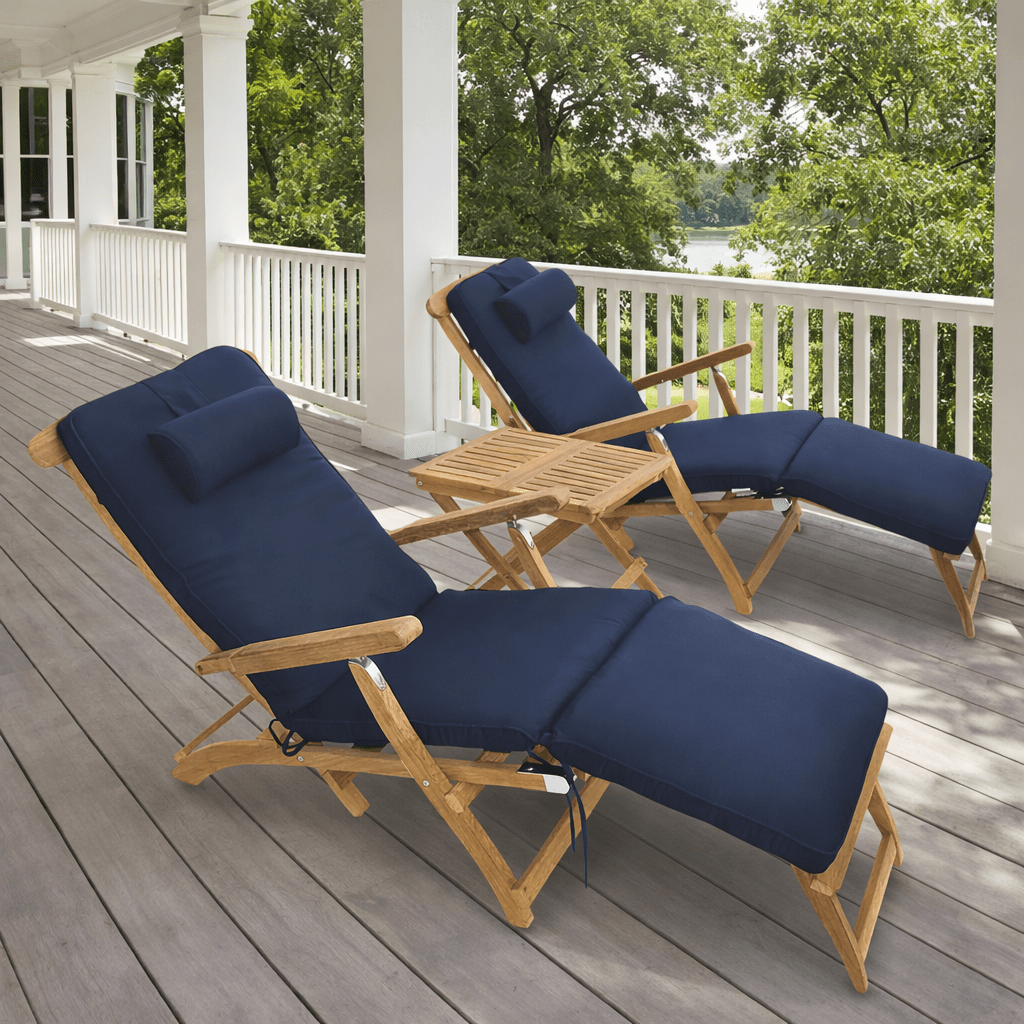 Homes with stronger ocean exposure may benefit from occasional fresh-water rinsing to remove salt and surface debris before it accumulates. More protected inland-facing patios may need this less frequently. Let the site's actual exposure determine the schedule rather than following an arbitrary calendar.
For routine cleaning, use appropriate teak-cleaning products and follow the furniture manufacturer's directions. Avoid creating a maintenance process more aggressive than the condition of the furniture requires.
After rain or cleaning, good airflow helps furniture and cushions dry. Avoid creating areas where organic debris remains trapped against damp surfaces for long periods. Leaves, dirt, and moisture are more useful indicators that cleaning is needed than the mere passage of a certain number of weeks.
If furniture uses removable cushions, follow the cushion manufacturer's care guidance. Many TeakHQ patio-seating products include Sunbrella cushions, which are weather resistant, fade resistant, UV resistant, and water resistant, but “water resistant” should not be interpreted as a reason to neglect wet cushions indefinitely.
Untreated teak will naturally weather toward silver-gray. Homeowners who like that color can allow the process to occur without applying a finish simply for durability. Those who want to retain more of the original teak tone can use suitable teak care products or sealers according to product directions.
Consistency matters visually. On a large furniture collection, decide whether you want the pieces to weather together or maintain a warmer finish together rather than treating individual items differently without a design reason.
Premium teak does not require protective covers for basic outdoor durability. A cover may still be useful when reducing dirt, bird debris, leaves, or cleaning frequency matters to the homeowner. If you use one, choose an outdoor cover and manage it so moisture is not unnecessarily trapped against furniture or cushions.
Laguna Beach does not create the same winter-storage problem faced by homeowners in severe freeze-and-snow climates. Teak furniture can remain outdoors year-round. Owners may still store cushions, accessories, or lesser-used pieces during wetter periods to reduce cleaning and keep the outdoor space orderly.
If your goal is simply to reduce clutter from cushions and outdoor accessories, a teak deck box can be more useful than moving the furniture itself.
The right outdoor furniture should make the property easier to use, not simply make the patio look furnished. Start with the view, exposure, circulation, and way you actually entertain; then choose the dining, lounge, and poolside pieces that support those priorities. Premium Grade A teak is especially well suited to homeowners who want natural materials, long-term outdoor performance, and the freedom to maintain a warm teak color or let the furniture weather naturally.
There is no single material that fits every property. High-quality teak and aluminum can both work well outdoors, while premium synthetic materials may suit homeowners prioritizing minimal upkeep. Grade A teak is particularly attractive for Laguna Beach because it combines natural wood, moisture and weather resistance, substantial weight, and long-term outdoor durability.
Grade A teak is naturally resistant to moisture and rot and is well suited to coastal outdoor use. Salt and grime can still collect on surfaces, so furniture exposed directly to ocean air should be rinsed or cleaned periodically rather than ignored indefinitely.
Yes. TeakHQ's Grade A teak furniture is designed for year-round outdoor use and withstands rain, sun exposure, and temperature fluctuations. Covers are optional rather than required for basic durability.
Yes. Unfinished teak naturally develops a silver-gray patina with outdoor exposure. This is expected weathering. Homeowners who prefer the original golden appearance can use appropriate teak care products to help maintain the desired look.
Prioritize furniture that preserves sightlines and fits the deck comfortably when people are actually using it. Small deep-seating groups, club chairs, swivel chairs, loungers, and side tables often work better than oversized arrangements on narrow view terraces.
Choose substantial furniture, limit lightweight accessories, preserve clear circulation, and consider where the building provides natural wind protection. Teak's heavier feel can be helpful, but furniture and accessories should still be secured or moved during unusually strong winds.
Both can be appropriate premium choices. Aluminum is lighter and often has a more contemporary character. Teak is heavier, warmer, natural, and has a more organic appearance. The better choice depends on the architecture, desired maintenance routine, furniture weight, and aesthetic you prefer.
For many homes, seating for four to six is practical for routine outdoor meals, while larger terraces can accommodate eight or more. On constrained decks, an extendable dining table can provide extra guest capacity without permanently consuming valuable view and circulation space.
No. Premium teak is designed for outdoor weather exposure, so covers are not required for durability. Some homeowners still use covers to reduce dirt and cleaning or to protect cushions and accessories.
There is no useful one-size-fits-all schedule because exposure varies dramatically by property. An oceanfront or bluff-top patio may accumulate salt and residue faster than a protected courtyard. Inspect the furniture regularly and clean or rinse it when visible buildup develops.


