
FREE SHIPPING
within mainland USA
within mainland USA
Home ▸ Teak Outdoor Furniture ▸ By Location ▸ Lake Tahoe, California
Furnishing an outdoor space at Lake Tahoe means planning for two very different seasons: sunny summers built around decks, dining and lake views, followed by a long winter environment with snow, moisture and repeated temperature changes. Furniture on an exposed lakefront terrace also faces different demands than pieces beneath a covered porch or tucked into a forested cabin setting. Premium Grade A teak is especially appealing here because its dense grain, natural oils and weather resistance suit homeowners who want substantial outdoor furniture without treating every seasonal change as a furniture emergency.

Lake Tahoe asks more of outdoor furniture than a typical warm-weather market. The central issue is not one single extreme; it is the combination of bright summer exposure, moisture, winter snow, cold temperatures and substantial seasonal transitions. Furniture that feels perfectly suited to a July afternoon may spend part of the year beneath snow, exposed to meltwater or sitting unused while temperatures repeatedly move above and below freezing.
A common mistake is evaluating patio furniture only for Tahoe's beautiful summer weather. The better question is what happens during the other eight or nine months of the ownership cycle. Furniture may remain outside through winter, move beneath a roof, or be stored depending on the property and how often the home is occupied.
That makes material quality particularly important. Wood species that readily absorb moisture or move excessively as conditions change can require more attention. Lightweight furniture creates a different concern on exposed decks. Upholstered pieces introduce yet another question: where will cushions go when the property is vacant or winter weather arrives?
The obvious concern with winter is accumulated snow, but moisture management matters just as much. Snow eventually melts. Meltwater can sit around furniture feet, collect against debris or repeatedly wet surfaces as daytime and nighttime conditions change.
For that reason, we would prioritize outdoor furniture made from materials that are genuinely intended for weather exposure rather than furniture that merely looks appropriate outdoors. Premium Grade A teak is designed for year-round outdoor use and naturally resists moisture, rot and warping, making it a particularly practical wood choice for this environment.
Tahoe's cool air can make summer sun feel less punishing than desert heat, but exposed decks, docks and lake-view terraces still receive substantial direct sunlight. Finishes and fabrics should therefore be chosen with UV exposure in mind.
Teak does not need an artificial stain for durability. When unfinished teak is left outdoors, its original warm color gradually weathers toward a silver-gray patina. That is an aesthetic change rather than a reason to assume the furniture has reached the end of its useful life. Homeowners who prefer the original color can choose an appropriate teak-care routine instead.
Many Tahoe patios and decks sit beneath or near mature trees. In these settings, the practical nuisance is often not dramatic weather but needles, pollen, leaves and other organic material collecting between furniture pieces or remaining damp against the wood.
Good furniture selection cannot eliminate yard debris, so accessible layouts matter. Leave enough clearance around large dining and lounge groups to sweep or blow out the deck without moving half the furniture. That simple planning decision can make a second home's outdoor space much easier to manage.
Several premium materials can work in Tahoe. Quality aluminum has an advantage when owners specifically want a lighter, contemporary appearance, while synthetic materials can appeal to homeowners prioritizing minimal material care. For buyers who want the warmth and authenticity of real wood, however, Grade A teak occupies a particularly useful middle ground: it has the character of natural wood while possessing natural properties that make it well suited to prolonged outdoor exposure.
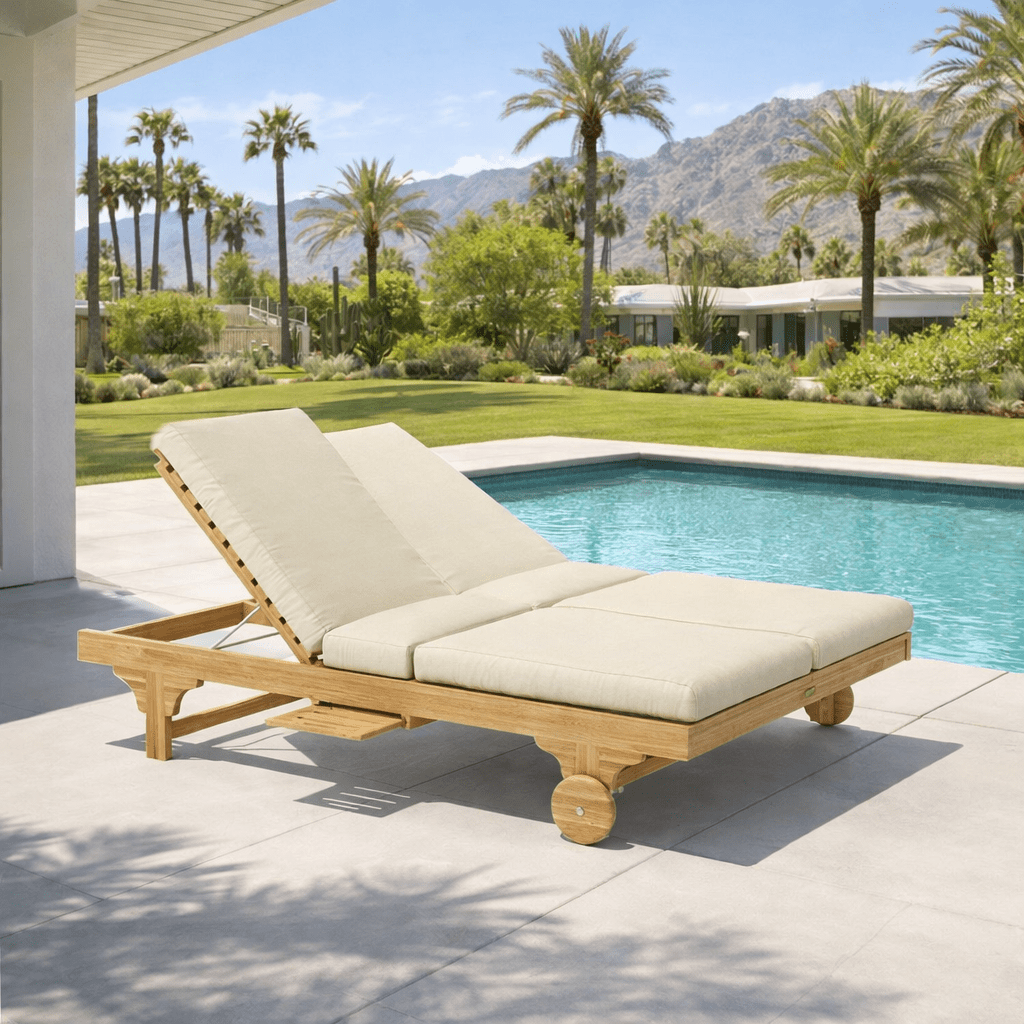 Grade A teak is naturally high in oils and has a dense grain structure. Those characteristics help it resist moisture, rotting, insects and warping—important qualities when furniture must transition from dry summer afternoons to rain, snow and snowmelt.
This is where teak differs from buying a generic wooden patio set and hoping a surface finish will do all the work. Teak's outdoor suitability comes from the wood itself. Sealers or oils can be used for appearance preferences, but they are not required simply to make the furniture durable outdoors.
Tahoe furniture does not experience one stable climate. It can move through strong sunlight, precipitation and substantial temperature fluctuations over the course of a year. Grade A teak is designed to withstand rain, sun exposure and temperature changes and is naturally resistant to warping.
No outdoor material eliminates the need for sensible ownership practices. Heavy snow should not be treated as an excuse to ignore furniture indefinitely, and cushions deserve different treatment than the teak frame. The advantage is that the wood itself does not require the elaborate seasonal coating routine associated with many lesser outdoor woods.
Tahoe homeowners can choose between two legitimate teak ownership styles. One is to let unfinished teak weather naturally to silver-gray. On a rustic-modern cabin, weathered lake house or contemporary mountain property, that appearance can feel completely intentional.
The second approach is to preserve more of the original golden-brown appearance with optional teak-care products. Neither choice makes the furniture inherently more appropriate for Tahoe. It is primarily a design and maintenance preference, which is useful for second-home owners who may prefer not to add another recurring chore to their property-management list.
Premium teak costs more initially than many mass-market outdoor materials. Tahoe is one of the environments where it makes sense to evaluate that cost over a longer ownership period. Teak furniture can last for decades, and its natural weather resistance means the purchasing decision does not need to revolve around replacing inexpensive sets every few seasons.
For a furnished vacation property, there is another form of value: continuity. A substantial dining table or lounge group can remain part of the architecture and identity of the outdoor space rather than feeling like temporary patio equipment.
| Lake Tahoe Challenge | Why Premium Grade A Teak Performs Well |
|---|---|
| Snow and snowmelt | Natural oils and dense grain help resist moisture and rot. |
| Freeze/thaw conditions | Teak is resistant to warping and handles temperature fluctuations. |
| Summer sun | Designed for sun exposure; unfinished teak can weather naturally to silver-gray. |
| Rain and seasonal moisture | Grade A teak is naturally moisture resistant. |
| Long off-seasons | Designed for year-round outdoor use without mandatory sealing. |
| Wooded properties | Durable wood can be cleaned as seasonal organic debris accumulates. |
| Long ownership cycles | Quality teak can last for decades with appropriate care. |
We would start with the property's summer lifestyle, but design the arrangement around what happens in winter. That distinction is important. Tahoe outdoor spaces should work beautifully during the months you use them most without becoming unnecessarily difficult to manage when snow returns.
At many Tahoe homes, the outdoor room has a dominant visual direction: the lake, mountains, forest or evening sunset. We would orient the primary lounge arrangement toward that view before deciding where every secondary chair belongs.
A multi-piece teak lounge set works particularly well when the deck has enough depth for a sofa-or-loveseat arrangement plus club chairs and a coffee table. On larger terraces, a sectional can establish the main gathering zone without scattering individual chairs across the entire deck.
When space allows, Tahoe decks benefit from two distinct zones. The first is an upright dining area close to food preparation. The second is a lower, more relaxed conversation area where people can stay outside after dinner as temperatures cool.
For households that regularly shift between immediate family and groups of visiting friends, we especially like extendable teak dining tables. They preserve circulation space on normal weekends while creating additional capacity when the cabin fills up.
Summer is not the only useful outdoor season. Sunny spring and autumn afternoons can still pull people outside, while evenings may cool rapidly enough that the gathering naturally shifts toward a fire feature.
That is why teak fire pit tables can make more sense here than in markets where heat is the dominant outdoor-living problem. The goal is not to turn the patio into a winter room. It is to extend the hours during which an otherwise comfortable deck is inviting.
We would make a cushion plan before buying a large cushioned collection. Many TeakHQ patio seating pieces include Sunbrella cushions, while others vary by product. The teak frame is intended for outdoor use; cushions are a separate ownership consideration.
A dry interior storage location is ideal when a seasonal home will sit unattended. A teak deck box can also help organize frequently used outdoor items during the active season. The key insight is simple: at Tahoe, storage is part of furniture planning, not something to figure out after the first snow forecast.
Begin with the way your property is actually used. Lakefront and view-oriented homes often benefit most from a substantial lounge group; cabins that host extended families may get more value from dining capacity; smaller decks may be better served by Adirondack chairs and compact accent tables. For second homes, also consider how easily each arrangement can be cleaned, covered or prepared when the property is vacant for an extended period.
Outdoor living in Tahoe is unusually seasonal but intensely important. Summer decks can become the center of the home, while shoulder-season afternoons favor sunny seating, fire features and smaller gatherings. The most useful furniture plans acknowledge those changing patterns rather than trying to make one arrangement behave exactly the same way all year.
During warm-weather visits, the deck often functions as a second dining room. Rather than treating the outdoor table as overflow seating, we would size it around the gatherings the home actually hosts. A six-person household that routinely welcomes another family may be better served by eight-person capacity or an extendable table than by a perfectly scaled six-seat arrangement.
This is especially relevant for vacation homes because occupancy is lumpy. A home may feel quiet during the week and suddenly host a full group over a holiday weekend.
Some of Tahoe's most enjoyable outdoor time occurs outside the middle of the day: coffee on a quiet deck, a late dinner, or conversation after the temperature begins to drop. Those uses reward comfortable seating more than purely decorative furniture.
Deep seating, side tables and a central coffee or fire table create a room people can use for hours. An Adirondack pair positioned at the edge of the primary furniture zone can also create a more casual place for two people to enjoy the view without occupying the main gathering area.
A primary residence can be adjusted continually. A second home may need to work after weeks of absence and accommodate different groups from one visit to the next. That favors simpler, substantial furniture arrangements rather than many small pieces spread across the property.
If friends, adult children or rental guests use the home, intuitive layouts matter as well. People should immediately understand where to eat, where to gather and where outdoor cushions or accessories belong.
Tahoe's defining furnishing challenge is that the same property may function like a lake house in August and a ski house in January. That does not mean the patio needs to remain fully staged through winter. It means the core furniture should make sense within a four-season property.
We generally prefer permanent-looking teak frames paired with removable soft goods over outdoor rooms that depend entirely on upholstered components. The resulting space can feel complete in summer without creating unnecessary winter complexity.
The best Tahoe furniture category depends less on the ZIP code than on the deck geometry, view direction and number of people the property hosts. Start by identifying the home's primary outdoor activity, then build secondary zones around it.
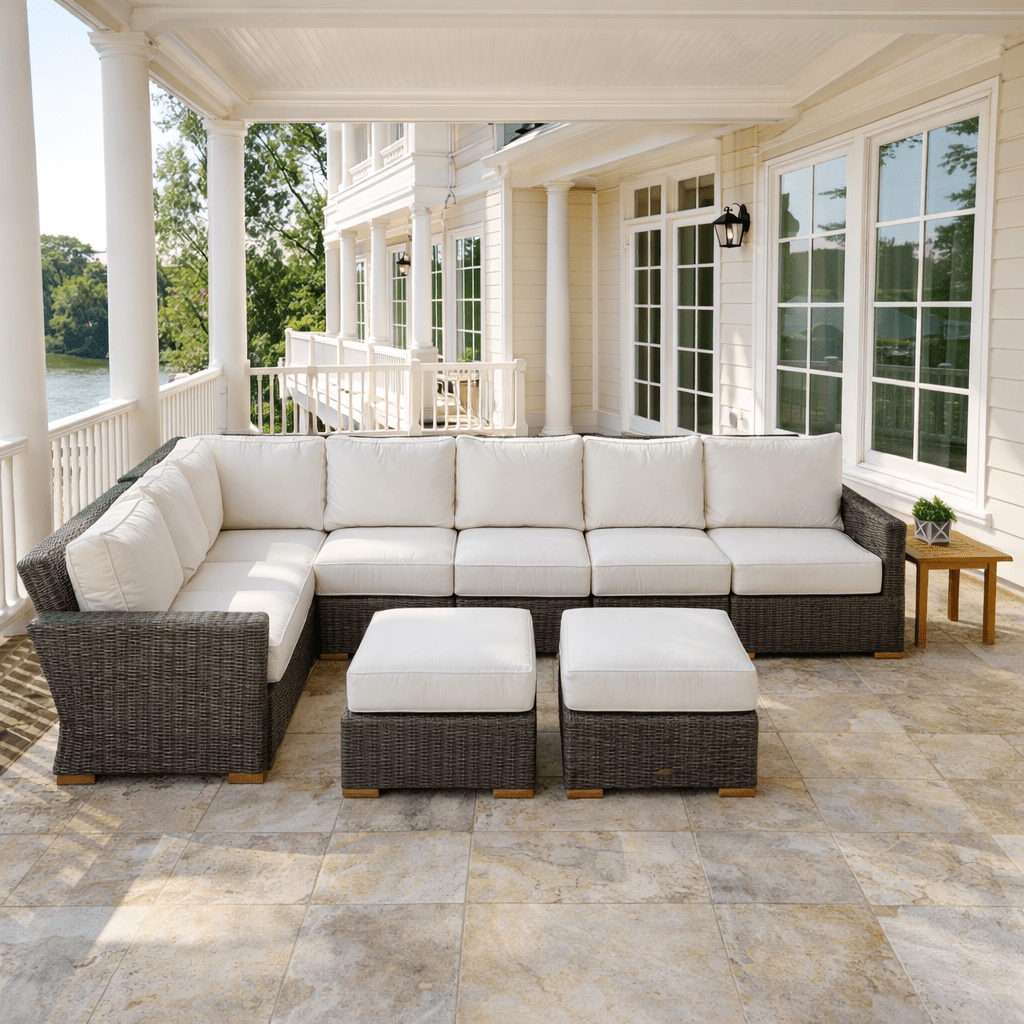 Large decks at lakefront homes and higher-elevation properties are natural candidates for teak sectional seating. A sectional gives the deck a clear center of gravity and provides more visual order than lining the railing with unrelated chairs.
Before choosing the largest configuration that fits, preserve the circulation route from the house to stairs, grill and view edge. A mountain deck often has fewer usable traffic paths than its square footage suggests. Furniture should frame the view without turning the deck into an obstacle course.
For many homes, a complete teak outdoor dining arrangement is the second priority. Six-person sets suit smaller households, while eight- and ten-person configurations make sense when the property serves as the gathering place for extended family.
Consider chair clearance before table capacity. On a deck, every additional seat requires room not only for the chair but for someone to pull it back without colliding with a railing or creating a bottleneck.
Teak Adirondack chairs are unusually natural fits for Tahoe because they bridge lake-house and mountain-cabin aesthetics. Use them where lingering matters more than formal entertaining: a lake-facing corner, fire area, garden edge or quiet secondary deck.
Pairs usually work better than isolated chairs. Add a side table between them and the arrangement becomes a complete destination rather than leftover seating.
A fire table can anchor a dedicated evening seating area and visually separate it from daytime dining. Surround it with deep seating or lounge chairs while maintaining the clearances and operating practices required for the specific fire product and property.
This configuration is especially useful when a large deck would otherwise feel empty after dinner. Instead of trying to illuminate and occupy every square foot, create one comfortable nighttime zone.
Not every scenic spot needs a full furniture group. A teak garden bench can make sense along a landscaped path, near a quieter side of the home or at a secondary viewpoint where a dining or lounge set would be excessive.
This is an example of furnishing according to duration. The primary deck deserves furniture for hours of use; the overlook where someone pauses with coffee may need only one excellent seat.
Tahoe architecture ranges from traditional cabins and lodge-inspired houses to contemporary mountain homes with large areas of glass, steel and stone. Teak is useful precisely because it does not force the homeowner into one version of “mountain style.” Its natural wood character can reinforce rustic materials while cleaner-lined collections also sit comfortably beside contemporary architecture.
On homes dominated by timber, stone and darker exterior finishes, natural teak brings warmth without requiring furniture that imitates log construction. Adirondack chairs, substantial dining tables and classic lounge pieces tend to feel especially appropriate.
If the architecture already contains many rustic materials, we would avoid over-theming the furniture. Simple teak forms allow the house, forest and landscape to provide the mountain character.
Modern Tahoe homes often benefit from greater contrast. Clean-lined teak seating against stone paving, dark metal railings or contemporary siding softens the architecture without making it feel traditional.
Sectionals, streamlined dining tables and restrained cushion colors work particularly well here. The wood becomes an organic counterpoint to harder architectural surfaces.
For lakefront and broad-view homes, furniture should support rather than compete with the setting. Keep the tallest visual elements away from the most important sightlines, and resist filling every edge of a deck simply because space exists.
One well-proportioned conversation group plus a separate dining zone usually reads more intentionally than numerous small arrangements. The lake remains the focal point; the furniture gives people a comfortable reason to stay and enjoy it.
Allowing natural teak to develop a silver-gray patina can be particularly attractive alongside stone, weathered siding and subdued mountain materials. Homeowners who prefer the warmer original teak color can maintain it instead.
The important point is to decide which appearance you prefer before establishing a maintenance routine. Patina is not something that automatically needs to be “fixed.”
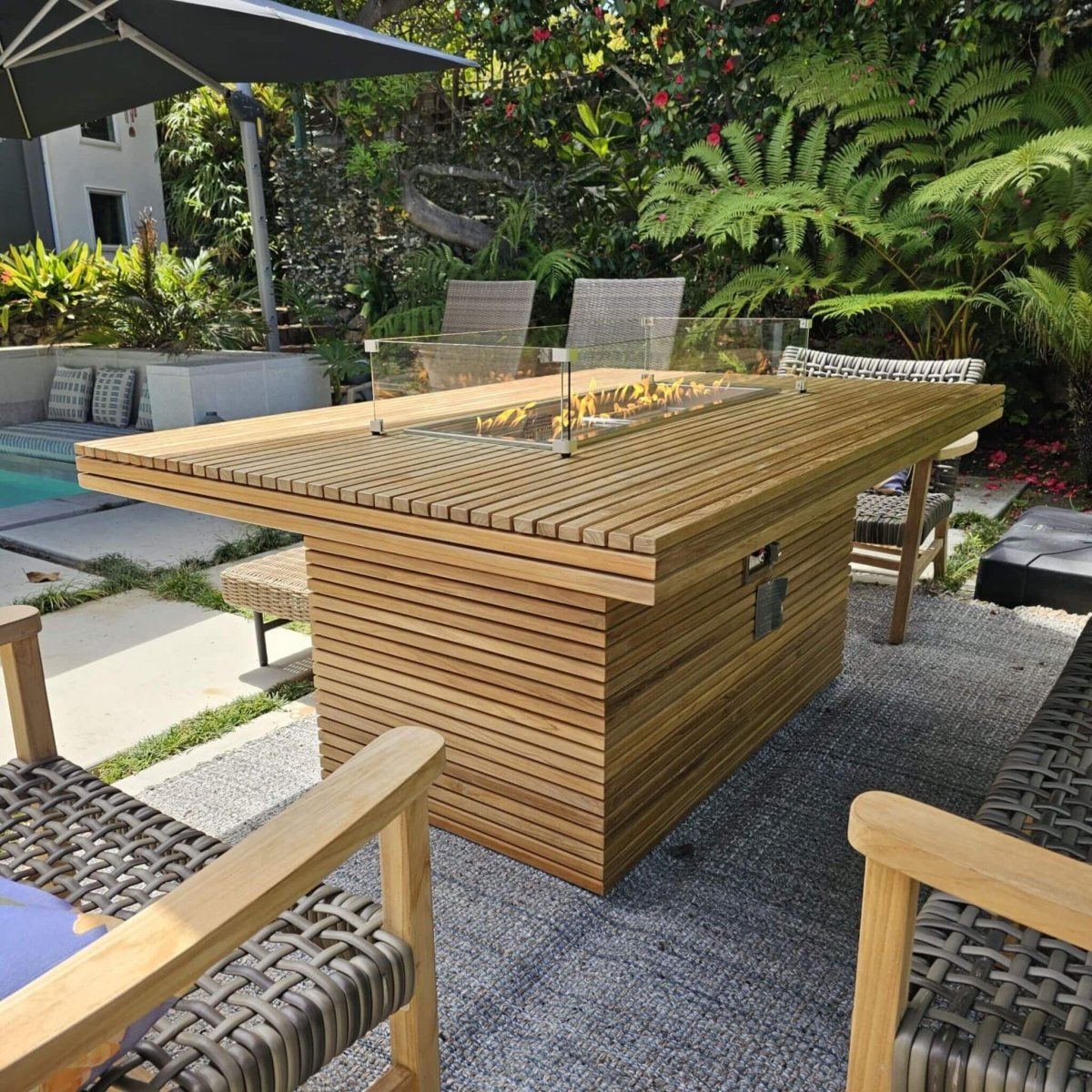 A patio set can look ideal during July and still be a poor match for the property if nobody has considered winter. Before purchasing, decide whether furniture remains outside, moves beneath cover or goes into storage.
Grade A teak simplifies the wood-frame side of that equation because it is designed for year-round outdoor exposure. Cushions and accessories should still have a separate seasonal plan.
One of the most Tahoe-specific planning mistakes happens before winter even starts: owners create a beautiful summer arrangement that blocks the routes needed to clear snow from doors, stairs and deck surfaces.
Think about the winter version of the deck before placing a large sectional or dining table. The memorable rule is simple: design the summer room around the winter pathway. A few inches of furniture placement can make seasonal management much easier.
Scattered chairs, stools and accent tables can make a large mountain deck look furnished in a showroom but fragmented in real life. They also create more objects to move, clean around and prepare for winter.
We generally prefer fewer, more complete groups: one dining area, one conversation area and perhaps one small scenic seating area. Teak's heavier, substantial feel works well with that approach.
Weather-resistant fabric is not the same thing as “never think about it again.” Sunbrella cushions used on many TeakHQ lounge pieces are weather-, fade-, UV- and water-resistant, but Tahoe owners should still consider snow season, prolonged vacancy and dry storage.
If there is no realistic place for a large volume of cushions, reduce the number of cushioned pieces or prioritize products with sling, synthetic-rope or uncushioned seating where appropriate.
Natural unfinished teak changes color outdoors. Homeowners sometimes respond to normal silver-gray weathering by starting an unnecessary cycle of aggressive maintenance.
Decide whether you prefer natural patina or original teak color. If gray teak works with the house, letting it weather can actually be the lower-maintenance ownership strategy.
Tahoe care should be seasonal rather than constant. Grade A teak does not need paint, artificial stain or mandatory sealing for outdoor durability. Most maintenance revolves around cleaning accumulated debris, deciding which color you want the teak to maintain, and handling cushions appropriately before extended winter conditions.
 A practical schedule is to inspect and clean furniture when the outdoor season begins and again when preparing the property for winter, with additional cleaning when visibly needed. Wooded decks may need attention more frequently because pine needles, pollen and organic debris can collect in joints and underneath furniture.
The goal is not constant polishing. Remove debris and surface dirt before it remains trapped against damp furniture for long periods.
Premium Grade A teak is designed for year-round outdoor use, so indoor storage of the teak furniture itself is not mandatory for durability. Nevertheless, owners may choose covered or protected placement to simplify snow clearing or reduce seasonal cleaning.
Before major winter accumulation, check that furniture is stable and positioned where it will not interfere with access. Do not treat the deck as a forgotten storage zone simply because the frame is weather resistant.
For Tahoe, cushion management deserves more attention than teak-frame maintenance. Before extended winter vacancy, we would generally favor a clean, dry storage location for removable cushions.
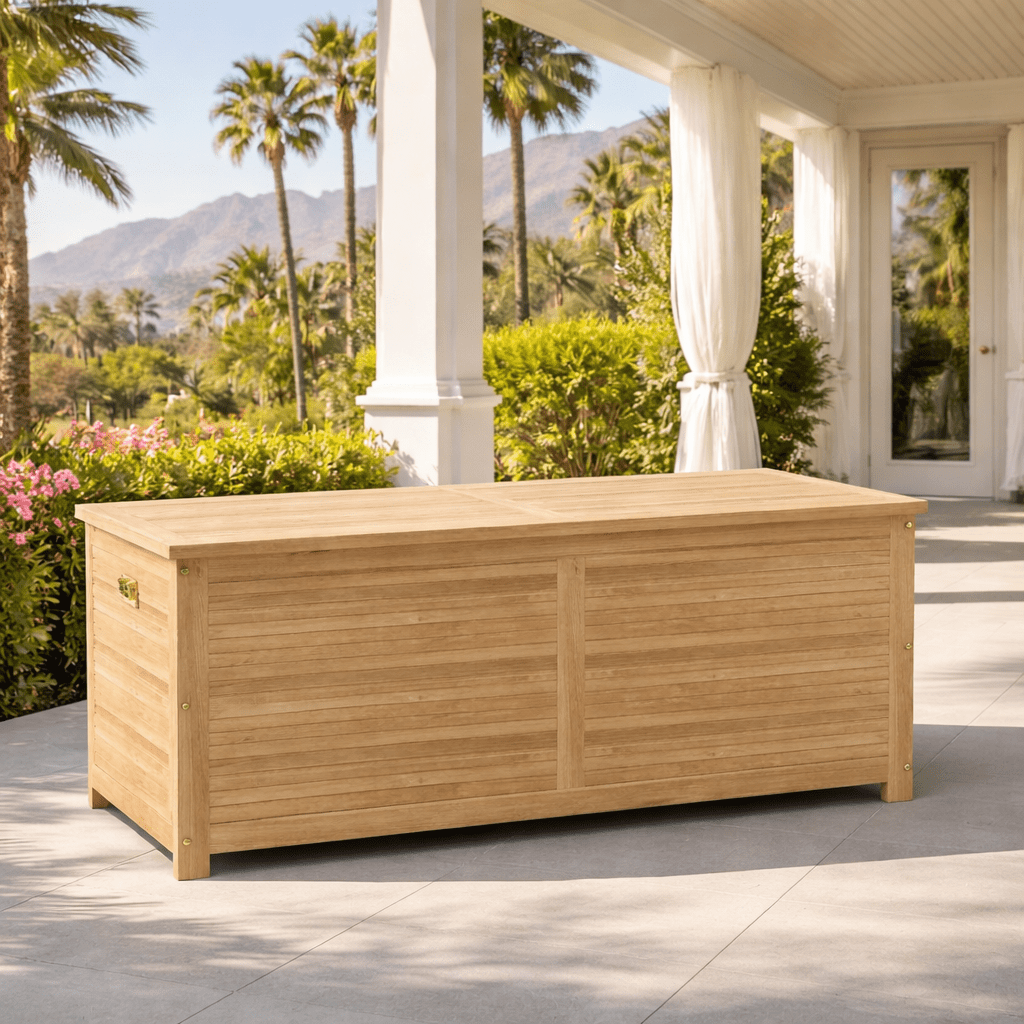
Deck boxes are useful during the active season for keeping outdoor accessories organized, but owners should follow the storage characteristics of the specific box and cushion products rather than assuming every outdoor container is equivalent to conditioned indoor storage.
If left untreated, teak naturally transitions to silver-gray. Homeowners who like that appearance can allow the process to occur and focus their maintenance primarily on cleanliness.
If retaining the original teak color is important, optional teak-care products can be used. Because sealing or oiling is not required for teak's inherent durability, this becomes an aesthetic decision rather than an obligation.
Protective covers can reduce debris and direct weather exposure, but TeakHQ's Grade A teak does not require covers simply to survive outside. If covers are used, they should be managed sensibly rather than trapping unwanted moisture or becoming an obstacle during snow season.
Second-home owners should choose the care system they can actually maintain. A simple routine completed consistently is more useful than an elaborate regimen that depends on being at the property every few weeks.
Start with the part of the property you use most: the lake-view deck, family dining terrace, fireside conversation area or quiet cabin porch. Then choose furniture around real household size, guest patterns, winter access and your preferred level of seasonal maintenance. Premium Grade A teak is especially compelling when you want authentic wood, substantial construction and an outdoor furnishing plan intended to remain part of the property for years rather than seasons.
Look for materials designed to handle sun, moisture, temperature changes and winter weather. Quality aluminum and some synthetic materials can work well, while premium Grade A teak is a particularly strong choice for homeowners who want real wood because it naturally resists moisture, rot, insects and warping.
Yes. TeakHQ's Grade A teak furniture is designed for year-round outdoor use and can withstand rain, sun exposure and temperature fluctuations. Owners may still move furniture beneath cover or reposition it to simplify snow management, and removable cushions deserve a separate winter-storage plan.
Teak itself does not require a cover for durability, although a cover can reduce direct weather exposure and seasonal debris. More importantly, make sure furniture placement does not interfere with snow clearing and that any cover is used appropriately rather than simply forgotten for the season.
Premium Grade A teak is naturally resistant to moisture and warping and is designed to withstand outdoor temperature fluctuations. Sensible winter placement and periodic inspection are still worthwhile, particularly on decks that experience repeated snow accumulation and meltwater.
Start with the view direction. A deep-seating lounge group or sectional works well on larger decks, while Adirondack chairs are excellent for smaller viewpoints. Preserve clear circulation to doors, stairs and winter snow-clearing routes.
Size the table around peak guest count rather than only the number of permanent residents. Vacation homes frequently host additional family and friends, making six-, eight- and ten-person sets or extendable dining tables useful. Always verify chair clearance and deck circulation before increasing capacity.
Yes, particularly on a large deck used for family gatherings. A sectional concentrates seating into one organized conversation zone. Before purchasing, make sure there is a realistic plan for removable cushions during prolonged vacancy and winter weather.
Unfinished teak naturally develops a silver-gray patina when exposed outdoors. That weathered appearance is normal. If you prefer the original teak color, optional teak care products can be used to help maintain the desired appearance.
Neither material is automatically right for every property. Aluminum is lighter and can suit highly contemporary spaces. Teak is heavier, warmer and made from natural wood, making it particularly attractive when you want furniture that complements timber, stone and other mountain-home materials.
Remove accumulated organic debris, clean the furniture as needed, store removable cushions appropriately and preserve access for snow clearing. Teak furniture can remain outdoors, so winter preparation is usually more about managing the overall patio than protecting the wood with mandatory coatings.


