
FREE SHIPPING
within mainland USA
within mainland USA
Home ▸ Teak Outdoor Furniture ▸ By Location ▸ Martha’s Vineyard, Massachusetts
Outdoor furniture on Martha’s Vineyard has to fit a lifestyle shaped by salt air, ocean breezes, damp coastal weather, bright summer sun, and a distinct seasonal rhythm. From Edgartown terraces and Katama beach houses to rural Chilmark properties and Vineyard Haven decks, furniture often serves as part dining room, part gathering space, and part place to enjoy the view. Premium Grade A teak is especially worth considering here because it combines natural weather resistance with the substantial, timeless character that works naturally with Vineyard homes.

Martha’s Vineyard is not simply a summer destination with ocean views; it is a coastal island environment where furniture may encounter salt-laden air, wind, periods of dampness, strong seasonal sun, rain, falling organic debris, and winter weather. Those conditions change what matters when evaluating premium outdoor furniture. Appearance is important, but material stability, moisture tolerance, practical maintenance, and the ability to remain outdoors through changing seasons deserve equal attention.
Waterfront and near-water properties deserve a different furniture evaluation than inland suburban patios. Salt carried through marine air can settle repeatedly on furniture surfaces and hardware. That makes corrosion resistance, simple cleaning, and the underlying outdoor suitability of the furniture more important than they may be farther inland.
Wood avoids some of the aesthetic issues associated with exposed painted or powder-coated metal surfaces, although hardware still matters. TeakHQ’s Royal Teak and Anderson Teak furniture uses stainless-steel hardware, while Verandis Teak uses brass hardware. Premium Grade A teak itself is naturally high in oils and has a dense grain structure, helping it resist moisture and outdoor weather without requiring paint or artificial stain for durability.
A common mistake in coastal furniture shopping is focusing only on rainfall. Direct rain is obvious; persistent moisture is less obvious. Morning dampness, humid air, shaded decks, wet bathing suits, and furniture positioned near vegetation can all keep an outdoor setting damp longer than expected.
Materials that depend on a delicate surface coating or that readily absorb moisture can require more intervention in those circumstances. Grade A teak is naturally resistant to moisture, rot, insects, and warping, which is one reason it has long been suited to outdoor applications.
The Vineyard combines two very different ownership periods. During summer, a dining terrace or deck may be used continually for breakfasts, afternoon lounging, cocktails, and dinner. During the quieter months, the same furniture may sit unused for extended stretches while experiencing rain, cold, wind, and temperature changes.
That favors furniture selected for the entire ownership cycle rather than for a few perfect July afternoons. Premium teak is designed for year-round outdoor use and can withstand sun, rain, and temperature fluctuations. Homeowners who prefer not to move large pieces into storage each fall therefore have more flexibility.
Ocean exposure also affects furniture planning. Rather than automatically filling a large deck with lightweight pieces, consider whether a more substantial setup will feel appropriate for an exposed terrace. Teak furniture has a naturally heavier, sturdier character than many lightweight alternatives.
That does not eliminate the need to prepare outdoor spaces for severe weather or secure loose items such as cushions and umbrellas. It does mean that everyday Vineyard breezes should be considered when comparing the overall feel of different furniture materials.
Several premium materials can work well on coastal properties. Quality aluminum offers a clean contemporary appearance and lower weight, while synthetic materials can appeal to owners who prioritize minimal intervention. For homeowners who want genuine wood, however, Grade A teak offers a particularly useful combination of weather resistance, structural stability, longevity, and visual compatibility with traditional coastal architecture.
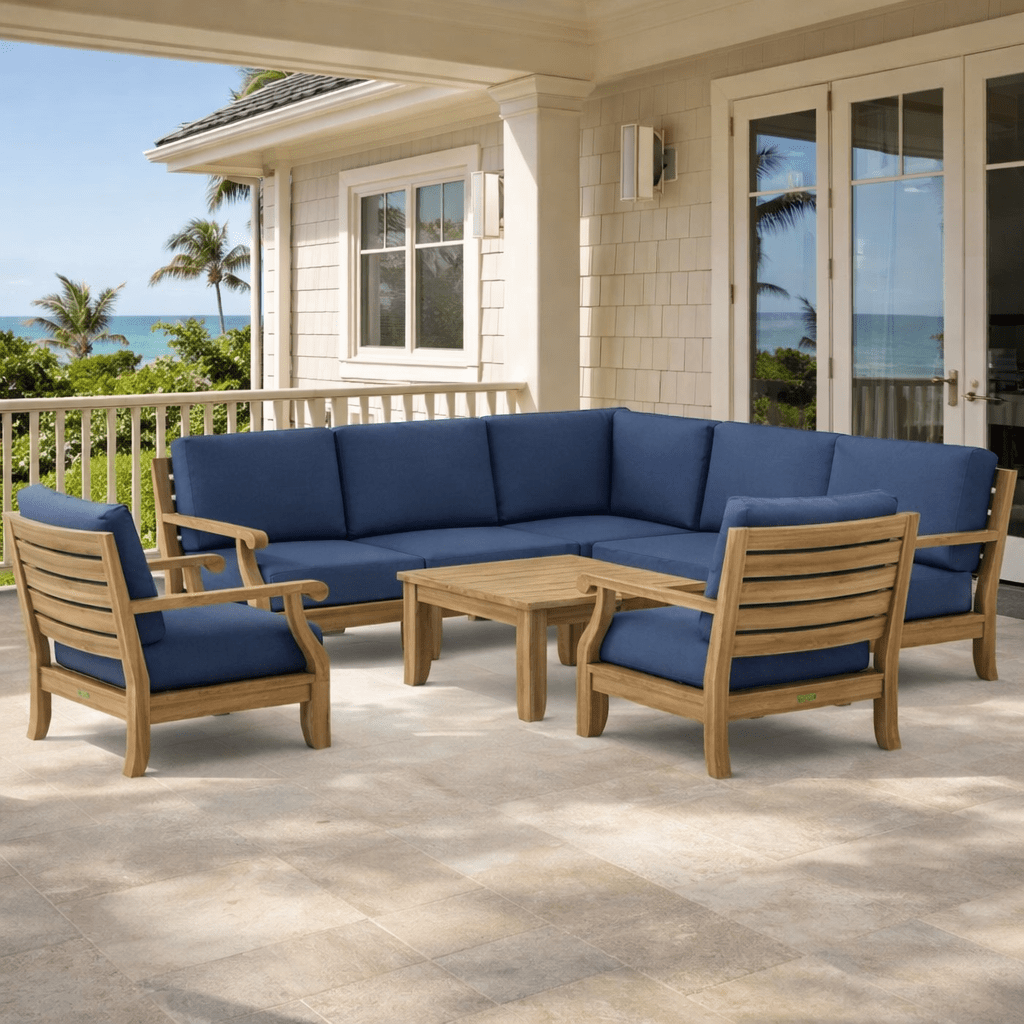 The fundamental advantage begins with the wood itself. Grade A teak contains naturally high levels of oils and a dense grain structure. Those characteristics contribute to its resistance to moisture, rot, insects, and warping without requiring an artificial stain for durability.
That matters on an island where a piece may experience sun one afternoon, damp coastal air overnight, and rain the following day. Instead of choosing a wood primarily for its showroom appearance and then depending heavily on coatings to protect it, teak begins with useful outdoor properties inherent to the material.
Outdoor furniture on the Vineyard encounters more than summer sunshine. Seasonal homes may leave furniture exposed through significant changes in temperature and moisture. Grade A teak is designed for outdoor use through rain, sunlight, and temperature fluctuations, making it well suited to that cycle.
Teak’s resistance to warping is particularly useful for furniture with moving or fitted components, including dining tables, chairs, and extendable tables. No natural material is immune to weathering, but premium teak is selected precisely because of its ability to remain functional in outdoor environments over long periods.
Natural unfinished teak gradually develops a silver-gray patina outdoors. On Martha’s Vineyard, that change can actually complement weathered shingles, white trim, stone walls, beach grasses, and other materials common in coastal landscapes.
Homeowners who prefer teak’s original warmer color can maintain or seal it instead. Those who like the naturally weathered look can leave it untreated. The important distinction is that allowing teak to gray is an aesthetic choice rather than evidence that the furniture has failed.
Premium teak costs more upfront than many outdoor furniture materials, so it makes sense to evaluate it as a long-term purchase rather than against the price of a replacement-oriented patio set. Properly made teak furniture can last for decades rather than seasons.
That can be particularly attractive for a Vineyard property where furniture is part of the home's established outdoor architecture. Instead of repeatedly finding another temporary set that approximately fits the deck, owners can build a dining or lounge arrangement intended to remain part of the property for years.
| Martha’s Vineyard Challenge | Why Premium Grade A Teak Performs Well |
|---|---|
| Coastal moisture | Natural oils and dense grain help resist moisture and rot. |
| Salt-laden air | Teak requires no painted surface coating for its outdoor durability. |
| Summer sun | Designed for outdoor sun exposure and naturally weathers to a silver-gray patina. |
| Rain | Grade A teak is naturally weather and moisture resistant. |
| Temperature changes | Dense teak is resistant to warping and designed for seasonal outdoor conditions. |
| Long off-season | Furniture is designed for year-round outdoor use. |
| Low-maintenance ownership | Teak can be allowed to weather naturally rather than requiring paint or stain. |
If we were helping furnish a Martha’s Vineyard property, we would start with how the home is actually used rather than choosing pieces individually. A summer house that hosts extended family needs a different plan from a quiet Chilmark retreat, and a narrow harbor-facing deck needs different proportions from a large Katama terrace.
For many Vineyard homes, we would make outdoor dining the first priority. Summer entertaining often changes quickly from household-only meals to gatherings of visiting family and friends, making a generously sized or extendable teak dining table especially practical.
An extendable table solves a problem that is easy to underestimate: you do not necessarily want a ten-person table occupying the terrace every day just because you occasionally seat ten people. A table that expands when guests arrive lets the patio feel comfortable during ordinary use without sacrificing entertaining capacity.
If space allows, we would avoid asking the dining table to serve every social function. A distinct teak lounge seating area gives guests somewhere to move after dinner and makes the patio useful even when no meal is planned.
On a larger property, position lounge seating where it captures a harbor, garden, meadow, or sunset view while keeping primary circulation between the house and dining table open. Sofas or loveseats paired with club chairs generally create a more natural conversational arrangement than pushing every seat against the perimeter.
One of the best opportunities on a Vineyard property is often not the main patio at all. A garden edge, bluff-facing section of lawn, corner of a porch, or quieter part of a deck may deserve its own small seating destination.
This is where a pair of Adirondack chairs, steamers, or a garden bench can outperform another large furniture group. The goal is not to fill every available area. It is to create several reasons to use different parts of the property throughout the day.
Vacation-home owners should also consider what happens when nobody is there. Cushions, serving pieces, umbrellas, and smaller accessories require more attention than a substantial teak frame. Furniture that can remain outdoors while loose items are brought in simplifies departure day and makes reopening the house easier.
A dedicated teak deck box can help centralize outdoor accessories, although cushions and other textiles should always be stored according to their specific care requirements.
Begin with the activity that defines your property. For homes built around long summer meals, start with dining sets or extendable tables; for waterfront decks used primarily for relaxing, begin with lounge seating or chaise loungers. Larger family and vacation properties usually benefit from combining one primary dining collection with a separate conversation or view-oriented seating area rather than trying to make one furniture arrangement do everything.
Outdoor living on the Vineyard is unusually seasonal but unusually intensive. A terrace that receives limited use during winter can function almost like another room in summer. That rhythm favors furniture that is comfortable enough for frequent use, substantial enough to feel permanent, and flexible enough to accommodate changing numbers of guests.
A Vineyard dining area often earns more use than a typical suburban patio because meals naturally migrate outdoors during good weather. Breakfast may begin with immediate family, lunch becomes casual after a beach trip, and dinner expands when friends or relatives arrive.
That pattern is why seating capacity deserves more thought than simply counting full-time residents. For a house that sleeps eight, a six-seat table may feel undersized precisely when the property is being enjoyed most. An eight- to ten-person teak dining set or an expandable configuration often better reflects how a vacation property actually functions.
Second homes and vacation properties frequently alternate between quiet days and full-house weekends. Rather than furnishing every area for maximum occupancy, create a few flexible zones. Dining should absorb the largest gathering; lounge seating can handle smaller groups; movable individual chairs can supplement either area when needed.
This reduces the temptation to overcrowd the patio permanently. Good outdoor planning is less about maximizing seat count than ensuring that seats remain comfortable to reach, use, and move around.
On waterfront and rural properties, the obvious instinct is to point every piece of furniture toward the view. That works for chaise lounges or Adirondack chairs but can make conversation awkward. For lounge areas, angle chairs toward both the scenery and one another so guests do not have to choose between socializing and looking outward.
A useful Vineyard rule is to reserve the strongest uninterrupted view for furniture designed for looking rather than talking. Dining and conversation arrangements can then occupy spaces where orientation is more flexible.
For higher-end vacation rentals, outdoor furniture must also be intuitive. Guests should understand immediately where to eat, where to relax, and where outdoor accessories belong. A coherent dining set and clearly defined lounge arrangement typically work better than a collection of unrelated movable chairs.
Durable natural materials can also help an outdoor area feel integrated with a premium property rather than temporarily furnished for rental use.
The strongest furniture choices depend less on whether a property is technically coastal—it nearly always is—and more on its specific relationship to space, views, entertaining, and the house itself. These are the configurations we would consider first.
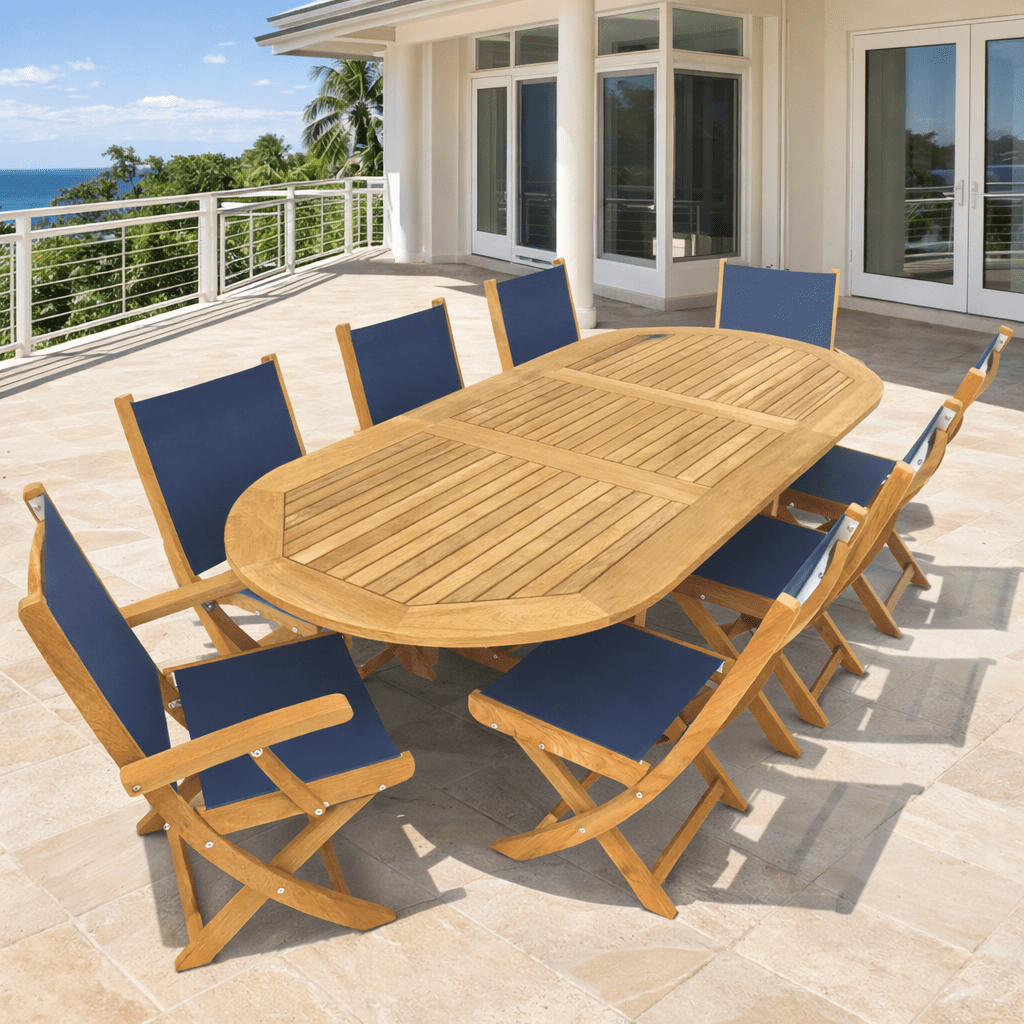 For an Edgartown, Katama, or up-Island home with a generous terrace, teak outdoor dining sets are usually the logical foundation. Six seats work well for smaller households, while eight- and ten-person configurations better accommodate homes where summer guests are expected.
Measure not only the tabletop footprint but also the space required to pull chairs out and walk behind occupied seats. On decks with railings or narrow transitions, that circulation zone can determine the appropriate table size more accurately than the nominal dimensions of the patio.
Covered porches and larger terraces are natural locations for deep seating. A sofa or loveseat with two lounge chairs creates a comfortable conversational group without requiring the footprint of a full sectional. Larger properties can use a sectional when the seating area is clearly defined and circulation remains open.
Most—but not all—TeakHQ patio seating pieces include Sunbrella cushions, which are weather resistant, fade resistant, UV resistant, and water resistant. Because specifications vary, check the individual product details rather than assuming every teak seating piece includes cushions.
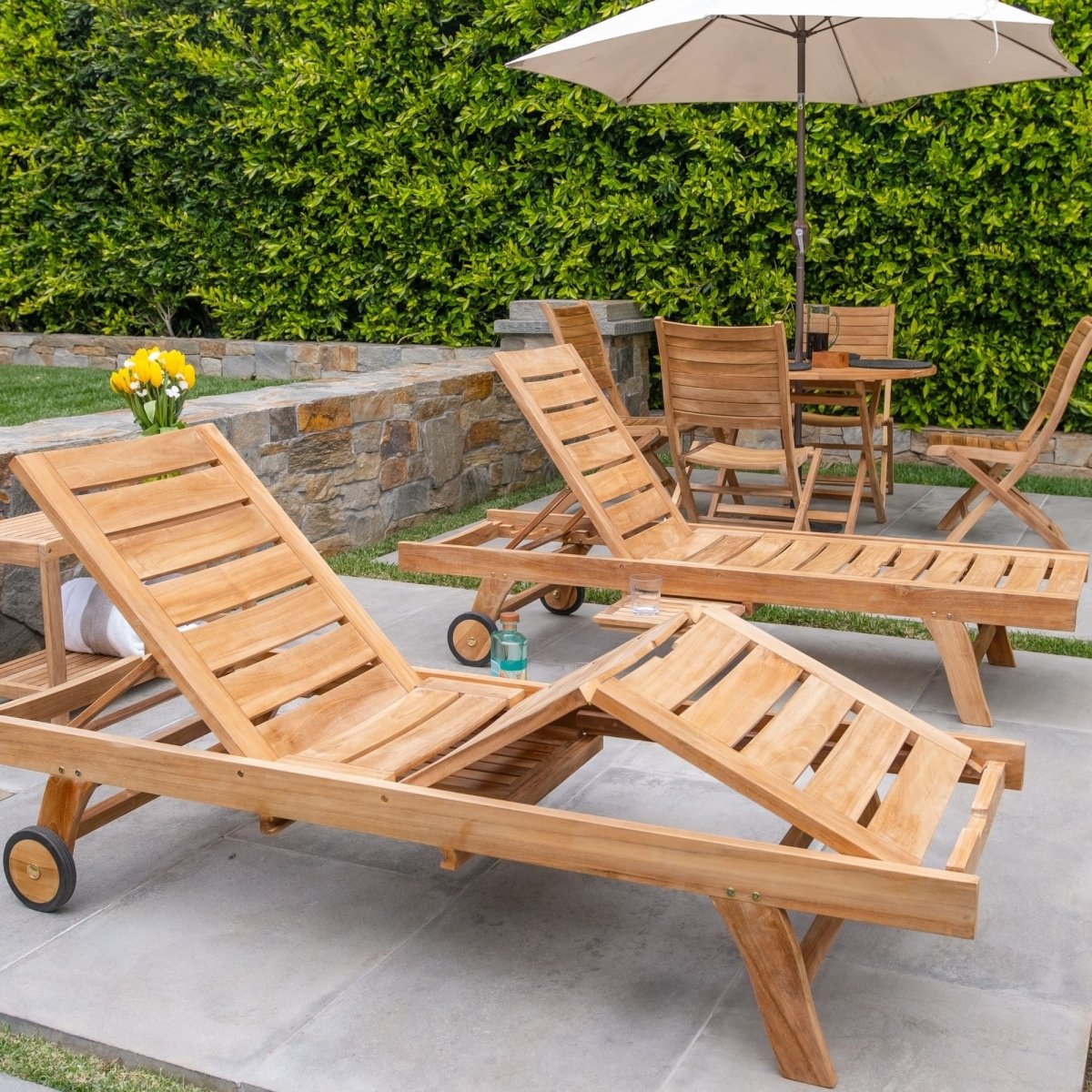
Where swimming pools, expansive lawns, or sunny decks are part of the property, teak chaise loungers create a destination separate from the dining area. A pair can make sense on a smaller deck; four or more work better where the home regularly hosts groups.
Do not automatically line loungers tightly against a pool or railing. Allow room for a side table, towels, circulation, and access to the adjustable chair mechanism. Slightly fewer loungers with usable spacing generally create a more luxurious setting than maximum seat density.
Few furniture types fit the informal side of island living better than Adirondack chairs. They work well at lawn edges, around casual fire areas, overlooking water, or on a secondary deck where a complete lounge set would feel excessive.
Using real teak rather than a synthetic imitation preserves the natural material character many owners want around shingle, stone, cedar, and traditional New England landscapes.
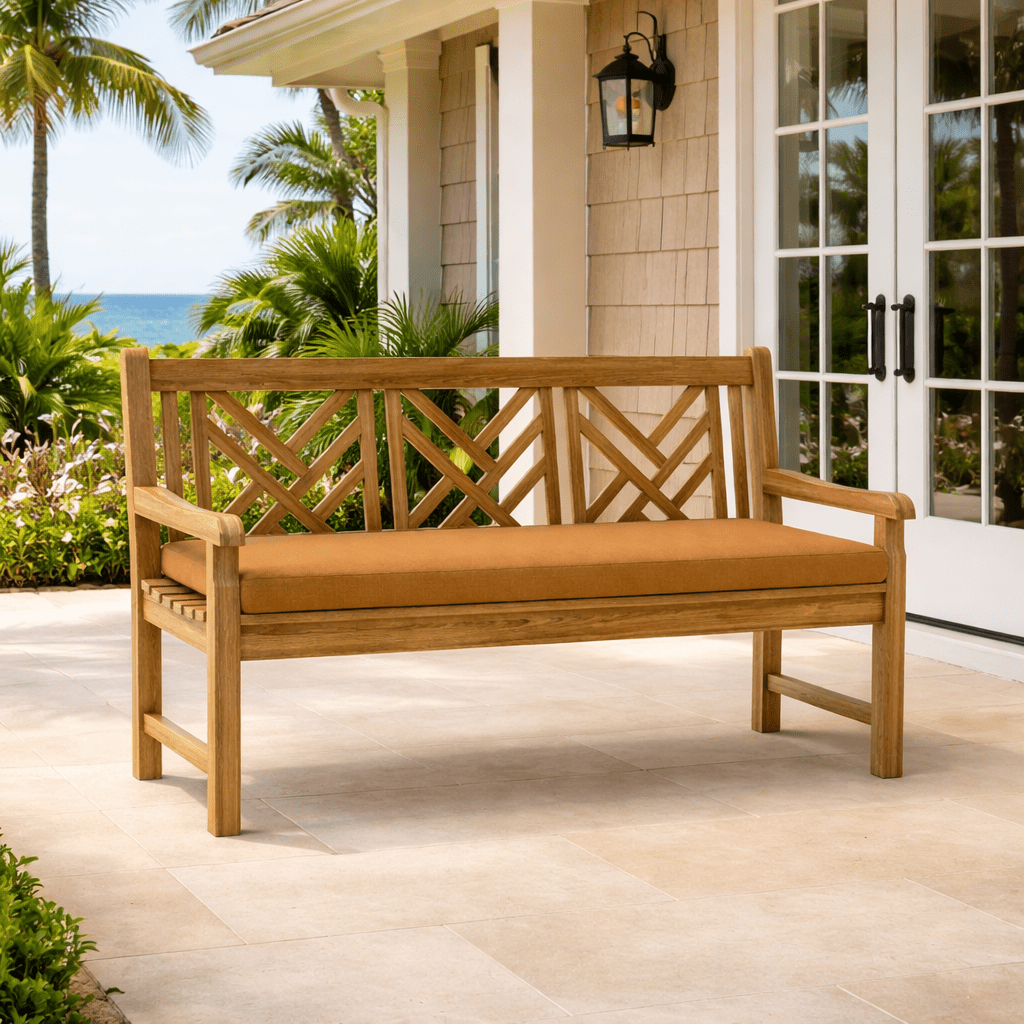
A teak garden bench can turn an otherwise transitional area into a usable part of the property. Consider the end of a garden path, an edge of lawn, a sheltered location near hydrangeas or other plantings, or a place where guests naturally pause between the house and another outdoor area.
These secondary seats are especially effective on larger Vineyard properties because they encourage people to experience more than the main terrace.
Martha’s Vineyard does not have one architectural identity. The island includes white clapboard whaling-era homes, Greek Revival influences, colorful Oak Bluffs cottages, Cape-inspired houses, shingled coastal homes, rural farmhouses, and contemporary interpretations of traditional New England architecture. The common design lesson is restraint: outdoor furniture generally looks most natural when it complements the house rather than competing with it.
Against white clapboard, traditional trim, brick, stone, or established gardens, teak works because the material itself provides warmth without requiring elaborate styling. Straightforward dining chairs, classic benches, and restrained lounge furniture allow the architecture to remain dominant.
Owners who let teak weather naturally may find that its silver-gray color becomes increasingly compatible with established coastal materials over time.
Weathered shingles and natural teak share a useful design characteristic: both can become quieter visually as they age. That makes teak particularly easy to integrate into a restrained coastal palette where texture matters more than bright color.
For a contemporary shingle-style property, cleaner teak silhouettes and simple cushion colors can keep the space feeling current without introducing a material that seems disconnected from the landscape.
Oak Bluffs presents a different opportunity. Where architecture already contains distinctive trim, color, or Victorian detail, furniture does not need to imitate those decorative elements. A simple teak table, rocking chair, or garden bench can provide visual calm and allow the architecture to remain the focal point.
West Tisbury, Chilmark, and Aquinnah often suggest a less formal approach, particularly around gardens, lawns, stone walls, wooded edges, and expansive landscapes. Furniture can be distributed in smaller destinations rather than concentrated on one formal patio.
This is where Adirondack chairs, benches, loungers, and modest conversation areas become especially useful. A large property does not necessarily need large furniture everywhere.
 A furniture set can look perfect during a calm summer afternoon and still be poorly suited to the property over a full year. Vineyard homeowners should consider moisture, temperature changes, wind exposure, and the long periods when furniture may remain outdoors unused.
Grade A teak helps solve this mismatch because it is designed for year-round outdoor use rather than only sheltered seasonal use.
Another mistake is assuming that furniture is protected simply because it does not sit directly on the beach. Marine air can reach decks and patios well away from immediate spray.
Choose materials based on coastal exposure from the beginning and clean deposited salt and dirt periodically. Teak’s natural moisture and weather resistance makes it a strong option, but routine cleaning is still sensible.
Large summer gatherings encourage owners to buy the largest table or sectional that physically fits. That can leave a patio difficult to use during the other 90 percent of the time.
Instead, preserve walking space and use adaptable pieces. An extendable table is often more useful than a permanently oversized table, while occasional chairs can increase capacity without crowding everyday circulation.
Outdoor fabrics can be highly weather resistant without being something you want perpetually soaked or covered in debris. Sunbrella cushions offer water, UV, weather, and fade resistance, but sensible handling still extends the pleasant ownership experience.
Plan where cushions will go before purchasing a large deep-seating arrangement. If the answer is “somewhere inside,” departure day at a vacation house can become much more complicated than expected.
On a property with a beautiful landscape, placing every chair beside the house can waste some of the home's best outdoor experiences. A bench in a garden, two Adirondacks overlooking the water, or a pair of loungers on a quieter deck can create more useful variety than adding another sofa to an already complete patio.
Teak ownership on the Vineyard can be relatively straightforward because the wood does not need paint, artificial stain, or mandatory sealing for outdoor durability. The most important distinction is between cleaning the furniture and deciding what color you want the teak to maintain.
 Salt, pollen, sand, leaves, bird residue, and ordinary dirt will eventually accumulate on outdoor furniture. Periodic cleaning helps keep surfaces pleasant to use and prevents organic debris from sitting against the wood for unnecessarily long periods.
How often you clean should depend on the property rather than an arbitrary calendar. An exposed waterfront deck may need attention more often than a sheltered inland garden patio.
Although teak is naturally moisture resistant, good outdoor housekeeping still matters. Avoid allowing piles of leaves, damp towels, covers, or other moisture-trapping materials to remain against furniture unnecessarily.
Keep the area around and beneath furniture reasonably clear so air can circulate, particularly in shaded locations where surfaces take longer to dry.
Untreated teak gradually changes from its original warm golden-brown appearance toward silver gray. Some Vineyard homeowners intentionally choose that look because it works beautifully with weathered shingles and coastal landscapes.
If you prefer the original color, teak can be treated with appropriate care products. TeakHQ offers teak cleaners and sealers for owners who want a more managed appearance. Treatment is optional rather than a requirement for the wood's durability.
Large teak frames do not necessarily need to be moved indoors each winter because the furniture is designed for year-round outdoor use. Before leaving a seasonal property, however, remove loose objects that may become problematic in severe weather and follow the care guidance for cushions, umbrellas, and accessories.
If you use a protective cover, choose and install it so moisture is not unnecessarily trapped against the furniture. A cover should solve a maintenance problem, not create a damp enclosure.
Teak care becomes simpler when owners stop trying to keep outdoor wood looking newly unpacked forever. Decide whether you prefer golden teak or naturally weathered silver-gray teak, adopt the maintenance routine appropriate to that choice, and allow the material to behave like genuine outdoor wood.
For many Vineyard homes, that gradual aging is not a compromise. It becomes part of the property's coastal character.
The right Vineyard furniture plan begins with the property: how many people normally use it, where guests gather, which views deserve their own seating, how exposed the space is, and how much seasonal maintenance you want to manage. Once those questions are answered, premium Grade A teak becomes a compelling option for homeowners who want genuine wood, long-term outdoor performance, flexible maintenance, and furniture that feels at home in both traditional and contemporary island settings.
Explore TeakHQ’s dining, lounge, deck, and garden collections to build an outdoor setting around the way your Martha’s Vineyard home is actually used.
For coastal homes, prioritize materials that tolerate moisture, sun, temperature changes, and repeated outdoor exposure. Quality aluminum and some synthetic materials can work well, while premium Grade A teak is especially attractive for homeowners who want real wood with natural moisture, rot, insect, and weather resistance.
Yes. Grade A teak is naturally high in oils and has a dense grain structure that helps it resist moisture and outdoor weather. On coastal properties, periodically cleaning salt and other residue from the furniture is still good practice.
Yes. TeakHQ’s Grade A teak furniture is designed for year-round outdoor use and can withstand rain, sun exposure, and temperature fluctuations. Cushions, umbrellas, and loose accessories may require separate seasonal storage or protection.
Prioritize a complete dining area, comfortable lounge seating, and simple accessory storage. An extendable dining table is particularly useful because vacation homes often alternate between small household meals and much larger gatherings.
A cover is optional rather than required for teak's outdoor durability. If you choose to cover furniture, use the cover properly and avoid creating conditions that unnecessarily trap moisture against the wood.
Yes. Natural unfinished teak gradually weathers to a silver-gray patina when exposed outdoors. That color change is normal. Owners who prefer the original warmer teak color can use appropriate care products to maintain it.
There is no single schedule appropriate for every property. Waterfront furniture exposed to salt, sand, pollen, and dampness may need cleaning more frequently than furniture on a sheltered patio. Clean when visible residue accumulates rather than relying exclusively on a fixed calendar.
Base capacity on peak realistic use rather than only the number of permanent residents. Homes that frequently host summer guests often benefit from seating for eight or more, but an extendable table can provide that capacity without occupying maximum space every day.
Each material has legitimate advantages. Aluminum is lighter and can suit highly contemporary spaces, while poly furniture offers a synthetic, lower-maintenance approach. Teak is heavier, made from genuine wood, has a warmer natural appearance, and offers the long-term weather resistance many coastal homeowners prefer.
Start with the deck's primary use. Choose dining furniture when meals and entertaining dominate; use loungers or deck chairs where enjoying the view is the priority; and choose deep seating where conversation is the main activity. Avoid filling the deck so completely that circulation and sightlines suffer.


