
FREE SHIPPING
within mainland USA
within mainland USA
Home ▸ Teak Outdoor Furniture ▸ By Location ▸ Nantucket, Massachusetts
Outdoor furniture on Nantucket lives in a demanding but distinctive environment: salt-laden air, wind, periods of damp weather, bright summer sun, and long seasonal exposure. At the same time, furniture needs to look appropriate beside weathered-shingle cottages, historic homes, ocean-facing decks, sheltered gardens, and larger summer properties designed for guests. Several premium materials can work here, but Grade A teak is especially compelling because its natural oils, dense grain, substantial feel, and flexible aging make it well suited to coastal island ownership.

Choosing outdoor furniture on Nantucket is less about finding something labeled “weather resistant” and more about understanding the combination of exposure a particular property receives. An inland garden near Town may be relatively sheltered. A deck in Madaket, Pocomo, Dionis, or near an exposed stretch of shoreline can experience a much more persistent mix of wind, airborne salt, moisture, and sun. Furniture that works beautifully in a protected suburban backyard on the mainland may require more attention when placed in an exposed island setting.
Salt is one of the most important differences between furnishing an island property and furnishing a comparable home farther inland. It can settle on exposed furniture, cushions, hardware, glass, and nearby surfaces even when a home is not directly on the beach. The practical implication is simple: materials, hardware, and finishes should be chosen with long-term outdoor exposure in mind rather than merely for how they look in a showroom.
Real Grade A teak is a strong candidate because its natural oils and dense grain help it resist moisture and outdoor weathering without requiring paint or an artificial stain for durability. Royal Teak and Anderson Teak pieces also use stainless-steel hardware, while Verandis Teak uses brass hardware.
On an exposed Nantucket deck, furniture weight and configuration deserve more attention than they might in a sheltered inland courtyard. Lightweight pieces can be inconvenient when weather changes quickly or when a property is left unattended between visits. Teak has a heavier, sturdier, more architectural feel than lightweight aluminum, which can be an advantage where homeowners prefer furniture that feels substantial.
That does not mean furniture should be treated as storm equipment. Cushions, umbrellas, accessories, and movable pieces should still be secured or brought into a protected location when severe weather is expected. The useful distinction is everyday stability versus storm preparation.
Marine humidity, rain, shade, and organic debris can create damp surfaces. Even with a moisture-resistant material, placement matters. Furniture performs better when water can drain, air can circulate, and leaves or debris are not allowed to remain trapped beneath cushions or around joints.
This is particularly important in garden settings surrounded by dense plantings or on shaded porches where surfaces dry more slowly than they do on sunny, open decks. The furniture material is only one part of the equation; drainage and airflow are part of the furnishing plan.
A Nantucket summer home may sit unattended for meaningful stretches of the year. That changes how we evaluate outdoor furniture. A material that looks excellent only when someone frequently refinishes, moves, or monitors it can become inconvenient for a seasonal property.
Grade A teak can be left outdoors year-round and can also be left untreated, allowing it to weather naturally to a silver-gray patina. For many owners, that flexibility is more useful than trying to keep every outdoor surface looking freshly finished throughout the season.
The case for teak is strongest when it is compared with the actual demands of the property. Aluminum can be an excellent choice for homeowners who want a lighter, distinctly modern material. Poly lumber offers a synthetic, lower-maintenance approach. Premium Grade A teak makes the most sense for Nantucket buyers who want real wood, substantial construction, natural weather resistance, and an appearance that works naturally with coastal and traditional architecture.
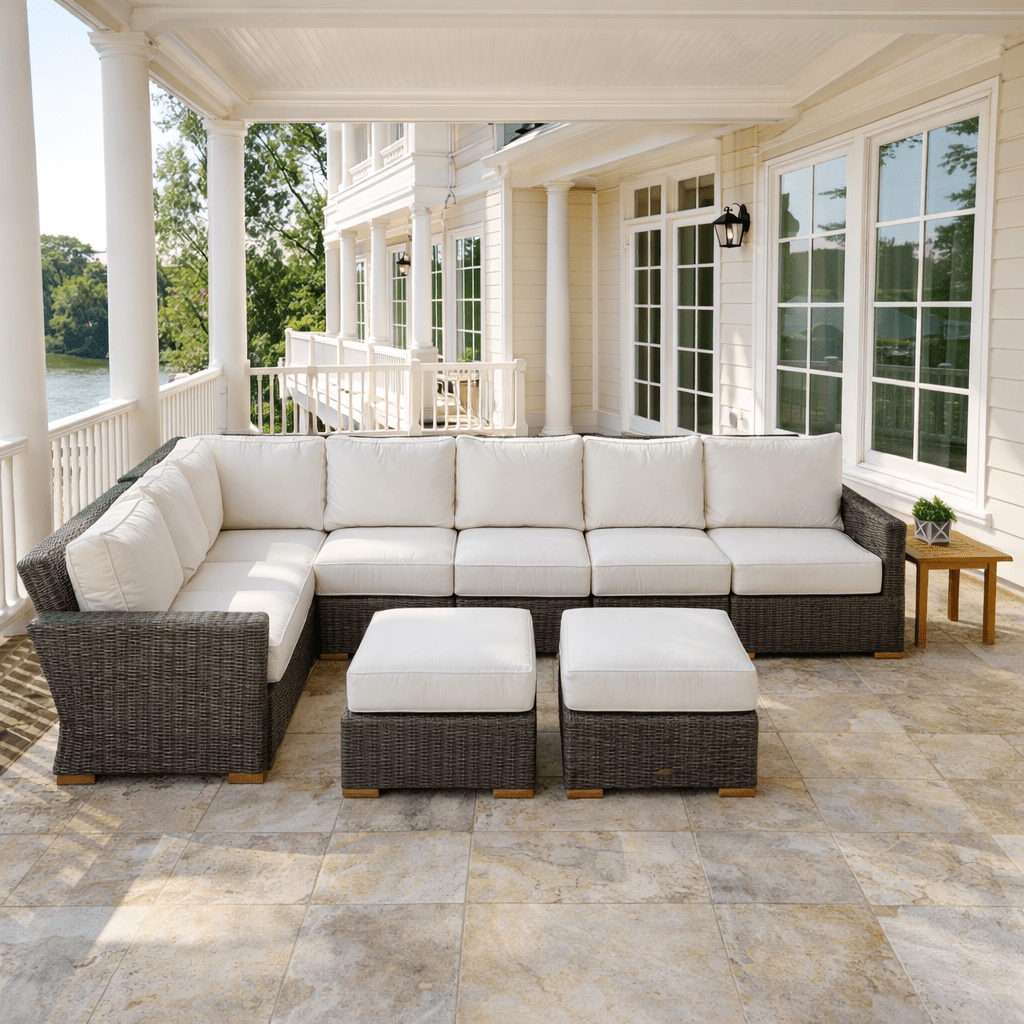 Grade A teak contains naturally high levels of oils and has a dense grain structure. Those characteristics help the wood resist moisture, rotting, insects, and warping. On Nantucket, where furniture may encounter humid air, rain, coastal exposure, and changing temperatures over the course of a year, those are practical rather than theoretical advantages.
The key is that teak does not depend on a painted coating for its fundamental outdoor durability. An owner can choose how much cosmetic maintenance to perform without making routine refinishing a prerequisite for outdoor use.
Outdoor teak exposed to sunlight naturally transitions from its original warm wood tone toward a silver-gray patina unless the owner chooses to maintain the original color with appropriate teak-care products. That change is normal weathering rather than an indication that the wood has reached the end of its useful life.
On Nantucket, that is especially worth understanding before purchase. Some owners deliberately prefer weathered teak because the gray tone looks at home beside cedar shingles, pale trim, beach grasses, and restrained coastal palettes. Others prefer the warmer original teak color. Both approaches are legitimate; the important thing is choosing intentionally.
Teak's moisture resistance and rot resistance are important in an island environment, but “moisture resistant” should not be confused with “never clean it.” Salt residue, pollen, dirt, leaves, and organic material can still accumulate on any outdoor furniture.
The advantage is ownership flexibility. Premium teak can be cleaned as needed and allowed to age naturally, or an owner can take a more active approach to preserving its original appearance. That is particularly attractive for second-home owners who would rather spend their Nantucket visits using the patio than managing a demanding finish schedule.
Premium teak costs more upfront than many outdoor furniture materials, so the useful question is not whether teak has the lowest initial price. It does not. The better question is how long the homeowner expects the outdoor space to remain furnished at a premium level.
Quality teak furniture is built to last decades rather than seasons. For a long-term property, that can make the higher purchase price easier to justify because the decision is being made over a much longer ownership horizon.
| Nantucket Challenge | Why Premium Grade A Teak Performs Well |
|---|---|
| Salt-laden coastal air | Dense, naturally oily teak is well suited to outdoor moisture and weather exposure. |
| Marine humidity | Teak naturally resists moisture and rotting. |
| Rain | Grade A teak is designed for year-round outdoor use and withstands rain. |
| Summer sun | Teak withstands sun exposure and naturally develops a silver-gray patina over time. |
| Temperature changes | Teak is designed to withstand outdoor temperature fluctuations and resists warping. |
| Exposed decks | Teak has a heavier, sturdier feel than lightweight outdoor furniture. |
| Seasonal ownership | It may be left untreated outdoors rather than requiring an artificial stain for durability. |
We would begin with the property, not the furniture catalog. A compact cottage in Siasconset, an older home near Town, a large summer property in Dionis, and an ocean-facing house in Madaket should not receive the same furniture plan. The first questions would be where people naturally gather, how exposed each area is, how many guests typically visit, and whether the home is occupied continuously or mainly during the summer.
For many Nantucket homes, we would allocate the prime protected outdoor zone to dining first. Summer houses tend to attract guests, and a table creates a natural center for breakfast, seafood dinners, grilling, and evenings that extend well past the meal.
A teak outdoor dining set sized for the household plus regular guests is a logical starting point. Where guest counts change from weekday to weekend, an extendable teak dining table can be more useful than permanently filling the terrace with the largest table that might ever be needed.
On larger properties, we would resist the temptation to create one oversized furniture grouping. Dining and conversation function differently. The dining table works best near the kitchen or grill; lounge seating often works better closer to the view, garden, fire feature, or quieter side of the terrace.
A distinct teak lounge set also lets guests redistribute naturally after dinner. Instead of eight people remaining upright around the table all evening, some can move to sofas or club chairs while others stay at the dining area.
One of the most useful Nantucket-specific planning rules is this: do not automatically point every chair toward the house just because that makes the furniture photograph neatly. On an island property, the view may be the most valuable feature of the outdoor room.
For a harbor, ocean, moor, or garden outlook, orient the primary lounge seats toward what people came outside to enjoy. Dining can remain more architectural and aligned with the house, while pairs of Adirondack chairs, loungers, or a bench can turn toward the landscape.
If the home is frequently unoccupied, simplify the number of loose items that need attention. Cushions can make deep seating exceptionally comfortable, and many TeakHQ patio pieces include Sunbrella cushions, but an absentee-owner plan should also include a realistic place to put cushions and accessories when rough weather is expected or the property is being closed for a period.
This is one reason teak deck boxes can be particularly useful on seasonal properties: storage becomes part of the furniture plan rather than an afterthought.
Start with the way the home is actually used. Frequent hosts should look first at dining sets and extendable tables; homes with generous terraces may benefit from a separate deep-seating group; view-oriented properties often justify Adirondack chairs, steamers, or chaise lounges. For cottages and smaller decks, prioritize adaptable pieces and comfortable seating rather than trying to reproduce the furniture count of a large estate.
Nantucket outdoor living is intensely seasonal even though the furniture itself may remain outside far longer. Warm-weather weeks can turn decks, gardens, porches, and terraces into primary living spaces, while quieter portions of the year place more emphasis on exposure, weather, and unattended-property planning. That concentrated use pattern should influence both furniture quantity and configuration.
A second home that ordinarily serves four people may suddenly need to accommodate eight or ten when family and friends arrive. Designing the patio only around the normal household size can leave the space undersized precisely when it matters most.
This does not necessarily mean buying the largest table available. An extendable table, additional stackable or folding chairs, and a nearby lounge area can absorb a changing guest count more gracefully than one enormous permanent dining arrangement.
For a summer property, outdoor dining is not merely an occasional alternative to the kitchen table. Breakfast after a morning walk, lunch between beach trips, grilling in the evening, and leisurely dinners with guests can all use the same outdoor room.
That level of use is why we would prioritize comfortable dining chairs and enough circulation space around the table rather than maximizing seat count to the very edge of the deck.
Some of the most satisfying Nantucket spaces are simple: two substantial chairs and a small table positioned toward water, marsh, moorland, or a landscaped garden. Not every part of a premium property needs to become a formal entertaining area.
This is where teak Adirondack chairs, steamers, or a garden bench can do something a sectional cannot. They create a destination rather than another room.
Furniture decisions should account for who will actually manage the property. Owners who arrive for weekends or several summer stretches often benefit from outdoor materials that do not demand a complicated maintenance ritual before the patio can be used.
Teak's option to weather naturally is valuable in this setting. Homeowners who enjoy the silver-gray appearance can accept the change rather than treating it as another seasonal project.
 The right furniture category depends less on the island as a whole than on the micro-setting of the home. A protected Town garden, compact Siasconset cottage, open Surfside deck, and broad waterfront terrace each call for a different combination. The goal is to put the largest pieces where they earn their footprint and use smaller seating to take advantage of views and secondary spaces.
For a primary terrace beside the kitchen, start with a table sized for ordinary use rather than maximum occupancy. Six seats can be ideal for a family-oriented home; eight or more makes sense when guest entertaining is routine.
Large properties can explore the broader teak dining furniture collection, while changing guest counts are a strong argument for extension capability. Leave enough space around the chairs that people can move comfortably even when every seat is occupied.
Deep seating works best where the available footprint supports an actual conversation zone. On broad patios and sheltered terraces, a sofa or sectional with a coffee table can effectively create an outdoor family room.
For tighter spaces, two club chairs and a loveseat may produce a better result than a sectional squeezed against circulation paths. The measure of a good layout is not how many seats fit on paper but whether people can move naturally between the house, dining area, grill, lawn, and view.
Few furniture forms suit a relaxed island property better than seating intended simply for looking outward. Adirondack chairs work well on lawns, broad decks, or quiet edges of a garden. Steamers provide a more nautical deck-chair profile and can work particularly well on traditional coastal properties.
Place these pieces where two people would genuinely choose to sit with coffee or a drink. A pair positioned at the right viewpoint may be used more often than six extra seats added to the main terrace.
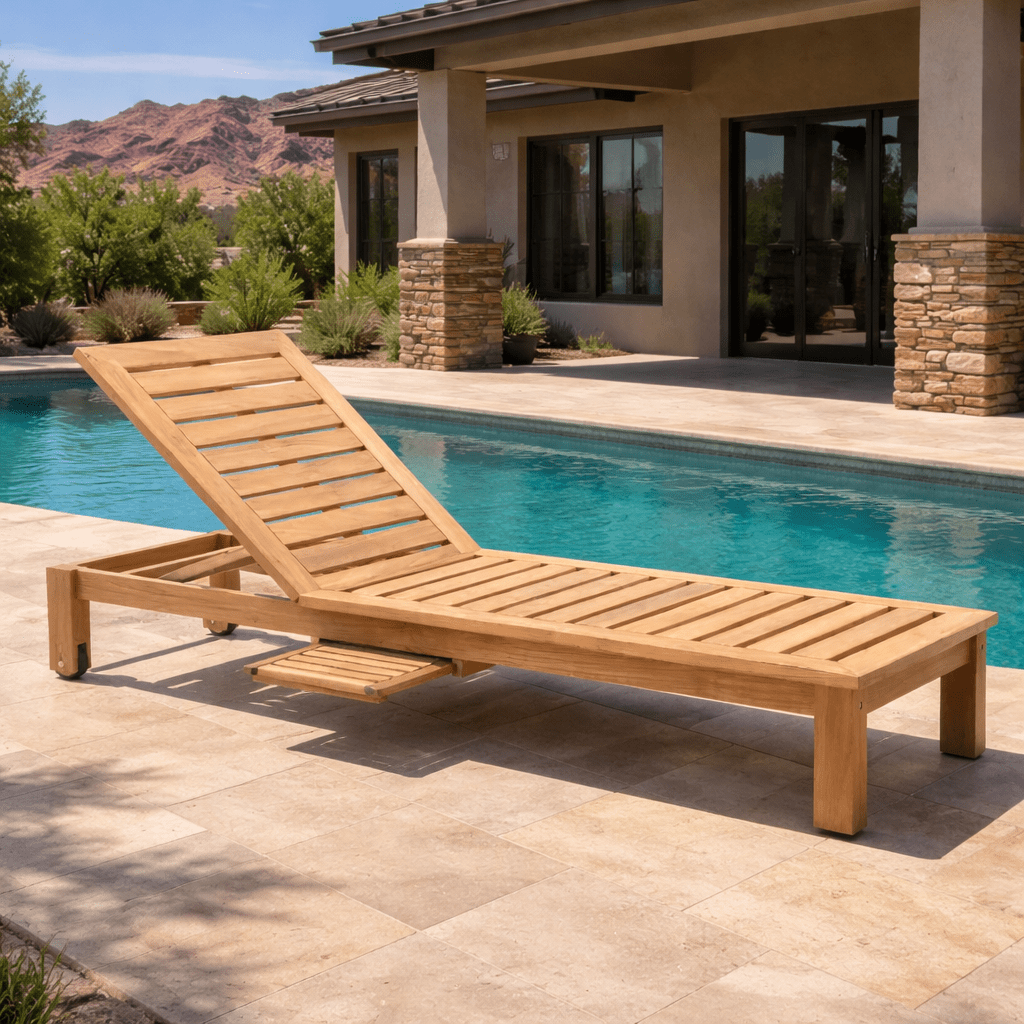 Chaise lounges make sense around pools, sunny decks, and private terraces where reclining is actually part of the household routine. They take more floor area than upright chairs, so we would not automatically add them simply because a property is near the beach.
If loungers are appropriate, provide side-table access and enough space to reach each chair without weaving between furniture. A well-spaced pair is usually more inviting than a crowded row.
Nantucket properties with established landscaping often contain spots that should remain quieter than the main entertaining terrace. A teak garden bench can establish a destination near a path, flowering garden, lawn edge, or view without turning that location into another full furniture grouping.
These secondary seating moments are particularly effective on traditional properties because they make the landscape feel inhabited without overwhelming it.
Nantucket furniture should generally support the architecture rather than compete with it. The island contains historic buildings, modest cottages, Shingle-style residences, Colonial Revival influences, and newer homes designed to fit within a visually restrained coastal context. Natural teak is unusually adaptable because it can begin warm and golden, then develop a quieter silver-gray surface as it ages.
Traditional Nantucket architecture often favors texture and proportion over showy ornament. On these homes, natural materials tend to integrate more comfortably than furniture that looks conspicuously synthetic or visually heavy.
Untreated teak's eventual gray patina can be especially compatible with weathered shingles. The important distinction is that homeowners do not need to wait for the wood to gray: new golden teak can provide a warm counterpoint to a subdued exterior, while aged teak produces a more tonal look.
A common design mistake is assuming that a historic or Shingle-style home requires heavily decorative furniture. Often the opposite works better. Clean teak frames, straightforward slatted forms, and restrained cushions allow the architecture and landscape to retain visual priority.
This makes teak useful across both traditional and transitional outdoor spaces. The same wood can feel classic beside a cottage and considerably more contemporary when used in a sectional with simple cushions and crisp geometry.
There is no need to make every furnishing blue, striped, or explicitly nautical for a Nantucket patio to feel coastal. Wood, shingles, sand-colored hardscape, grasses, flowers, and the surrounding landscape already establish the setting.
For cushioned lounge pieces, a restrained fabric palette often gives homeowners more flexibility over time. Most TeakHQ patio seating includes Sunbrella cushions, with available colors varying by product and brand.
In gardens, the most successful furniture often feels placed rather than installed. A bench near a planting bed, dining table partially framed by vegetation, or two Adirondack chairs looking across a lawn can feel more appropriate than filling every open hardscape surface.
That principle matters particularly on an island known for strong architectural and landscape character: leave enough visual space for the property itself to remain part of the outdoor room.
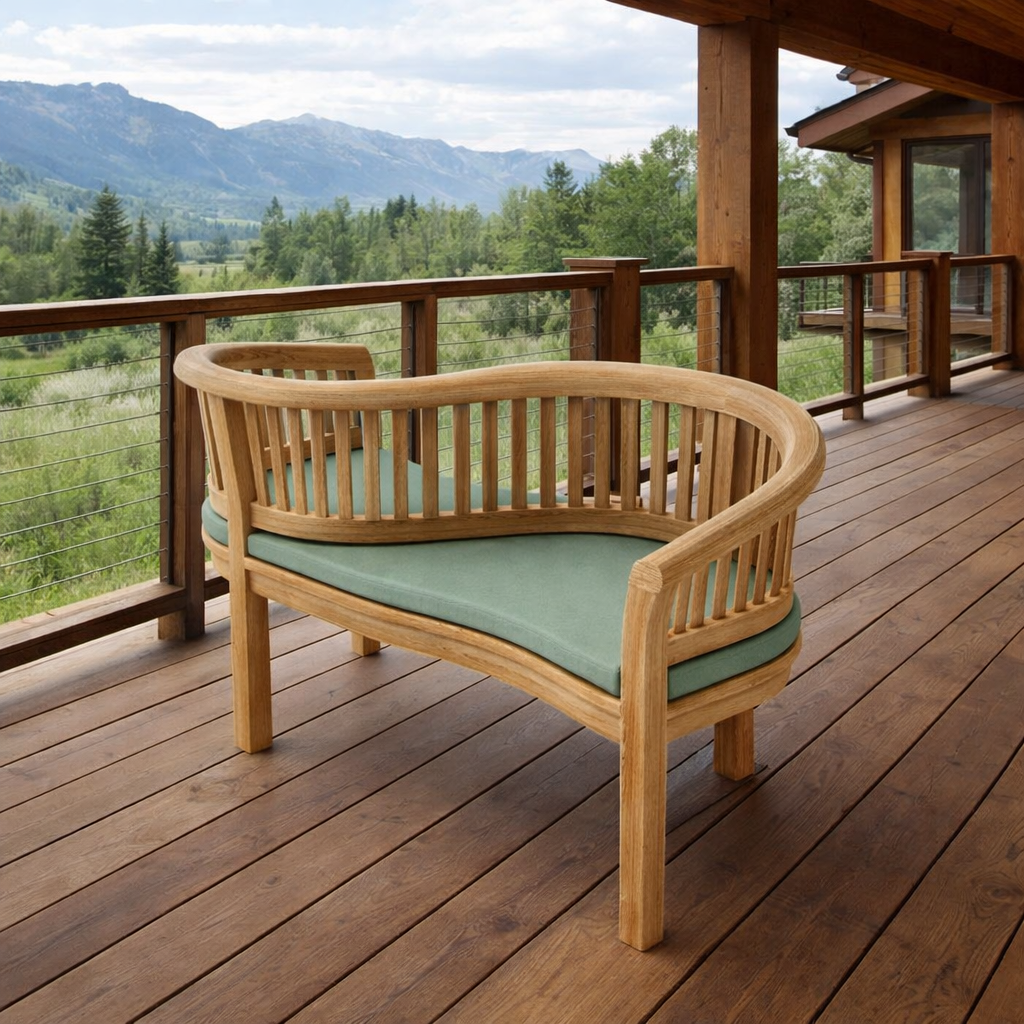 A piece can be technically suitable for outdoor use and still be annoying on an exposed deck if it feels excessively light. Homeowners should evaluate everyday stability, not just rain resistance. Teak's heavier, sturdier feel is useful here, although cushions, umbrellas, and furniture still need appropriate storm preparation when severe weather approaches.
Preparing for a large August gathering by permanently filling a patio with maximum-capacity furniture can make the space feel crowded during the rest of the season. A better strategy is a comfortable everyday layout with expandable dining capacity and supplemental chairs that can be deployed when needed.
Teak dining chairs are available in folding and stackable configurations, and extendable tables can help a terrace change with the household.
Homeowners unfamiliar with teak sometimes interpret the transition from golden brown to silver gray as evidence that something has gone wrong. It is the normal result of outdoor weathering. Decide before purchase whether you prefer the natural gray appearance or intend to maintain more of the original teak color.
On Nantucket, accepting the patina can be particularly attractive because aged teak often fits naturally with weathered coastal materials.
High-quality outdoor fabrics simplify ownership, but no cushion should be treated as if storage planning is irrelevant. Sunbrella cushions used on many TeakHQ lounge pieces are weather resistant, fade resistant, UV resistant, and water resistant, yet an island home still benefits from a practical plan for prolonged bad weather, seasonal closing, and extended periods when nobody is present.
Large sectionals and dining sets can unintentionally dominate the very outlook that makes the property special. Before ordering, stand inside the house and look outward through important doors and windows. Then sit where people will actually sit outdoors.
Furniture should frame views when possible, not simply occupy the largest available rectangle. Sometimes a lower-profile chair arrangement or strategically placed bench is the better luxury choice.
Nantucket does not require an elaborate teak-maintenance program. The most useful routine is straightforward: keep furniture reasonably clean, remove salt and organic residue, encourage drainage and airflow, decide whether you want natural gray weathering or maintained color, and prepare loose accessories appropriately when the property is unattended.
There is no universal calendar that fits every property. A sheltered garden several blocks from open water and an exposed waterfront deck can accumulate different amounts of salt, pollen, sand, and debris.
Inspect the furniture periodically and clean it when buildup becomes visible rather than following an arbitrary schedule. Properties receiving more direct coastal exposure may simply need rinsing or cleaning more often.
Salt residue should not be allowed to accumulate indefinitely on furniture, cushions, or hardware. Routine cleaning is particularly sensible on properties close to open water or subject to wind-driven coastal air.
Teak itself is naturally moisture resistant, but keeping the entire furniture piece clean—including hardware and adjacent fabric—is good ownership practice.
Moisture-resistant wood still benefits from airflow. Avoid leaving wet leaves, towels, or other organic material sitting against furniture for long periods. Do not create permanently damp conditions beneath covers or cushions.
If mildew appears on surface grime or accumulated organic material, clean the affected area rather than assuming the furniture itself is immune to anything that can grow on a dirty exterior surface.
Owners essentially have two appearance paths. Leave teak unfinished and allow it to weather naturally toward silver gray, or use appropriate teak-care products if maintaining more of the original color is important. Neither path is required for structural legitimacy; the choice is primarily about appearance and the amount of cosmetic maintenance desired.
Teak care products are available for owners who prefer a more managed appearance.
Grade A teak is designed for year-round outdoor use, so the furniture itself does not inherently have to be moved indoors every winter. Seasonal homeowners may nevertheless choose protected storage or covers to reduce dirt accumulation and make spring opening easier.
If covers are used, choose and position them so moisture is not needlessly trapped against the furniture. Cushions and loose accessories deserve separate consideration, particularly when a home will be unoccupied for an extended period.
The best Nantucket outdoor furniture plan balances three things: the island environment, the architecture of the property, and the way the household actually spends its summer days. Premium Grade A teak is particularly well suited to homeowners who want real wood, substantial construction, coastal versatility, and the option to let their furniture age naturally rather than continually chasing a just-refinished appearance.
Start with the space that matters most—often outdoor dining or a primary conversation area—then add view seating, loungers, benches, and storage only where they solve a real need. The result should feel less like a furnished patio and more like a natural extension of the home.
Several premium materials can work, including teak, aluminum, and quality synthetic products. Grade A teak is especially well suited to Nantucket because it is real, dense, naturally oily wood that resists moisture, rotting, insects, and warping while providing a substantial feel appropriate for coastal homes.
Yes. Grade A teak's natural oils, moisture resistance, and outdoor durability make it a strong choice for coastal environments. Furniture exposed to airborne salt should still be cleaned periodically so salt and surface residue do not accumulate indefinitely.
Prioritize substantial furniture and avoid relying entirely on very lightweight pieces. Teak has a heavier, sturdier feel than lightweight aluminum, which can be useful for everyday wind exposure. Cushions, umbrellas, and movable items should still be secured or protected during severe weather.
Only if large groups are routine. For homes that alternate between a small household and busy summer weekends, an extendable teak table can provide guest capacity without permanently consuming the terrace.
Grade A teak is designed for year-round outdoor use and withstands rain, sun, and temperature fluctuations. Owners may still use covers or protected storage to reduce dirt and simplify seasonal opening, but teak does not require indoor winter storage for durability.
Yes. Untreated outdoor teak naturally develops a silver-gray patina over time. That is normal weathering rather than a sign that the furniture is failing. Many Nantucket homeowners may find the gray appearance especially compatible with weathered-shingle architecture.
No. Teak does not require sealing, painting, or an artificial stain for durability. It can be left untreated to age naturally. Owners who prefer to retain more of its original color can choose appropriate teak care products.
Prioritize circulation and adaptability. A modest dining set, folding or stackable chairs, a loveseat or pair of lounge chairs, and small side tables generally make more sense than forcing a sectional or oversized dining table onto a compact deck.
Do not plan around fabric performance alone. Many TeakHQ lounge pieces include weather-resistant Sunbrella cushions, but seasonal homes should still have a practical place to protect cushions during prolonged bad weather and extended periods when the property is unoccupied.
It can be when the priority is long-term ownership rather than minimum initial cost. Premium teak is built to last decades rather than seasons, can remain outside year-round, and allows owners to choose between maintaining the original color or letting the wood age naturally.


