
FREE SHIPPING
within mainland USA
within mainland USA
Home ▸ Teak Outdoor Furniture ▸ For Napa Valley

Napa Valley has a Mediterranean-style climate characterized by dry summers and a much wetter winter season. Just as importantly, conditions vary within the valley: southern areas receive more marine influence, while locations farther north can experience warmer summer conditions, cooler winters, and greater rainfall. Elevation, exposure, and surrounding hills create additional local variation.
For much of the outdoor-living season, furniture may spend day after day exposed to sunshine with little rain. That makes material stability, UV-related appearance changes, surface temperature, and cushion selection more important than they might be in a heavily shaded or consistently cloudy climate.
The practical question is not simply, “Can this furniture be outdoors?” It is whether the furniture can remain attractive and structurally dependable through repeated sun exposure without requiring a demanding finishing routine. Premium Grade A teak is designed for outdoor use and withstands sun exposure and temperature fluctuations without requiring paint or artificial stain for durability.
One of Napa Valley's most useful design lessons comes from the same day-to-night temperature shifts that matter to local vineyards: the patio you furnish for a warm afternoon may feel very different several hours later. Napa's warm, dry summer days are moderated by cooler marine influences, and meaningful day-to-night temperature changes are characteristic of the region.
That favors outdoor rooms that work beyond the hottest part of the day. Deep seating near a fire feature, comfortable dining chairs for meals that stretch into the evening, and side tables for drinks or blankets can be more useful than filling the entire patio with furniture intended primarily for daytime sunbathing.
Napa is not a year-round dry climate. Most rainfall is concentrated in the cooler portion of the year, so furniture that remains outdoors must transition from extended summer dryness to repeated winter moisture.
This is where outdoor furniture materials differ substantially. Some homeowners respond by moving furniture into storage every winter. Others prefer materials that can remain outdoors while storing or covering only cushions and accessories. Grade A teak is particularly useful for the second approach because its natural oils, dense grain, and resistance to moisture and rot allow it to remain outdoors year-round.
A furnishing strategy for a protected patio near Carneros should not automatically be copied onto an exposed property farther up-valley. The southern valley experiences stronger marine influence, while farther north the ocean's moderating effect weakens and summer temperatures tend to be warmer.
That means shade, cushion exposure, furniture placement, and seasonal use should be evaluated at the property level. In Napa Valley, the most useful question is often not simply “What furniture is best for Napa?” but “What happens on this particular patio between 3 p.m. and 9 p.m.?”
Landscape debris, dust, pollen, and—in years when regional wildfire activity produces ashfall—fine ash can accumulate on exposed furniture. These conditions are usually more of a cleaning issue than a reason to select an entirely different furniture material, but highly textured surfaces and complicated woven details may require more effort to clean than straightforward wood surfaces.
Several premium outdoor materials can work well here. Quality aluminum is lightweight and modern, while synthetic poly furniture offers a different maintenance profile. But for homeowners who want natural material, substantial construction, long service life, and a look that fits both contemporary and traditional wine-country properties, Grade A teak offers an unusually strong combination.
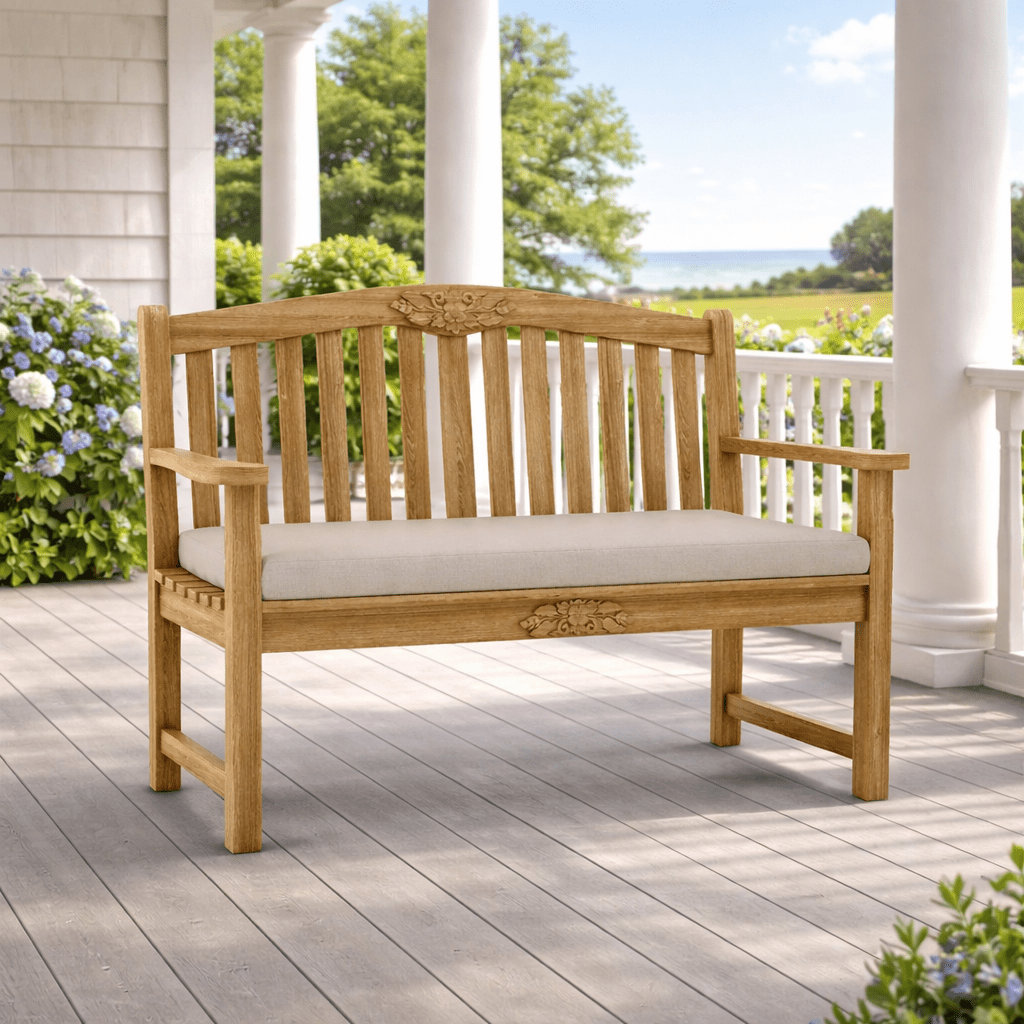 Natural Oils Support Outdoor Durability
Grade A teak contains naturally high levels of oils and has a dense grain structure. Those characteristics contribute to its resistance to moisture, rot, insects, and warping. Unlike wood furniture that depends on a painted or stained protective coating for outdoor durability, teak does not require an artificial stain to withstand normal outdoor exposure.
That matters on Napa properties where a bench might sit beside a garden path, beneath mature landscaping, or away from the home's main covered patio. Furniture can be chosen for where it belongs in the landscape rather than only where it can be protected from weather.
A material that performs beautifully during a dry August still has to deal with the wet season. Premium teak's moisture resistance allows the wood itself to remain outdoors through rain without requiring that every piece be moved into seasonal storage.
That does not mean every component should be treated identically. Cushions are a separate consideration. Most TeakHQ lounge seating includes Sunbrella cushions, while cushion inclusion varies by furniture category and product. During extended wet weather, managing cushions separately can simplify ownership even when the teak frames remain outdoors.
Natural teak will gradually weather toward a silver-gray patina when left untreated. That appearance change is normal and does not mean the furniture has failed. Homeowners who prefer the original warmer teak color can maintain or seal the wood; homeowners who enjoy a weathered wine-country look can allow it to age naturally.
This distinction is important in Napa because weathered teak can look intentional alongside stone, stucco, gravel, mature landscaping, and other natural materials. The decision to maintain teak's original color can therefore be aesthetic rather than structural.
Teak is heavier and has a more architectural feel than lightweight outdoor furniture. That can be an advantage on properties where patios are furnished as permanent living spaces rather than occasionally used seasonal areas.
For a homeowner building an outdoor dining room, pool terrace, vineyard-facing lounge, or covered entertaining pavilion, furniture that visually belongs with the architecture often makes more sense than furniture selected primarily because it is easy to move.
| Napa Valley Challenge | Why Premium Grade A Teak Performs Well |
|---|---|
| Dry summer sun | Designed for outdoor use and able to withstand regular sun exposure. |
| Day-to-night temperature changes | Dense teak resists warping and handles temperature fluctuations. |
| Winter rain | Natural oils and dense grain provide strong moisture and rot resistance. |
| Seasonal outdoor exposure | Can remain outdoors year-round without paint or artificial stain. |
| Dust and landscape debris | Solid wood surfaces can be periodically cleaned as needed. |
| Appearance changes from weathering | Can weather naturally to silver-gray or be maintained for warmer color. |
We would begin with how you actually use the property, not with a furniture catalog. In Napa Valley, the first questions would be: Where is the best view? Where is the afternoon sun? Where does shade arrive in the evening? How many people are normally present, and how many arrive when you're entertaining?
For many wine-country properties, outdoor dining deserves to be the anchor. If the patio connects directly to the kitchen or outdoor cooking area, we would normally place the primary dining table there rather than at the far edge of the yard. Carrying plates, serving dishes, wine, and glassware twenty extra yards sounds insignificant until you're doing it repeatedly during a dinner.
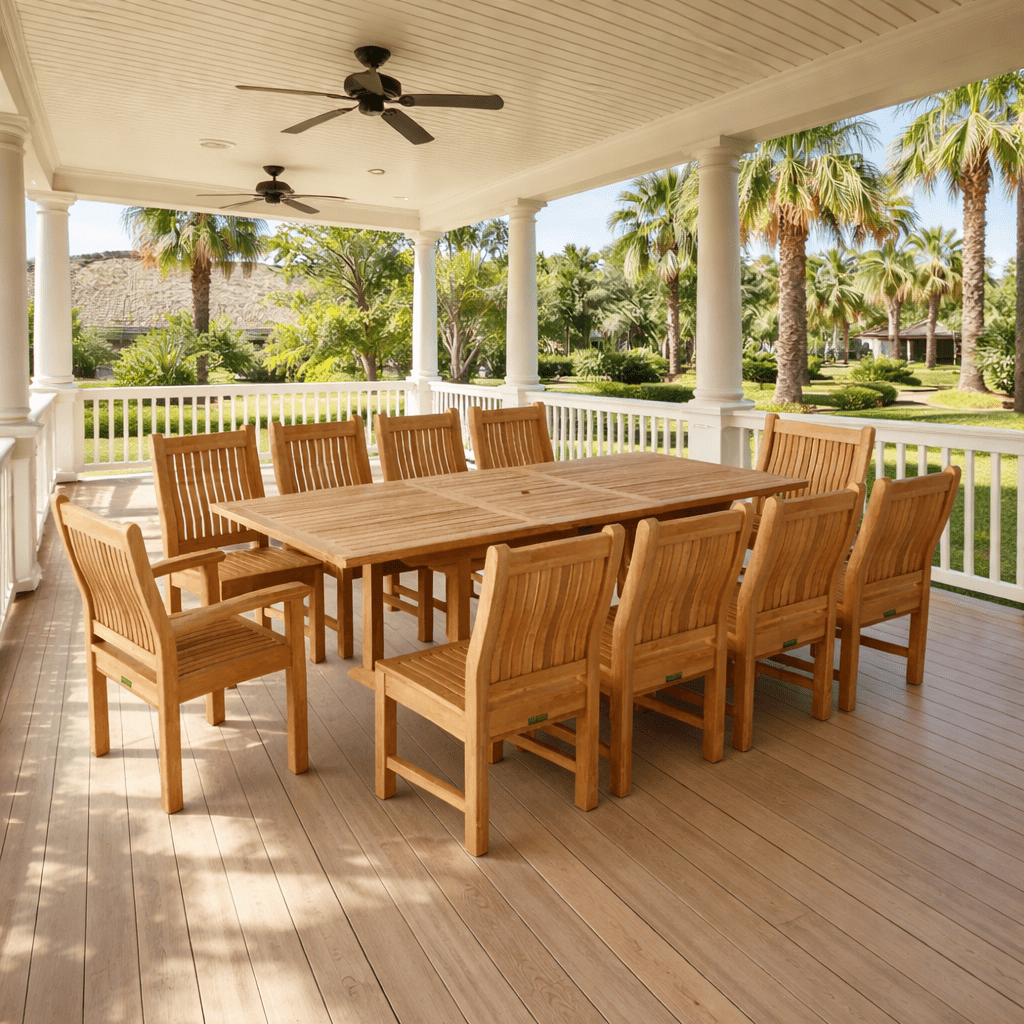
For homeowners who regularly host, an eight-person table can be a practical starting point. If daily use is smaller but entertaining occasionally becomes much larger, an extendable teak dining table may be the more intelligent choice because the patio does not have to be organized around the largest gathering you host all year.
The best outdoor spaces do not force every activity to happen around the dining table. We would create a second zone with a sofa, loveseat, sectional, or club chairs arranged for conversation. A multi-piece teak lounge set works especially well when you want a coordinated seating area, while teak sectional sets make sense where a larger terrace can support a more defined outdoor room.
A useful Napa-specific design principle is to orient this area for the hours after dinner rather than the hottest hour of the afternoon. If a view opens toward hills, vineyards, or the western sky, protect that sightline before deciding where every chair belongs.
For homes with pools, we would not simply scatter chairs around the perimeter. Create a dedicated lounging zone with enough walking space around it, then add small tables where guests can actually reach them from the loungers. Teak chaise loungers give this area a more permanent, integrated appearance than lightweight furniture that visually floats around the pool deck.
A large property does not need furniture everywhere. One well-placed teak garden bench under a tree, along a path, or facing a view can make an underused part of the property feel intentional.
That is particularly relevant in Napa Valley, where outdoor space may include landscaping, vineyard views, terraces, lawns, and gardens in addition to the principal patio. The goal is not to fill acreage with furniture. It is to give people a reason to occupy the best places on the property.
Start with the part of your property that gets used most. Frequent hosts should usually solve outdoor dining first; homeowners who spend evenings outside may get more value from lounge seating, while pool-focused properties should prioritize loungers before adding secondary pieces. Once the primary activity zone works, complementary furniture can be added without making the patio feel overfurnished.
Napa Valley's outdoor culture is closely connected to food, wine, hospitality, gardens, and the landscape itself. The region's tourism identity is built around wineries, restaurants, tastings, and leisurely experiences rather than quick stops, and that same pattern translates naturally to residential outdoor spaces designed for lingering rather than simply passing through.
Napa is one of the rare markets where a large outdoor dining table can be more than occasional-event furniture. For homeowners who enjoy wine dinners, family celebrations, harvest-season gatherings, or weekends with visiting friends, seating capacity can have more practical value than adding another decorative patio zone.
If ten people at dinner is genuinely normal rather than hypothetical, buy for that reality. TeakHQ offers large teak dining sets for ten or more as well as smaller configurations. The important distinction is whether large groups are routine enough to justify dedicating permanent patio space to them.
A dining table is useful for eating, but it is not always where guests want to stay for the next two hours. Deep seating allows the evening to shift naturally from dinner into conversation without sending everyone indoors.
For this reason, a dining zone and lounge zone often provide more real-world flexibility than one oversized arrangement trying to serve both functions.
Pool terraces support a different rhythm: sun, reading, swimming, conversation, and drinks rather than formal meals. Chaise loungers paired with compact side tables usually make more sense here than adding additional dining chairs merely because seating capacity is available.
Homes with outdoor kitchens or built-in counters can benefit from bar- or counter-height furniture. These pieces work particularly well for smaller groups gathering around food preparation or drinks without occupying the formal dining table.
For a second home or short-term rental, the purchasing calculation changes. Furniture should be intuitive, durable, and appropriate for the number of people the property actually accommodates. Overspecialized pieces can be less useful than a straightforward combination of dining, lounge seating, loungers, and occasional tables.
The most useful furniture configuration depends less on total property size than on how individual outdoor areas connect to one another. A large estate can still have a relatively compact dining terrace, while a smaller home may have one exceptionally well-designed patio capable of supporting dining and lounge seating.
 Dining Terraces and Outdoor Kitchens
For a terrace adjacent to the kitchen, begin with a teak outdoor dining set sized around normal entertaining rather than theoretical maximum capacity. Allow comfortable circulation behind occupied chairs and preserve a direct route between the table and cooking area.
If entertaining ranges dramatically from four people on an ordinary evening to ten for special gatherings, an extendable table can be more useful than permanently giving a twelve-seat table most of the patio.
Covered outdoor rooms are ideal locations for deep seating because cushions receive additional protection and the space naturally supports longer stays. A sofa or loveseat facing two club chairs creates a more conversational arrangement than lining all seating against exterior walls.
Add a coffee table for shared use and individual side tables where needed. The test is simple: every comfortable seat should have somewhere reasonable to set a drink.
Place chaise lounges where people naturally want to spend time rather than automatically arranging them symmetrically around the entire pool. A smaller, concentrated lounging zone often feels calmer and leaves more deck area open for circulation.
If the pool area is separated from the house, add side tables so guests do not have to balance drinks, books, phones, or towels on the ground.
A view terrace should be designed from the seated eye level. Before buying furniture, sit where the chairs will go and check whether railings, walls, landscaping, or the furniture itself interrupts the view.
This is one of the easiest mistakes to make on a Napa property: selecting a beautiful high-backed arrangement and discovering afterward that the furniture blocks the landscape it was meant to enjoy.
Secondary landscape areas usually benefit from restraint. A bench, pair of chairs, or small table can establish a destination without turning the garden into another full patio.
Teak is especially appropriate for these locations because its natural wood appearance works comfortably alongside stone, gravel, greenery, stucco, and other materials commonly associated with wine-country landscapes.
When meals regularly involve wine bottles, serving dishes, glassware, or buffet-style food, the dining table can become crowded quickly. A teak serving or buffet table near the dining area creates a staging surface without consuming guest seating space.
That small planning decision can improve entertaining more than adding another decorative chair: keep serving activity off the table so the table remains comfortable for the people sitting around it.
Napa Valley architecture is varied, but natural materials and strong relationships between buildings and landscape are recurring themes. Contemporary vineyard homes, Mediterranean- and European-influenced estates, farmhouse-inspired properties, resort-style compounds, and renovated traditional homes can all be found within the region. Local wine-country design frequently draws on materials such as stone, stucco, wood, glass, and restrained natural palettes.
On contemporary properties, teak provides warmth against glass, concrete, metal, and clean architectural lines. Simple dining tables, streamlined lounge furniture, and restrained cushion colors usually preserve the modern character better than heavily ornamented furniture.
Natural teak also works easily alongside stucco, stone terraces, courtyards, arbors, and established gardens. Here, the furniture does not need to imitate historic architecture. A straightforward teak profile often provides enough warmth while allowing the home and landscape to remain visually dominant.
For casual wine-country homes, long rectangular tables, benches, and substantial lounge seating can reinforce the relaxed character without making the space feel themed. Allowing teak to weather naturally can further soften the relationship between furniture and landscape.
The strongest Napa patios often treat the landscape as the main visual feature. Furniture should frame a vineyard, oak-covered hillside, garden, pool, or sunset rather than compete with it.
A useful rule is to choose the viewing direction first, the activity second, and the furniture third. Reversing that order is how expensive outdoor spaces end up beautifully furnished but awkward to use.
A patio may be intensely sunny in mid-afternoon but become the property's favorite gathering area after the sun drops. Designing only around peak daytime conditions can lead homeowners to underinvest in comfortable evening seating.
Plan around actual occupancy. If most outdoor time happens during dinner and afterward, prioritize dining comfort, conversation seating, side tables, lighting, and shade placement rather than filling the patio with furniture intended primarily for sunbathing.
 Using One Layout for Every Microclimate
Napa Valley is not climatically uniform. Conditions change with location, elevation, exposure, and distance from marine influence.
A covered southern-valley terrace and an exposed up-valley patio may need different approaches to shade and cushion management even if both use teak furniture. Evaluate the site before buying accessories and deciding what should remain exposed.
Large-property owners sometimes assume the largest available table is automatically appropriate. The consequence can be a patio dominated by furniture that is rarely fully occupied.
Choose for normal use first. If guest counts expand occasionally, an extendable teak table gives you additional capacity without permanently consuming the circulation space.
A large dining set solves the meal but not necessarily the evening. Without a conversation area, guests either remain sitting upright around the dining table or move indoors.
A teak sofa, loveseat, sectional, or group of club chairs gives the outdoor space a second phase and can make the patio useful for quiet evenings even when no meal is being served.
The teak frame and the cushion are not the same material and should not be managed as though they are. Teak can remain outside year-round, while cushions benefit from more deliberate care during prolonged winter rain.
Many TeakHQ lounge pieces include weather-resistant Sunbrella cushions, but keeping cushions clean, dry, and appropriately protected during extended wet periods can improve the ownership experience.
Teak is moisture resistant, but good site planning still matters. Do not make standing water, persistent irrigation spray, or poorly drained soil part of the furniture's normal environment simply because teak tolerates outdoor weather.
A stable patio, deck, gravel terrace, or other appropriately drained surface creates a cleaner and more practical installation.
Untreated teak naturally develops a silver-gray patina. Homeowners who expect the original golden-brown appearance to remain unchanged can mistake normal weathering for deterioration.
Decide before purchase which appearance you prefer. If you like natural gray, allow the furniture to weather. If maintaining warmer teak color matters to you, plan for optional cosmetic maintenance.
Napa Valley is comparatively straightforward for teak ownership because coastal salt spray is not a normal maintenance concern. The more relevant issues are seasonal dust, landscape debris, summer sun, occasional ash, and the transition into winter rain.
There is no useful universal calendar requiring every Napa homeowner to clean teak at the same interval. A protected covered patio will need less attention than furniture beneath trees or beside an exposed garden.
Clean surfaces when dust, pollen, leaves, food residue, or other debris accumulates. Periodic inspection is more useful than unnecessary frequent maintenance.
If regional wildfire conditions result in ash settling on outdoor furniture, remove loose material and clean the surface rather than allowing layers to remain through subsequent moisture. The goal is straightforward housekeeping, not a special teak treatment.
The wood frames can remain outside, but prolonged wet periods are a good reason to manage cushions more actively. Depending on the product and your setup, that may mean using appropriate protection or storing cushions somewhere dry when the seating will not be used for extended periods.
Leaving teak untreated is a legitimate low-maintenance choice. It will gradually develop its characteristic silver-gray patina.
If you prefer the original warmer teak appearance, optional sealing or oiling can be incorporated into your maintenance routine. This is an appearance decision rather than something teak requires in order to survive outdoors.
Teak itself does not require a cover for outdoor durability. Covers may still be useful when a homeowner wants to reduce cleaning, protect cushions, or keep furniture ready for use after wet weather.
If you use covers, follow sensible moisture-management practices rather than sealing damp cushions or debris underneath them for long periods.
The best Napa Valley outdoor spaces are not simply filled with furniture. They are planned around meals, views, shade, evening temperatures, entertaining patterns, and the parts of the property people naturally want to occupy. Choose premium Grade A teak furniture around those realities, and the result can feel less like a furnished patio and more like another well-designed room of the home.
There is no single appropriate material for every homeowner. High-quality aluminum can suit a lightweight modern aesthetic, while synthetic materials appeal to buyers who prioritize a different maintenance profile. Grade A teak is particularly compelling when you want real wood, substantial construction, weather resistance, long service life, and an appearance that complements wine-country architecture.
Yes. TeakHQ's Grade A teak furniture is designed for year-round outdoor use and withstands rain, sun exposure, and temperature fluctuations. Cushions may benefit from separate protection or storage during prolonged wet periods.
That depends on the material. Grade A teak itself does not require a protective cover for durability. A cover can still reduce cleaning, while cushions and accessories may benefit more from protection during extended winter rain.
Teak is designed to withstand outdoor sun exposure. Untreated teak will change color over time and develop a silver-gray patina, so homeowners should distinguish normal weathering from structural deterioration.
Base the table on the number of people you normally host, not the largest party you can imagine. If everyday gatherings are six to eight people but occasional dinners are larger, an extendable table can preserve patio space while still providing additional capacity when needed.
It can be particularly practical for owners who do not want outdoor wood furniture that depends on constant refinishing for durability. Teak can remain outdoors and can either be maintained for warmer color or allowed to weather naturally.
Choose furniture according to seated sightlines. Dining sets work well where meals are the primary activity, while low-profile lounge seating can preserve the visual connection to the landscape. Check views from actual seated height before selecting high-backed pieces.
The furniture material does not necessarily need to change, but the site plan may. Southern portions of Napa Valley receive stronger marine influence, while areas farther north can experience warmer summer conditions and cooler winters. Shade, sun exposure, and cushion management should therefore be evaluated for the individual property.
It depends on your priorities. Teak is natural wood, warmer in appearance, heavier, and offers a premium architectural feel. Aluminum is lighter and can suit a more explicitly modern look, while poly furniture is synthetic and offers a different maintenance experience. For buyers who value genuine wood and long-term outdoor use, teak is often the stronger fit.
Remove loose ash and clean the furniture rather than allowing residue to remain indefinitely, particularly before it becomes wet. No unusual teak-specific treatment is required simply because ash has settled on the surface.


