
FREE SHIPPING
within mainland USA
within mainland USA
Home ▸ Teak Outdoor Furniture ▸ By Location ▸ Nashville, Tennessee
Nashville outdoor spaces have to handle more than summer entertaining. Hot, humid stretches, frequent rain, strong sun, seasonal temperature swings, and occasional winter freezes all influence which furniture materials make sense for a long-term investment. From covered porches in established neighborhoods to expansive patios and outdoor kitchens around Franklin and Brentwood, many homeowners also furnish for groups rather than just two or four people. Premium Grade A teak is especially worth considering because it combines a natural, substantial look with the weather resistance and ownership flexibility needed for this four-season environment.

Nashville is not an environment where outdoor furniture faces one dominant stress. Instead, homeowners need to plan for a combination of summer heat and humidity, regular wet weather, strong sun, organic debris from mature landscaping, and meaningful seasonal temperature changes. That mix makes material selection more important than it may be in a consistently dry or consistently mild climate.
Summer humidity is one of the most important considerations for outdoor furniture in Middle Tennessee. Furniture on uncovered patios can repeatedly get wet and dry, while pieces under a roof may remain shaded and humid even when direct rainfall never reaches them. That second situation is easy to overlook.
A covered porch protects furniture from some direct weather, but it does not automatically keep furniture dry. Damp air, wind-driven rain, condensation, and slow evaporation can still affect materials. For natural wood furniture, resistance to moisture and rot therefore matters even in sheltered spaces.
When evaluating outdoor furniture for Nashville, we would pay as much attention to how quickly the entire setting can dry as to whether rain reaches it. Deep seating pushed against a wall, furniture surrounded by dense landscaping, or cushions left continuously in shade can create a slower-drying microclimate than an open patio.
This leads to a useful Nashville-specific planning principle: roof coverage and airflow should be treated as two separate design decisions. Cover protects a seating area; airflow helps it recover after wet weather. The most practical layouts provide both.
Nashville homeowners can experience hot summer conditions and freezing winter weather on the same patio within a single year. That makes outdoor furniture designed for year-round exposure particularly convenient. Materials that demand frequent seasonal refinishing or indoor storage may be perfectly acceptable, but owners should understand that commitment before buying.
Premium Grade A teak is designed for year-round outdoor use and withstands rain, sun exposure, and temperature fluctuations. Its dense grain and naturally high oil content also help it resist moisture, rotting, insects, and warping, making it well matched to the region's changing conditions.
Many established Nashville-area properties use mature trees and lush landscaping to create shade and privacy. The tradeoff is pollen, leaves, seed pods, dirt, and other organic material collecting on horizontal furniture surfaces. Shaded patios can also dry more slowly after rain.
For these settings, uncomplicated furniture surfaces and realistic cleaning expectations matter. No premium outdoor material eliminates the need to remove accumulated debris. Choosing furniture because it tolerates outdoor exposure well is more useful than expecting it to remain perpetually clean.
Several premium materials can work well here. Quality aluminum, for example, is lightweight and offers a clean contemporary appearance, while synthetic materials may appeal to homeowners who prioritize minimal upkeep. Grade A teak becomes especially compelling when a homeowner wants natural wood, substantial construction, year-round outdoor suitability, and flexibility in how the furniture ages.
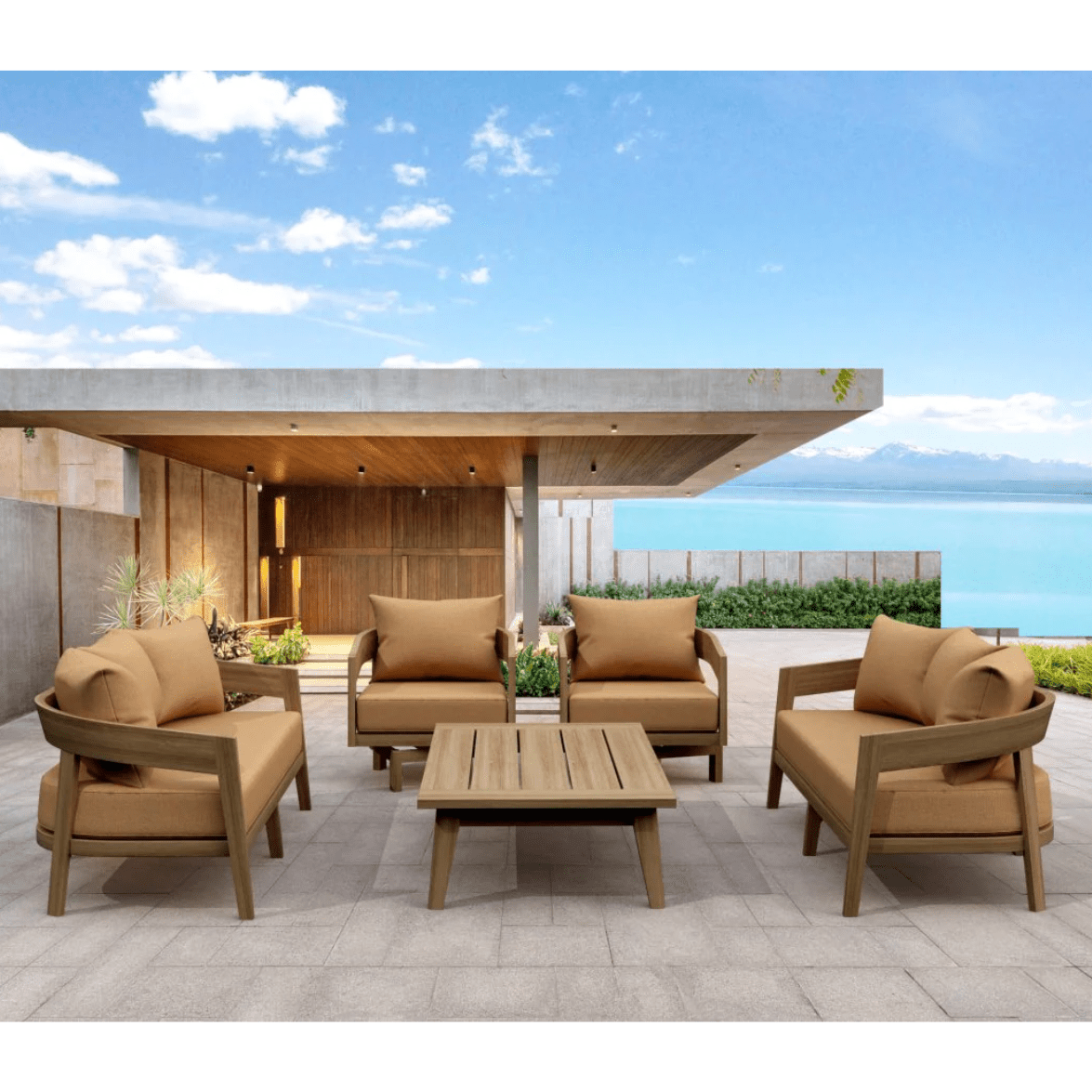 Teak's naturally high oil content and dense grain structure help it resist moisture and rotting. That characteristic matters in Nashville because exposure often comes as repeated wet-and-dry cycles rather than a single rainy season.
It also makes teak useful for both uncovered patios and covered outdoor rooms where humidity can linger. Teak does not need artificial stain to provide its basic outdoor durability, although homeowners can choose optional care products depending on the appearance they want.
Grade A teak is designed for year-round outdoor use and can withstand rain, sunlight, and temperature fluctuations. For homeowners who would rather not relocate an entire dining set or sectional every winter, that is an important practical advantage.
That does not mean cushions or accessories should be ignored during severe weather. Most TeakHQ lounge seating includes Sunbrella cushions, while cushion inclusion varies by product. Moving or protecting cushions during extended wet periods can make day-to-day ownership easier even though the teak frames themselves are suited to outdoor exposure.
Natural teak gradually weathers toward a silver-gray patina when left untreated. That change is expected and does not mean the wood has failed. Homeowners who like the weathered look can let the process occur naturally; those who prefer the original warmer teak color can choose to maintain it.
This gives Nashville homeowners useful flexibility because different parts of one property may receive very different amounts of sun. Furniture does not need an artificial stain for durability simply because it is exposed to sunlight.
Premium teak carries a higher initial price than many outdoor furniture options, so the right comparison is not merely the purchase price of two patio sets. Teak furniture can last for decades. For a homeowner furnishing a long-term residence, that makes lifetime ownership cost more relevant than the first-year price.
Its heavier, more architectural character can also suit substantial porches, stone patios, outdoor kitchens, and landscaped backyards where very lightweight furniture can feel visually undersized.
| Nashville Challenge | Why Premium Grade A Teak Performs Well |
|---|---|
| Summer humidity | Natural oils and dense grain help resist moisture and rot. |
| Frequent rain | Designed for outdoor exposure and repeated wet weather. |
| Strong sun | Suitable for sun exposure and can weather naturally to silver-gray. |
| Temperature swings | Designed to withstand outdoor temperature fluctuations. |
| Winter freezes | Can remain outdoors year-round rather than requiring routine seasonal storage. |
| Damp shaded patios | Moisture and rot resistance suit slower-drying outdoor spaces. |
| Insects | Teak naturally resists insects. |
| Long ownership horizon | Premium teak can last for decades with appropriate care. |
We would begin with how your household actually uses the backyard rather than choosing individual pieces first. In Nashville, the most successful outdoor spaces often function as extensions of the kitchen and family room: somewhere to eat, visit, watch a game, host friends, or spend a quieter evening after the larger gathering ends.
The first question we would ask is not the size of your patio; it is how many people you realistically seat when you entertain. A family of four that routinely hosts another family may be better served by an eight-person table than by a compact four-person set that technically fits the household.
For homeowners who frequently host, we would begin with teak outdoor dining sets. Where normal dinners are smaller but weekend gatherings can become large, an extendable teak dining table is often the smarter use of patio space.
On larger Brentwood, Franklin, Forest Hills, or Belle Meade properties, we would rarely try to make one furniture group perform every function. A dining table is excellent for meals but less natural for a two-hour conversation after dinner. Deep seating is comfortable for visiting but awkward for serving a full meal.
If space permits, create two distinct zones: dining close to the kitchen or grill and a teak patio seating area farther into the patio or beneath a covered structure. A coffee table and accessible side tables make the lounge area function as an actual outdoor room rather than a collection of chairs.
Covered porches and roofed patios are especially valuable in Nashville because they increase the number of days an outdoor space is comfortable and usable. We would generally reserve the most protected area for cushioned lounge seating and place a dining group where it still enjoys reasonable protection without blocking circulation between the house, grill, and yard.
Do not fill every square foot with furniture. In humid climates, breathing room around the furniture helps air circulate, while wider pathways make large gatherings feel more relaxed.
Spring and fall can be some of the most appealing times to use a Nashville patio. A conversation grouping around a fire feature can extend the usefulness of a space beyond summer. Teak fire pit tables are particularly useful where homeowners want the fire feature to become part of the seating plan rather than a separate element at the edge of the yard.
Start with the collection that solves your property's main job. Frequent hosts should begin with dining sets or extendable tables; homeowners building a second family room outdoors should begin with sectionals or multi-piece seating. Porch-focused homes may get more everyday value from swings and rockers, while larger patios can layer dining, lounge seating, and a fire feature into separate zones.
Nashville outdoor living is often less about creating a resort-like showpiece and more about making the home work better for people. Dining, grilling, conversation, family visits, neighborhood gatherings, and football Saturdays can all occur in the same backyard, sometimes within the same weekend. Furniture therefore needs to support both everyday household use and occasional larger groups.
A practical Nashville entertaining setup usually benefits more from flexible capacity than from formal symmetry. An eight-person table that comfortably handles six on an ordinary night can be more useful than a perfectly proportioned small table that becomes inadequate every time friends visit.
This is one reason eight- to ten-person teak dining sets make sense for households with sufficient patio space. The goal is not to buy the largest table possible; it is to avoid designing the entire patio around the smallest number of people who will ever use it.
Football entertaining creates a different furniture problem from dinner parties. Some guests want a table for food while others naturally settle into softer seating facing a television or conversation area. Trying to accomplish both with one oversized dining set generally makes the space less comfortable.
A dining zone plus a sectional or sofa grouping gives guests a reason to spread out instead of clustering around the kitchen door. If an outdoor television is part of the plan, orient lounge seating around both sight lines and glare rather than centering it solely on the architecture.
Nashville's newer outdoor kitchens and elaborate patios receive plenty of attention, but a good porch remains one of the most usable outdoor spaces in the region. Its shade is valuable during summer, and its proximity to the house encourages short periods of everyday use that a distant pool deck or fire pit may not.
Teak porch swings, rockers, or a compact conversation group can turn that transitional space into somewhere homeowners actually sit rather than simply walk through.
Outdoor furniture purchasing often happens in warm weather, but Nashville homeowners should design for spring and fall too. Those seasons may favor lounge seating, fire features, and morning coffee spaces differently than midsummer afternoons do.
A well-planned patio should therefore have both shade and a reason to use it when temperatures cool. This is another argument for multiple smaller zones rather than one enormous furniture grouping.
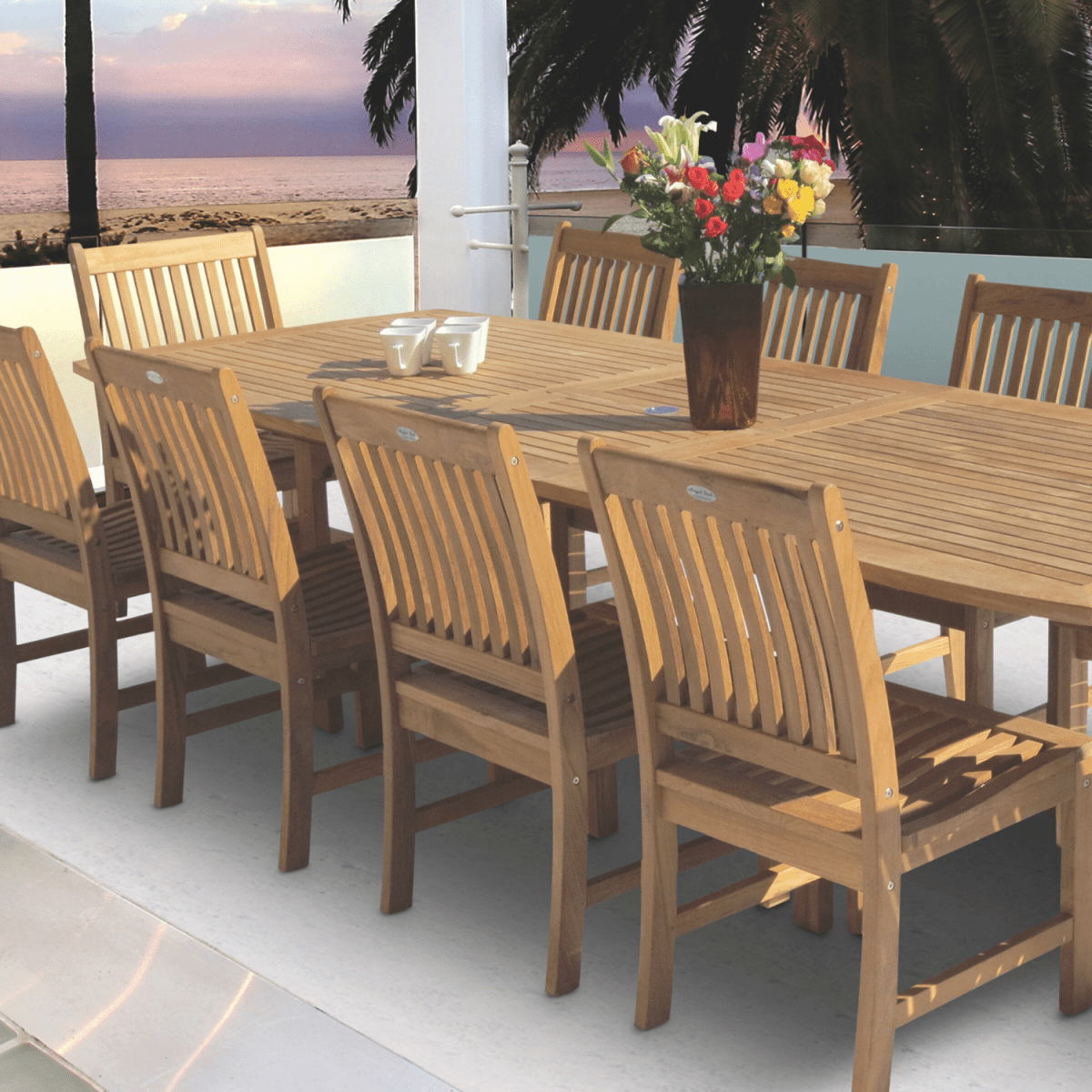 The most useful teak furniture depends less on a Nashville ZIP code than on the relationship between the house, patio, yard, and people using them. We would match each outdoor area to a specific purpose first and choose furniture second.
For a roofed patio adjoining the main living area, deep seating is often the strongest starting point. A sectional creates a defined conversation area on a large patio, while a sofa with club or swivel chairs can be easier to adapt around doors, fireplaces, televisions, and traffic routes.
If the room is used for game days or casual entertaining, teak sectional sets can establish a substantial central seating area. Leave enough space behind and beside the group for airflow and circulation rather than pushing every piece tightly against walls.
Near an outdoor kitchen, we would prioritize dining before lounge furniture. Food moves more easily from grill to table, guests have a natural place to gather, and the cook remains part of the conversation.
Large households and frequent hosts should consider tables for eight or more. An extendable table is especially useful when you want generous entertaining capacity without dedicating the entire patio footprint to a ten-person configuration every day. A serving or buffet table can also keep beverages and platters away from the main dining surface.
For Nashville-area homes with pools, divide the deck into active and dry zones. Chaise loungers belong where sun and pool access matter; cushioned conversation furniture usually works better farther from splashing and heavy foot traffic.
Teak's outdoor suitability makes it appropriate for either area. If loungers are the priority, consider teak chaise loungers with side tables so each seat has a practical place for a drink, book, or phone.
A front or back porch does not always need a complete furniture suite. Two rockers with a side table can be more useful than a sofa when the space is narrow. A swing works particularly well where the porch itself is part of the home's character.
Garden benches are better treated as destination seating. Position one where there is something worth looking at—a landscaped bed, mature trees, or a quiet edge of the property—rather than placing it in leftover space simply because a bench fits there.
Nashville's housing mix gives teak unusual design flexibility. The same material can work with traditional brick homes, historic-inspired porches, modern farmhouses, transitional new construction, contemporary infill, and large estate properties because the wood itself is visually warm without dictating one architectural style.
Natural teak fits easily beside brick, stone, painted siding, and traditional porch detailing. In these settings, dining furniture, benches, swings, and classic lounge arrangements tend to feel integrated rather than overly contemporary.
If the architecture is formal, resist the temptation to make every outdoor element equally formal. A relaxed teak seating group can soften a substantial masonry patio and make the space feel more approachable.
Modern farmhouse and transitional homes often combine neutral exterior colors with strong black, stone, or wood accents. Natural teak adds another warm material without requiring the entire patio to match. Straightforward silhouettes generally work particularly well when the house already has prominent beams, gables, or contrasting trim.
On wooded or mature properties, teak tends to sit comfortably alongside greenery because it is real wood rather than a material trying to imitate it. Homeowners can preserve its warmer original appearance or allow it to age toward a silver-gray patina.
We would coordinate the furniture with the architecture first and the landscaping second. Plants change, mature, and get replaced; the house is the more permanent visual anchor.
One of the most common design issues on large suburban patios is furniture that is physically adequate but visually too small. An expansive stone or concrete terrace can make lightweight pieces appear scattered.
Teak's heavier, sturdier, architectural character makes it a natural candidate for these larger settings. Instead of filling the space with extra pieces, use fewer substantial furniture groups and give each one a clear function.
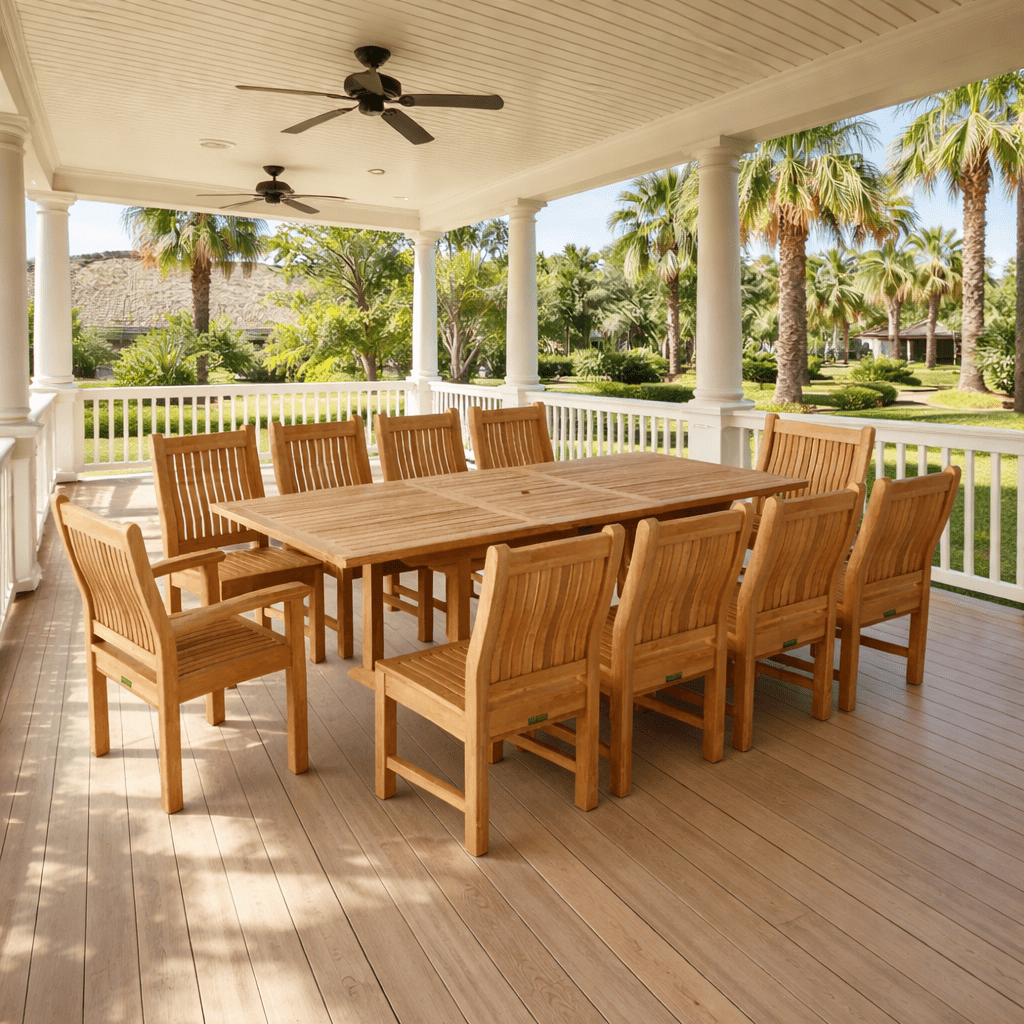 A roof prevents direct rainfall, but it does not eliminate humidity, wind-driven moisture, or slow drying. Homeowners sometimes pack covered patios with furniture and leave little airflow around the pieces.
Allow space around seating and avoid trapping cushions against damp walls or dense plantings. Grade A teak's moisture and rot resistance is useful in these conditions, but smart placement still improves the ownership experience.
A household of four does not necessarily need a four-person outdoor dining set. If eight people regularly gather for birthdays, cookouts, holidays, or game days, a table sized only for daily use becomes the weak link in the patio.
Buy for the number you host often enough to matter. Extendable teak tables are a practical compromise when large gatherings are frequent but not constant.
Large patios invite homeowners to purchase one large matching group. The result can still be functionally limited. Dining, conversation, television viewing, grilling, and quiet lounging ask for different seating relationships.
Two purposeful zones are usually more useful than one oversized zone. Teak collections make that approach straightforward because individual pieces and coordinated multi-piece sets are both available.
The teak frame and the cushion should be treated as different materials with different care needs. Most TeakHQ patio seating pieces include Sunbrella cushions, which are weather-resistant, fade-resistant, UV-resistant, and water-resistant, but water-resistant does not mean there is never a reason to protect them.
During long wet stretches or severe weather, moving cushions to a protected location can reduce drying time and keep the seating ready to use sooner.
Some buyers love new teak's warm golden-brown appearance but are surprised when untreated teak gradually develops a silver-gray patina. Others repeatedly maintain the original color when they would actually prefer the lower-intervention weathered look.
Decide which appearance you want before establishing a maintenance routine. Teak can be left untreated to age naturally or maintained to preserve more of its original color.
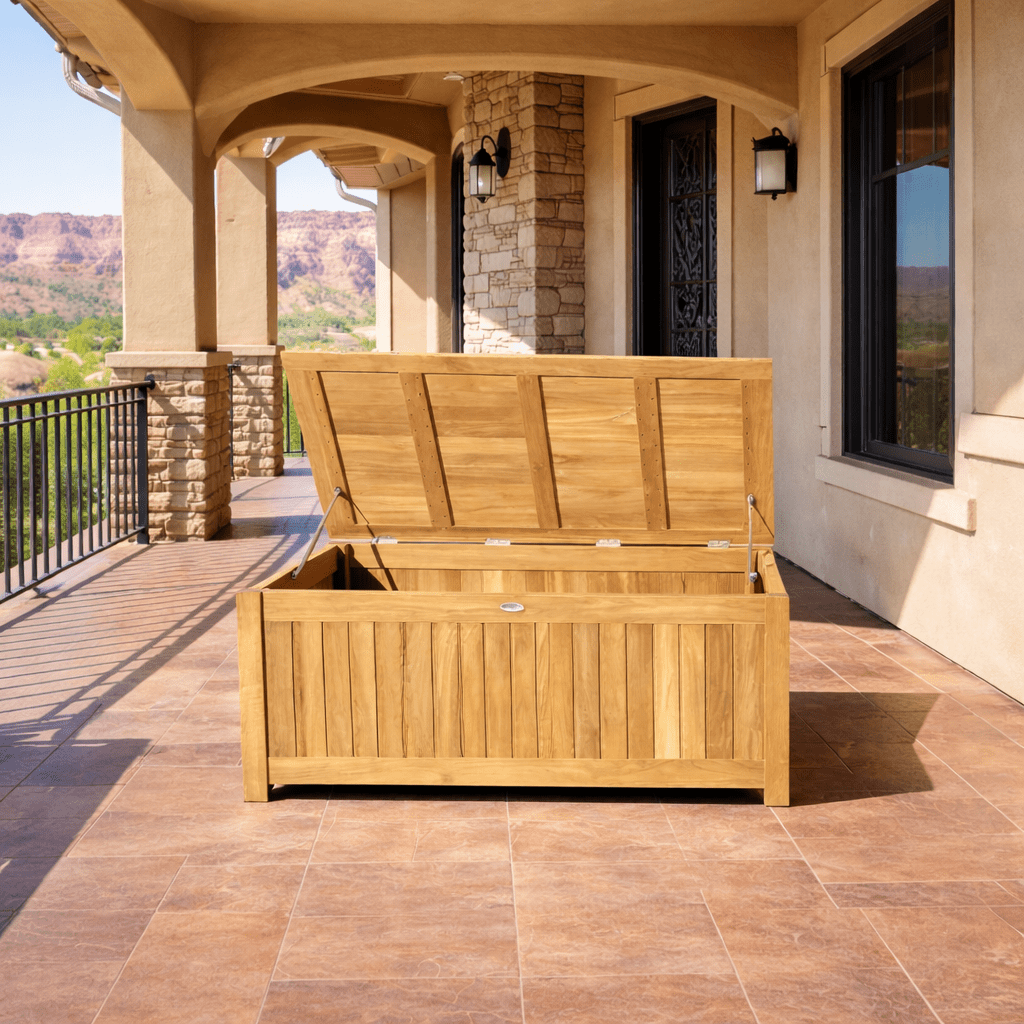 Nashville teak care is less about protecting the wood from every change in weather and more about keeping the furniture clean, allowing it to dry properly, and deciding how you want the teak to look as it ages.
There is no useful one-size-fits-all cleaning calendar. A table under mature trees may need attention more frequently during heavy pollen or leaf drop than a furniture group on an open patio. Remove accumulated leaves, pollen, dirt, and organic debris rather than letting them sit against damp surfaces for long periods.
Inspect furniture periodically and clean when conditions warrant it. This condition-based approach is more practical than cleaning solely because a certain number of weeks have passed.
Teak itself is naturally moisture resistant, but the entire furniture setting benefits from drying after wet weather. Keep drainage paths open, avoid leaving wet covers or textiles pressed against furniture, and allow air around cushioned pieces.
This is particularly important on deeply shaded porches where summer humidity can outlast the rain that caused the initial dampness.
Premium Grade A teak is designed for year-round outdoor use, so moving every teak frame indoors for winter is not required. Homeowners who prefer to cover furniture may do so, but covers are optional rather than necessary for the durability of the teak itself.
If using covers, choose a routine that does not trap persistent moisture underneath. Cushions and other soft accessories can be stored separately when extended periods of non-use make that more convenient.
Untreated teak will naturally weather toward a silver-gray patina. If you like that appearance, the simplest strategy is to let the wood age naturally while keeping it clean.
If you prefer the original teak color, optional sealing or oiling can be part of your care plan. The important distinction is that these treatments are an appearance choice rather than an artificial stain required to make Grade A teak suitable for outdoor use.
The right outdoor furniture should fit how your household actually lives: how many people you host, which parts of the patio stay protected, where people naturally gather, and how much ongoing care you want to perform. For Nashville's combination of humidity, rain, sun, seasonal changes, and outdoor entertaining, premium Grade A teak offers a compelling balance of natural beauty, substantial construction, weather resistance, and long-term ownership value.
Start with the space you use most—dining, conversation seating, porch living, poolside lounging, or a fire-side gathering area—and build outward from there.
Choose materials designed for repeated moisture, outdoor temperature changes, and year-round exposure. Premium Grade A teak is a strong natural-wood option because its oils and dense grain help it resist moisture, rot, insects, and warping. High-quality aluminum can also be appropriate for homeowners who prefer a lighter, more contemporary material.
It depends on the material. Grade A teak is designed for year-round outdoor use and can withstand rain, sunlight, and temperature fluctuations, so the teak frames do not need routine winter storage. Cushions and accessories may still be easier to maintain when protected during long periods of non-use.
Yes. Teak's naturally high oil content and dense grain make it resistant to moisture and rotting, which is particularly useful in Nashville's humid and frequently wet conditions.
No. Protective covers are optional rather than required for Grade A teak's outdoor durability. If you use covers, avoid trapping persistent moisture beneath them and consider storing cushions separately during extended periods of non-use.
Size the table for the number of people you regularly entertain, not only the number living in the house. Homeowners who normally seat four but frequently host eight may be better served by an extendable dining table or an eight-person set.
Choose dining first if meals, grilling, and large gatherings are the patio's main purpose. Choose a sectional first if the space functions more like an outdoor family room for conversation, television, or game days. Larger patios often benefit from separate dining and lounge zones.
Yes. Natural unfinished teak gradually develops a silver-gray patina when left untreated. This is normal weathering. Homeowners who prefer the original warmer teak color can use optional maintenance products to help preserve that appearance.
Clean according to exposure rather than following an arbitrary schedule. Furniture beneath mature trees may collect spring pollen, leaves, dirt, and organic debris more quickly than furniture in an open setting. Remove buildup when needed and avoid allowing damp debris to remain on surfaces for extended periods.
Deep seating, rockers, porch swings, and compact conversation arrangements are all good options. Remember that covered does not necessarily mean dry: humidity and wind-driven moisture still matter, so choose outdoor-rated materials and leave enough space around furniture for airflow.
It can be for homeowners planning to keep their outdoor furniture for many years. Grade A teak carries a higher upfront cost, but quality teak furniture can last for decades and does not require artificial stain for outdoor durability. The value proposition is strongest when longevity, natural materials, and substantial construction matter more than minimizing the initial purchase price.


