
FREE SHIPPING
within mainland USA
within mainland USA
Home ▸ Teak Outdoor Furniture ▸ By Location ▸ New England Coast
Outdoor furniture on the New England Coast has to handle more than a pleasant summer afternoon. Salt-laden air, damp mornings, seasonal rain, strong coastal weather, winter freezes, and months of changing conditions all influence what belongs on a waterfront deck or seaside patio. At the same time, these spaces often become the center of summer meals, visiting family, and long evenings outdoors. Premium Grade A teak is especially well suited to this mix because it combines a substantial natural-wood feel with proven outdoor durability and flexible maintenance.

The New England Coast combines conditions that rarely occur together in the same way farther inland: marine air, frequent moisture, strong seasonal swings, exposed waterfront sites, and winters that can subject furniture to prolonged cold, snow, and repeated temperature changes. The exact balance changes from Connecticut and Rhode Island through Cape Cod, coastal New Hampshire, and Maine, but the buying question is similar: can the furniture stay structurally sound and attractive without turning seasonal ownership into a maintenance project?
For an inland patio, homeowners can often focus primarily on sun, rain, and appearance. Near the Atlantic, salt exposure deserves its own place in the decision. Salt carried through marine air and spray can accumulate on outdoor surfaces and hardware, particularly on exposed decks, docks, and properties close to the water.
That does not mean every coastal home requires one specific material. High-quality aluminum, synthetic materials, and premium hardwoods can all make sense in the right setting. The important distinction is that a coastal homeowner should evaluate the entire construction—frame material, hardware, finish, cushions, and maintenance requirements—rather than choosing by style alone.
Rain is only part of the moisture picture. Fog, heavy morning dew, humid stretches, shaded porches, and areas beneath mature trees can all leave outdoor furniture damp even when it has not recently rained. That makes moisture resistance especially important for natural materials and makes airflow around cushions and beneath furniture worth planning.
Premium Grade A teak has natural oils and a dense grain structure that help it resist moisture and rot. Those properties are valuable on the New England Coast because furniture may cycle between wet and dry conditions repeatedly throughout the outdoor season.
A Newport terrace in July and the same terrace in January are two very different environments. New England furniture can experience summer sun, rain, autumn leaf litter, cold weather, snow, and changing temperatures over the course of a year. Furniture intended to remain outdoors therefore needs to be selected for the entire annual cycle, not merely for peak summer conditions.
Grade A teak is designed for year-round outdoor use and can withstand rain, sun exposure, and temperature fluctuations. Homeowners may still choose to relocate cushions, use covers, or move pieces seasonally for convenience, but the wood itself does not require indoor winter storage simply to remain suitable for outdoor use.
A sheltered porch in Kennebunkport and an open ocean-facing deck on Cape Cod should not be furnished identically. Wind exposure, overhead protection, shade, drainage, and distance from the water often matter more than the town name on the mailing address.
One of the most useful planning exercises is to walk the property after bad weather. Notice where rain blows under the roof, where water lingers, which corners collect leaves, and which areas remain exposed to wind. Those observations often tell you more about the right furniture configuration than a generic regional recommendation can.
Teak's fit with coastal New England comes from the combination of properties rather than any single benefit. Premium Grade A teak is naturally dense, high in oils, resistant to moisture and rot, resistant to insects and warping, and designed for outdoor exposure. That is a practical match for a region where furniture may encounter damp weather in June, strong sun in August, leaves in October, and freezing conditions a few months later.
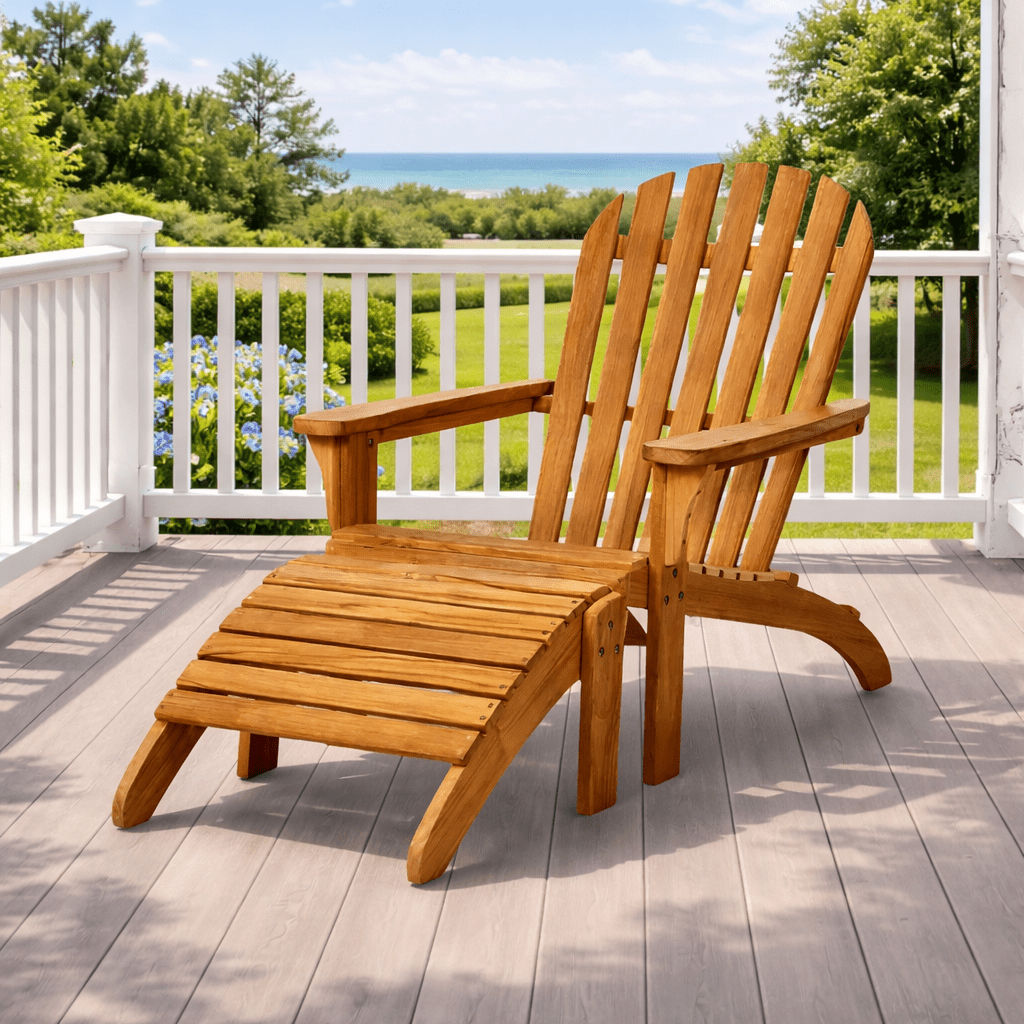 Teak's naturally high oil content and dense grain structure are central to its outdoor performance. The wood resists moisture and rotting without depending on an artificial stain for durability. On coastal properties where furniture may repeatedly become damp from rain, fog, or dew, that simplifies the material decision considerably.
This does not eliminate ordinary cleaning. Organic debris, surface dirt, pollen, and coastal residue can still collect on furniture. It does mean that maintaining the wood's durability does not require homeowners to continually create an artificial protective barrier.
New England's seasonal transitions can be demanding on outdoor materials. Teak's resistance to warping and its suitability for temperature fluctuations make it a strong choice for furniture expected to remain outdoors through changing conditions.
That is especially useful for substantial dining tables, benches, sofas, and chairs that homeowners would rather position thoughtfully once than shuttle between storage and the patio several times a year.
Natural teak can weather from its original warm tone to a silver-gray patina when left untreated. For many coastal homes, that weathered appearance is aesthetically compatible with cedar shingles, stone, gray siding, weathered decking, and traditional seaside architecture.
Homeowners who prefer the original teak color can maintain it with appropriate products. Those who like the silver-gray appearance can allow the change to occur naturally. The key is deciding which look you want before assuming discoloration means deterioration. Teak does not need to retain its original color to remain durable.
The most practical advantage for many vacation-home and waterfront owners is flexibility. Teak can be left unfinished and allowed to weather naturally, or homeowners can choose a more active appearance-maintenance routine. For owners who want to preserve or refresh the wood's appearance, TeakHQ offers teak care products.
This matters in New England because seasonal homes often have a concentrated maintenance calendar. Furniture that gives the owner a choice about cosmetic maintenance is easier to fit around dock work, landscaping, storm preparation, house opening, and winterizing.
| New England Coast Challenge | Why Premium Grade A Teak Performs Well |
|---|---|
| Salt-laden air | Dense natural teak is well suited to exposed outdoor environments. |
| Rain and damp weather | Natural oils and dense grain help resist moisture and rot. |
| Humidity and morning dew | Moisture resistance supports repeated wet-and-dry exposure. |
| Summer sun | Teak is designed for sun exposure and can weather naturally to gray. |
| Temperature changes | Grade A teak resists warping and is designed for outdoor temperature fluctuations. |
| Snow and winter exposure | Teak is designed for year-round outdoor use. |
| Organic debris | Durability does not depend on an artificial surface stain. |
We would begin with how the property is actually used, not with a catalog. Is this a primary residence where two people eat outdoors most evenings? A Nantucket or Cape Cod house that suddenly hosts ten people every summer weekend? A Maine property where the best view is on an exposed deck? Those answers determine furniture size and configuration more than the home's square footage.
For many coastal New England homes, we would prioritize dining first. The outdoor season is valuable precisely because people want to use it: lobster dinners, grilled seafood, family lunches, visiting friends, and long evenings outside. A substantial table creates a dependable center for all of those uses.
For a household that entertains regularly, we would start with teak outdoor dining sets sized for normal use rather than the largest possible party. The goal is comfortable everyday proportions with enough flexibility for guests.
A common New England problem is that summer occupancy and year-round occupancy may be dramatically different. A vacation home may seat four most of the time and ten when children, grandchildren, or friends arrive. Permanently furnishing the deck for the largest gathering can consume valuable space during the rest of the season.
That is why an expandable table is often more useful than simply buying the largest fixed table that fits. It allows the patio to feel proportional during ordinary weeks while still accommodating a full house when needed.
After dining, we would usually create a separate conversation zone rather than extending the dining area across the entire deck. On larger properties that may mean a sofa and lounge chairs around a coffee table. On a narrower porch, it may simply be a loveseat with two chairs.
Teak outdoor sofas are useful here because they give the space a more settled, architectural feel than a collection of unrelated occasional chairs. Most TeakHQ patio seating includes Sunbrella cushions, although cushion inclusion varies by product and should be confirmed on the individual listing.
The signature planning insight for a coastal New England property is simple: do not automatically point every seat toward the house or toward the center of a furniture grouping. If the property's value comes partly from a harbor, marsh, beach, island, garden, or sunset view, preserve that sightline.
Sometimes the best arrangement is intentionally asymmetrical: dining near the kitchen, a pair of chairs angled toward the water, and a bench in a separate location where someone can sit alone with coffee. A good outdoor plan does not need every chair to participate in the same conversation.
Start with the collection that solves your property's main use. Frequent hosts will usually get the most value from dining furniture or an extendable table; homes built around harbor or ocean views may benefit more from Adirondack chairs, deck chairs, or lounge seating. Once that primary zone works, add secondary pieces such as side tables, benches, and storage rather than trying to furnish the entire property at once.
Coastal New England outdoor living is intensely seasonal without being limited to summer alone. Warm-weather weekends tend to pull meals, conversation, reading, and visiting outside, while spring and fall can still provide excellent patio time when the furniture layout works with sun, wind, and shelter. The result is that outdoor spaces often function less like decorative patios and more like seasonal rooms.
One of the most distinctive furniture-planning issues along the coast is fluctuating household size. A home that feels quiet during the week can fill quickly on a summer weekend. Adult children arrive, friends stay over, neighbors stop by, and the dining table becomes the center of the house.
That favors furniture that can accommodate changes without dominating the patio every day. Extendable tables, movable dining chairs, occasional benches, and small side tables give owners more options than a single oversized fixed arrangement.
Covered porches remain especially valuable because they extend outdoor use when direct sun, drizzle, or a cool breeze would make an exposed patio less comfortable. They also tend to be narrower than modern resort-style terraces, so scale deserves attention.
A porch often benefits from fewer, better pieces: two rockers, a small table, or a compact conversation arrangement rather than a full suite pushed tightly against railings and doorways.
On oceanfront, harbor-front, river-mouth, and marsh properties, furniture placement should protect the reason people want to sit outside in the first place. Low-profile seating can preserve views through railings, while individual chairs can be moved toward the sun or away from wind as conditions change.
This is also where traditional deck-chair and Adirondack forms feel particularly at home. They provide a relaxed alternative to upholstered deep seating and can establish smaller destinations around a larger property.
A sheltered south- or west-facing sitting area can become far more valuable than an exposed deck once evenings cool. For homeowners who want more than a short midsummer furniture season, we would identify these protected microclimates before deciding where the primary lounge grouping belongs.
In other words, the "best patio" in July may not be the best outdoor room in May or October. Large properties often benefit from more than one intentionally furnished zone.
 The right configuration depends heavily on whether the property is a compact historic in-town home, a beach cottage, a large summer house, or a waterfront estate. Rather than choosing one universal "coastal set," match each furniture type to the job the space needs to perform.
For a home where summer guests are part of the rhythm of ownership, dining deserves first priority. Six- to ten-person configurations work well for many family-oriented properties, while larger homes may justify even more capacity.
If guest counts vary substantially, extendable teak dining tables can be especially useful. They preserve more open deck space during ordinary use without giving up the ability to seat a larger group for weekend dinners.
Few furniture forms look more natural on a New England coastal property than an Adirondack-style chair. We would use them where lounging and scenery matter more than formal conversation: overlooking a harbor, beside a lawn, near a fire feature, or at the edge of a deck.
Teak Adirondack chairs are particularly appropriate when homeowners want the familiar profile in genuine natural wood rather than a synthetic interpretation.
On ocean-view decks and narrower porches, deep seating is not always the answer. A pair of teak deck chairs and steamers can provide dedicated lounging without turning the entire deck into one large conversation set.
They also work well on properties where chairs are frequently repositioned for sun, shade, wind, or the view. Pair them with compact side tables instead of forcing a coffee table into a narrow circulation path.
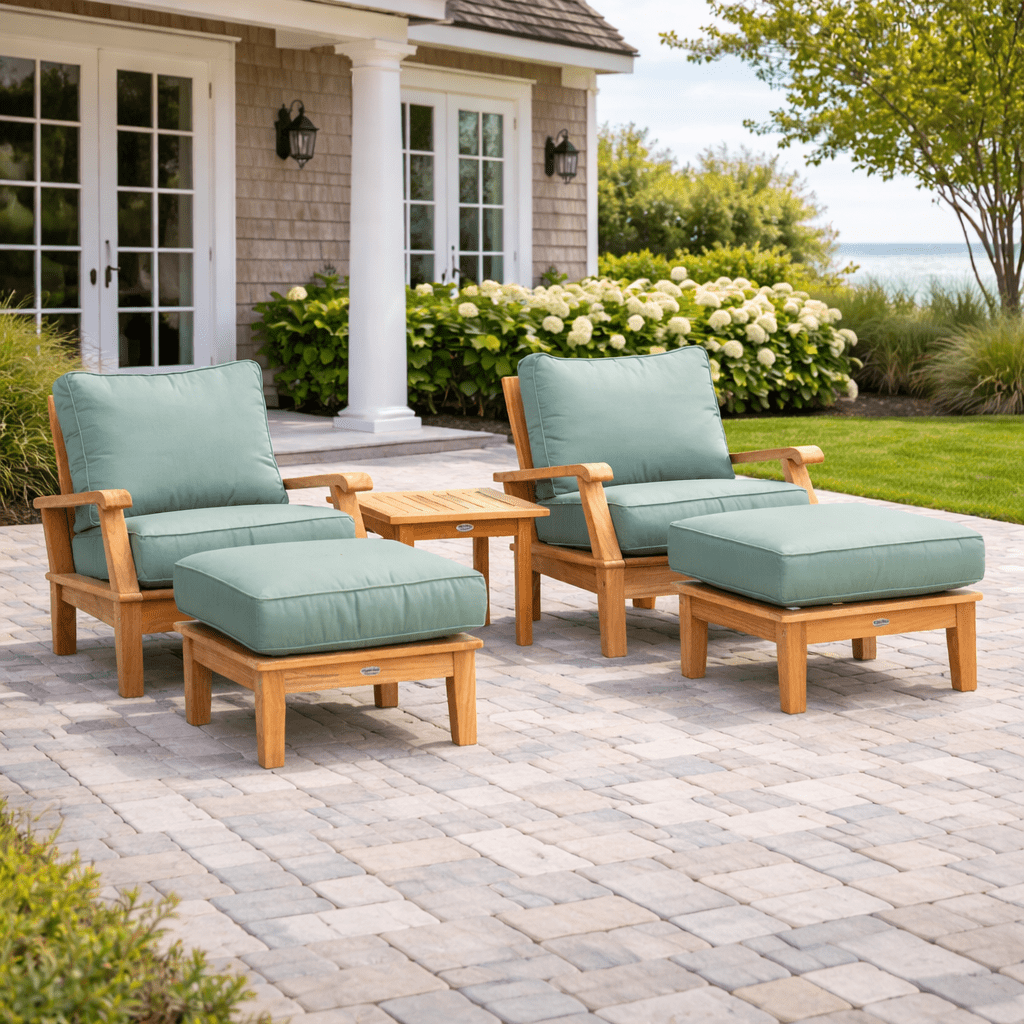
Where there is enough depth, a sofa or loveseat with lounge chairs creates a true outdoor living room. We like this configuration most on protected terraces, wider porches, and patios where people will spend hours talking rather than simply stopping outside for a few minutes.
Pay attention to cushion management. Most TeakHQ patio seating includes Sunbrella cushions, but not every piece does. Sunbrella is weather-, fade-, UV-, and water-resistant, yet removable cushions are still easier to keep clean and ready for use when stored during prolonged bad weather or the off-season.
Large coastal properties often have places worth furnishing that are not patios at all: hydrangea gardens, lawn edges, paths, harbor overlooks, or quiet corners beneath mature trees. A teak garden bench can make these locations useful without creating another full furniture zone.
These secondary seats are easy to overlook during the initial purchase, but they often become some of the most-used furniture on a property because they create a destination away from the main gathering area.
Teak fits the New England Coast particularly well because the material is visually adaptable. The same natural wood can complement weathered coastal architecture, formal historic homes, contemporary waterfront construction, and traditional gardens without requiring every property to adopt a literal nautical theme.
Weathered shingles, painted trim, natural stone, and restrained landscaping create an easy setting for teak. Fresh natural teak adds warmth; weathered silver-gray teak can become quieter and more integrated with an established coastal palette.
We would resist filling these properties with overtly themed accessories. A few substantial natural-wood pieces usually feel more authentic than anchors, ropes, navy stripes, and other decorative signals competing for attention.
In older communities such as Newport, Marblehead, Portsmouth, and Newburyport, outdoor furniture often shares space with architecture that already has significant visual character. Traditional benches, dining chairs, rockers, and straightforward tables can complement the home without becoming the focal point.
Scale is especially important on historic porches. Furniture should leave room to walk comfortably past columns, doors, railings, and steps rather than filling every available square foot.
Modern glass, dark siding, simple rooflines, and broad decks can also work well with teak. In these settings, choose cleaner furniture silhouettes and limit the number of different furniture styles within one sightline.
Teak's warmer, more organic character can soften a modern exterior without undermining its simplicity. This is also where the contrast between natural wood and stone, steel, concrete, or dark architectural finishes can be particularly effective.
Coastal landscapes are not limited to hardscape. Lawns, hedges, mature trees, perennial gardens, and flowering shrubs often create multiple places to pause. A bench or pair of chairs placed at the edge of a garden can be more useful than adding still more seats to the principal patio.
Think of these pieces as destinations rather than decoration. Give each one a reason to exist: morning sun, a view, evening shade, proximity to a garden, or a quiet place away from the main group.
 A furniture set can look perfect during a sunny summer showroom visit and still be poorly matched to the rest of the year. Coastal New England owners should also think about wet spring weather, autumn debris, freezing temperatures, and winter exposure.
Teak helps simplify this decision because Grade A teak is designed for year-round outdoor use and temperature fluctuations. The wood itself does not have to be brought indoors simply because summer is over.
Open decks and exposed shorefront properties can be much windier than sheltered inland patios. Furniture that is easy to move can be convenient, but extremely lightweight pieces may demand more attention when weather changes.
Premium teak has a heavier, sturdier feel than lightweight outdoor furniture. That does not make any furniture storm-proof; movable objects should still be secured or handled appropriately when severe weather threatens. But substantial furniture can be a better everyday fit for an exposed property.
Buying a permanent twelve-person table because twelve people visit twice each summer can make the deck worse for everyone during the other hundred days. Oversized furniture interrupts traffic, crowds railings, and reduces flexibility.
An extendable table is often the smarter New England solution. Furnish for the household you have most days, then build flexibility into the arrangement for the weekends when the house fills up.
Teak naturally changes color outdoors. Homeowners sometimes interpret the developing silver-gray surface as a sign that the wood needs to be "rescued," when in fact natural weathering is an expected aesthetic change.
Decide whether you prefer warm natural teak or weathered gray teak. Both can work beautifully on a coastal home. The mistake is beginning an appearance-maintenance routine without first deciding whether you actually want to preserve the original color.
Water-resistant performance fabric is helpful, but a coastal property can still experience prolonged rain, pollen, debris, and an extended winter off-season. Leaving cushions wherever they happen to sit makes spring opening more complicated than it needs to be.
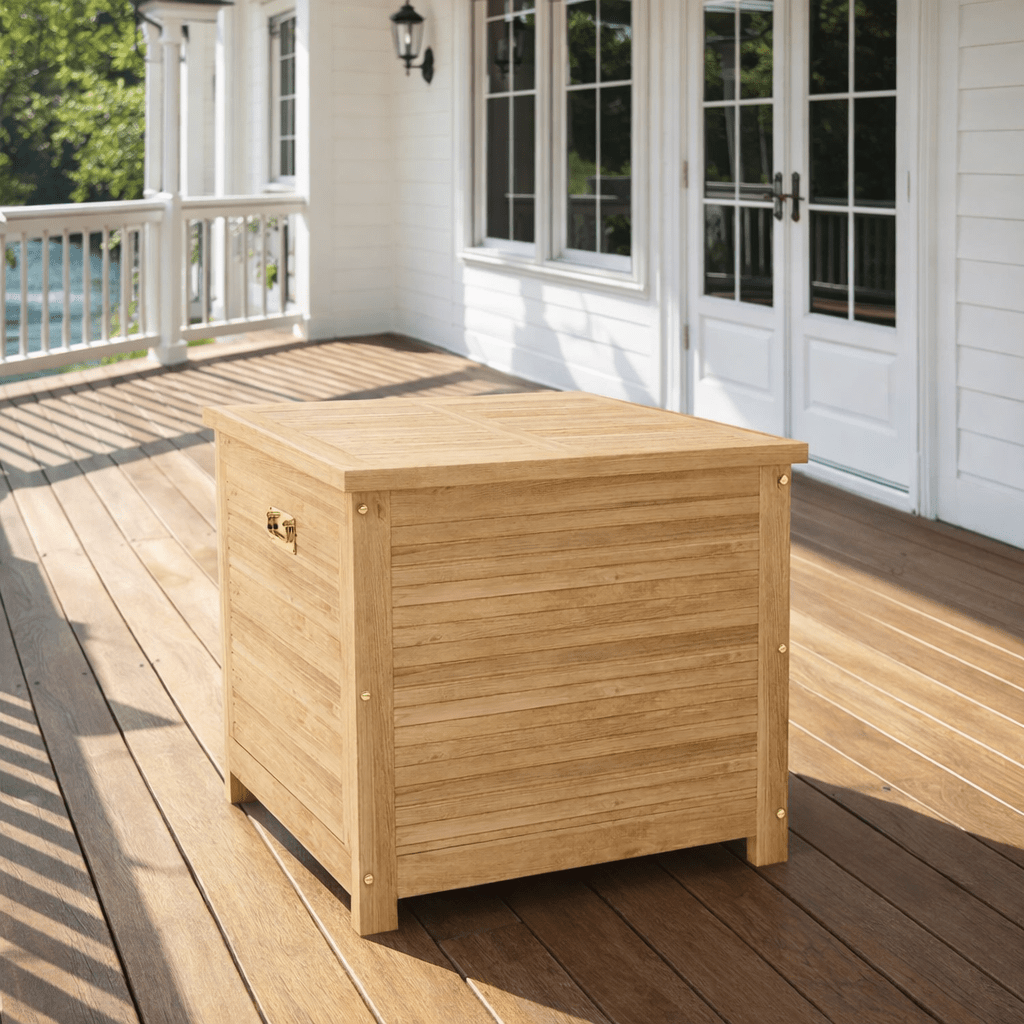
Plan cushion storage at the same time you buy lounge furniture. A nearby storage location or teak deck box can make daily and seasonal routines much easier.
 Teak does not need an elaborate coastal maintenance program to remain durable. The most useful routine is usually simpler: keep surfaces reasonably clean, prevent piles of wet organic material from sitting against the furniture, manage cushions separately, and decide whether you want the wood to remain golden or weather naturally.
There is no single cleaning calendar that fits every New England property. An exposed oceanfront deck may collect salt residue and windblown material more quickly than a sheltered inland-facing porch. A furniture grouping beneath trees may need more frequent attention during pollen and leaf seasons than one on an open terrace.
Inspect the furniture periodically and clean when visible dirt, coastal residue, pollen, or organic debris accumulates. That is more useful than cleaning simply because a certain number of weeks has passed.
Homes close to open water can accumulate marine residue on outdoor surfaces. Periodic gentle cleaning helps keep furniture looking cared for, particularly on exposed rail-side decks and shorefront patios.
Pay attention to hardware as well as wood. Royal Teak and Anderson Teak products use stainless-steel hardware, while Verandis Teak products use brass hardware.
Furniture on a shady porch, beneath trees, or in an area with slow drainage may remain damp longer than pieces in open sun. Keep leaves and other organic debris from accumulating beneath or against the furniture, and avoid arrangements that unnecessarily trap moisture.
If cushions become wet, allow them to dry thoroughly rather than enclosing them immediately in a storage space. Most TeakHQ lounge cushions use Sunbrella fabric, which is weather-, fade-, UV-, and water-resistant, but normal drying and cleaning practices still matter.
If you like the silver-gray look associated with naturally weathered teak, the wood can be left untreated. If you want to maintain more of the original warm color, use appropriate care products and follow the specific product instructions.
Neither approach should be confused with structural protection. Teak's outdoor durability does not depend on painting or artificially staining the wood.
Before winter, remove food residue and heavy organic buildup and decide how you will handle cushions and movable accessories. Cushions are generally better stored clean and dry during a long period when the furniture will not be used.
Teak furniture itself can remain outside year-round. Protective covers are optional rather than required for the wood's durability. If you use covers for cleanliness or convenience, make sure they fit the furniture appropriately rather than allowing trapped debris or moisture to become a new maintenance problem.
The best New England outdoor space is not necessarily the one with the most furniture. It is the one that works equally well for a quiet morning, a full summer weekend, and the realities of a coastal climate. Start with the area your household will use most—often dining or view-oriented seating—then add the pieces that make the rest of the property more useful. Premium Grade A teak offers a natural, substantial foundation that can handle the changing seasons while fitting comfortably into both traditional and contemporary coastal homes.
Look for materials that handle moisture, changing temperatures, sun, and repeated outdoor exposure well. Premium hardwoods such as Grade A teak are particularly practical because teak naturally resists moisture, rot, insects, and warping and is designed for year-round outdoor use. High-quality aluminum and synthetic materials can also be appropriate depending on the style and construction.
Furniture near the coast should be selected as a complete system: frame, hardware, cushions, finish, and maintenance needs all matter. Grade A teak is well suited to outdoor coastal environments because of its dense grain, natural oils, and moisture resistance. Periodic cleaning of marine residue is still sensible on highly exposed properties.
Yes. Premium Grade A teak is designed for year-round outdoor use and can withstand rain, sun exposure, temperature fluctuations, and winter conditions. Cushions and accessories may still be easier to keep clean and ready for spring if they are stored separately during the off-season.
Teak does not require a cover for durability. Some homeowners still use covers to reduce dirt, leaves, snow, and spring cleanup. If convenience is the goal, choose well-fitting covers and follow the furniture and cover manufacturers' instructions.
Yes. Untreated teak naturally develops a silver-gray patina with outdoor exposure. That color change is normal weathering rather than an indication that the wood has failed. Homeowners who prefer the original warm teak appearance can use appropriate teak care products.
Start with the deck's size and primary use. Dining sets work well where meals and guests are the priority; Adirondack chairs and deck chairs suit view-oriented lounging; sofas and lounge chairs make sense on deeper decks with room for a dedicated conversation area. Preserve circulation and sightlines rather than filling every open space.
They can be especially useful. Many vacation homes have a small everyday household but a much larger weekend or holiday guest count. An extendable teak table provides additional seating when needed without permanently consuming as much deck or patio space.
Use performance fabrics designed for outdoor exposure and allow wet cushions to dry thoroughly. Most TeakHQ patio seating includes Sunbrella cushions, although inclusion varies by product. During extended bad weather or the winter off-season, clean, dry storage can reduce unnecessary exposure and simplify spring setup.
No. Teak does not require sealing, painting, or artificial staining for durability. You may choose care products if you prefer to maintain the original teak color rather than allowing the wood to weather naturally.
Quality teak furniture is a long-term purchase intended to last for decades rather than a few seasons. Its higher initial cost is one reason buyers should compare lifetime ownership, construction, and maintenance rather than judging outdoor furniture on purchase price alone.


