
FREE SHIPPING
within mainland USA
within mainland USA
Home ▸ Teak Outdoor Furniture ▸ By Location ▸ Newport Beach, California
Outdoor furniture in Newport Beach has to suit more than Southern California sunshine. Homes near the harbor and ocean may face salt-laden air and marine moisture, while exposed terraces and pool decks spend long periods in direct sun. Just as important, outdoor spaces here often function as genuine extensions of the home—from harbor-view dining areas to Newport Coast pool patios. Premium Grade A teak is a particularly strong option because it combines a natural coastal aesthetic with the durability and ownership flexibility required for long-term outdoor use.

Newport Beach is not simply another mild Southern California furniture market. The combination of Pacific exposure, Newport Harbor, strong sun, irrigated landscaping, pools, and highly used outdoor living areas creates a particular set of priorities. The challenge is rarely surviving a harsh winter. It is choosing furniture that can remain attractive and structurally dependable through repeated exposure to sun, moisture, salt-laden air, everyday entertaining, and relatively little true off-season.
For properties close to the ocean, harbor, or channels, coastal exposure deserves more attention than the temperature forecast. Salt carried through the air can settle repeatedly on furniture and hardware. That does not mean every coastal property experiences the same level of exposure, but homes on Balboa Peninsula, Balboa Island, Lido Isle, Bayshores, and other waterfront settings warrant a more coastal-minded buying strategy than a protected inland Orange County patio.
For wood furniture, the important question is whether the material is naturally suited to outdoor moisture and weather rather than dependent on a decorative surface coating for its basic durability. Hardware quality matters as well. TeakHQ's Royal Teak and Anderson Teak furniture uses stainless-steel hardware, while Verandis Teak uses brass.
A covered courtyard in Corona del Mar and an exposed west-facing terrace in Newport Coast can require very different furniture planning even though both are in Newport Beach. Open pool decks, upper terraces, and ocean-view patios receive more direct sunlight than spaces protected by deep rooflines or mature landscaping.
The furniture material itself is only part of this decision. Upholstery should also be evaluated separately. Most TeakHQ patio seating includes Sunbrella cushions, which are designed to resist weather, fading, UV exposure, and water. On heavily exposed properties, shade from an umbrella or permanent structure can improve everyday comfort even when the furniture itself is designed for outdoor use.
Coastal homeowners should think about moisture as a daily-use issue rather than simply a rainfall issue. Morning dampness, coastal air, pools, sprinklers, wet towels, and routine cleaning can all introduce moisture around a patio. Furniture positioned in a shaded courtyard or beside dense landscaping may also dry more slowly than pieces on an open terrace.
This is one reason material selection matters even in a relatively mild climate. Outdoor furniture needs to tolerate repeated wetting and drying without requiring the homeowner to treat every change in weather as a storage event.
Many Newport Beach patios are not occasional-use spaces. A dining terrace may be used for weeknight meals, a sectional for morning coffee and evening conversation, and pool loungers throughout much of the year. That makes comfort, useful furniture scale, and long-term construction at least as important as weather resistance.
A practical rule is to buy for the way the space operates on a normal Saturday, not for the empty patio shown on a floor plan. Newport Beach homes often benefit from fewer, properly scaled furniture zones rather than filling every available edge with individual pieces.
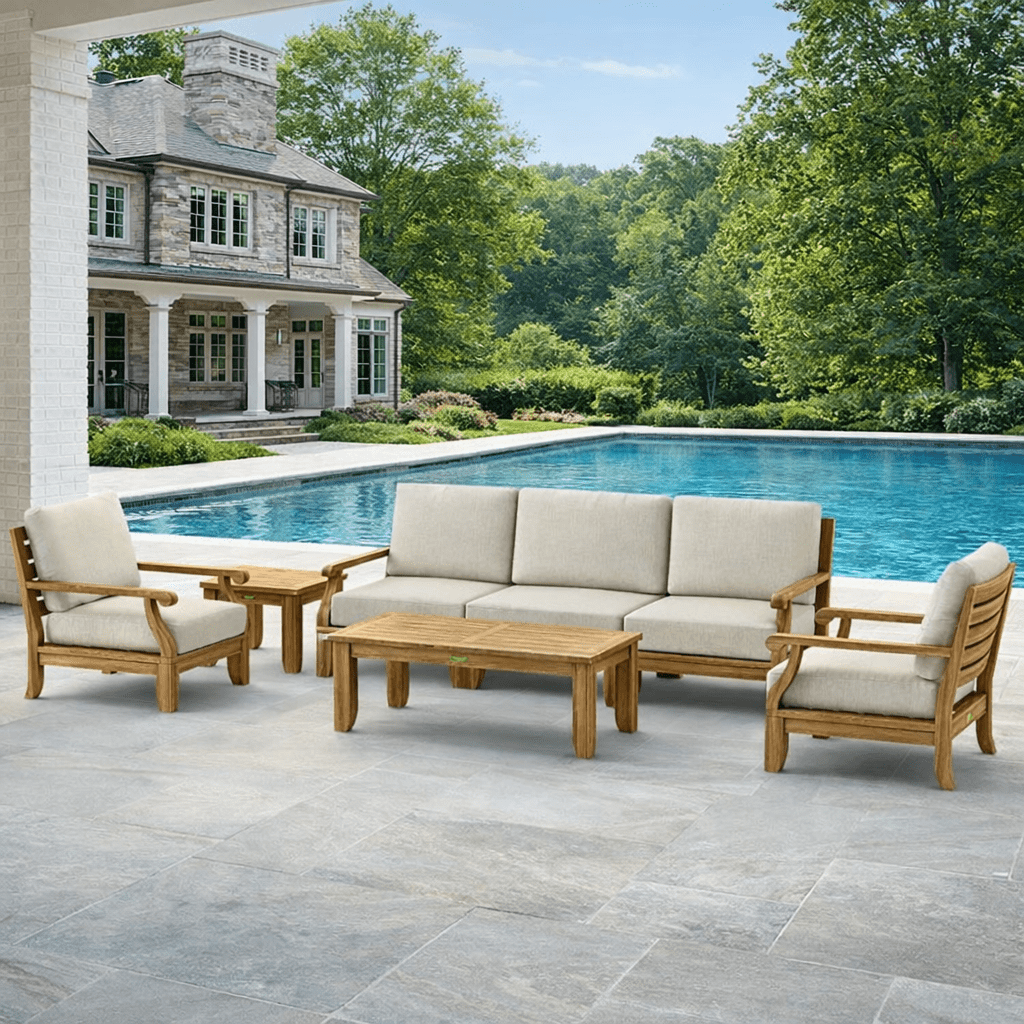 Premium Grade A teak contains naturally high levels of oils and has a dense grain structure. Those characteristics help make teak resistant to moisture, rotting, insects, and warping and are central to why it has a long history as an outdoor furniture material. For Newport Beach, that means the wood does not depend on paint or an artificial stain to provide its basic outdoor durability.
This is particularly useful on patios that experience a combination of marine moisture, irrigation, pool activity, and ordinary outdoor exposure. Premium teak can be used year-round and is designed to withstand rain, sun, and temperature fluctuations.
One of the most useful things to understand before buying teak is that natural color change is expected. Unfinished teak gradually develops a silver-gray patina when left exposed outdoors. That change is cosmetic rather than an indication that the wood has stopped functioning as outdoor furniture.
For some Newport Beach homes, especially coastal-modern, cottage, and relaxed harbor settings, the weathered gray can become part of the design. Homeowners who prefer the original warmer teak appearance can instead use appropriate teak care products to maintain it. The advantage is flexibility: the owner can decide how much cosmetic maintenance is worthwhile.
Premium outdoor furniture is a different purchase from lightweight furniture intended to be replaced every few seasons. Grade A teak's dense structure and resistance to warping make it well suited to substantial dining tables, sofas, sectionals, loungers, and other pieces that are expected to remain part of the property for years.
Teak is also comparatively heavy and architectural in feel. That characteristic is often desirable on larger Newport Beach patios where furniture should feel visually proportional to stone paving, outdoor kitchens, pools, substantial homes, and expansive views rather than appearing temporary.
Teak furniture carries a higher initial cost than many mass-market outdoor materials, so it makes the most sense for homeowners who value long service life. Well-made teak furniture can last for decades rather than seasons. For a primary residence, second home, or property undergoing a significant outdoor renovation, evaluating lifetime usefulness can be more meaningful than comparing only initial purchase prices.
That does not make teak automatically right for everyone. Aluminum may appeal to someone who specifically wants lightweight furniture and a distinctly contemporary material, while poly lumber may suit a buyer prioritizing a synthetic, low-maintenance solution. Teak is compelling when the homeowner wants real wood, substantial construction, natural character, and long-term outdoor performance.
| Newport Beach Challenge | Why Premium Grade A Teak Performs Well |
|---|---|
| Coastal air | Naturally oily, dense teak is designed for outdoor weather exposure. |
| Marine moisture | Teak naturally resists moisture and rotting. |
| Direct sunshine | Teak withstands sun exposure and can weather naturally outdoors. |
| Wet pool areas | Moisture resistance suits frequently wet outdoor environments. |
| Repeated wet/dry cycles | Grade A teak resists warping and handles outdoor temperature fluctuations. |
| Year-round exposure | Premium teak is designed for year-round outdoor use. |
| Long ownership horizons | Quality teak furniture can provide decades of service. |
We would begin with the property's actual outdoor routine rather than selecting furniture piece by piece. In Newport Beach, the highest-value spaces are often the places where people naturally gather: outside the kitchen, beside the pool, overlooking the harbor, or on a protected terrace with comfortable evening seating. Establish those zones first, then choose furniture to support them.
If a home has one large terrace, we would usually resist the temptation to divide it into too many small furniture groupings. A substantial teak patio seating arrangement can establish a true outdoor living room, particularly on Newport Coast terraces, harbor-view patios, and larger pool decks.
Sectionals work especially well when the patio has a defined corner or architectural edge. Sofas and club chairs offer more flexibility where sightlines matter. Around a harbor or ocean view, we would preserve the most important viewing direction instead of automatically centering furniture around the house.
Outdoor meals are sufficiently common here that dining should usually be treated as a primary zone rather than an accessory. For households that entertain, an extendable teak dining table is particularly useful because the patio does not have to permanently accommodate the largest possible gathering.
Allow generous circulation behind occupied chairs. This becomes especially important on terraces with sliding doors, outdoor kitchens, pool traffic, or routes leading toward the harbor. The most impressive table is not necessarily the best table if guests constantly have to squeeze around it.
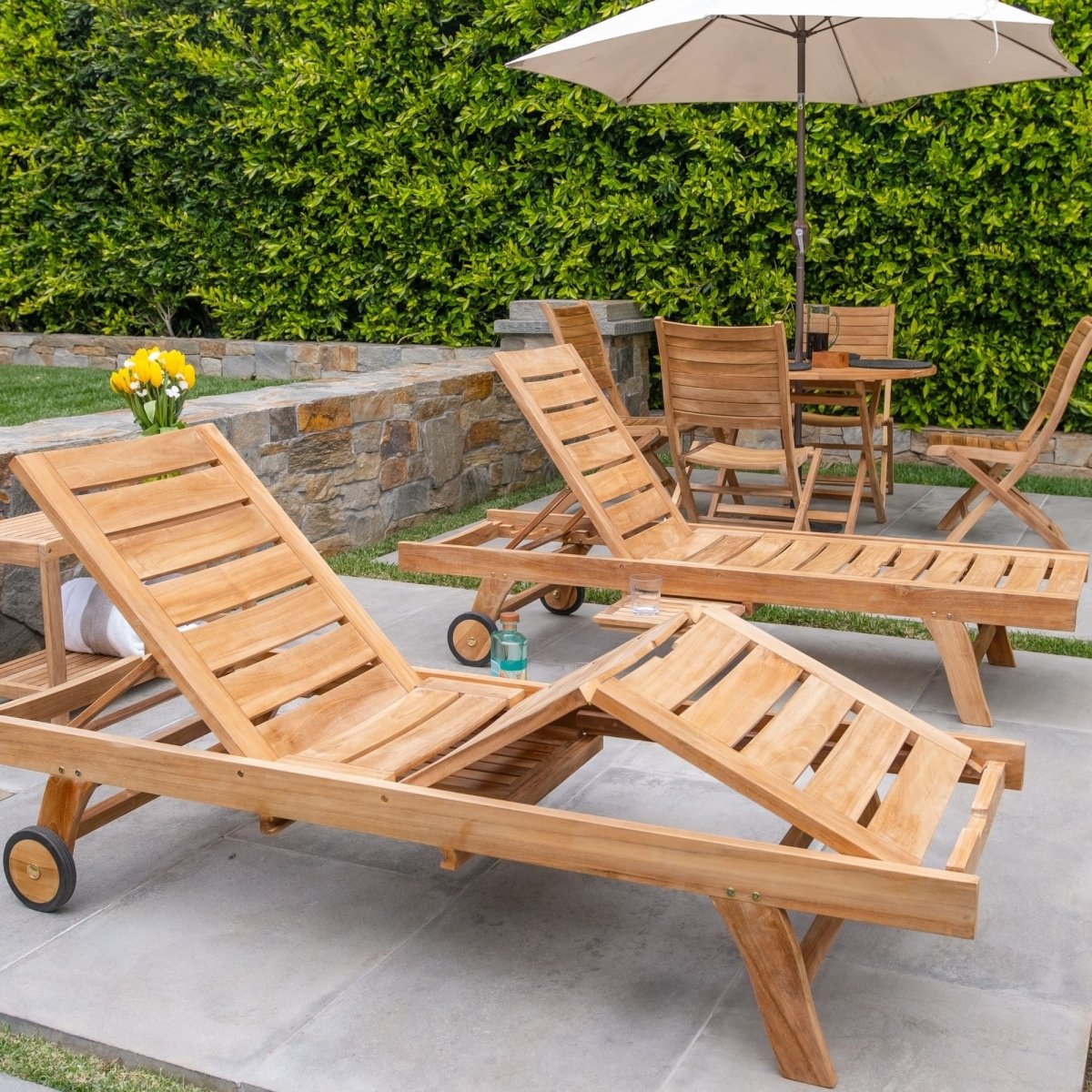
A chaise lounge performs a different job from a club chair or sectional. Where space allows, give the pool its own dedicated lounging zone and keep the main conversation furniture farther from splash traffic. Browse teak chaise loungers for the pool edge, then use deep seating where people are more likely to gather with drinks, food, or evening guests.
This separation is particularly helpful for families. Wet swimmers do not have to move through the primary upholstered seating area simply to find somewhere to sit.
One of the most common planning mistakes on a scenic property is treating every chair as though its relationship to the house matters more than its relationship to the view. On hillside and waterfront properties, we would first identify the two or three strongest sightlines and arrange furniture accordingly.
A memorable Newport Beach patio often feels less like an outdoor showroom and more like a sequence of destinations: dining near the kitchen, conversation seating oriented toward the view, and a pair of loungers or chairs in the quietest corner. Furniture should help people use the property, not simply fill it.
Begin with the activity that defines your outdoor space. Large entertaining patios should usually start with dining or sectional seating; pool-oriented homes may prioritize chaise loungers; smaller harbor and village properties often benefit from flexible tables, club chairs, and compact accent pieces. Once the primary zone is established, add supporting pieces that make that area easier to use rather than creating unrelated furniture groups.
Newport Beach outdoor living is shaped as much by geography and property layout as by climate. A Balboa Island patio, a Corona del Mar courtyard, a Newport Coast pool terrace, and a Lido Isle waterfront home may all be within the same city, yet they call for very different furniture plans. The common thread is that outdoor areas tend to be used as functional living space rather than treated as purely decorative yards.
Waterfront outdoor spaces deserve a furniture plan built around orientation. Seating may be more valuable facing the harbor than facing every other chair, and dining tables should be positioned so the best view is shared rather than reserved for only one end of the table.
For these properties, movable club chairs and side tables can complement a larger fixed grouping. They give hosts a way to adjust the patio for a quiet evening, visiting couples, or a larger gathering without constantly rearranging the main furniture.
Larger properties in Newport Coast and similar hillside communities can support distinct pool, dining, and lounge zones. The key is not making each one equally large. If the family spends most afternoons around the pool, prioritize loungers and shade there, then place the main deep-seating area where it remains comfortable later in the day.
Pool furniture should also be easy to use with wet hands and towels. Side tables beside loungers are deceptively important because they keep drinks, phones, books, and sunscreen off the ground.
Outdoor dining here does not need to be designed solely around large parties. A table that works comfortably for four to six people on an ordinary evening may ultimately get more use than a permanently oversized table. Households that occasionally host larger groups can solve that conflict with an extendable table.
For homeowners with an outdoor kitchen, keep the dining table close enough to make serving easy but outside the primary cooking circulation path. A separate serving or buffet table can be more useful than simply buying a larger dining table because it keeps platters and drinks away from each guest's place setting.
Balboa Island, the Peninsula, and other village or waterfront settings can reward restraint. Smaller patios often work better with one excellent dining or conversation area than with several undersized zones. Foldable or compact tables, club chairs, benches, and side tables can provide function without consuming every walkway.
In constrained outdoor spaces, measure open doors, gates, stairs, grill access, and chair pull-out depth—not just the patio's length and width. Those circulation dimensions often determine whether a layout feels generous or frustrating.
 On larger terraces and pool patios, teak sectional sets can create a defined outdoor living room without requiring a collection of unrelated chairs. They are particularly effective when there is enough depth to preserve circulation behind the seating.
Before choosing a sectional, decide whether the priority is conversation, watching an outdoor television, facing a fireplace, or preserving an ocean or harbor view. Modular seating is most useful when its shape follows the way people actually use the space rather than simply following the nearest wall.
A complete teak outdoor dining set is a practical starting point when dining is the property's main outdoor activity. Six-person configurations work well for everyday family use, while larger tables become more appropriate for homeowners who routinely entertain.
We would prioritize table size after accounting for chair clearance and serving circulation. On a view terrace, a slightly narrower table with comfortable movement around it can feel more luxurious than a larger table that dominates the space.
Dedicated chaise loungers make sense when the pool itself is a regular destination rather than a background feature. A row of loungers can create a resort-like pool zone, but spacing matters. Leave enough room for side tables and movement so guests do not have to climb around one another.
For smaller pools, two well-positioned chaises may be more functional than four tightly packed ones. Furniture quantity should follow usable deck width rather than symmetry alone.
Club chairs are particularly versatile around Newport Beach homes because they can supplement a sofa, form a small conversation group, or occupy a secondary view location without committing the patio to a large footprint. They are also easier to angle toward changing focal points than a large sectional.
Pair them with teak side and end tables. Small surfaces dramatically improve how often secondary seating areas get used because guests immediately have somewhere for a drink, book, or phone.
If entertaining is frequent, a serving table can solve a problem that homeowners often try to fix with a larger dining table. Keeping drinks, serving dishes, and grilling tools on a dedicated surface preserves usable table space and reduces traffic between the house and patio.
That is especially useful where kitchen doors or outdoor cooking areas create natural bottlenecks. Think of serving furniture as circulation infrastructure rather than decoration.
Newport Beach does not have one uniform architectural vocabulary. Compact coastal cottages, updated village homes, Mediterranean-influenced properties, transitional residences, contemporary rebuilds, and expansive Newport Coast homes can all be found within the market. Teak works particularly well here because its visual identity comes primarily from natural wood rather than a highly specific decorative style.
Natural teak and weathered silver-gray teak both pair naturally with relaxed coastal architecture. On smaller cottages and village homes, we would favor simpler furniture profiles and avoid overwhelming limited patios with excessively deep seating.
The objective is not to make the furniture look nautical. A restrained palette of teak, neutral upholstery, and greenery generally allows the architecture and coastal surroundings to provide the sense of place.
Modern architecture often benefits from the visual warmth of real wood. Teak can soften expanses of glass, plaster, stone, and concrete without making the outdoor space feel traditional. Clean-lined sectionals, dining tables, and loungers are especially effective when the surrounding architecture is already visually strong.
Warm teak tones sit comfortably beside stone, stucco, tile, and mature landscaping. For transitional properties, the material can bridge classic architecture and more contemporary outdoor renovations without forcing the homeowner to match every piece to a single design period.
Teak furniture does not need an elaborate decorative scheme to feel complete. Pool water, coastal planting, stone paving, hedges, planters, and ocean or harbor views can provide most of the visual interest. Furniture should support that composition rather than compete with it.
 A common mistake is shopping as though Newport Beach were simply a warm inland climate. Properties close to the water should account for marine moisture and salt-laden air when evaluating wood, finishes, hardware, and maintenance expectations.
Premium Grade A teak helps address the wood portion of that problem because it naturally resists moisture, rotting, and warping. Quality hardware remains important as well.
A patio designed around the largest party of the year can be awkward for the other 364 days. Oversized dining tables and too many permanent chairs consume circulation space and can block views.
A better approach is to design for normal use and build flexibility into the plan. Extendable tables, movable club chairs, and occasional seating can increase capacity when needed without making the everyday patio feel crowded.
Dining chairs, chaise loungers, club chairs, and sectional seating solve different problems. Trying to make one category serve the entire property usually produces compromises. Pool users need reclining space; dinner guests need upright seating; conversation areas benefit from deeper seats.
Divide the patio by activity first. Then choose the furniture type for each zone.
Homeowners frequently measure whether a table or sofa physically fits but overlook what happens when chairs are occupied, doors open, or people carry food from the kitchen. This is especially consequential on narrow terraces, island lots, and compact coastal patios.
Mark the proposed furniture footprint on the ground before purchasing. Then walk the paths people will actually use. A few feet of open circulation can be more valuable than another chair.
Teak's gradual transition toward silver-gray is normal when the wood is left untreated. A buyer who expects exposed teak to remain indefinitely golden without cosmetic care may interpret a normal process as a product problem.
Decide before purchase which appearance you prefer. If weathered teak suits the property, maintenance can remain quite simple. If maintaining the warmer original appearance is important, plan for periodic teak care from the beginning.
 There is no useful Newport Beach cleaning schedule that applies equally to every property. A protected courtyard several blocks inland may stay clean much longer than a waterfront patio exposed to salt residue, pool traffic, irrigation, or windblown debris.
Inspect the furniture periodically and clean it when visible dirt and surface buildup warrant it. Waterfront owners may find that occasional fresh-water rinsing helps remove accumulated coastal residue before normal cleaning.
Teak itself is naturally moisture- and rot-resistant, but the entire patio environment still benefits from airflow and reasonable cleanliness. Furniture in shaded areas, beside dense landscaping, or near frequently wet surfaces may remain damp longer than pieces in open sun.
Keep organic debris from accumulating around furniture and allow wet cushions to dry properly. This is particularly important for upholstered seating because cushion care is separate from teak care.
Untreated teak can simply be allowed to weather toward its silver-gray patina. Owners who prefer that appearance do not need to apply a cosmetic finish merely to make the teak suitable for outdoor use.
If you want to preserve more of the original golden teak appearance, use appropriate teak care products and follow the product-specific instructions. Think of this as an aesthetic decision rather than a prerequisite for the wood's basic outdoor durability.
Premium Grade A teak is designed for year-round outdoor use, so protective covers are not required simply to make the furniture outdoor-capable. Covers may still be convenient for homeowners who want to reduce cleaning, keep cushions ready for use, or protect furniture from debris during periods when the patio is used less often.
If you do use covers, avoid trapping persistent dampness underneath them. Furniture and cushions should be reasonably dry before long periods of covering.
Newport Beach homeowners generally do not need to approach outdoor teak furniture with the seasonal storage routine required in harsher climates. The more relevant maintenance cycle is based on use, exposure, and desired appearance.
That is a useful distinction: on this coast, patio maintenance is often about keeping an actively used outdoor room clean and comfortable rather than packing it away for a long winter.
The right Newport Beach outdoor furniture plan begins with the property: where people gather, where the strongest views are, how close the patio is to the coast, how many people use it most days, and how much maintenance the owner actually wants. Premium Grade A teak is especially well suited to homeowners who want real wood, substantial construction, long outdoor service life, and the freedom to maintain a warm teak appearance or let the furniture weather naturally.
Start with the primary activity—dining, conversation, or poolside lounging—then build the rest of the outdoor space around it. That approach usually produces a more comfortable, more coherent patio than choosing individual pieces first and trying to make them work together later.
There is no single material that is right for every homeowner. Premium teak, quality aluminum, and some synthetic materials can all be appropriate. Grade A teak is especially compelling for Newport Beach homeowners who want real wood with natural resistance to moisture, rot, insects, and warping plus long-term outdoor durability.
Yes. Grade A teak's natural oils, dense grain, moisture resistance, and outdoor weather resistance make it particularly well suited to coastal environments. On waterfront properties, hardware quality and routine cleaning of accumulated coastal residue should also be considered.
Start with dedicated loungers for swimmers, then create a separate conversation zone using club chairs, sofas, or a sectional if space allows. Teak chaise loungers are particularly useful beside larger pools because they provide true reclining space rather than forcing dining or lounge chairs to serve two purposes.
It depends on the material and your maintenance preferences. Premium Grade A teak does not require a cover for basic outdoor durability. Covers can still reduce debris and cleaning or help keep an infrequently used patio ready for guests.
Yes. Unfinished teak naturally develops a silver-gray patina as it weathers outdoors. This is expected and does not mean the wood has failed. Homeowners who prefer the original warmer color can use appropriate teak care products.
No. Grade A teak does not require sealing for basic outdoor durability. Sealing or other teak-care treatments are optional choices for homeowners who want to maintain more of the wood's original appearance.
Clean when visible residue and dirt accumulate rather than relying on a universal calendar. Waterfront properties may benefit from occasional fresh-water rinsing to remove coastal residue, followed by normal teak cleaning as necessary.
Choose the table only after allowing room for occupied chairs and circulation. If you entertain occasionally but use the patio with a smaller household most days, an extendable teak table can provide extra capacity without permanently consuming valuable patio space.
It depends on what you value. Teak is natural, warm, heavier, and has a premium wood feel. Aluminum is lighter and can create a more distinctly modern look. Poly lumber offers a synthetic alternative with low-maintenance appeal. Teak is usually the stronger fit when natural material, substantial construction, and long-term character are priorities.
Yes. TeakHQ's premium Grade A teak furniture is designed for year-round outdoor use and withstands rain, sun exposure, and temperature fluctuations. Cushion care should still be handled according to the specific furniture and cushion manufacturer's recommendations.


