
FREE SHIPPING
within mainland USA
within mainland USA
Home ▸ Teak Outdoor Furniture ▸ By Location ▸ North Carolina Coast
Outdoor furniture on the North Carolina coast has to fit a distinctive combination of salt air, humidity, strong sun, wind-driven rain, and seasonal coastal storms. It also needs to work for the way beach and waterfront homes are actually used—from family dinners and vacation-week gatherings to quiet mornings on ocean-view decks. Premium Grade A teak is a particularly strong option because it combines natural weather resistance with the substantial, architectural feel that works well across both traditional beach houses and newer coastal homes.

The North Carolina coast asks more of outdoor furniture than many inland parts of the state. Barrier-island homes and oceanfront properties can face salt-laden air, persistent humidity, strong sun, blowing sand, wind-driven rain, and periodic tropical systems. Even several miles inland, outdoor spaces near sounds, marshes, rivers, and the Intracoastal Waterway can remain humid and exposed.
For coastal homeowners, moisture is not just about furniture getting wet during a rainstorm. Humid air, shaded decks, morning dew, and repeated wet-dry cycles can keep outdoor furnishings exposed to moisture for extended periods. Materials that depend heavily on painted finishes, thin coatings, or vulnerable joints can demand more attention in these settings.
Oceanfront homes add salt exposure to the equation. That makes material choice important, but it also makes hardware and maintenance worth considering. Premium furniture should be inspected periodically rather than assuming that any material is immune to the coast.
Many coastal decks have limited tree cover, especially on barrier islands. Ocean-view decks, pool areas, and upper-level porches may therefore receive long periods of direct sun. Buyers should think beyond whether furniture simply survives outdoors: they should also consider how its appearance changes with exposure and whether they are comfortable with that aging process.
With natural teak, sun exposure gradually shifts unfinished wood from its original golden-brown appearance toward a silver-gray patina. That change is cosmetic rather than a requirement to replace or refinish the furniture.
Coastal storms make furniture planning different from furnishing a protected inland patio. The question is not whether a chair or table can somehow be made “hurricane-proof.” It cannot. The better question is how easily the entire outdoor space can be prepared when severe weather is forecast.
That means thinking about removable cushions, umbrellas, accessories, storage, and the number of individual pieces that may need attention. A substantial teak dining table may feel reassuringly solid during normal windy days, but tropical-storm preparation should still follow local emergency guidance and the specific conditions at the property.
The contrast becomes obvious when comparing an exposed Outer Banks deck with a sheltered patio farther inland. Inland furniture may spend much of its life protected by trees, fences, or neighboring structures. A deck in Corolla, Nags Head, Emerald Isle, or Ocean Isle Beach may be considerably more exposed to wind, salt, sun, and blowing sand.
That is why coastal buyers should evaluate outdoor furniture as an exterior material system—not simply as an indoor-style furniture purchase that happens to sit outside.
Premium Grade A teak earns its place in coastal outdoor spaces because several of its natural properties address the conditions described above. Its dense grain and naturally high oil content contribute to resistance to moisture, rot, insects, and warping, while the wood is designed to remain outdoors through sun, rain, and temperature changes.
 Humidity and rain are major reasons we would favor genuine Grade A teak over many less durable wood choices near the coast. Teak's natural oils and dense grain give the wood inherent moisture and rot resistance rather than requiring an artificial stain simply to make the material suitable for outdoor use.
This does not eliminate basic cleaning or sensible care, but it changes the ownership experience. You can maintain the original appearance if that matters to you, or allow the furniture to weather naturally rather than treating every color change as a maintenance failure.
Teak can remain outdoors in sun exposure, but homeowners should understand what “weather resistant” looks like in practice. Unfinished teak naturally develops a silver-gray patina with time. Some owners consider that weathered color especially appropriate for beach architecture; others prefer the warmer original tone and choose optional teak care products to help preserve it.
The useful distinction is between appearance maintenance and durability maintenance. Teak does not require an artificial stain for durability, so preserving the golden color is a design choice rather than an obligation.
Coastal furniture repeatedly moves through hot sun, damp evenings, rain, and changing temperatures. Grade A teak's dense structure and resistance to warping make it particularly practical where those cycles are routine.
Its substantial feel is another useful characteristic for exposed spaces. Teak is heavier and more architectural than lightweight outdoor furniture, although weight should never be interpreted as storm protection.
The wood may be the largest part of the furniture, but coastal shoppers should not ignore the hardware. Royal Teak and Anderson Teak products use stainless-steel hardware, while Verandis Teak products use brass hardware. Around salt air, occasional inspection and cleaning remain sensible even with outdoor-appropriate materials.
That is a useful coastal buying habit in general: evaluate the entire piece rather than judging furniture solely by the headline material.
| North Carolina Coast Challenge | Why Premium Grade A Teak Performs Well |
|---|---|
| Humidity | Natural oils and dense grain provide strong moisture resistance. |
| Frequent rain | Designed for year-round outdoor use and resistant to rotting. |
| Direct sun | Handles sun exposure while naturally weathering toward a silver-gray patina. |
| Wet-dry cycles | Dense Grade A teak resists warping and outdoor weather changes. |
| Salt-air locations | Natural wood does not rely on a painted exterior coating for outdoor durability. |
| Seasonal storms | Substantial construction suits exposed outdoor spaces, though storm preparation remains necessary. |
| Long outdoor season | Designed for continued outdoor use rather than seasonal indoor storage. |
We would start with how the property is actually used—not with a furniture catalog. A primary residence in Wilmington, a large Outer Banks rental, and a compact oceanfront deck on Wrightsville Beach can all justify teak, but they should not be furnished the same way.
For many coastal homes, especially vacation properties, we would first decide whether dining or lounging is the main event. If family meals, seafood dinners, and group breakfasts dominate the week, start with teak outdoor dining furniture. If the deck is mostly used for morning coffee, reading, drinks, and conversation, prioritize lounge seating instead.
Trying to fit a full dining area and a full conversation area onto a deck that comfortably supports only one often creates a less useful space. One well-proportioned primary zone usually works better than two cramped ones.
A memorable coastal planning rule is this: furnish the outdoor space for the house when it is full, not when it is quiet.
A second home might normally host two or four people, yet become the center of a family vacation when children, grandchildren, or friends arrive. Large beach houses and rentals often benefit from a generously sized table or an extendable teak dining table that can adapt between normal use and peak gatherings.
That does not mean every chair must permanently occupy the deck. Folding or stackable seating can provide overflow capacity without consuming prime floor space every day.
Where the property has enough room, we would usually pair dining with a second zone built around teak patio seating. Deep seating works particularly well on covered porches, broad oceanfront decks, and larger soundfront patios where people naturally linger after dinner.
Large homes can justify teak sectional seating, while narrower decks are often better served by a sofa or loveseat with club chairs. The best configuration is the one that protects circulation to stairs, doors, grills, outdoor showers, and beach-access paths.
Coastal furniture should work with the view rather than simply follow the outline of the deck. On oceanfront and soundfront properties, we often prefer seating angled toward the water while keeping conversation possible among guests.
This is one reason movable chairs can sometimes outperform one oversized fixed arrangement. A beautiful sectional is useful only if its footprint leaves people looking at the back of someone else's head—or squeezing around furniture every time they come in from the beach.
Begin with the collection that serves your property's primary outdoor activity. Large family and rental homes will often get the most value from dining sets and flexible lounge seating; pool properties should give greater priority to chaise lounges, while covered porches may call for conversational seating or porch swings. Once the main zone is right, add secondary pieces that solve a specific need rather than filling every open corner.
Coastal outdoor living is closely tied to the rhythm of the property itself. A beach house may move from quiet coffee at sunrise to wet swimsuits at lunch, a crowded dinner at sunset, and a long evening of conversation—all on the same deck. Furniture works best when it accommodates those transitions without requiring constant rearranging.
One of the defining differences between many coastal homes and ordinary suburban patios is occupancy. Beach properties are often gathering places. A house that feels spacious during a normal weekend can suddenly be hosting several households during a summer vacation or holiday.
That favors outdoor furniture that can support groups without making the deck feel permanently crowded. Flexible dining capacity, movable chairs, and a few useful secondary seats often work better than designing everything around the minimum number of everyday occupants.
On the coast, the dining table is often more than a decorative patio feature. It can become the breakfast table, seafood-boil headquarters, card table, kids' lunch area, and evening gathering point.
For households that entertain regularly, generous table space is usually a better investment than an elaborate assortment of small accent pieces. If you're uncertain where to spend first, we would generally prioritize the primary table and comfortable chairs before adding secondary furniture.
Covered porches are especially valuable because they create a transition between conditioned indoor space and exposed decks. They are natural places for sofas, club chairs, rocking chairs, and swings—furniture meant for longer periods of sitting rather than quick meals.
They can also provide a useful second outdoor zone when open decks become too sunny or windy. That division lets a coastal home support several activities at once without turning one patio into an overcrowded all-purpose room.
Rental owners face another constraint: furniture needs to make sense to people who have never used the property before. Straightforward layouts, obvious circulation, adequate table seating, and useful storage reduce friction for guests.
More pieces do not necessarily create a more luxurious experience. A clear, comfortable plan is usually more valuable than filling every available square foot.
Once the major zones are established, the right furniture categories become much easier to identify. We would match each collection to the way that specific portion of the property is used.
 For primary decks near the kitchen, full teak dining sets are a natural starting point. Six-person arrangements work well for many households, while larger vacation homes should consider whether eight or more seats are routinely needed during peak visits.
Leave enough clearance around the table for occupied chairs as well as circulation. Coastal decks often have several competing traffic routes—to stairs, grills, sliding doors, beach access, and outdoor showers—so sizing a table from the empty deck dimensions alone can be misleading.
Sofas, loveseats, club chairs, and sectionals are strongest where people stay for longer stretches. Covered porches and broad soundfront decks are especially good candidates.
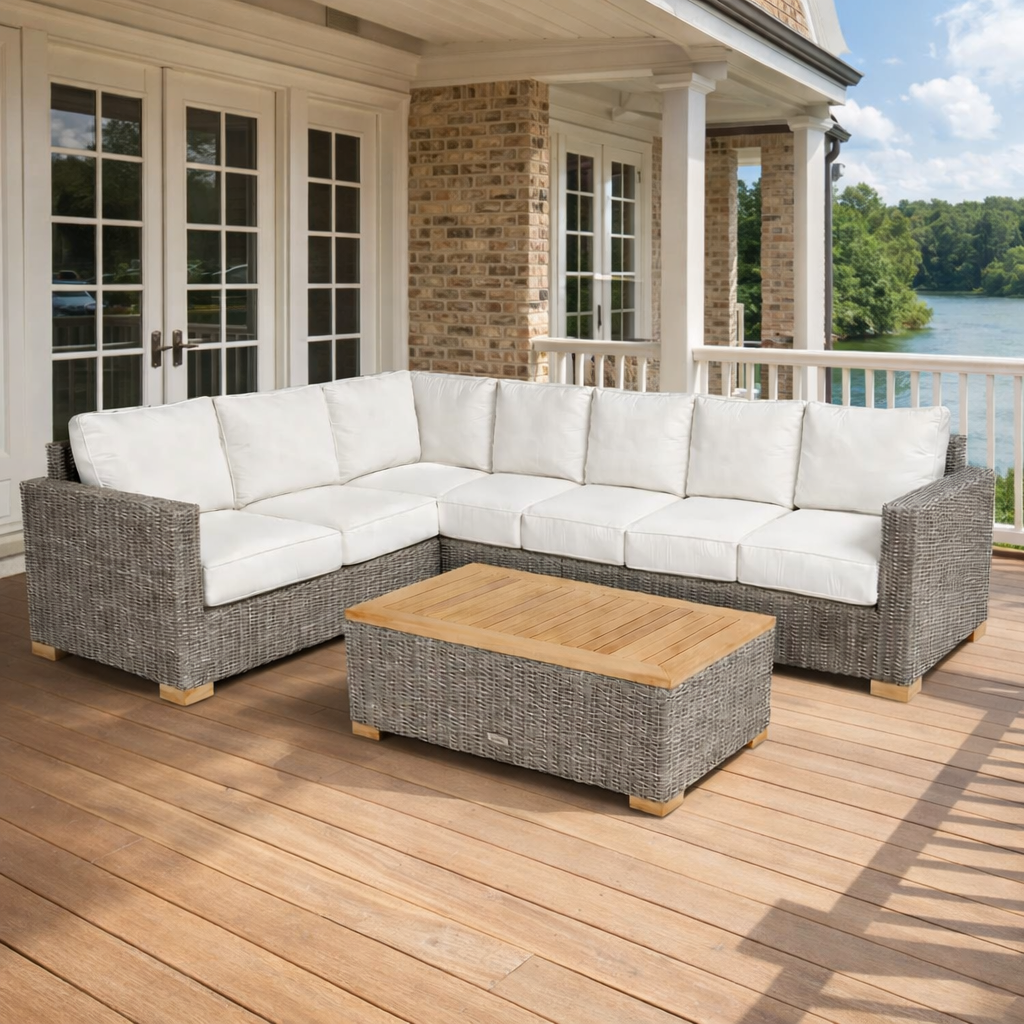
Many TeakHQ patio seating pieces include Sunbrella cushions, although inclusion varies by product. When furnishing an exposed coastal property, check the individual product details rather than assuming every chair or sofa has the same cushion configuration.
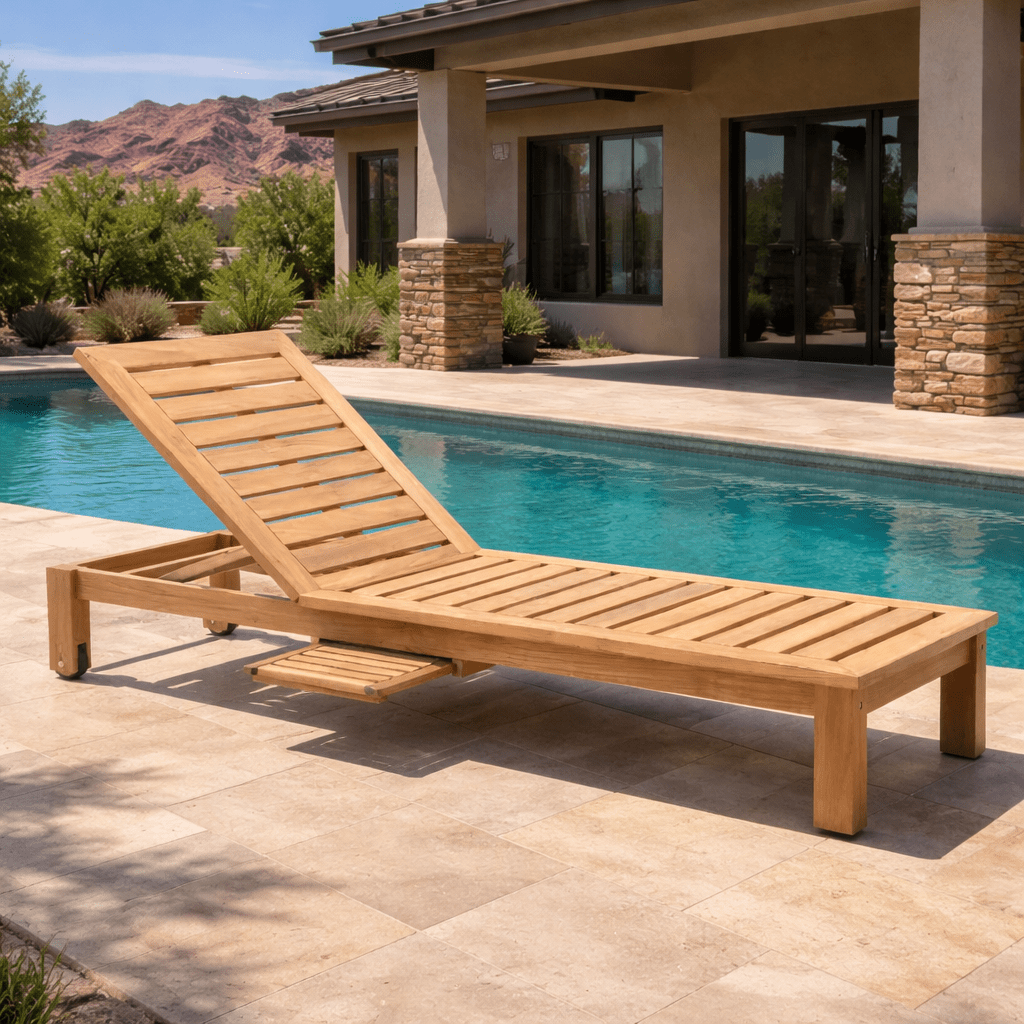
Pool decks, larger oceanfront patios, and open sun decks are logical places for teak chaise lounges. Pairs work well for quieter residential settings, while larger homes may benefit from repeating loungers in a consistent row.
Keep a side table within reach of every one or two lounges. Small conveniences—somewhere for a drink, book, phone, or sunglasses—often determine whether a lounging area gets used regularly.
Teak Adirondack chairs fit the relaxed character of beach and waterfront properties particularly well. We would use them where the furniture's main job is enjoying a view rather than supporting dining or formal conversation: dune-facing decks, soundfront lawns, secondary patios, or fire-pit areas.
A wide covered porch does not always need another sofa. Teak porch swings and rocking chairs can give the space a more distinctly coastal and residential character while keeping the layout visually lighter.
They are especially useful as secondary seating once the primary dining and conversation zones are already solved.
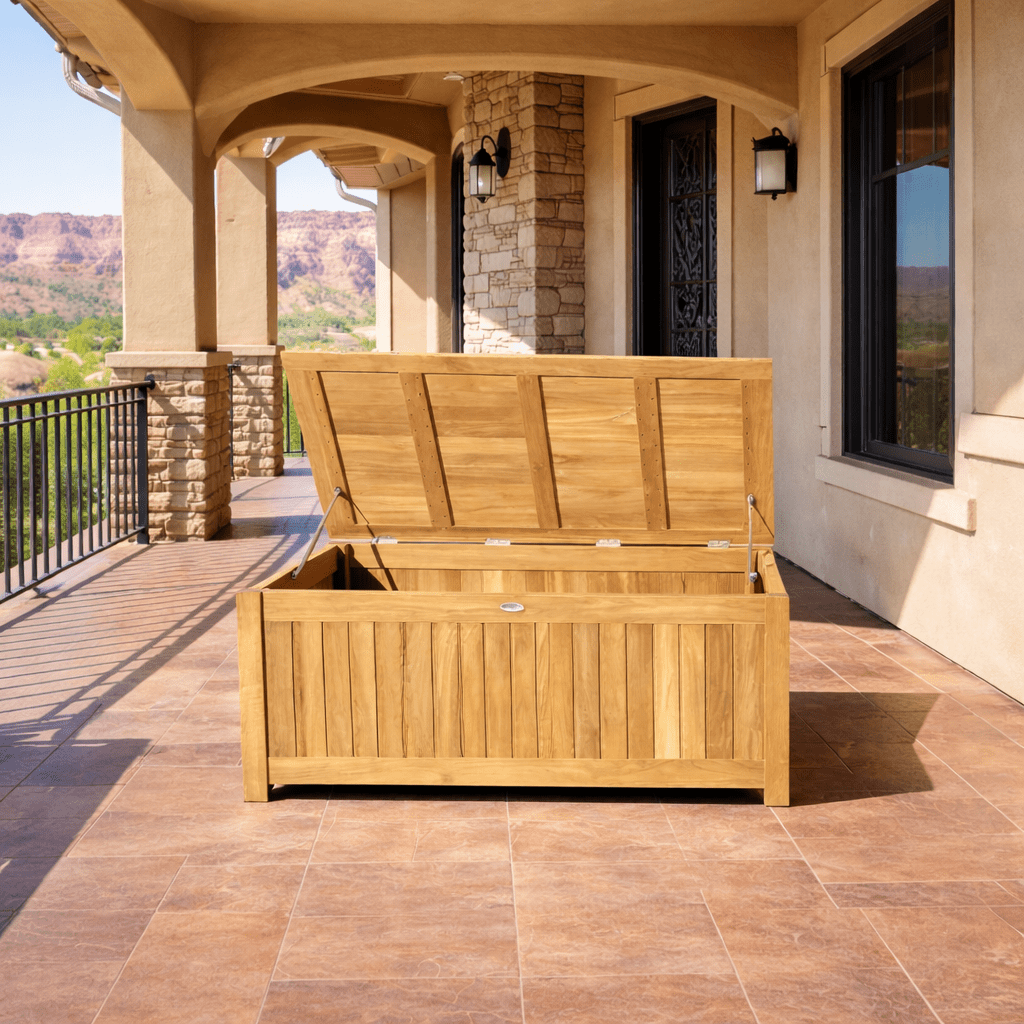
Coastal houses accumulate outdoor accessories quickly: furniture cushions, pool items, beach gear, and small entertaining pieces all need somewhere to go. A teak deck box can be useful when positioned near the activity it serves instead of tucked into an inconvenient corner.
Before purchasing storage, decide exactly what will live inside it. Otherwise, it is easy to buy a box that becomes outdoor clutter rather than solving it.
North Carolina's coast is not a single architectural market. It includes elevated Outer Banks beach houses, historic maritime towns, modern waterfront homes, resort-style communities, traditional porches, and newer properties with broad glass openings toward the water. Teak works across that range because the material reads as natural rather than strongly tied to one decorative style.
Elevated homes with multiple decks usually benefit from a restrained palette and clearly differentiated furniture zones. Rather than repeating a complete dining-and-lounge arrangement on every level, give each deck a purpose: dining on one, conversation seating on another, perhaps Adirondacks or loungers where the view is the priority.
This prevents the exterior from feeling overfurnished and simplifies storm preparation.
Homes around Wilmington and its nearby beaches often transition between traditional Southern porch architecture and contemporary coastal design. Natural teak can bridge that gap: simple, straight-lined furniture works comfortably with modern architecture, while traditional dining chairs, benches, swings, and rockers suit more classic porches.
On the Crystal Coast, waterfront orientation frequently matters as much as architecture. Decks facing the ocean, sound, marina, or marsh can be planned around sightlines, with lower-profile seating placed where preserving the view is important and dining positioned where people can comfortably move between indoor and outdoor kitchens.
Properties around Oak Island, Southport, Ocean Isle Beach, and neighboring communities often support the familiar combination of family beach trips, boating, outdoor meals, and relaxed porch time. Here, a coordinated mix of dining furniture, lounge seating, and a few traditional porch pieces can feel more natural than forcing every area into the same style.
The goal is continuity without sameness: let the teak material connect the zones while allowing each area to perform a different job.
 A beach house that normally has four occupants may regularly host eight or twelve during vacations. Furnishing only for the quietest week of the year often leaves the outdoor area undersized exactly when it matters most.
Plan around realistic peak use. Extendable dining tables, additional chairs, benches, or secondary seating can add capacity without permanently filling the deck.
Homeowners often measure the empty deck, confirm that a table physically fits, and stop there. That misses the space occupied by pulled-out chairs, walking paths, grill access, stairs, doors, and people carrying food.
A slightly smaller teak arrangement with comfortable circulation will generally function better than a larger set that makes every meal awkward.
Coastal durability is about more than the main frame material. Hardware, cushion components, moving mechanisms, and accessories are also exposed.
TeakHQ's Royal Teak and Anderson Teak furniture uses stainless-steel hardware, while Verandis uses brass, but coastal owners should still inspect and clean hardware periodically rather than assuming salt exposure can be ignored.
Some buyers are surprised when natural teak begins losing its original golden color. That is normal weathering. Unfinished teak can develop a silver-gray patina while remaining serviceable outdoors.
If you prefer the original color, choose an appropriate care routine from the beginning. If you like the weathered coastal look, you do not need to treat normal graying as a defect.
Substantial furniture can feel secure in ordinary wind, but no outdoor layout should be planned as though major coastal storms will never occur. Loose cushions, umbrellas, small tables, and accessories may require special attention when severe weather approaches.
Keep the number of pieces, storage locations, and preparation process in mind when furnishing an exposed deck. A layout that can be prepared efficiently is often better than one overloaded with decorative extras.
Coastal teak care should be simple and deliberate. Grade A teak does not need to be sealed for outdoor durability, but periodic cleaning and a little extra attention to salt, moisture, cushions, and hardware can keep an outdoor space looking better and easier to use.
 There is no universal coastal cleaning calendar because exposure varies enormously. An uncovered oceanfront deck may collect salt film, sand, pollen, and organic debris faster than a screened or covered porch several miles inland.
Inspect the furniture periodically and clean when buildup is visible. The goal is not constant refinishing; it is simply preventing dirt and debris from accumulating unnecessarily.
Homes close to the ocean may benefit from occasional rinsing when salt or windblown residue becomes noticeable. Pay attention to hardware, joints, and horizontal surfaces where material can collect.
Salt air is a reason for routine observation, not a reason to coat natural teak in unnecessary finishes.
Most—but not all—TeakHQ lounge furniture includes Sunbrella cushions. Sunbrella fabric is weather-, fade-, UV-, and water-resistant, but water resistance should not be confused with a reason to ignore wet cushions indefinitely.
After heavy rain, allow cushions and the surrounding furniture to dry. During extended periods when the property is vacant, owners may prefer to store removable cushions in a protected location.
You have two legitimate ownership paths. Leave unfinished teak untreated and allow it to develop its natural silver-gray patina, or use appropriate care products if maintaining more of the original golden appearance is important to your design.
Neither choice changes the underlying fact that teak does not require artificial stain for outdoor durability. The decision is primarily aesthetic.
Before a major coastal storm, furniture care becomes property preparation. Remove or secure umbrellas and other loose accessories, bring cushions into protected storage when appropriate, and follow local emergency guidance for the property.
Do not assume that a heavy teak table or sectional is immune to extreme winds or storm surge. Furniture durability and hurricane safety are separate questions.
Grade A teak is designed for year-round outdoor use, so North Carolina coastal owners do not need to move every teak table and chair indoors simply because winter arrives. Seasonal storage may still make sense for cushions, umbrellas, and accessories that will not be used for months.
Furniture covers are optional rather than required. If you choose to use them, inspect beneath them periodically so trapped debris or persistent dampness does not go unnoticed.
The best North Carolina coast outdoor furniture plan begins with the property: how exposed it is, how many people gather there, which views matter, and what happens when the house is full. Premium Grade A teak is a strong long-term choice because it combines natural outdoor durability, flexible maintenance, and a substantial look that works comfortably from Outer Banks decks to Wilmington-area porches and southern beach homes.
Start with the zone your household will use most, size it generously enough for real gatherings, and add secondary pieces only when they make the space more useful.
Look for materials that tolerate moisture, strong sun, rain, and long-term outdoor exposure without depending on fragile exterior finishes. Premium Grade A teak is a strong option because its natural oils and dense grain make it resistant to moisture, rot, insects, and warping.
Yes. Grade A teak is well suited to outdoor environments because it is naturally moisture resistant, designed for year-round use, and can withstand rain, sun, and temperature fluctuations. Oceanfront owners should still periodically clean salt residue and inspect hardware.
Start with how many people the house holds during peak visits. Larger Outer Banks homes often benefit from generous outdoor dining sets, flexible lounge seating, and secondary Adirondack or porch seating rather than numerous small decorative pieces.
Yes. TeakHQ's Grade A teak furniture is designed for year-round outdoor use. You may still choose to store cushions and accessories during long periods of nonuse or before major coastal storms.
No. Grade A teak does not require sealing for outdoor durability. A sealer or teak-care product may be used if you prefer to preserve more of the original golden-brown appearance rather than allowing the wood to weather naturally.
Yes. Unfinished teak naturally weathers toward a silver-gray patina with outdoor exposure. This is a normal appearance change. Homeowners who prefer the original color can use appropriate teak care products.
Plan around peak occupancy rather than average occupancy. If the home regularly fills with extended family or rental guests, consider seating for the number of people who realistically eat together and preserve enough clearance for chairs and walking paths.
Weight is worth considering on exposed decks. Teak has a heavier, more substantial feel than many lightweight alternatives, which can be appealing in normal coastal conditions. No furniture material should be treated as hurricane-proof, however, and severe-weather preparation remains essential.
No. Protective covers are optional because Grade A teak is designed for year-round outdoor use. Covers can help reduce surface debris when a property sits unused, but teak does not require them for basic outdoor durability.
Each can be appropriate depending on your priorities. Aluminum is lighter and often has a more modern character, while poly lumber is synthetic and generally emphasizes low maintenance. Teak offers real natural wood, a warmer and more architectural feel, natural weather resistance, and the ability to age to a silver-gray patina.


