
FREE SHIPPING
within mainland USA
within mainland USA
Home ▸ Teak Outdoor Furniture ▸ By Location ▸ Oregon Coast
Outdoor furniture on the Oregon Coast lives in a demanding environment: frequent moisture, wind-driven rain, salt exposure near the ocean, and long stretches when decks stay damp rather than quickly drying. Homes from Cannon Beach to Bandon also make outdoor spaces part of the coastal experience, whether that means an ocean-view deck, sheltered porch, garden, or vacation-home patio. Material choice therefore matters as much as style. Premium Grade A teak is a particularly strong option for homeowners who want real wood with natural moisture resistance and the flexibility to remain outdoors year-round.

Choosing outdoor furniture on the Oregon Coast is less about preparing for one dramatic weather extreme and more about managing repeated exposure. Rain, damp surfaces, coastal air, wind, shade, and seasonal temperature changes can all affect how furniture looks and ages. A material that performs well on a dry inland patio may create a very different ownership experience beside the Pacific.
The important distinction between the coast and much of inland Oregon is not simply how much water furniture encounters. It is how often furniture may become wet and how slowly a shaded coastal deck can dry. That makes moisture resistance, drainage, and easy cleaning more important than they might be on a sunnier, drier patio.
For wood furniture, species matters. Outdoor furniture should not be selected merely because it is labeled “wood.” Premium Grade A teak has naturally high oils and a dense grain structure that help it resist moisture, rot, insects, and warping, making it much better suited to repeated outdoor exposure than many ordinary woods.
Oceanfront and near-ocean properties add another consideration: salt carried through the coastal environment. Exposure varies significantly with distance from the water, orientation, wind, and shelter, so a protected patio several blocks inland should not be treated exactly like an exposed ocean-view deck.
The practical lesson is to evaluate the microclimate of the furniture itself. An open west-facing deck deserves more conservative material and maintenance choices than a covered courtyard protected by the house. For coastal homeowners, “Where will this piece sit?” can be as important a question as “What city is the house in?”
Exposed decks can experience conditions very different from enclosed patios and porches. Lightweight furniture may be easier to rearrange or store, but heavier furniture can feel more substantial in a windy setting. Teak's naturally heavier, sturdier feel is one reason it can make sense for permanent outdoor living areas.
Wind should also influence the accessories you choose. Cushions, umbrellas, covers, and other loose items require more active management than the furniture frames themselves. Furniture placement should preserve clear circulation paths and avoid creating a deck crowded with pieces that become cumbersome whenever weather changes.
Many coastal properties combine decks with mature trees, roof overhangs, covered porches, or forested surroundings. Shade is desirable, but it can mean slower drying and more accumulated leaves and organic debris. Rather than assuming a covered space requires no maintenance, plan for airflow and periodic cleaning around and beneath the furniture.
Several premium materials can work in a coastal setting. High-quality aluminum offers a lighter, more contemporary alternative, while synthetic materials such as poly lumber appeal to owners who prioritize a manufactured, lower-maintenance surface. Teak is especially compelling when the goal is a natural material with substantial weight, classic appearance, and strong outdoor performance.
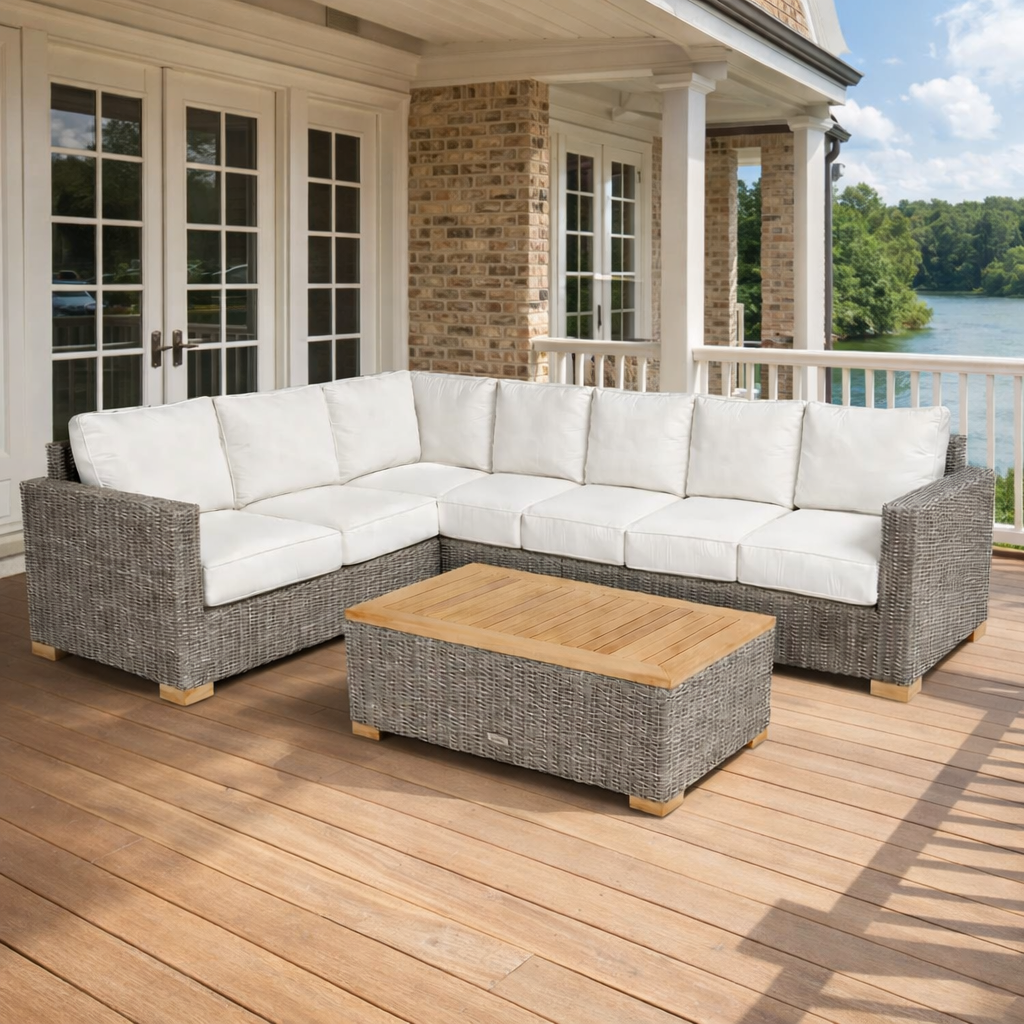 Grade A teak's naturally high oil content and dense grain structure help it resist moisture, rotting, insects, and warping. On a coast where furniture can repeatedly cycle between wet and dry conditions, those characteristics matter more than a decorative finish applied to a less suitable wood.
Teak does not require artificial stain for durability. That is useful for second homes and primary residences alike because owners can choose a relatively simple maintenance approach rather than making a protective cosmetic finish central to the furniture's ability to live outdoors.
Natural teak changes appearance outdoors. Left untreated, it gradually develops a silver-gray patina. That weathered appearance can be particularly compatible with cedar-sided beach houses, shingled coastal architecture, weathered decks, stone, and muted Pacific Northwest landscapes.
Homeowners who prefer teak's original warmer color can instead use appropriate care products to maintain that appearance. Neither approach needs to be treated as the universally correct one. On the Oregon Coast, deciding which appearance you want before buying can save you from maintaining a finish you never really needed.
The coast's reputation for clouds can cause homeowners to underthink UV exposure. Outdoor furniture still encounters sun, and cushions and finishes should be chosen for outdoor conditions. Teak is designed to withstand sun exposure and temperature fluctuations, while most TeakHQ lounge seating includes weather-, fade-, UV-, and water-resistant Sunbrella cushions.
Premium teak costs more upfront than many mass-market outdoor materials, so the useful comparison is not simply today's purchase price. Quality teak furniture can last for decades. For a home intended to remain in the family, a frequently used vacation property, or an outdoor space furnished as deliberately as an interior room, longevity can make the higher initial investment easier to justify.
| Oregon Coast Challenge | Why Premium Grade A Teak Performs Well |
|---|---|
| Frequent rain | Natural oils and dense grain provide strong moisture resistance. |
| Prolonged dampness | Teak naturally resists moisture and rot. |
| Coastal exposure | Real Grade A teak is designed for year-round outdoor use. |
| Seasonal sun | Teak withstands sun exposure and naturally weathers over time. |
| Temperature changes | Teak is designed to withstand outdoor temperature fluctuations. |
| Insects | Teak's natural properties provide insect resistance. |
| Windy decks | Teak has a heavier, sturdier feel than lightweight alternatives. |
| Low-maintenance priorities | Owners can leave teak untreated and allow a natural gray patina. |
We would start with the property rather than a furniture catalog. Is the primary outdoor area an exposed ocean-view deck, a covered porch, a sheltered courtyard, or a backyard surrounded by coastal forest? Then we would identify what you actually do outside—eat, entertain, read, watch sunsets, gather around a fire, or accommodate vacation guests. Those answers determine the furniture plan.
For many coastal homes, we would make outdoor dining furniture the anchor of the main deck or patio, particularly when the outdoor area connects directly to the kitchen. A six-person table is versatile for a household plus weekend guests, while an extendable teak dining table makes sense when the home alternates between quiet weekends and larger family visits.
The best location is often not the spot with the most dramatic view. If a slightly more protected portion of the deck gets you out of the strongest wind, it may produce far more actual dining hours. Preserve the prime view, but optimize the table for where people will comfortably remain seated.
On a larger deck, we would avoid turning every square foot into dining space. A dedicated teak patio seating area gives guests somewhere to move after a meal and makes the deck useful when nobody is eating.
For compact beach houses, a sofa or loveseat with two chairs and a coffee table can be more flexible than a sprawling sectional. Larger decks can support a coordinated multi-piece lounge set, but circulation around doors, stairs, railings, and view corridors should come first.
Some of the best coastal seating is not part of the main patio at all. A pair of Adirondack chairs overlooking the ocean, a garden bench facing a wooded edge, or two deck chairs positioned for sunset can create a second outdoor “room” without requiring another complete furniture set.
This is especially useful on sloped or irregular coastal properties. Instead of forcing every activity onto one deck, let different parts of the property serve different purposes.
The most functional coastal spaces make it easy to react to changing conditions. Keep frequently moved cushions close to a protected storage location, preserve easy access between the house and dining area, and avoid furnishing so densely that cleaning beneath pieces becomes difficult.
A memorable rule for the Oregon Coast is simple: design for the drying day, not just the sunny day. A beautiful arrangement that traps leaves, blocks airflow, or makes wet-weather cleanup tedious will be less enjoyable over time than a slightly simpler layout that can breathe and dry.
Start with the activity that defines your outdoor space. For a deck connected to the kitchen, dining sets and extendable tables usually deserve priority; for a view-focused beach house, lounge seating or Adirondack chairs may matter more. Larger vacation homes can combine dining and conversation zones, while smaller cottages often benefit from fewer, more purposeful pieces rather than trying to reproduce a resort-sized patio.
Outdoor living here tends to reward flexibility. A coastal deck may host coffee on a calm morning, family lunch when the clouds break, and a bundled-up evening around a fire rather than functioning as an uninterrupted warm-weather room. Furniture should support those changing uses without requiring the homeowner to constantly move the entire setup indoors.
A second home may be occupied by two or four people one weekend and a much larger group the next. That makes expandable dining and movable accent seating unusually useful. Rather than furnishing for the maximum possible crowd everywhere, create a comfortable everyday arrangement and build flexibility into one or two pieces.
For example, an extendable table can handle additional dinner guests without permanently dominating the deck. Adirondack chairs, dining chairs, and smaller accent tables can provide secondary seating without committing the entire outdoor area to one oversized configuration.
Oceanfront and elevated properties often have a natural focal point that ordinary backyard furniture plans lack. If the Pacific is the reason the deck exists, arrange seating to acknowledge it. A conventional inward-facing conversation circle can unintentionally make everyone turn away from the property's best feature.
One solution is to use angled chairs, swivel seating, or a partially open conversation arrangement that works for both people and scenery. Dining tables can often be positioned so guests along the long sides retain outward views.
Outdoor living does not have to stop when temperatures become less suited to sunbathing. Deep seating, Adirondack chairs, and fire-centered arrangements can support evenings when the attraction is fresh air, conversation, and the coastal setting rather than heat.
A teak fire pit table can become a useful gathering point where appropriate for the property and local rules. Leave adequate circulation around any fire feature and follow all product and local safety requirements.
For vacation rentals, we would favor an arrangement guests can understand immediately: an obvious dining area, an obvious lounge area, and enough side-table surfaces for everyday use. Complicated modular arrangements and large quantities of loose accessories can create more work between stays.
Teak's ability to remain outdoors year-round and age naturally can be attractive for owners who prefer not to make regular refinishing central to their maintenance routine.
 The right category depends more on the outdoor room than on the ZIP code. On the coast, we would match each furniture group to its exposure, view, available space, and frequency of use rather than buying one matching collection for every exterior area.
A teak outdoor dining set is a strong starting point for homes where the primary deck is adjacent to the kitchen or great room. Six seats suit many households, while eight or more can make sense for larger vacation homes and properties regularly hosting extended family.
Measure the entire occupied footprint—not just the tabletop. Chairs need room to pull out, guests need a route behind them, and doors and stairs must remain accessible. On narrower coastal decks, this circulation space can matter more than adding two extra permanent seats.
Deep seating works particularly well in protected outdoor rooms where people linger for conversation, reading, or evening drinks. A sofa with two club chairs gives a large deck a flexible arrangement without requiring the footprint of a full sectional. Most TeakHQ patio seating includes Sunbrella cushions, although inclusion varies by product.
Where exposure is higher, think about cushion management before selecting the largest possible upholstered configuration. Weather-resistant fabric is useful, but water resistance does not mean that leaving cushions continuously wet is the ideal ownership routine.
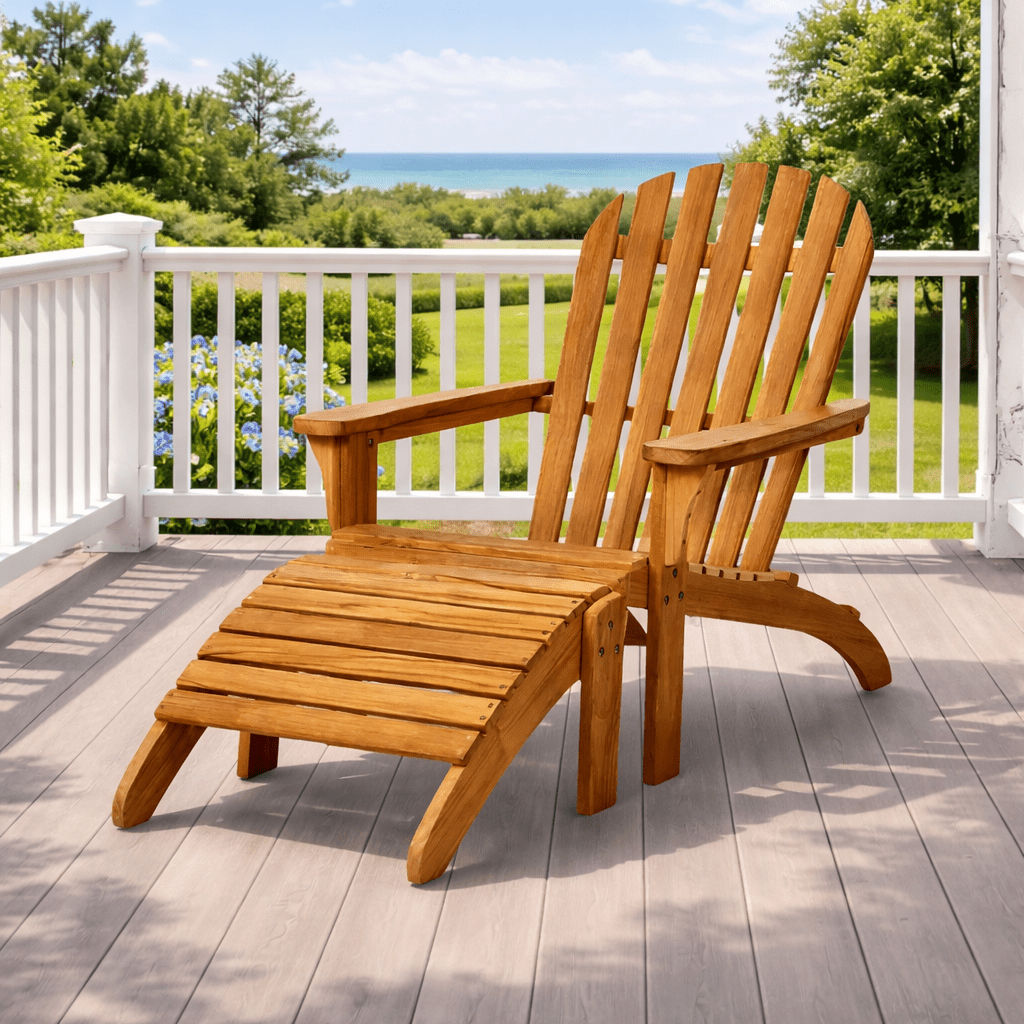 Few configurations are simpler than two teak Adirondack chairs and a small side table facing the view. They work particularly well for secondary decks, patios, garden edges, and locations where the goal is watching the water rather than hosting a full gathering.
This is also an effective way to furnish an exceptional viewpoint without overcrowding it. Not every scenic corner needs a sofa set.
Coastal landscaping often creates opportunities for seating away from the main deck. A teak garden bench can establish a destination beside a path, sheltered garden, entry area, or viewpoint without visually dominating the landscape.
Benches are particularly useful where the surrounding vegetation is the attraction. The natural character of teak works comfortably with stone, gravel, wood decking, native-looking planting schemes, and forested settings.
The Oregon Coast does not have a single architectural language. Traditional cottages, weathered beach houses, contemporary ocean-view homes, cabins, shingled exteriors, and modern vacation properties all appear along the shoreline. Teak's advantage from a design standpoint is versatility rather than adherence to one coastal aesthetic.
Against cedar, shingles, stone, dark siding, concrete, or naturalistic landscaping, real teak contributes warmth without requiring a highly decorative design. Its appearance can move in two directions: maintained golden teak provides a warmer contrast, while naturally weathered silver-gray teak can blend quietly with subdued coastal palettes.
That choice is worth making deliberately. If your home already uses weathered wood and gray tones, allowing teak to patina can create visual continuity while reducing cosmetic maintenance. A more contemporary home with dark siding or large expanses of glass may benefit from the contrast of warmer natural teak.
Contemporary ocean-view properties often benefit from furniture with clean silhouettes and restrained layouts. Instead of filling the deck with many small pieces, use fewer substantial furniture groups: one dining zone, one lounge zone, and perhaps a pair of view chairs.
Teak can provide the organic counterpoint that keeps concrete, metal, glass, and dark exterior finishes from feeling overly hard without requiring the entire design to become rustic.
Smaller coastal cottages require a different approach. A furniture group can be premium without being large. Folding dining pieces, compact tables, loveseats, benches, and paired chairs may preserve more of the deck and keep sightlines open.
Before buying, tape or mark the intended furniture footprint on the deck. Include the space occupied by pulled-out chairs. This simple exercise often reveals that a smaller table with flexible seating will make a coastal deck feel substantially larger.
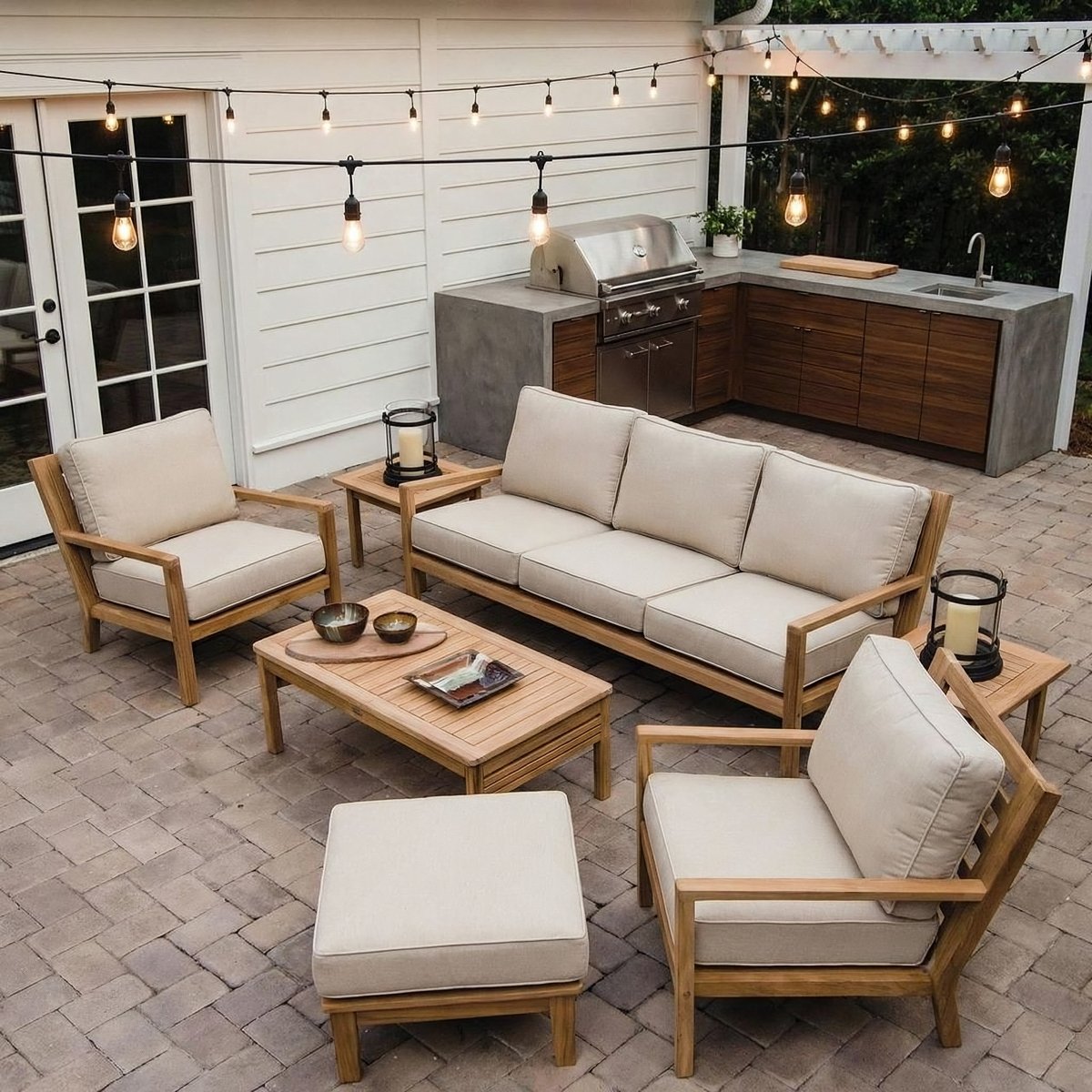 The most expensive outdoor furniture mistake is not necessarily choosing the wrong style. It is choosing a material, scale, or maintenance routine that does not match the exact place where the furniture will live.
“Wood outdoor furniture” is too broad a category to be useful in a wet coastal environment. Species and grade matter. Furniture made from wood without teak's natural moisture and rot resistance may require a very different maintenance strategy.
Premium Grade A teak addresses this concern through its naturally high oils, dense grain structure, and resistance to moisture, rot, insects, and warping. Buy based on the material itself, not merely the appearance of wood.
An exposed oceanfront deck and a roofed porch on the landward side of the same house can behave like two different furniture environments. Buying identical configurations for both without considering wind, rain exposure, shade, and drying time can create unnecessary maintenance.
Use more upholstered lounge seating where it is easier to protect and dry cushions. In exposed locations, simpler teak seating can reduce the number of soft components that need attention.
Vacation-home owners often know that twelve people may visit during a holiday and consequently furnish the deck for twelve people every day of the year. The result can be a crowded outdoor area during the far more common weekends when only a few people are present.
An extendable table, movable chairs, and secondary seating areas are often a better answer. Design first for normal occupancy, then create a deliberate plan for peak occupancy.
Wet-weather furniture planning includes the surface underneath the furniture. Leaves and debris should be easy to remove, water should not be unnecessarily trapped, and furniture should not make routine deck cleaning difficult.
Teak's moisture resistance helps with the furniture itself, but good placement still matters. Durable furniture is not a substitute for a functional patio or deck layout.
Protective covers can be useful, particularly for keeping furniture cleaner during periods of limited use, but they are optional for teak rather than required for durability. In damp conditions, a cover also needs to be used appropriately so moisture is not simply trapped beneath it.
For many owners, storing cushions while allowing the teak frame itself to remain outdoors is simpler than covering every furniture piece whenever rain approaches.
Coastal teak care should focus more on cleanliness, moisture management, and your preferred appearance than on repeatedly applying protective finishes. Teak can remain outside year-round, and sealing or oiling is optional rather than necessary for durability.
There is no useful one-size-fits-all cleaning calendar. An exposed deck near the ocean, a covered porch, and a forested patio collect different amounts of salt, dirt, leaves, and organic debris. Inspect the furniture periodically and clean when buildup warrants it.
Pay particular attention to horizontal surfaces, joints, and areas where leaves or debris accumulate. Keeping the surrounding deck clean also reduces the amount of material that remains against furniture during prolonged wet periods.
For homes exposed to ocean air and spray, periodic cleaning helps remove accumulated surface residue. The closer and more exposed the property is to the Pacific, the more attention this deserves.
Do not assume that a sheltered inland-facing porch needs the same schedule as furniture overlooking the surf. Base care on actual exposure rather than the broad label “coastal.”
Teak naturally resists moisture and rot, but good housekeeping still improves the ownership experience. Remove accumulated leaves and organic material, maintain airflow around furniture, and allow wet surfaces and cushions to dry.
For cushioned lounge furniture, follow the cushion manufacturer's care instructions and consider protected storage during extended wet periods. Most TeakHQ lounge seating uses Sunbrella cushions with weather-, fade-, UV-, and water-resistant fabric, but individual product specifications should always be checked.
Untreated teak naturally weathers toward silver-gray. If you like that appearance, you can allow the process to occur without treating the color change as damage. If you want to preserve the warmer original appearance, appropriate teak care products can be used.
The important thing is consistency. Decide whether you want natural patina or maintained color before establishing a maintenance routine instead of repeatedly switching approaches because the wood's normal weathering was unexpected.
TeakHQ's Grade A teak furniture is designed for year-round outdoor use, so bringing the furniture indoors for winter is not required. Homeowners may still choose storage or breathable protective covers to reduce dirt and seasonal cleanup.
If storage space is limited, prioritize removable cushions and loose accessories rather than assuming the entire teak furniture set must occupy the garage every winter.
The best Oregon Coast outdoor space is not necessarily the largest or most heavily furnished one. Start with your home's actual exposure, identify the outdoor activities you value most, and choose furniture that makes those activities easier in real coastal conditions. Premium Grade A teak is especially well suited to homeowners who want natural wood, long-term outdoor performance, and the freedom to either maintain its warm appearance or let it weather naturally.
Choose materials based on repeated moisture exposure, wind, maintenance requirements, and your preferred appearance. Several premium outdoor materials can work, but Grade A teak is particularly well suited to wet coastal conditions because its natural oils and dense grain help it resist moisture, rot, insects, and warping while allowing it to remain outdoors year-round.
Yes. TeakHQ's Grade A teak furniture is designed for year-round outdoor use and can withstand rain, sun exposure, and temperature fluctuations. Winter storage and covers are optional rather than required for the teak's durability.
Yes. Premium Grade A teak is a strong choice for exposed coastal properties because of its moisture resistance, weather resistance, substantial feel, and outdoor longevity. Oceanfront homeowners should still periodically clean surface salt and debris and separately manage cushions and loose accessories.
That depends on the material. Teak does not require a cover for durability, although a suitable cover can help keep furniture cleaner. If you use covers in a damp coastal environment, use them appropriately rather than trapping persistent moisture beneath them.
Start with sturdy furniture and avoid excessive lightweight accessories. Teak has a heavier, more substantial feel than aluminum and can work well in permanent outdoor arrangements. Regardless of frame material, umbrellas, cushions, covers, and other loose items need appropriate management during windy conditions.
Not automatically. Furnish first for the number of people who normally use the home, then accommodate peak gatherings with an extendable dining table or flexible extra seating. This keeps the deck comfortable during ordinary weekends without sacrificing capacity for family visits.
Yes. Untreated teak naturally develops a silver-gray patina over time. That color change is normal weathering rather than an indication that the wood has failed. Owners who prefer the original warmer appearance can use appropriate teak care products to maintain it.
No. Teak does not require sealing for durability. Its natural oils provide inherent outdoor protection. Sealing or oiling is optional for homeowners who want to influence the wood's appearance rather than allow it to develop its natural silver-gray patina.
Both can be legitimate premium choices. Aluminum is lighter and can provide a more modern appearance; teak is heavier, warmer, natural, and has a more architectural feel. For homeowners who specifically want real wood with strong moisture resistance and decades-long potential life, teak is particularly compelling.
Keep the furniture clean, remove leaves and organic debris, address accumulated coastal residue as needed, and allow wet areas to dry. Teak can be left untreated and allowed to weather naturally, or maintained with appropriate teak care products if you prefer its warmer original color.


