
FREE SHIPPING
within mainland USA
within mainland USA
Home ▸ Teak Outdoor Furniture ▸ By Location ▸ Pacific Northwest
Pacific Northwest outdoor spaces ask more of furniture than the region's mild temperatures might suggest. Months of cool rain, shaded decks, damp tree-covered properties and occasional winter freezes contrast with remarkably dry, sunny summer stretches. From Puget Sound waterfront homes to Portland garden patios, the smartest furniture choices account for both moisture exposure and how quickly a space can dry between storms. Premium Grade A teak is especially well suited to that combination, offering a natural material that can remain outdoors year-round without requiring constant refinishing.

The Pacific Northwest is often reduced to one word—rainy—but that description misses the furniture conditions that matter most. West of the Cascades, the important pattern is a long cool, damp season followed by a comparatively dry summer. A patio set may spend months exposed to repeated wetting, leaf debris and limited drying sun, then experience substantially stronger sun exposure once summer arrives. That combination makes material quality, drainage and placement more important than simply choosing something labeled “outdoor.”
The most important question for outdoor furniture in Seattle, Portland and the maritime Northwest is not simply, “Can it get wet?” Almost every respectable outdoor material can survive an occasional rainstorm. The more demanding question is what happens after weeks of repeated wetting when furniture sits on a shaded deck or beneath trees and has fewer opportunities to dry completely.
That is where material selection begins to matter. Powder-coated aluminum, quality synthetic materials and premium hardwoods can all be reasonable choices. Natural Grade A teak deserves particular consideration because its dense grain and naturally high oil content provide resistance to moisture, rot and warping without requiring an artificial stain for durability.
One of the most useful ways to evaluate a Pacific Northwest patio is to stop thinking about rainfall totals and start thinking about drying time. A south-facing open deck in Portland may dry quickly after a shower. A north-facing Seattle patio beneath mature evergreens can remain cool and damp much longer. The second space demands more attention to airflow, drainage and cleaning even if both homes receive similar weather.
Before buying furniture, look at where roof runoff lands, where leaves accumulate and which corners remain damp after the rest of the patio dries. Furniture that tolerates outdoor exposure is important, but intelligent placement can reduce maintenance for any material.
The region's summer weather creates a different challenge. Long daylight hours and dry stretches encourage frequent outdoor dining, lounging and entertaining, while exposed furniture receives considerably more sun than it did during winter. That means a good Pacific Northwest material must handle both moisture and sunlight rather than being optimized for only one season.
Grade A teak can withstand rain, sun exposure and temperature fluctuations. Untreated teak will gradually weather from its original golden-brown appearance to a silver-gray patina, a cosmetic change rather than a requirement to replace or refinish the furniture.
Seattle, Tacoma, Olympia and Portland share many maritime influences, but the broader Pacific Northwest changes quickly east of the Cascades. Bend, Central Oregon and eastern Washington are generally drier environments with greater temperature swings and more intense summer dryness. Coastal properties add marine exposure and wind, while higher-elevation homes may deal with considerably more winter snow.
For that reason, regional advice should be adjusted to the property. West-side homeowners should usually prioritize repeated moisture and drying conditions first. Drier inland homeowners may place more emphasis on sun exposure, temperature swings and seasonal storage practices.
Premium Grade A teak is unusually well matched to the Pacific Northwest because its strengths align with the region's alternating wet and dry seasons. It is not the only premium outdoor material worth considering—well-made aluminum and quality synthetics have legitimate advantages—but teak combines outdoor durability with the warmth and architectural character many Northwest homeowners prefer.
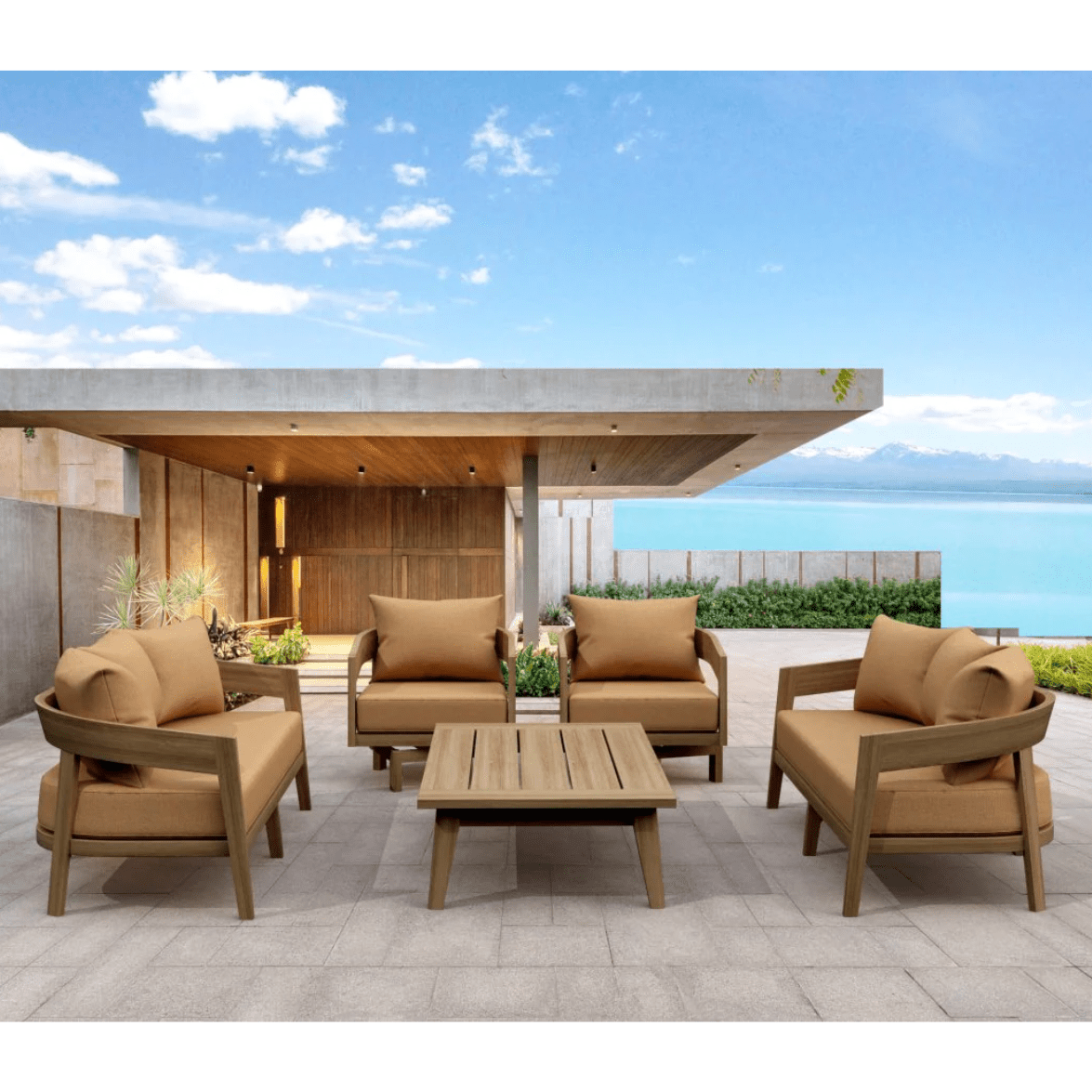 Grade A teak has naturally high oil content and a dense grain structure. Those characteristics help it resist moisture, rotting, insects and warping, which is especially valuable on patios that experience repeated rain rather than occasional storms.
The practical advantage is ownership flexibility. TeakHQ furniture is designed for year-round outdoor use, so the wood itself does not require paint, stain, sealant or a protective cover in order to remain durable. Owners may still use covers or treatments for convenience or appearance, but those choices are optional rather than fundamental to the wood's outdoor suitability.
Outdoor furniture in this region moves between damp winter conditions, mild transitional seasons and warm summer afternoons. Premium teak is resistant to warping and designed to withstand temperature fluctuations, helping it remain a practical choice through those seasonal changes.
This is also where grade matters. “Teak” is not a complete specification by itself. TeakHQ uses real, plantation-grown Grade A teak rather than composite material or veneer. For a major outdoor furniture investment, the actual material quality deserves more attention than the species name printed in a product title.
Teak does not need an artificial stain for durability. If it is left unfinished outdoors, sunlight and weather gradually change its surface from warm golden teak to a silver-gray patina. Many Northwest homes look especially natural with that weathered finish, particularly against cedar siding, stone, dark metal railings and evergreen landscaping.
If you prefer the original teak color, maintenance products can be used to help preserve that appearance. The important distinction is that maintaining the golden look is an aesthetic decision, not something you must continually do simply to keep the furniture outdoors.
Premium teak furniture costs more upfront than many mass-market patio materials, so it makes the most sense when the buyer is thinking in years rather than seasons. High-quality teak can last for decades with appropriate ownership and care. That changes the buying calculation: instead of asking which set is least expensive today, compare how often a lower-cost set might need replacement.
For established homes, vacation properties and carefully designed outdoor rooms, that longer horizon is often one of teak's strongest advantages.
| Pacific Northwest Challenge | Why Premium Grade A Teak Performs Well |
|---|---|
| Repeated rain | Natural oils and dense grain provide strong moisture resistance. |
| Prolonged damp weather | Grade A teak naturally resists rot and can remain outdoors year-round. |
| Sun after wet winters | Designed to withstand both rain and sun exposure. |
| Temperature changes | Teak resists warping and handles normal outdoor temperature fluctuations. |
| Wooded properties | Durable outdoor wood tolerates exposure well; routine debris cleaning remains important. |
| Low-maintenance ownership | No paint, artificial stain or sealing is required for durability. |
| Changing appearance | Untreated teak naturally develops a silver-gray patina instead of requiring refinishing. |
If we were planning a Pacific Northwest outdoor space from scratch, we would begin with how the area is actually used during changing weather—not with a furniture catalog. The most successful spaces usually have one protected everyday zone and one more exposed fair-weather zone, allowing the patio to remain useful beyond the short stretch of perfect summer afternoons.
On a Seattle or Portland-area property, we would normally give the most protected portion of the deck to the furniture used most often. That usually means a conversation grouping or dining table under a roof extension, pergola or substantial overhang.
A teak patio seating arrangement works especially well here because the frame can remain outdoors while cushions can be managed according to weather and use. Most TeakHQ patio seating includes Sunbrella cushions, though inclusions vary by product, so check the individual listing rather than assuming every seating piece is configured identically.
Outdoor dining often works best immediately outside the kitchen rather than at the far end of the property. Shorter food and dish runs matter more when an unexpected drizzle arrives halfway through dinner.
For households that entertain irregularly, an extendable teak dining table is particularly useful. It allows a table to stay appropriately proportioned for normal family meals without permanently giving up deck circulation just to accommodate occasional larger gatherings.
Cool evenings are a defining part of Northwest outdoor living, so we would devote real space to sitting rather than treating lounge furniture as an afterthought. A sofa or sectional with club chairs and a coffee table creates a more usable outdoor room than scattering individual chairs around the patio perimeter.
Where permitted and appropriate, a fire feature can give that area a natural focal point. The goal is not simply warmth; it is to create a reason for people to stay outside after dinner when temperatures begin to drop.
Many Northwest properties have something worth orienting toward: mature trees, a garden, water, mountain views or simply a quiet green backyard. Do not automatically point every chair toward the house. A separate bench or pair of Adirondack-style chairs can create a second destination without requiring another full patio.
This is particularly effective on Bainbridge Island, Mercer Island, Lake Washington and Puget Sound properties where the best view may not align with the main dining or conversation area.
Begin with the activity that defines your outdoor space most often. Frequent hosts will usually get the most value from complete teak dining sets or expandable dining, while households that use the deck primarily for reading, conversation and evening relaxation should start with deep seating. Larger covered patios can support both zones; smaller decks are usually better served by choosing one primary function and furnishing it generously rather than squeezing several undersized zones together.
Pacific Northwest outdoor living is less about using a patio every day of the calendar and more about extending the number of days when being outside feels comfortable. Covered decks, heaters, fire features and strategically protected seating turn a weather-dependent patio into a genuine extension of the home.
A defining Northwest outdoor space is often neither completely indoors nor completely exposed. Roof extensions, covered decks and sheltered patios let homeowners enjoy fresh air while protecting the seating area from routine rain. In many higher-end renovations, these spaces function almost like outdoor family rooms, with lighting, heaters and nearby cooking areas.
That changes furniture priorities. Comfortable deep seating becomes more useful than furniture selected only for occasional sunny afternoons, and substantial natural materials tend to fit better visually with timber ceilings, stone fireplaces and landscaped surroundings.
Summer is when outdoor dining becomes a major part of the lifestyle. Long evenings make a deck or patio useful well past dinner, especially when the dining area flows directly from the kitchen or outdoor grill.
For families that host relatives and friends, the most practical configuration is often a six- or eight-person table that can expand for larger gatherings. The table does not need to dominate the patio all year simply because Thanksgiving-sized groups appear a few times each summer.
Homes around Puget Sound, Lake Washington, Lake Sammamish, the Willamette River and other Northwest waterways often need two different furniture orientations: one toward the people and one toward the view. A dining table encourages face-to-face interaction, while swivel chairs, lounge seating or strategically placed benches make it easier to appreciate the setting.
On exposed waterfront decks, wind also affects comfort and accessory choices. Large umbrellas, lightweight décor and loose cushions deserve more attention than the frame material alone.
The Northwest landscape is often part of the outdoor room rather than a backdrop to it. Mature conifers, maples, ferns and layered gardens make secondary seating areas particularly worthwhile. A garden bench along a path or beneath partial tree cover can create a useful destination without visually competing with the landscape.
The tradeoff is more organic debris. Furniture beneath trees needs more frequent brushing and cleaning than the same piece on an open terrace.
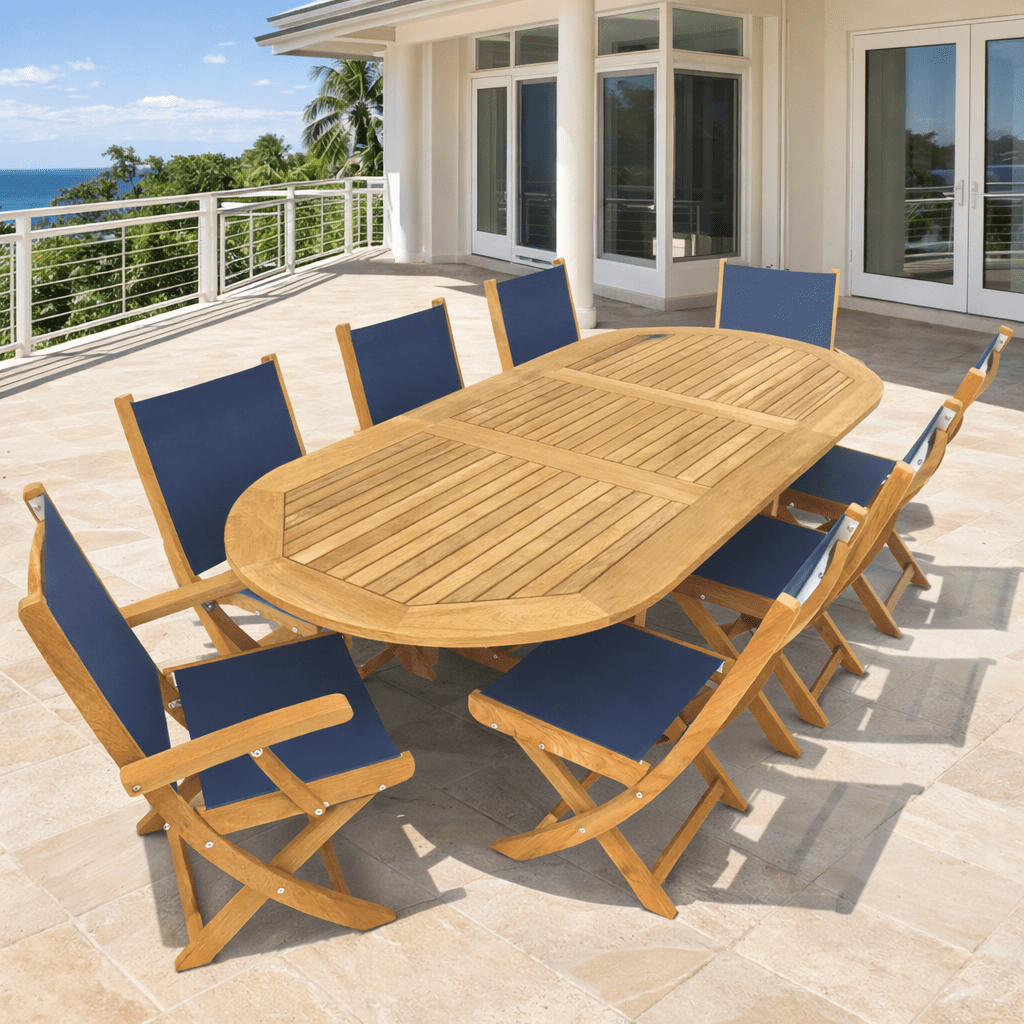 The right teak furniture configuration depends more on the property's layout than on regional style alone. A narrow urban deck, a wooded Sammamish backyard and a waterfront Mercer Island terrace may share the same weather but should not be furnished the same way.
For a substantial covered deck, we would usually prioritize a sofa-based conversation area. An outdoor teak sectional works well when the space has a clear corner or when the goal is to seat several people without scattering chairs across the deck. In a narrower space, a sofa with two club chairs is often easier to circulate around.
Add a coffee table and at least one side table. Small supporting surfaces matter more in real life than they do in showroom photos because a lounge area quickly becomes inconvenient if every drink must be set on the main coffee table.
If the deck is primarily for meals, size the table for normal use first and occasional entertaining second. An extendable table can make better use of limited square footage than purchasing the largest table the deck can physically hold.
Leave enough circulation room to pull out chairs and still move between the kitchen door, grill and yard. This matters especially on elevated decks where railings create hard boundaries and there is no extra lawn space to absorb overflow.
For cool evenings, arrange seating so people naturally face one another rather than lining every chair toward the fire. A teak fire pit table can serve as both focal point and gathering surface, but the surrounding seating still needs comfortable access paths.
For larger spaces, pair a sofa or loveseat with movable club chairs. That allows the layout to adapt when the group expands without locking the entire patio into one rigid arrangement.
A teak garden bench is particularly useful in Northwest landscaping because it can create a quiet destination without requiring a hardscaped patio underneath every seating area. Place one where the garden changes character—near a pond, under a mature tree, along a path or at the edge of a view.
This is one category where allowing teak to weather naturally can be especially attractive. The silver-gray patina can sit quietly within green landscaping instead of calling attention to itself.
Even though the teak frame itself does not require seasonal indoor storage, accessories often do. A teak deck box near the house can reduce friction around cushion and accessory management. The easier storage is to use, the more likely people are to actually use it before an extended rainy period.
The Pacific Northwest has no single architectural style, but several recurring design themes influence outdoor spaces: natural materials, strong indoor-outdoor connections, dark metal accents, exposed timber, restrained color palettes and landscapes that deliberately preserve mature vegetation. Teak works comfortably within that language because it reads as real wood rather than a synthetic imitation of one.
Modern Northwest homes often combine large windows, dark siding or metal details with warm wood and restrained landscaping. Clean-lined teak sofas, sectionals and dining tables reinforce that contrast without making the patio feel overly formal.
If the architecture is already visually complex, we would keep the furniture layout simple: one substantial seating group, one dining zone and repeated materials rather than many unrelated accent pieces.
Teak also fits naturally with Craftsman homes, shingle-sided houses and more traditional Northwest architecture. Slatted dining furniture, benches and classic lounge chairs have enough visual warmth to sit comfortably alongside stone, brick, cedar and established gardens.
Here, matching every piece is less important than maintaining material continuity. A teak dining set can coexist with separate teak benches or lounge chairs without making the space look like a single showroom collection.
On lake and Sound properties, keep sightlines in mind before choosing seat-back heights and furniture placement. The best-looking sectional in a catalog can become the wrong sectional if its back blocks the view from the kitchen or living room.
A useful test is to stand inside the house at the primary window or door before laying out the patio. Outdoor furniture should enhance the view from indoors as well as the experience once you step outside.
In heavily landscaped settings, unfinished teak can be allowed to age naturally so the furniture becomes quieter over time. For owners who prefer stronger contrast against evergreen planting, maintaining more of the wood's original warm color is an aesthetic option.
The memorable design lesson is simple: in the Northwest, the patio is often viewed through glass for more months than it is occupied. Furnish for the view from the house, not only for the hours spent sitting outside.
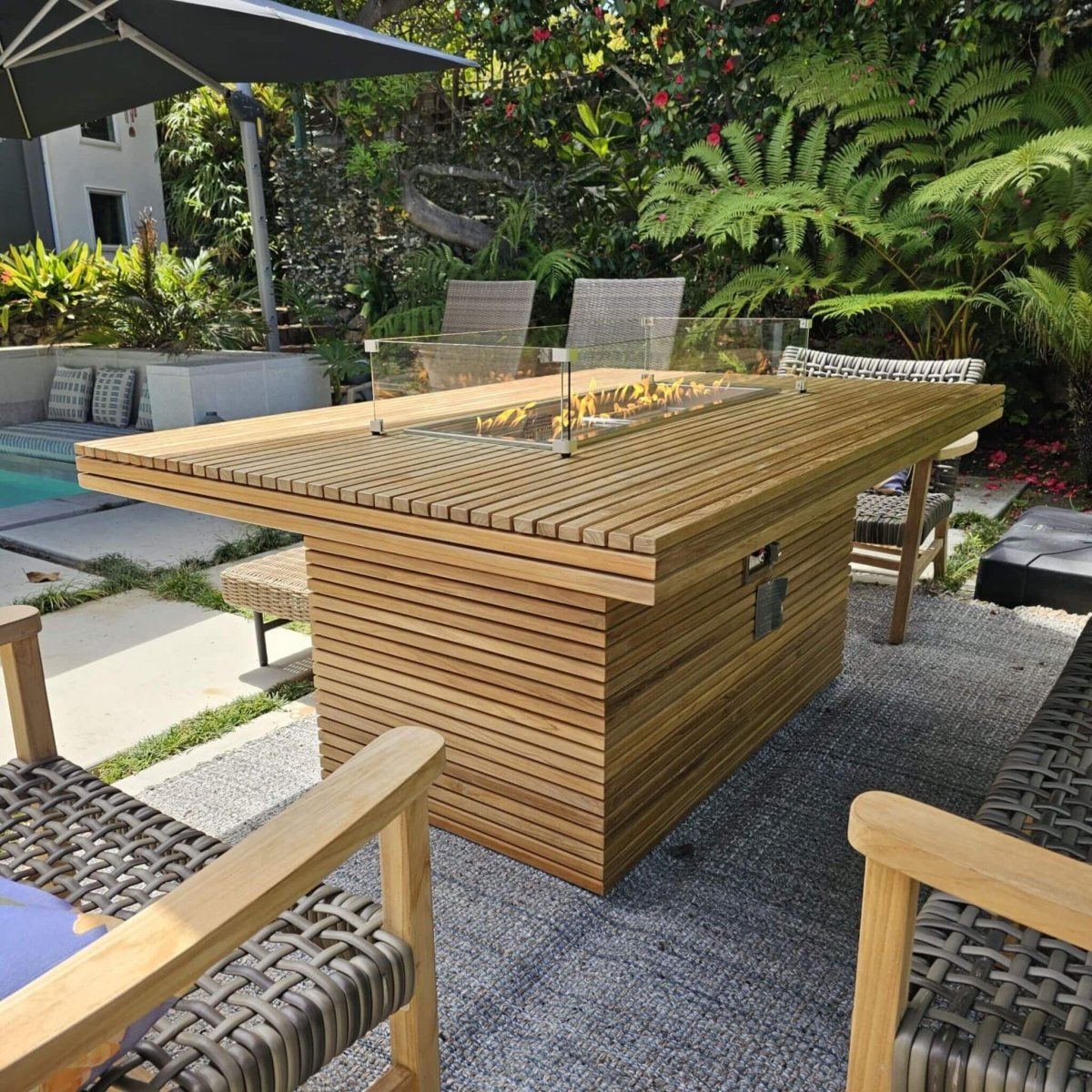 A patio can look perfect in July and still be poorly planned for most of the year. Lightweight furniture, no protected seating and nowhere to manage cushions can turn the outdoor room into a seasonal installation rather than part of the home.
Premium teak helps by allowing the furniture frame to remain outside year-round. Pair that durability with a covered zone, convenient accessory storage and a layout that works during shoulder seasons.
Homeowners often assess a deck based on its sunniest area. The better test is the opposite: after a wet spell, find the corner that stays damp the longest. That location tells you more about potential cleaning and maintenance than the best summer afternoon does.
Teak's moisture and rot resistance make it well suited to outdoor exposure, but no furniture benefits from being buried under wet leaves or trapped against surfaces with poor airflow. Keep debris cleared and allow air to move around the frame.
Large Northwest decks invite large furniture, but circulation can disappear quickly once dining chairs are pulled out. A table that technically fits may still make the route from kitchen to grill frustrating.
For irregular entertaining, an extendable teak table often solves the problem more elegantly than permanently dedicating the patio to maximum capacity.
A coastal deck, a Portland garden patio and a drier Central Oregon terrace do not face identical conditions. Moisture may dominate west of the Cascades, while stronger temperature swings and summer sun become more important farther inland.
Grade A teak works across those conditions because it is designed for year-round outdoor use and withstands rain, sunlight and temperature fluctuations, but the surrounding decisions—covers, cushions, shade and cleaning frequency—should still reflect the property.
On scenic properties, furniture is often purchased before anyone studies sightlines from inside the home. High-backed seating can unintentionally interrupt water, garden or mountain views.
Plan the primary view corridors first. Then choose the seating configuration that supports them. Furniture should occupy the outdoor room without visually swallowing it.
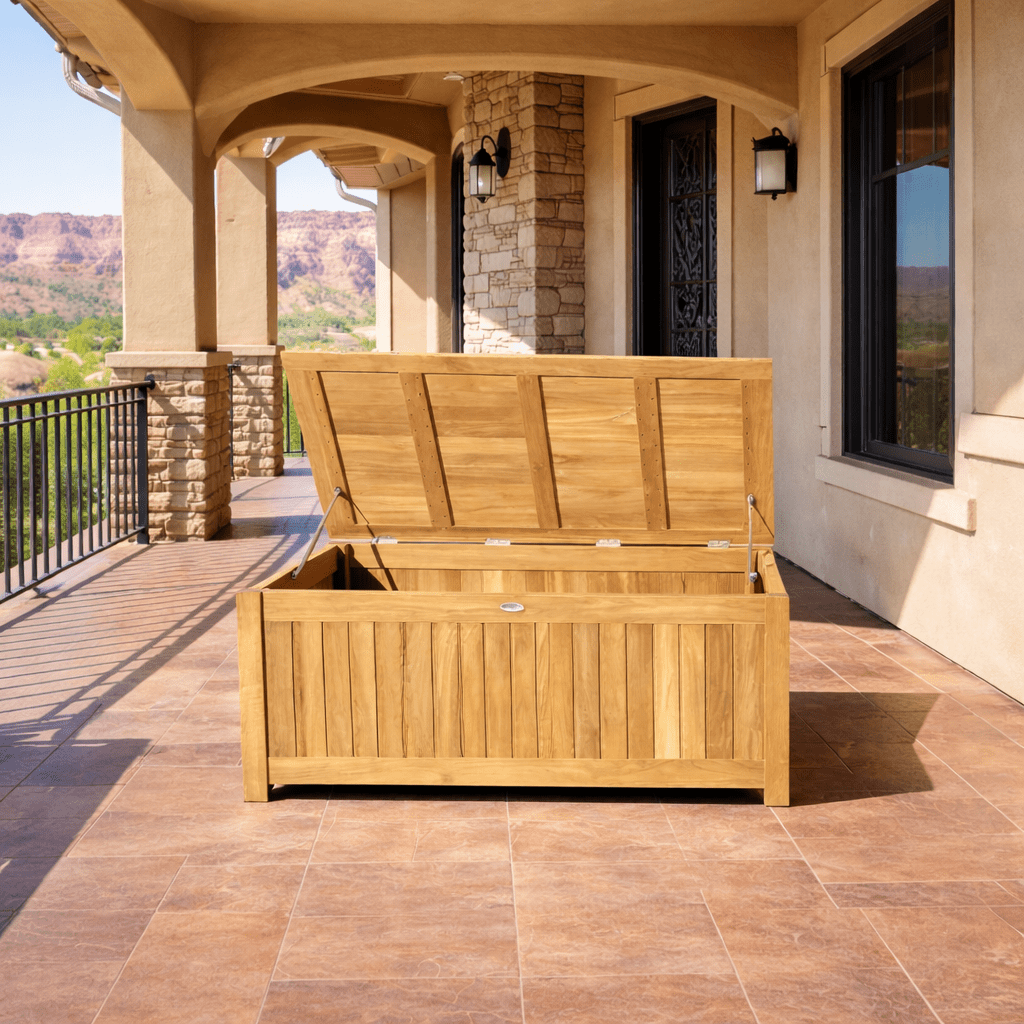 Pacific Northwest teak care is less about intensive refinishing and more about controlling the things that sit on the wood: wet leaves, pollen, dirt and prolonged organic debris. Grade A teak can remain outdoors year-round, but sensible cleaning keeps the furniture looking better and prevents surface grime from becoming a bigger project.
A covered urban patio may need relatively little attention, while a bench beneath maple or fir trees may need regular brushing during leaf and pollen seasons. Clean when visible dirt and organic material accumulate rather than following an arbitrary calendar.
The goal is simple: do not allow damp debris to sit against the surface unnecessarily. This is especially important in shaded spaces with limited airflow.
Most TeakHQ lounge seating includes Sunbrella cushions, though exact inclusions vary by product. Sunbrella fabric is weather-, fade-, UV- and water-resistant, but “water-resistant” does not mean there is a benefit to leaving cushions saturated through every extended rainy period.
During long stretches when the patio will not be used, storing removable cushions in a convenient dry location can reduce cleaning and make the space quicker to use when good weather returns.
You do not need to seal teak simply because you live in a wet climate. Untreated teak can remain outdoors and naturally weather to silver gray. If you prefer the original golden tone, you can choose to maintain that appearance with appropriate products.
Make that decision based on aesthetics before beginning a treatment routine. Many homeowners inadvertently create more maintenance for themselves because they assume teak must be kept looking new in order to remain durable.
Furniture covers are optional for teak durability. If you use them for cleanliness or convenience, follow the cover manufacturer's instructions and avoid creating a situation where moisture is trapped unnecessarily around the furniture.
For many covered Northwest patios, the more practical strategy is to leave the teak frame in place and focus storage effort on cushions, throws and smaller accessories.
TeakHQ's Grade A teak furniture is designed for year-round outdoor use, so moving a large dining table or sectional into storage every autumn is not required for the wood itself. Some homeowners still choose seasonal storage for convenience or appearance, particularly at vacation homes.
If the furniture remains outside, keep surfaces reasonably clear of accumulated leaves and debris and inspect the surrounding patio drainage periodically through the wet season.
The best Pacific Northwest patio is not necessarily the one with the most furniture. It is the one that remains easy to use as conditions change—from damp spring evenings to long summer dinners and crisp autumn gatherings. Start with the activity your household values most, choose furniture that fits the actual dimensions and exposure of the space, and invest in materials you are comfortable owning for the long term. Premium Grade A teak is a strong fit when you want natural wood, substantial construction and the flexibility to leave the furniture outdoors while deciding for yourself how much cosmetic maintenance you want to perform.
Look for materials that tolerate repeated moisture, seasonal sun and temperature changes. Premium teak, quality powder-coated aluminum and well-made synthetic materials can all be appropriate. Grade A teak is especially attractive when you want real wood with natural moisture, rot and warping resistance.
Yes. TeakHQ's Grade A teak furniture is designed for year-round outdoor use and can withstand rain, sun and temperature fluctuations. Routine cleaning of leaves and organic debris is still worthwhile.
No. Teak does not require sealing for durability. You can leave it untreated and allow it to develop a silver-gray patina, or use appropriate teak care products if you prefer to maintain more of its original color.
Deep seating, dining furniture and conversation groupings are particularly useful because a roof extends the number of comfortable outdoor days. Choose the configuration based on whether your household spends more time eating, entertaining or relaxing outside.
Keep wet leaves, pollen and organic debris from accumulating, especially on shaded patios. Good airflow and occasional cleaning are usually more useful than repeatedly applying cosmetic treatments.
A cover is optional rather than required for teak durability. Some owners use covers to reduce dirt and debris, while others leave teak uncovered. If you use a cover, follow its instructions and avoid unnecessarily trapping moisture.
Neither is universally better. Aluminum is lighter and often has a more contemporary appearance. Teak is heavier, warmer and made from natural wood. Buyers who value an organic look and long ownership horizon often prefer teak; buyers who prioritize light weight may prefer aluminum.
Outdoor teak naturally develops a silver-gray patina when left untreated. Weather and exposure influence how the appearance develops, but the color change is expected and does not mean the furniture has failed.
Choose for everyday household size first, then verify that chairs can be pulled out without blocking major walkways. If you host larger groups occasionally, an extendable teak table can preserve circulation while still providing extra guest capacity when needed.
Teak benches, dining furniture and lounge seating all work well in wooded settings. The bigger consideration is placement: furniture beneath trees will collect more leaves, pollen and debris, so choose locations with reasonable airflow and easy access for cleaning.


