
FREE SHIPPING
within mainland USA
within mainland USA
Home ▸ Teak Outdoor Furniture ▸ By Location ▸ Pacific Palisades, California
Outdoor spaces in Pacific Palisades often combine coastal exposure with the very conditions that make the area appealing: sunshine, ocean breezes, canyon settings, hillside terraces, and indoor-outdoor living. Furniture may move repeatedly between bright sun, cool marine air, seasonal rain, and damp mornings while remaining outside for much of the year. For homeowners furnishing ocean-view decks, pool patios, courtyards, or larger entertaining spaces, premium Grade A teak is a particularly practical material to consider.

Pacific Palisades is not simply a sunny Southern California furniture environment. Its position between the Pacific Ocean and the Santa Monica Mountains creates a mix of coastal air, strong sun, marine moisture, breezy exposures, canyon microclimates, and hillside sites. A patio close to the coast may experience different conditions from a protected courtyard or a terrace farther into the hills, so material selection should start with the actual exposure of the property rather than the ZIP code alone.
The first challenge is the combination rather than either condition alone. Furniture on a west-facing or ocean-view terrace may receive hours of direct sunlight, then spend evenings and mornings in cooler marine air. More exposed properties can also receive salt carried inland by coastal breezes. That favors furniture materials designed for long-term outdoor exposure rather than pieces whose appearance depends on delicate surface finishes.
High-quality aluminum and certain synthetic outdoor materials can also work well here. The decision often comes down to aesthetics, weight, feel, and how naturally the material fits the architecture. Teak is particularly appealing when homeowners want a genuine wood surface without choosing a wood species that demands artificial stain for outdoor durability.
Pacific Palisades does not have the persistent tropical humidity of South Florida, but coastal moisture still matters. Marine-layer mornings, shaded courtyards, vegetation, and canyon locations can leave furniture surfaces damp even when rain is absent. Cushions and debris trapped against furniture can extend that drying time.
For the furniture frame, this makes moisture resistance important. For cushions, the practical lesson is different: allow airflow, avoid letting wet cushions remain compressed against each other, and recognize that even weather-resistant outdoor fabric benefits from reasonable drying practices.
A memorable rule for Pacific Palisades is to furnish the exposure, not just the house. The same property can contain three different furniture environments: a sunny pool deck, a breezy elevated terrace, and a shaded canyon-side patio. Treating all three identically can create unnecessary compromises.
On exposed terraces, prioritize substantial furniture and sensible placement. In shaded areas, prioritize drainage and airflow. Around pools, choose materials that tolerate repeated wetting. This exposure-by-exposure approach is often more useful than searching for one supposedly perfect material for an entire property.
Many Palisades outdoor spaces are shaped by slopes, retaining walls, decks, terraces, steps, and view corridors rather than one large rectangular backyard. Furniture scale therefore matters as much as material. An oversized sectional can overwhelm a narrow terrace, while undersized seating can make a substantial pool deck or entertainment patio feel unfinished.
Measure usable furniture zones rather than total patio dimensions. Preserve walking routes, doors, stairs, pool circulation, and sightlines before deciding how large each seating group should be.
Premium Grade A teak fits this environment because its strengths align unusually well with the mix of moisture, sun, temperature changes, and long outdoor seasons. Its advantage is not that it eliminates every ownership task. Rather, teak gives homeowners considerable flexibility in how much cosmetic maintenance they want to perform while remaining a material designed for year-round outdoor use.
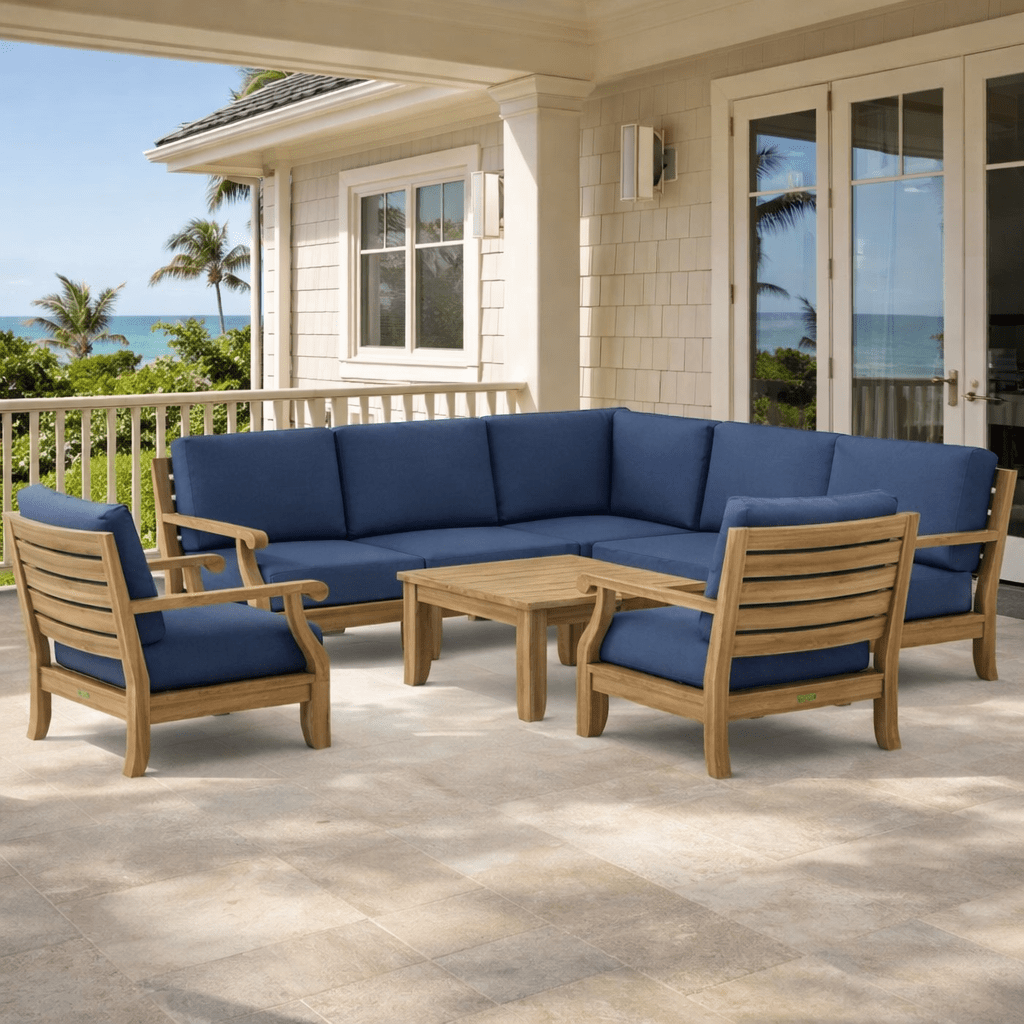 Grade A teak is naturally high in oils and has a dense grain structure. Those characteristics contribute to its resistance to moisture, rot, insects, and warping. In Pacific Palisades, that matters when furniture experiences alternating coastal moisture, seasonal rain, irrigation overspray, poolside use, and long dry periods.
Rather than depending on paint or an artificial stain for durability, most TeakHQ furniture is unfinished natural teak. That is useful on a property where homeowners may prefer the material itself to provide the visual character instead of maintaining a coated surface.
Teak is designed to withstand sun exposure, but homeowners should understand the cosmetic tradeoff before buying it. Natural teak will gradually weather toward a silver-gray patina if left untreated. That change is normal and does not mean that the wood has failed.
If you prefer the warmer original teak color, sealing or oiling can be used to help maintain it. If you like the softer silver-gray appearance—often an excellent fit with coastal contemporary architecture—you can leave the wood untreated. This choice between maintaining color and allowing natural aging is one of teak's most useful ownership advantages.
Grade A teak is resistant to warping and built for temperature fluctuations and outdoor weather. That makes it well suited to furniture that may remain outside throughout the Palisades' long usable outdoor season instead of being treated as temporary patio décor.
Its heavier, sturdier, more architectural feel is also valuable on substantial terraces and larger outdoor rooms. Aluminum remains a legitimate premium alternative, particularly when a homeowner wants a lighter or more overtly modern material. Teak is usually the stronger aesthetic choice when natural warmth and visual connection to surrounding landscaping are priorities.
Premium teak furniture costs more upfront than many mass-market patio sets. The appropriate comparison is therefore not purchase price alone. Teak furniture can last for decades, making lifetime ownership cost more meaningful than the cost of a single furnishing cycle.
That argument is particularly relevant to a high-quality outdoor renovation. If the hardscape, landscaping, pool, kitchen, or terrace is intended as a permanent part of the property, furniture with similar long-term intent often makes more sense than repeatedly replacing lower-cost pieces.
| Pacific Palisades Challenge | Why Premium Grade A Teak Performs Well |
|---|---|
| Strong sun | Designed for outdoor sun exposure; can weather naturally to silver-gray. |
| Marine moisture | Natural oils and dense grain contribute to moisture resistance. |
| Seasonal rain | Designed for year-round outdoor use and rain exposure. |
| Temperature changes | Grade A teak resists warping and tolerates outdoor fluctuations. |
| Poolside wetting | Moisture resistance suits furniture exposed to regular splash. |
| Coastal exposure | Durable natural wood avoids reliance on artificial stain for durability. |
| Long outdoor season | Long-term material designed to remain outdoors year-round. |
If we were walking a Pacific Palisades property with you, we would begin with how the outdoor areas are actually used. The biggest patio is not automatically the place that deserves the biggest furniture group. We would first identify where people naturally gather, where the views are strongest, which area connects most conveniently to the kitchen, and which spaces receive uncomfortable afternoon exposure or stronger wind.
For many larger properties, we would first create one clearly defined social center rather than scattering small pieces everywhere. If conversation and sunset views dominate, that may be a sectional or multi-piece lounge set. If meals and entertaining drive the space, the first investment may be a substantial teak outdoor dining area.
Give this primary zone enough visual weight to feel intentional. Then use smaller pieces to connect secondary spaces instead of trying to make every patio function as a complete outdoor room.
Where space allows, dining and lounging should perform different jobs. Dining belongs near food preparation and convenient indoor access. Deep seating belongs where guests are most likely to stay after dinner—often toward a view, garden, fireplace area, or quieter side of the terrace.
For households whose guest count varies, an extendable teak dining table can be especially useful. It preserves everyday breathing room while allowing the dining area to expand when family or friends arrive.
On ocean- and canyon-view properties, avoid automatically pushing the largest furniture against the outside railing. A deep sofa or tall chair back can become a visual barrier from inside the house. Sometimes the better plan is to pull seating inward, use lower-profile pieces near primary sightlines, and let furniture frame the view rather than occupy it.
This is one of the most important distinctions between furnishing a Palisades terrace and furnishing an ordinary ground-level suburban patio: the view itself is part of the room.
A pool deck should not simply inherit whatever furniture remains after the dining and lounge areas are finished. Establish a dedicated sun zone with teak chaise loungers, leaving generous circulation between the water, loungers, and adjacent entertaining areas.
For larger patios, repeating the same natural teak material across dining, lounging, and pool furniture can create continuity without requiring every piece to belong to an identical collection.
Start with the collection that matches the way your property is used most often. Large terraces and entertainment-oriented backyards may justify sectionals or full dining sets first, while pool-centered homes may benefit more from chaise loungers and complementary tables. Homes with smaller terraces or multiple outdoor levels often work better with individually scaled seating groups rather than one oversized arrangement.
The strongest outdoor spaces here tend to function as genuine extensions of the home. A terrace may serve breakfast in the morning, casual lounging during the afternoon, dinner at sunset, and conversation afterward. That puts more pressure on furniture layout than a patio used only occasionally: pieces need to support several activities without making the space feel crowded.
Larger properties often work best when guests can move naturally between dining, lounge, and pool areas. Think in terms of destinations: one table where people eat, one comfortable area where the evening continues, and perhaps another quieter pair of chairs away from the primary group.
This creates a more relaxed experience than trying to seat everyone in one enormous arrangement. It also allows the property to feel comfortable when only two or four people are outside.
The Southern California climate makes outdoor dining practical during much of the year, but that does not mean every property needs a ten-person table permanently occupying its best terrace. Match the everyday configuration to the household, then accommodate occasional guests with expandable or supplementary seating.
This is where flexible furniture is valuable. A six-person arrangement may be more enjoyable for ordinary dinners even if the household occasionally hosts ten. Expansion should solve the exception rather than dictate the everyday layout.
Ocean-facing and elevated patios often become most appealing late in the day, when direct sun softens and the outdoor space transitions into an evening gathering area. Comfortable lounge seating, nearby side tables, and a conversational layout may therefore provide more actual use than filling every open area with dining furniture.
If an outdoor room looks spectacular but nobody stays there for more than twenty minutes, the problem is often furniture planning rather than the space itself.
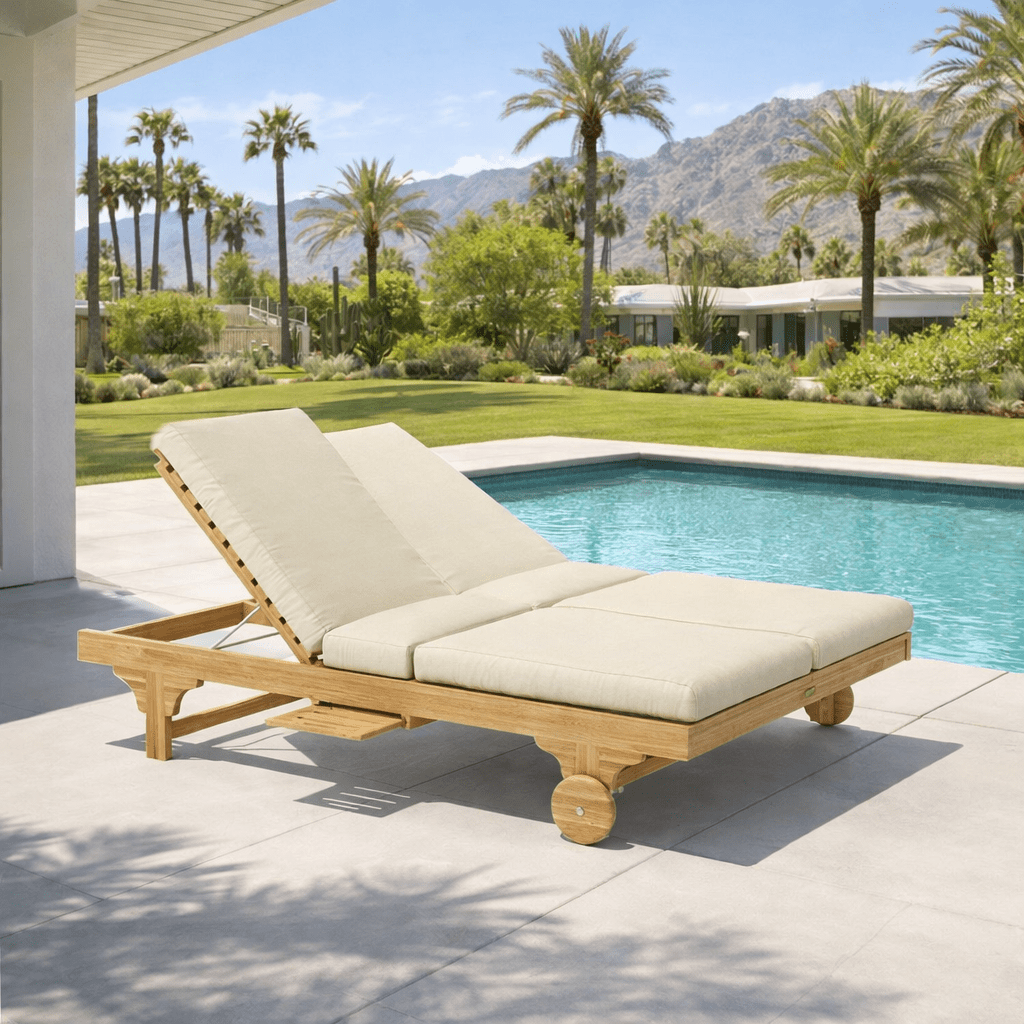 The right furniture category depends on where the piece will live. A pool terrace, narrow hillside deck, covered patio, and large entertainment courtyard should not all receive the same arrangement simply because they belong to the same property.
For terraces whose primary asset is the view, begin with seating rather than dining. A teak sectional can define a larger terrace, while club chairs, sofas, or smaller multi-piece groups can protect circulation on tighter decks.
Pair lounge seating with coffee or side tables rather than expecting one central table to serve every guest. On unusually narrow terraces, several small surfaces can be more usable than one large coffee table.
Chaise loungers are the obvious starting point, but spacing is just as important as quantity. Leave room to walk around the loungers without forcing guests toward the pool edge, and give at least some seats access to a side table for drinks, phones, books, and towels.
Where the pool terrace also serves as an entertainment zone, consider a separate conversation group instead of increasing the number of loungers indefinitely. Poolside furniture should support both swimming and the people who are simply there to spend time together.
Homes with outdoor cooking areas benefit from a clearly anchored dining table. Choose capacity around everyday use first. For hosts who frequently move between intimate household dinners and larger gatherings, extendable tables are often more efficient than permanently dedicating space to maximum seating.
Complete teak dining sets make sense when you want the table and seating to read as one cohesive architectural element. Individual tables and chairs offer more freedom when mixing armchairs, side chairs, or benches.
A deep-seating zone works particularly well on larger terraces, protected courtyards, and patios off a great room. Instead of maximizing seat count, create comfortable conversational distances. One sofa facing two club chairs can sometimes work better than a much larger sectional if people need to walk through the space.
For substantial entertainment patios, multi-piece teak lounge sets simplify the process of creating a coordinated grouping while still allowing pieces to be repositioned as the space changes.
Secondary garden seating should feel simpler than the main entertaining area. A teak bench along a path, beneath mature landscaping, or at a quiet viewpoint gives the property another usable destination without creating another full outdoor room.
These smaller locations are also where the natural appearance of teak works particularly well: the furniture can relate visually to stone, greenery, stucco, wood, and other landscape materials without demanding attention from the setting.
Pacific Palisades has never been defined by one architectural vocabulary. Spanish and Mediterranean influences coexist with ranch homes, mid-century modern houses, canyon residences, and contemporary properties that use large openings and terraces to connect indoor spaces with the surrounding landscape. The most successful furniture usually complements that architecture rather than competing with it.
Natural teak works especially well when modern architecture needs warmth. Against glass, concrete, stone, or crisp stucco, wood prevents the patio from becoming visually cold without introducing excessive ornament.
For these properties, simpler silhouettes and restrained furniture groupings usually allow the architecture to remain dominant. Repeating teak in two or three outdoor zones can create continuity while different furniture configurations keep each area purposeful.
Courtyards, stucco walls, tile, stone, arched openings, and traditional landscaping are natural partners for warm teak. Here, the goal is not necessarily to choose ornate furniture. Often a straightforward teak dining table or lounge group provides enough natural texture while letting the architecture supply the decorative detail.
In greener or more rustic settings, teak can visually bridge architecture and landscape. Allowing unfinished teak to age toward silver-gray can create a quieter appearance, while maintaining its warmer color produces more contrast against vegetation.
Neither choice is inherently better. Decide whether you want the furniture to recede into the landscape or remain a warmer visual feature.
Contemporary terraces often benefit from fewer, larger furniture groups rather than many small pieces. A sectional, substantial coffee table, and a limited number of accent tables can give a broad patio structure without cluttering the view.
TeakHQ's mix of traditional and contemporary teak designs makes the material adaptable across these different Palisades architectural contexts without requiring every property to adopt a stereotypical “coastal” look.
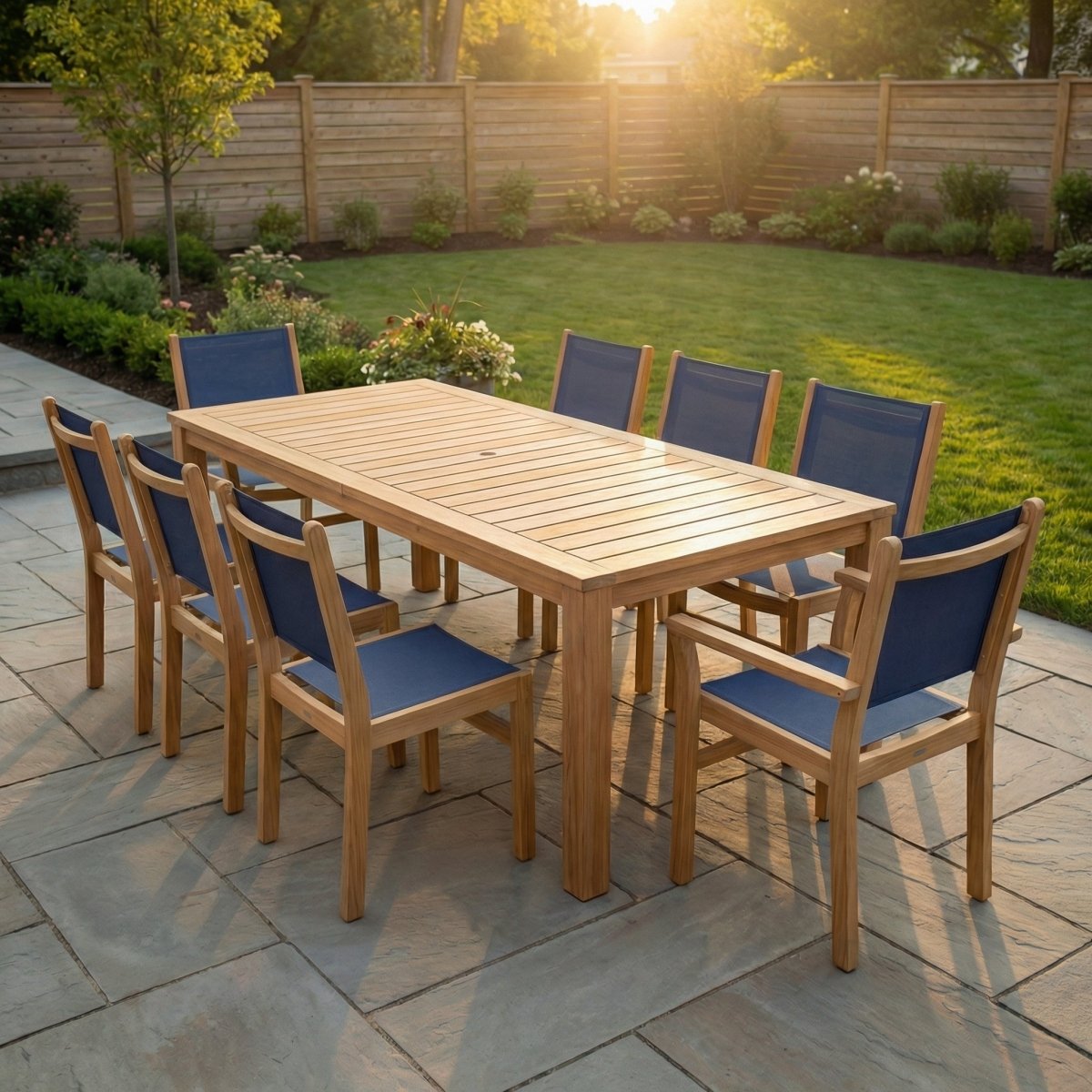 A common mistake is shopping as though this were simply a hot, dry Southern California environment. Coastal moisture and cooler marine air can be part of the ownership experience too, especially closer to the ocean or in shaded areas.
Choose furniture that is comfortable with both wet and dry outdoor exposure. Grade A teak is designed for rain, sun, and temperature fluctuations rather than requiring consistently dry conditions.
A homeowner who hosts twelve people a few times per year may instinctively buy a permanent twelve-person configuration. On a view terrace, that can sacrifice usable space every day for an occasional event.
Consider an expandable table, movable dining chairs, or multiple social zones instead. Furniture should make the patio feel better when two people use it as well as when twelve arrive.
The most expensive square footage outdoors can be the section with the clearest ocean, canyon, garden, or sunset view. Placing tall-backed or oversized furniture directly across that sightline may undermine the reason the terrace exists.
Map the view from inside the house as well as from the patio before positioning sofas and dining furniture. This simple step can matter more than the furniture style itself.
A protected courtyard and an open hillside deck may be only a short distance apart yet feel entirely different on a breezy day. Lightweight furniture can be less desirable in exposed positions. Teak has a heavier, sturdier feel than aluminum, which can be an advantage for homeowners who prefer substantial furniture.
That does not eliminate the need to secure or store loose accessories when conditions require it. Cushions, umbrellas, serving pieces, and lightweight décor deserve separate planning.
Performance fabric reduces maintenance concerns, but it does not eliminate common-sense care. Most TeakHQ lounge seating includes Sunbrella cushions, which are weather-, fade-, UV-, and water-resistant, but damp cushions still benefit from airflow and sensible drying.
Think ahead about where cushions will go when you intentionally want them stored. A convenient location will be used; an inconvenient one usually will not.
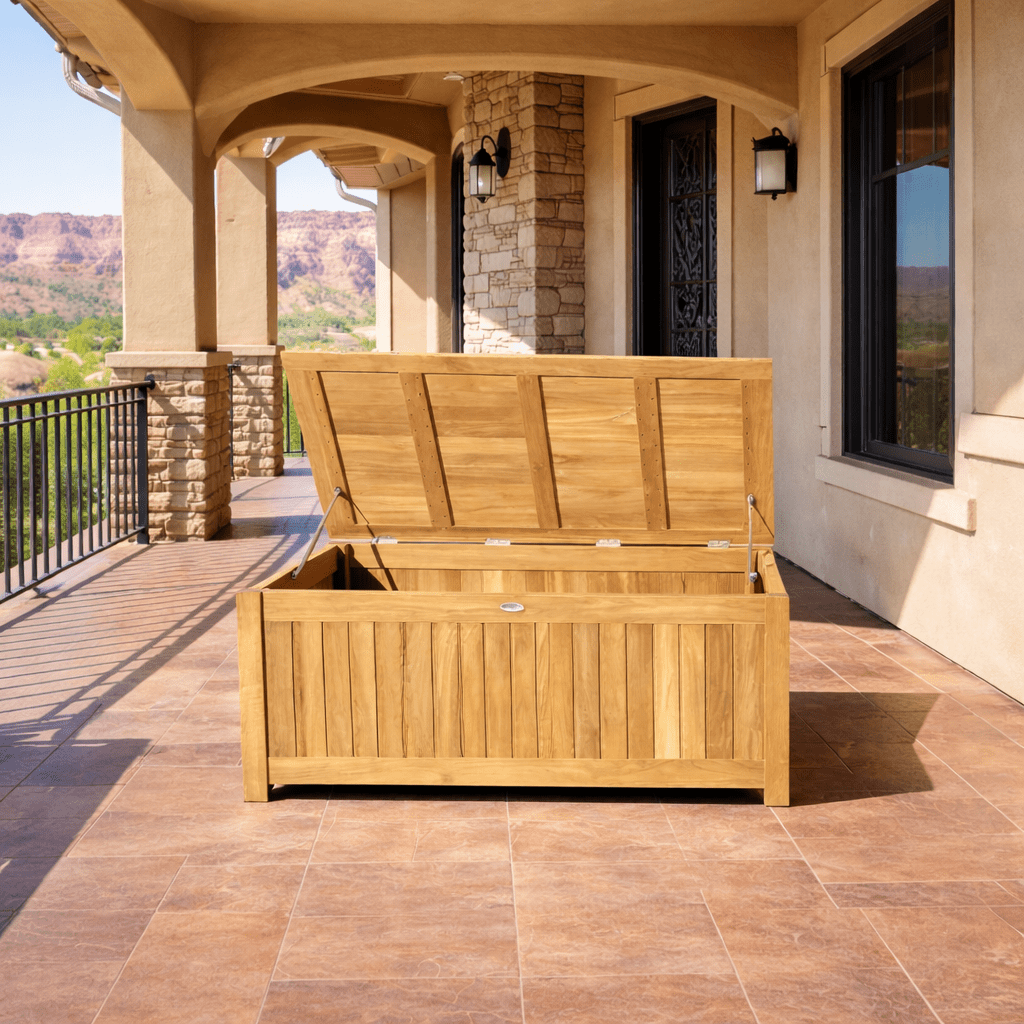 Teak ownership here can be straightforward because the wood does not require artificial stain, paint, or mandatory sealing for durability. Most of the useful maintenance is ordinary cleaning and deciding which appearance you prefer.
There is no useful universal cleaning calendar for every Pacific Palisades property. A protected courtyard may stay relatively clean for long stretches, while an ocean-facing or tree-covered terrace can accumulate salt residue, pollen, dust, leaves, or other debris more quickly.
Inspect the furniture rather than cleaning only by date. Remove surface debris and clean when needed, particularly after unusually dirty conditions or long periods of outdoor exposure.
On more exposed properties, periodic removal of coastal residue is sensible. This is less about creating a complicated teak-maintenance routine and more about preventing grime from accumulating on furniture surfaces and hardware.
Royal Teak and Anderson Teak products use stainless-steel hardware, while Verandis Teak uses brass hardware. Follow the care appropriate to the specific product rather than assuming every piece uses identical fittings.
Where furniture sits beneath dense landscaping, under a covered patio, or in a shaded canyon location, periodically clear leaves and other organic debris. Avoid allowing wet material to remain trapped between cushions and furniture surfaces for extended periods.
Airflow matters especially around cushions. Sunbrella performance fabric is designed for outdoor conditions, but allowing damp fabric to dry naturally remains good ownership practice.
This is the main cosmetic decision. Leave unfinished teak untreated and it can naturally weather toward a silver-gray patina. If you want to preserve more of the original warm teak appearance, sealing or oiling is optional.
Make that choice intentionally at the beginning. Homeowners are often more satisfied when they know the silver-gray transition is expected rather than interpreting it later as deterioration.
Pacific Palisades homeowners generally do not need to treat teak furniture as a seasonal product. TeakHQ's Grade A teak is designed for year-round outdoor use and can withstand rain, sun, and temperature fluctuations.
Protective covers are also optional rather than required for the teak itself. They may still be desirable for convenience, cleanliness, or reducing exposure to debris. If you use covers, follow good ventilation practices and avoid trapping prolonged moisture underneath them.
The best outdoor furniture plan should fit the property before it fits a product category. Start with the spaces you use most, protect important views and circulation, and choose furniture proportions around everyday life rather than the largest gathering you might host once or twice a year. For homeowners who want natural materials, substantial construction, flexible maintenance, and furniture intended to remain outdoors for the long term, premium Grade A teak is exceptionally well aligned with Pacific Palisades living.
There is no single correct material for every home. Premium aluminum and high-quality synthetics can be legitimate choices, but Grade A teak is particularly well suited to homeowners who want real wood, moisture and weather resistance, substantial weight, and long-term outdoor durability.
Yes. Grade A teak's natural oils, dense grain, moisture resistance, rot resistance, and outdoor weather performance make it a strong choice for coastal environments. On particularly exposed properties, routine cleaning of accumulated coastal residue is still sensible.
Prioritize scale, circulation, wind exposure, and sightlines. A sectional can work well on a large terrace, while a sofa-and-chair grouping may fit a narrow deck better. Browse teak patio seating by configuration rather than assuming the largest set is the best choice.
Plan furniture from both the patio and the rooms inside the house. Keep taller backs away from critical sightlines when possible, orient conversation seating toward the view, and avoid placing oversized groups directly against every railing.
No. Teak does not require sealing for durability. It can be left untreated and allowed to develop a silver-gray patina. Sealing or oiling is optional if you prefer to maintain more of the original warm teak color.
Yes, unfinished teak naturally weathers toward a silver-gray patina over time when left untreated outdoors. This is an expected cosmetic change rather than evidence that the wood has failed.
Yes. TeakHQ's Grade A teak furniture is designed for year-round outdoor use and to withstand rain, sun exposure, and temperature fluctuations. Covers are optional rather than required for the teak itself.
Size the everyday table for your normal household rather than your maximum party. If guest counts vary significantly, an extendable teak dining table can provide additional capacity without permanently consuming terrace space.
It depends on your priorities. Teak is warmer, more natural, and heavier, while aluminum is lighter and can create a more overtly modern appearance. Teak is often preferable when natural material, architectural weight, and long-term wood character matter most.
Quality teak furniture can last for decades rather than seasons. That longevity is one reason its higher upfront cost is better evaluated as a long-term investment instead of compared only with the purchase price of lower-cost patio furniture.


