
FREE SHIPPING
within mainland USA
within mainland USA
Home ▸ Teak Outdoor Furniture ▸ By Location ▸ Rancho Santa Fe, California
Rancho Santa Fe combines Southern California's mild coastal influence with sunnier inland exposure, large residential properties, pools, gardens, courtyards, and outdoor entertaining spaces designed to function as real extensions of the home. Furniture here needs to handle substantial sun, long dry periods, seasonal rain, and frequent outdoor use without looking out of place beside refined architecture and landscaping. Several premium materials can work well, but Grade A teak is particularly suited to homeowners who want natural wood, substantial construction, and the flexibility to leave furniture outdoors throughout the year.

Rancho Santa Fe occupies an interesting middle ground in San Diego County. It is close enough to the Pacific to benefit from coastal moderation, yet sufficiently inland that outdoor spaces can receive considerably more sun and warmth than patios directly along the coast. That distinction matters. A homeowner furnishing an estate here should think less about constant ocean spray and more about sun exposure, dry summers, intermittent wet weather, pool environments, landscape debris, and furniture that may remain outside for most or all of the year.
One of the easiest mistakes is treating Rancho Santa Fe exactly like Del Mar or another immediate coastal community. The Pacific still moderates the broader climate, but a sunny estate patio several miles inland can experience a different furniture environment from an ocean-facing deck. Direct solar exposure becomes more important, particularly on open pool decks, south- and west-facing terraces, and patios without mature tree cover or a roof structure.
That places extra value on materials that are genuinely intended for outdoor exposure rather than indoor-style furniture that happens to be marketed for patios. Sun affects surfaces, finishes, fabrics, adhesives, and synthetic components differently, so shoppers should evaluate the entire furniture construction rather than focusing only on appearance in a showroom photograph.
The local rainfall pattern is highly seasonal. Outdoor furniture may spend long periods in predominantly dry conditions and then be exposed to repeated moisture during the wetter part of the year. That cycle favors materials that can tolerate both sun and moisture without requiring constant intervention from the homeowner.
Drainage also deserves attention. A covered loggia can stay protected from direct rain yet remain damp longer after a storm, while furniture positioned beneath dense landscaping may collect leaves and organic debris. In practice, placement can influence cleaning needs as much as the material itself.
Many Rancho Santa Fe properties have resort-style pools, and furniture immediately surrounding a pool lives in a different environment from furniture under a covered dining terrace. Loungers can be repeatedly exposed to wet swimsuits and splashing. Tables may stay in direct sun for much of the day. Cushioned seating may need more active moisture management than an all-teak dining chair or sling-style lounger.
This is why furnishing a large property as one uniform patio is rarely the best approach. Treat the pool deck, dining terrace, covered lounge, garden, and fire feature as separate zones, then choose the furniture construction that makes sense for each.
Rancho Santa Fe's estate-oriented residential character creates another consideration that has little to do with weather: scale. Furniture that looks substantial in a product photograph can appear undersized on an expansive terrace or beside a large pool. Conversely, filling every open area with furniture can make even a generous property feel cluttered.
A better strategy is to establish a few intentional destinations. Give dining enough space to feel permanent. Create a separate conversation area. Furnish the pool independently. Then use benches, accent tables, planters, or occasional chairs to connect the landscape without turning every paved surface into another furniture group.
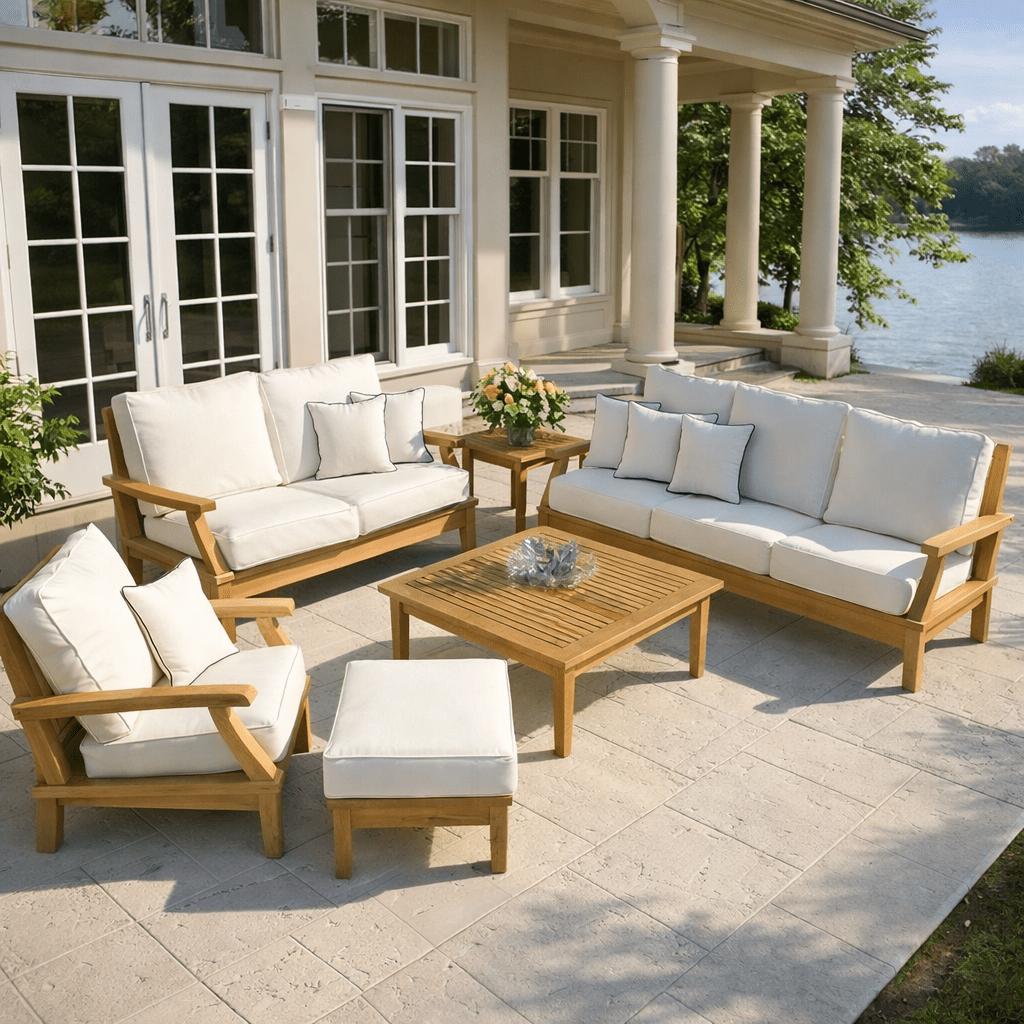 Premium Grade A teak contains naturally high levels of oils and has a dense grain structure. Those characteristics help it resist moisture, rot, insects, and warping while allowing it to remain outdoors through Southern California's alternating periods of strong sun and seasonal rain.
The important distinction is that durability does not depend on applying an artificial stain simply to make the wood suitable for outdoor use. Homeowners can instead make finishing decisions primarily according to the appearance they prefer.
Natural teak exposed outdoors gradually weathers from its original golden-brown appearance toward a silver-gray patina. For Rancho Santa Fe homeowners, that should be treated as a design decision rather than automatically as deterioration. On a Spanish-influenced estate, weathered teak can pair naturally with stone, stucco, mature landscaping, and muted architectural finishes. On a more contemporary property, some owners prefer to preserve more of the original teak color.
If retaining the warmer appearance is important, teak can be maintained with appropriate products. If the silver-gray look suits the property, the furniture can be allowed to age naturally. Either approach is legitimate.
Rancho Santa Fe is not a persistently wet climate, which can make moisture resistance seem less important than it is. The real advantage is flexibility. Grade A teak is designed for year-round outdoor use and can withstand rain and temperature fluctuations, so owners do not have to treat every winter weather system as a furniture-moving event.
That is especially valuable on large properties where bringing multiple dining groups, loungers, benches, and seating arrangements indoors whenever rain appears would be impractical.
Premium teak also has a substantial, architectural presence that works well on larger patios. It is heavier and more natural in character than lightweight aluminum furniture, and its dense construction is a good aesthetic match for stone terraces, substantial outdoor kitchens, masonry fireplaces, garden walls, and other permanent landscape elements common to high-end outdoor environments.
For buyers comparing teak with synthetic poly lumber, the tradeoff is different. Poly can offer very low maintenance, while teak provides genuine natural wood and a more traditional premium-material experience. The better choice depends on whether authenticity, aging character, and natural material are priorities.
Grade A teak furniture is a higher-upfront-cost purchase, but teak can last for decades rather than a few seasons. That makes it particularly logical for a homeowner furnishing a permanent outdoor environment rather than temporarily outfitting a patio.
For an estate with established landscaping and architecture, we would generally rather select a durable furniture framework once and let cushions, accessories, table settings, or smaller accent pieces change over time. That creates a more stable long-term outdoor design.
| Rancho Santa Fe Challenge | Why Premium Grade A Teak Performs Well |
|---|---|
| Strong sun exposure | Designed for outdoor sun exposure and naturally weathers over time |
| Long dry summers | Does not require artificial stain for outdoor durability |
| Seasonal rain | Natural oils and dense grain support moisture resistance |
| Wet poolside use | Resists moisture and is appropriate for outdoor environments |
| Temperature fluctuations | Designed to withstand changing outdoor temperatures |
| Insects and rot | Grade A teak naturally resists insects and rotting |
| Year-round placement | Designed to remain outdoors throughout the year |
| Long-term ownership | Quality teak can provide decades of service |
For a typical Rancho Santa Fe estate, we would not begin by asking which patio set you like best. We would begin with how the property actually works: where people leave the kitchen, where afternoon sun falls, where guests naturally gather, how the pool is used, and which views deserve a dedicated seating area. The furniture plan should follow those answers.
On a property where outdoor living is frequent and entertaining is important, dining usually deserves the first permanent zone. Rather than squeezing a table into whatever patio space remains, give the dining area enough room for chairs to move comfortably and for people to circulate behind seated guests.
For larger households or frequent hosts, teak outdoor dining sets sized for six, eight, or more people are often more useful than a small everyday table. An extendable format is especially practical when the household usually needs fewer seats but occasionally hosts larger dinners.
A dining chair and a lounge chair solve different problems. After a meal, guests usually want somewhere they can sit back rather than remain around the dining table. On larger Rancho Santa Fe patios, we would preserve enough distance between the two zones that each feels intentional while keeping them close enough to support one gathering.
A sofa-and-chair configuration works well for a traditional terrace. A teak sectional can make better use of a broad corner or define a large open patio. Coffee tables and end tables matter more than many homeowners expect; every comfortable seat should have a convenient landing place for a drink.
Do not automatically push lounge furniture against the house simply because that is where the main patio begins. If the pool is an important part of the property, furnish it independently with teak chaise loungers oriented around sun, shade, circulation, and the view.
A useful rule for large properties is to think in destinations rather than square footage. A four-acre estate does not need furniture everywhere. It needs a handful of places people actually want to go.
Rancho Santa Fe's rural character, mature vegetation, rolling terrain, and garden-oriented properties create opportunities beyond the primary patio. A bench near a garden, trail connection, lawn edge, or quiet viewpoint can make an otherwise decorative portion of the property usable.
This is one of the settings where teak's ability to complement both traditional and contemporary design is particularly helpful. The same natural material can appear around the pool, at the dining terrace, and deeper in the landscape without requiring identical furniture collections everywhere.
Begin with the part of the property that carries the most daily activity. Frequent hosts should generally start with dining and then add lounge seating; pool-centered households may prioritize chaise loungers and conversation furniture first. Large estates also benefit from flexible pieces—extendable tables, serving surfaces, fire tables, and mobile carts—that allow the outdoor environment to adapt when a quiet family evening becomes a larger gathering.
Outdoor furniture here is rarely just an accessory to the house. Large lots, mild weather, pools, garden spaces, and a long-standing rural estate character encourage homeowners to divide the landscape into multiple usable environments. The result is a different furnishing problem from a compact coastal patio or urban rooftop: the challenge is not finding room for furniture, but deciding where furniture will create the most meaningful places to spend time.
In smaller homes, outdoor dining often means a table squeezed near the back door. Estate properties allow a more deliberate approach. The dining area can become a true outdoor room, particularly when it sits between the kitchen and the rest of the landscape.
For homeowners who entertain frequently, the practical question is not simply “How many people live here?” It is “How many people are likely to sit down when the patio is being used at its best?” That may justify an eight- or ten-person table even in a smaller household.
Poolside furniture often needs to support several phases of the same day: sunbathing, watching children or guests swim, casual drinks, and eventually an evening conversation. Rather than asking one furniture group to do everything, use dedicated loungers for reclining and a separate conversation group nearby.
That separation also keeps wet pool activity from dominating the primary cushioned lounge area. It is a small planning decision that can make the entire outdoor space function better.
Large Rancho Santa Fe properties often have enough room for guests to spread out. That makes secondary gathering points valuable. A fire table, garden bench, pair of club chairs, or small cocktail area can draw people into the landscape rather than concentrating everyone immediately outside the house.
The goal is not to fill the grounds. It is to give people reasons to move through them.
The mild regional climate means outdoor spaces can remain relevant well beyond summer. Seasonal use changes more through sun angle, evening temperature, and rainfall than through a true winter shutdown. That makes permanent furniture worth prioritizing: the patio does not need to be designed around furniture that disappears into storage for half the year.
 The strongest starting point for many estate properties is a generous teak dining area close to the indoor or outdoor kitchen. If you regularly host six people but periodically entertain ten or twelve, an extendable teak dining table can be more useful than permanently dedicating the terrace to the largest possible table.
Leave room for service circulation as well. Guests should not have to move their chairs every time someone walks from the grill to the table. Where outdoor cooking is substantial, a buffet or serving table can prevent the dining table from becoming a staging area for platters, beverages, and cooking tools.
Deep seating makes the most sense where people are likely to spend an hour rather than ten minutes. Covered terraces, loggias, and patios oriented toward the pool or garden are ideal candidates for teak patio seating.
For a broad rectangular space, a sofa paired with club or swivel chairs keeps the arrangement visually open. A large sectional works especially well where the furniture needs to define a corner or establish a strong boundary within an oversized terrace. Most TeakHQ lounge seating is available with Sunbrella cushions, which are designed to resist weather, fading, UV exposure, and water.
For a substantial pool, we would usually choose several matching chaise loungers rather than a pair of isolated chairs. Four loungers immediately communicate that the pool area is meant to be used socially, while side tables between them give every two seats a practical place for drinks, books, and phones.
If the pool has multiple sun orientations, resist the temptation to bolt the layout visually to the architecture. Position loungers according to how people actually use the sun and shade, while preserving safe circulation around the water.
Rancho Santa Fe's warm days can give way to cooler evenings, making a dedicated conversation area around a teak fire pit table useful beyond a purely decorative role. Treat it as an evening room rather than simply inserting a fire feature into the daytime lounge.
Deep chairs or sofas should be close enough for conversation but arranged with appropriate clearance around the fire feature. This is often one of the best secondary destinations on a large property because it gives guests somewhere to migrate after dinner.
A teak garden bench can be surprisingly effective on properties with mature gardens, lawns, equestrian views, or rolling terrain. The best location is not necessarily the most picturesque spot when viewed from the house. Put the bench where someone sitting on it gets the better experience.
That distinction is easy to overlook. Outdoor furniture should sometimes be designed for the view from the furniture, not merely for the view of the furniture.
Large gatherings become easier when beverages, plates, and serving pieces have a dedicated place away from the main dining table. A serving table or teak bar cart can support outdoor kitchens, pool parties, and long dinners without taking over the main seating areas.
These pieces are particularly useful on large properties because the distance between the indoor kitchen and the active entertaining zone can be significant. The less often a host needs to disappear inside, the better the outdoor space functions.
Rancho Santa Fe's visual identity is closely tied to its rural landscape and architectural heritage. Spanish Colonial Revival influences remain important, while the broader market also includes Mediterranean, traditional California, transitional, ranch-oriented, and contemporary estate architecture. Natural teak works particularly well in this environment because its material character can bridge architecture and landscape without needing to imitate either.
Warm teak naturally complements stucco, terracotta, stone, clay tile, wrought iron, and other materials commonly used in Spanish- and Mediterranean-influenced outdoor spaces. The furniture does not need ornate styling to fit the architecture; in fact, simpler teak profiles can prevent a richly detailed house from becoming visually busy.
For these properties, we would usually let the architecture provide the ornament and allow furniture to provide warmth and structure.
Teak also works in modern environments when the furniture lines are clean and the arrangement is restrained. Natural wood can soften large expanses of glass, smooth stucco, concrete, and stone while still preserving a contemporary composition.
This is one reason material selection and furniture style should be treated separately. “Teak” does not require a traditional appearance any more than “aluminum” requires a modern one.
Rancho Santa Fe was planned around a low-density rural landscape, and that remains one of the area's defining characteristics. Garden furniture should therefore feel integrated rather than staged. Benches, occasional chairs, planters, and small tables can create useful destinations without turning landscaped areas into extensions of the main patio.
Natural teak is especially effective where furniture sits visually between architecture and vegetation. It provides enough presence to feel intentional without introducing a synthetic-looking material into a garden setting.
A useful design decision is to decide before purchasing whether you prefer teak's original golden color or its eventual silver-gray patina. Both can look appropriate here, but they create different relationships with the home.
Golden teak provides warmer contrast against pale stucco and stone. Silvered teak tends to blend more quietly with weathered stone, muted landscaping, and restrained contemporary palettes. Planning for the eventual appearance is better than being surprised by a natural change later.
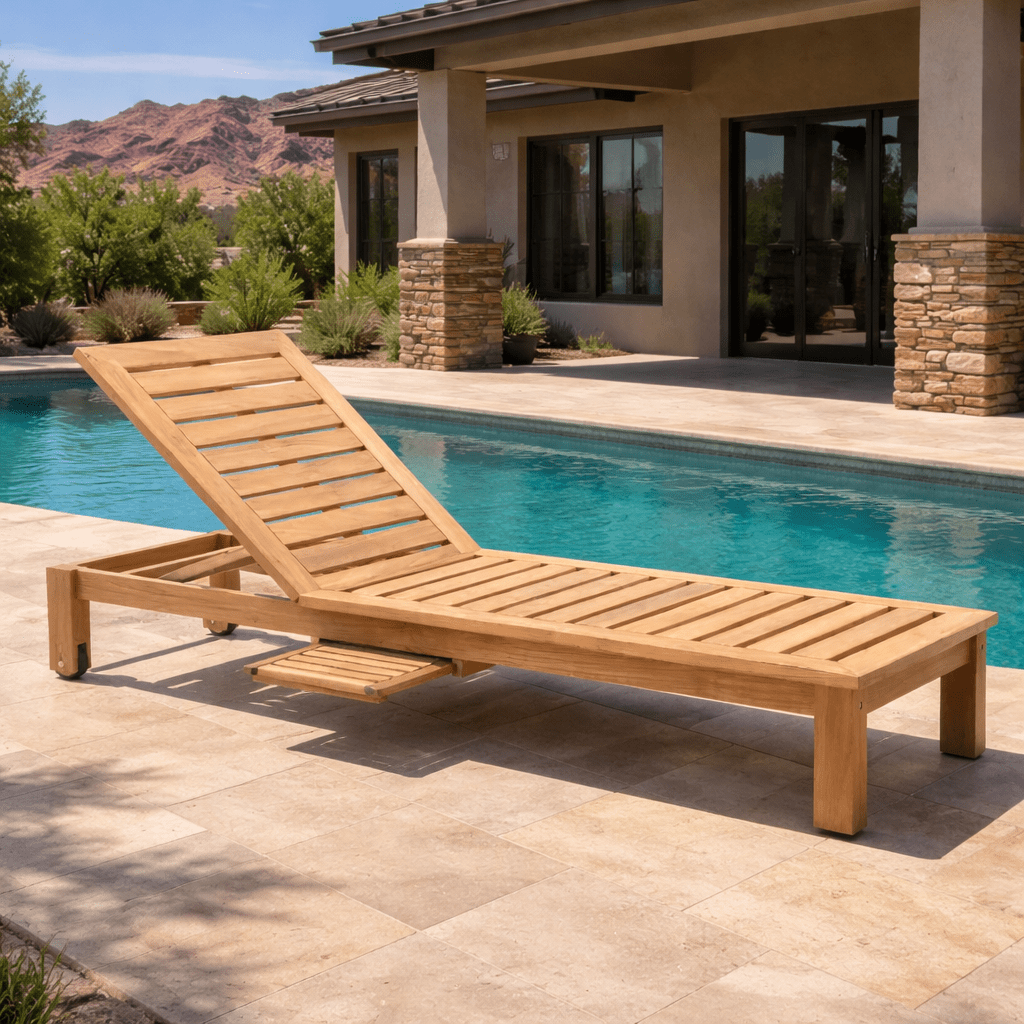 A large terrace can tempt homeowners to buy one enormous furniture arrangement simply because space is available. That can create a patio that looks furnished but functions poorly.
Break the property into dining, conversation, pool, garden, and evening zones first. Premium teak then becomes useful because the same natural material can connect several different furniture categories without forcing every area to use an identical matching set.
Small furniture can disappear visually beside large homes, expansive hardscaping, mature trees, and broad pools. Before purchasing, evaluate the overall footprint of the group—not just the dimensions of an individual chair.
A substantial teak dining set or sectional often feels more proportionate to an estate setting than lightweight pieces spaced too far apart in an attempt to occupy the same area.
Furniture placement should be tested at the time of day when the space will actually be used. A west-facing table that looks perfect at 10 a.m. may be uncomfortable during an early-evening dinner without adequate shade.
Teak is designed for sun exposure, but material durability does not eliminate human comfort. Plan umbrellas, architectural shade, tree cover, or covered dining areas around people first.
Teak itself can remain outside year-round, but cushions deserve separate consideration. Many TeakHQ lounge products include Sunbrella cushions with weather-, fade-, UV-, and water-resistant fabric, yet keeping cushions clean and allowing them to dry properly still improves the ownership experience.
Do not assume that because the wood frame requires relatively little intervention, every soft component should be managed identically.
Some buyers love golden teak but are surprised when untreated wood begins developing a silver-gray patina. Others unnecessarily commit themselves to maintaining the original color when they would have preferred the weathered appearance.
Decide which finish belongs with the property before building a maintenance routine. Teak gives you both options; the mistake is treating one as mandatory.
On an expansive property, the main patio may be beautifully furnished while the garden, lawn edge, or distant viewpoint remains unused. A secondary bench, small chair arrangement, or occasional table can change how the entire property is experienced.
The memorable rule is simple: furnish where people would want to stop, not merely where paving already exists.
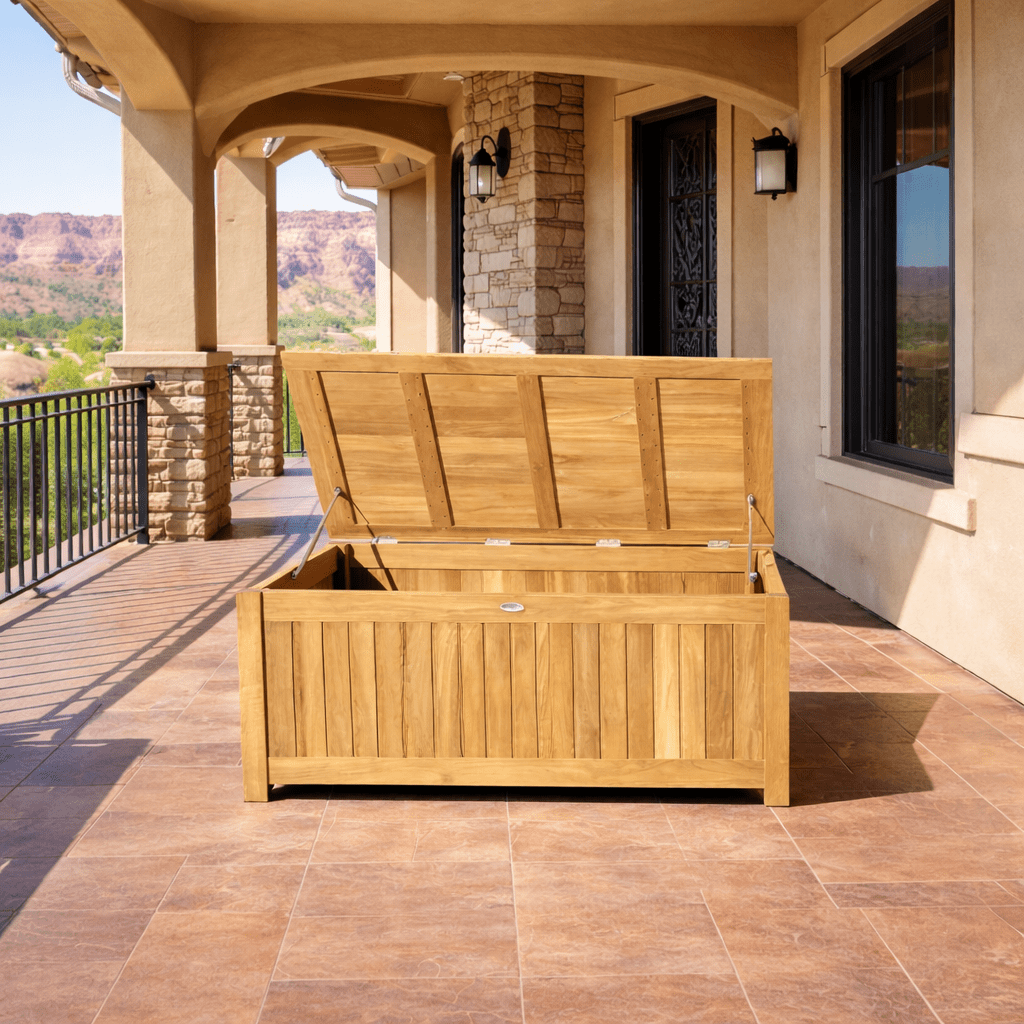 There is no reason to create an aggressive maintenance schedule simply because the furniture is outdoors. Instead, inspect furniture periodically and clean when dust, pollen, leaves, food residue, or other debris begins accumulating.
Open pool decks and garden areas generally need more attention than protected loggias. A dining table beneath trees may require more frequent surface cleaning than a lounge set beneath a roof, even though both are exposed to the same regional climate.
Grade A teak naturally resists moisture and is designed for year-round outdoor use. Seasonal rainfall therefore does not require moving the furniture indoors.
What does matter is avoiding unnecessary accumulation of organic debris and giving wet areas reasonable airflow. This is particularly relevant beneath dense vegetation, in heavily shaded corners, and around cushions or accessories that may hold moisture longer than the wood itself.
Pool furniture may collect splashed water, sunscreen residue, drink spills, and general outdoor debris more quickly than furniture elsewhere on the property. Routine cleaning is therefore more important around the pool even though teak is well suited to moisture exposure.
If cushions are used on loungers or lounge seating, allow wet cushions to dry properly rather than leaving them continuously trapped against another surface.
Untreated teak will naturally weather toward silver gray. Owners who prefer that appearance can allow the process to occur naturally. Those who want to retain more of the original golden color can use appropriate teak care products according to product instructions.
Sealing or oiling is an appearance choice rather than a requirement for the wood's basic outdoor durability. TeakHQ offers teak care products for homeowners who prefer a more managed finish.
Rancho Santa Fe does not require the kind of seasonal furniture shutdown associated with snowbound climates. Premium Grade A teak is intended for year-round outdoor use, so the furniture itself does not need to be moved inside simply because winter arrives.
Protective covers are likewise optional rather than necessary for teak's durability. Some homeowners use them to reduce cleaning or keep furniture presentation-ready between uses. If covers are used, follow the cover manufacturer's instructions and avoid creating a poorly ventilated environment that traps unnecessary moisture or debris.
On a large estate, maintenance decisions should also reflect how practical they are. A finish routine that seems simple for one dining table becomes a very different commitment when repeated across dining furniture, loungers, deep seating, benches, and accent tables.
Before choosing a maintained golden finish throughout the property, consider whether you actually want that responsibility. For many homeowners, allowing some or all of the teak to develop its natural patina is the more realistic long-term approach.
The best outdoor furniture plan begins with the property: how you entertain, where the sun falls, which spaces deserve to become destinations, and how much maintenance you actually want to perform. Premium Grade A teak is especially compelling when you want natural material, substantial furniture, flexible maintenance, and pieces intended to remain part of the outdoor environment for years rather than seasons.
Explore TeakHQ's dining, lounge, poolside, garden, and entertaining collections to build the spaces your property will genuinely use.
Several premium materials can work well. Aluminum is lightweight and contemporary, while poly lumber offers a synthetic, low-maintenance option. Grade A teak is particularly well suited to homeowners who prefer natural wood because it resists moisture, rot, insects, and warping, handles sun and seasonal rain, and is designed for year-round outdoor use.
Yes. Grade A teak is designed for outdoor sun exposure. Untreated teak will gradually change from its original golden-brown color to a silver-gray patina, but that natural weathering does not mean the furniture must be replaced or refinished.
That depends on the material. Premium Grade A teak is specifically designed for year-round outdoor use and can withstand rain, sun exposure, and temperature fluctuations, so seasonal indoor storage is not required.
Chaise loungers, side tables, and a separate conversation group make a particularly useful combination. The loungers support swimming and sunbathing, while the lounge area gives family and guests a more comfortable place to socialize. Explore teak loungers and deck chairs for poolside configurations.
Choose for your realistic entertaining capacity rather than household size alone. A family of four that regularly hosts eight people may get more value from an eight-person or extendable table than from a four-person everyday set. TeakHQ offers teak dining sets for eight to ten as well as larger configurations.
No. Premium Grade A teak does not require sealant or artificial stain for outdoor durability. Sealing or other teak-care treatments are optional choices for homeowners who want to maintain a particular appearance.
Yes. Natural unfinished teak gradually develops a silver-gray patina when exposed outdoors. Some Rancho Santa Fe homeowners prefer that weathered appearance with stone, stucco, and mature landscaping, while others maintain more of the original golden color with appropriate care products.
Neither material is automatically right for every homeowner. Teak is heavier, warmer, natural, and more organic in appearance. Aluminum is lighter and often visually more modern. For an estate where natural materials and substantial furniture are priorities, teak is often the stronger fit.
Premium Grade A teak does not require covers for durability. Covers can still be useful if your goal is to reduce cleaning or keep furniture presentation-ready, but they are optional rather than necessary.
Quality Grade A teak furniture can last for decades when used outdoors. That longevity is one reason teak's higher initial price can make sense for homeowners furnishing permanent patios, pools, gardens, and outdoor entertaining spaces rather than replacing lower-cost furniture repeatedly.


