
FREE SHIPPING
within mainland USA
within mainland USA
Home ▸ Teak Outdoor Furniture ▸ By Location ▸ Rocky Mountain Range
Outdoor furniture in the Rocky Mountains has to make sense across dramatically different seasons: strong high-elevation sun, summer storms, cold nights, snow, and repeated temperature changes. Mountain homes also tend to make views, decks, fire features, and relaxed gatherings central to outdoor living. That combination rewards furniture chosen for long-term exposure rather than a single summer season. Premium Grade A teak is a particularly strong option because it offers natural weather resistance, substantial construction, and the flexibility to remain outdoors year-round.

Choosing outdoor furniture in the Rocky Mountains is less about finding a material that handles one extreme condition and more about finding one that tolerates repeated change. A patio can experience strong sunshine and warm daytime temperatures during one season, then snow, freezing conditions, and long periods of limited use during another. At higher elevations, exposure can also feel considerably harsher than it does in protected lower-elevation settings.
Mountain homeowners often think first about snow, but sun exposure deserves equal attention when evaluating outdoor furniture. Elevated, open decks can receive substantial direct sunlight, and exposed furniture needs materials and fabrics selected with that reality in mind. This is particularly important for cushioned seating, finishes, and synthetic components.
For lounge furniture, TeakHQ's Grade A teak provides a natural wood structure that can withstand sun exposure and weather naturally over time. Most TeakHQ patio seating includes Sunbrella cushions, which are weather-, fade-, UV-, and water-resistant. That combination makes teak patio seating worth considering for sunny mountain decks where both the frame and upholstery need to be chosen thoughtfully.
Snow does not mean every piece of premium furniture must disappear into a garage each autumn. It does mean homeowners should distinguish between furniture that can tolerate outdoor exposure and accessories that are easier to manage seasonally. Grade A teak is designed for year-round outdoor use and withstands rain, sun, and temperature fluctuations, so the wood itself does not require seasonal indoor storage for durability.
Cushions are a separate decision. Even weather-resistant outdoor fabrics benefit from sensible management during extended periods when a deck may be buried in snow or unused for months. A mountain homeowner may therefore leave the teak frames outdoors while storing cushions somewhere dry and accessible.
A memorable way to think about Rocky Mountain furniture is this: do not shop only for the nicest July afternoon; shop for the transitions between July and January. Furniture that looks perfect during summer needs to remain practical when nights turn cold, storms arrive, and winter follows.
That favors materials that do not depend on a fragile decorative surface for basic durability. It also favors furniture substantial enough to feel appropriate on exposed decks rather than lightweight pieces that constantly need to be moved and managed.
A sheltered patio in a wooded mountain neighborhood is a different furniture environment from an open deck overlooking a valley. The first may collect more needles, pollen, moisture, and organic debris. The second may experience stronger sun and wind. Before choosing furniture, evaluate where each piece will actually sit rather than treating the entire property as one exposure zone.
This distinction is especially useful across Rocky Mountain communities. A wooded cabin near a forest edge, a contemporary ski home above a resort town, and a sunny high-desert mountain terrace can all belong to the same broad region while creating very different outdoor furniture requirements.
Several premium materials can work well in mountain environments. Quality aluminum offers low maintenance and a contemporary appearance, while poly lumber appeals to homeowners who prioritize synthetic materials and minimal upkeep. Premium Grade A teak deserves particular consideration when the goal is a substantial natural material that can handle changing outdoor conditions without relying on paint or artificial stain for durability.
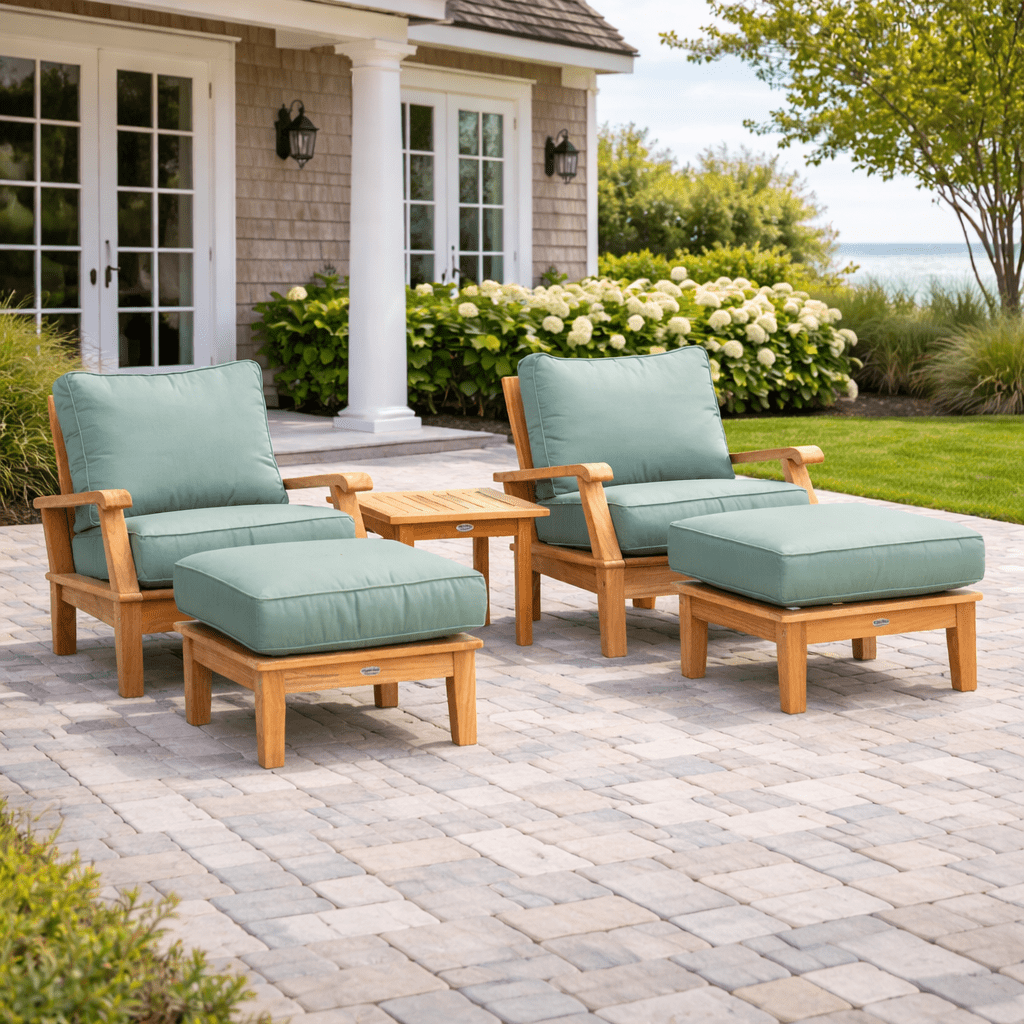 Grade A teak is naturally high in oils and has a dense grain structure. Those characteristics contribute to its resistance to moisture, rotting, insects, and warping. In a mountain environment, that matters because furniture may move repeatedly between sunshine, rain, cold temperatures, snow, and dry periods over the course of its life.
Rather than depending on a painted exterior to provide its core weather resistance, teak's outdoor suitability comes from the wood itself. That is a useful distinction for homeowners who want genuine wood furniture but do not want durability to depend on continually maintaining an artificial finish.
TeakHQ's Grade A teak is designed for year-round outdoor use and can withstand rain, sun exposure, and temperature fluctuations. Those are precisely the conditions that make mountain furniture selection unusual.
This does not mean ownership requires no attention. Dirt, organic debris, snow accumulation, and cushions still need practical care. The advantage is that protecting the underlying teak does not require mandatory annual painting or sealing.
Unfinished teak naturally changes from its original warm color to a silver-gray patina as it weathers. Some homeowners initially interpret that color change as deterioration, but it is a normal aesthetic change rather than a requirement to replace the furniture.
This creates two legitimate ownership approaches. You can allow the teak to weather naturally, which often complements stone, timber, and other mountain materials, or use appropriate teak care products if retaining more of the original color is important to your design. Neither approach requires artificial stain for basic durability.
Premium outdoor furniture is especially worth evaluating over a long time horizon at mountain properties. Teak furniture can last for decades, making its higher initial price easier to justify for homeowners who would rather furnish a deck once with a long-lived natural material than repeatedly replace short-lived outdoor sets.
That calculation can be even more relevant for second homes. Furniture that does not demand constant intervention is easier to own when you are not at the property every week.
| Rocky Mountains Challenge | Why Premium Grade A Teak Performs Well |
|---|---|
| Strong sun exposure | Designed to withstand outdoor sun exposure and weather naturally over time. |
| Snow and moisture | Natural oils and dense grain contribute to moisture and rot resistance. |
| Temperature fluctuations | Grade A teak is designed for year-round outdoor use and changing temperatures. |
| Seasonal rain | Natural weather resistance reduces dependence on protective paint or artificial stain. |
| Long winter exposure | The teak itself can remain outdoors year-round. |
| Organic debris | Solid teak surfaces can be cleaned as needed without requiring a decorative coating for durability. |
| Long ownership cycles | Quality teak can last for decades with appropriate ownership and care. |
We would begin with how the property is actually used, not with a furniture catalog. A primary residence with a large covered patio needs a different plan from a ski home occupied heavily during holidays, while a rental property needs layouts that are intuitive for guests. In all three cases, the mountain view often becomes the organizing feature of the outdoor room.
In many mountain homes, the most valuable part of the patio is not its square footage but its sightline. Before deciding between a sectional, sofa, or multiple chairs, stand inside the house and look through the primary windows toward the deck. Then stand outside and identify where people naturally look.
A large sectional can be excellent when the deck has a broad uninterrupted gathering zone. On a narrower view deck, however, a sofa with movable club or swivel chairs may preserve circulation and allow people to reorient themselves between conversation and scenery. Explore multi-piece teak lounge sets when flexibility is more useful than one large fixed arrangement.
Cool evenings are part of the appeal of mountain living, but they change how outdoor rooms function. Instead of spreading every chair around the perimeter, we would usually create one defined conversation area where guests can gather comfortably. A coffee table or fire feature gives that arrangement a center.
This is where a substantial lounge arrangement can outperform scattered occasional chairs. It makes the deck feel like an outdoor room rather than leftover space around the house.
Outdoor dining works best when carrying food, dishes, and drinks outside is easy. On a mountain property, we would normally place the primary dining table near the kitchen, grill, or covered portion of the patio rather than automatically putting it at the farthest scenic edge.
For households that alternate between quiet weekends and larger holiday gatherings, an extendable teak dining table can be especially useful. It preserves everyday circulation without forcing the homeowner to size the entire patio around the largest gathering of the year.
Finally, consider what happens when outdoor season winds down. A beautiful layout can become frustrating if every cushion, accessory, and lightweight object requires a complicated winter ritual.
We would prioritize durable furniture frames first, then decide which soft goods genuinely need seasonal storage. This approach makes the patio easier to reopen when warm weather returns and is particularly practical for vacation properties.
Start with the activity that defines your outdoor space. For a large deck or ski home used by groups, begin with deep seating and dining; for a smaller cabin, prioritize a few comfortable chairs and useful side tables. Homes built around evening gatherings may benefit most from lounge seating and a fire pit table, while frequent hosts should consider dining capacity and expandable configurations first.
Mountain outdoor living tends to be intensely seasonal rather than simply occasional. When the weather is inviting, decks and patios can become some of the most-used spaces on the property: breakfast overlooking the mountains, afternoon reading, dinner after hiking or biking, and long conversations as temperatures fall after sunset.
When warmer weather arrives, a well-planned mountain deck can function as a dining room, living room, and scenic retreat. That argues for furnishing by activity rather than lining the perimeter with unrelated chairs.
Where space allows, we would create at least two zones: one for meals and one for relaxed conversation. A teak outdoor dining area near the kitchen can handle meals, while lounge seating farther toward the view creates a destination for the rest of the evening.
Mountain evenings encourage people to gather rather than spread out. Deep seating, swivel chairs, and side tables work well because guests tend to settle into one conversation area once temperatures drop.
A fire feature can become the visual center of that arrangement. The practical consideration is circulation: leave enough room for guests to move around the furniture without squeezing between a fire table, chairs, railings, and doors.
A second home should be intuitive when you arrive after being away. The same principle applies to short-term rentals: guests should immediately understand where to eat, where to gather, and where wet or snowy equipment does not belong.
Choose a few purposeful furniture groups instead of filling every corner. Substantial teak frames can remain outdoors, while cushions and smaller accessories can be managed according to season and occupancy.
Mountain homes may be quiet for two people one weekend and full of family or friends the next. Designing permanently for maximum occupancy can make the patio feel overcrowded most of the time.
A better strategy is to establish comfortable everyday capacity and build in expansion. Extendable tables, movable chairs, ottomans, and secondary seating can accommodate larger gatherings without consuming the deck year-round.
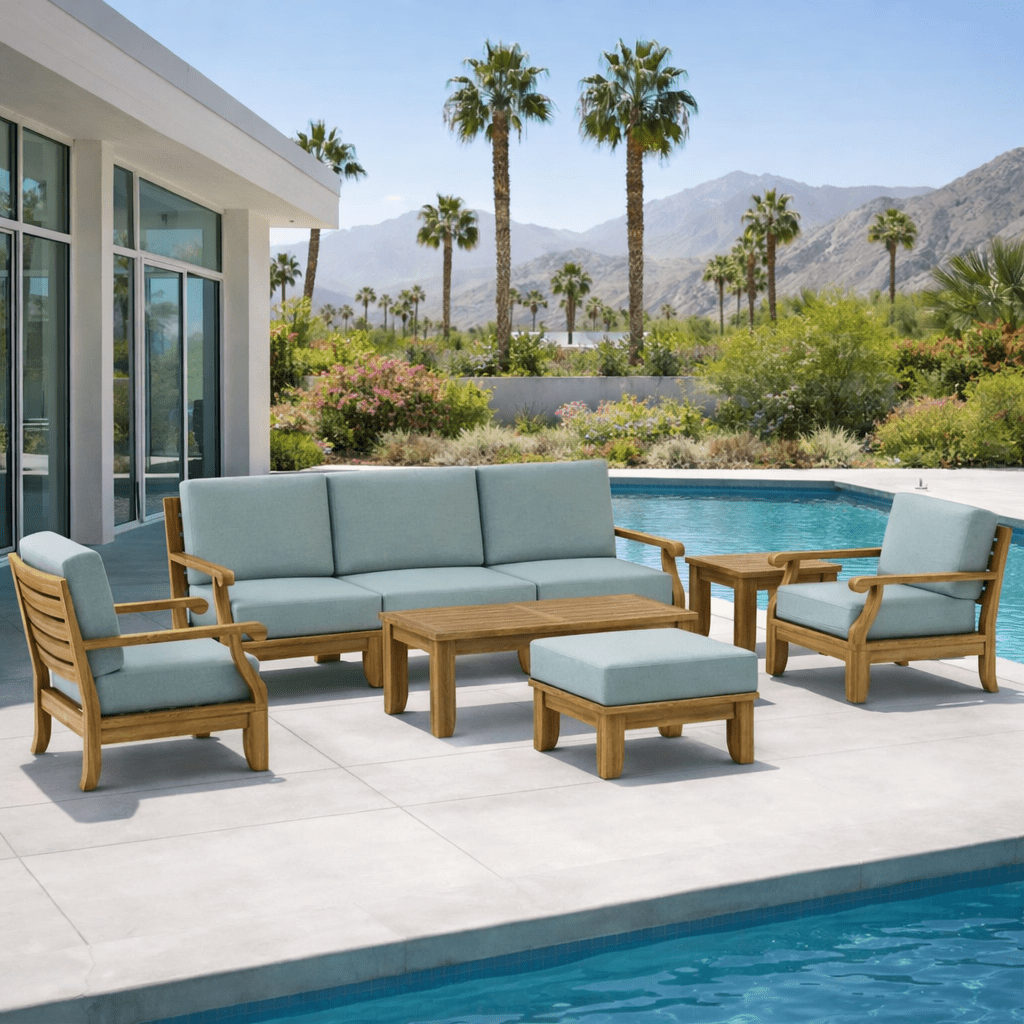 The right furniture category depends less on whether a property is technically a cabin, chalet, or contemporary mountain home than on the shape of its outdoor space. Start with the deck dimensions, door locations, railings, views, and gathering patterns, then choose furniture that supports those constraints.
For homes where large interior great rooms open directly onto expansive decks, deep seating creates the most natural continuation of the indoor living space. A teak outdoor sectional works particularly well when there is enough uninterrupted floor area for a defined conversation zone.
Do not automatically choose the largest sectional that fits on paper. Mountain decks often have premium sightlines, and an oversized arrangement can block circulation or turn every seat inward. Sometimes a sofa, two club chairs, and a coffee table produce a better relationship between conversation and the view.
On narrower decks, individual chairs are often more adaptable than large modular pieces. Swivel chairs are particularly useful where guests may want to face the group during conversation and then turn toward a valley or mountain view.
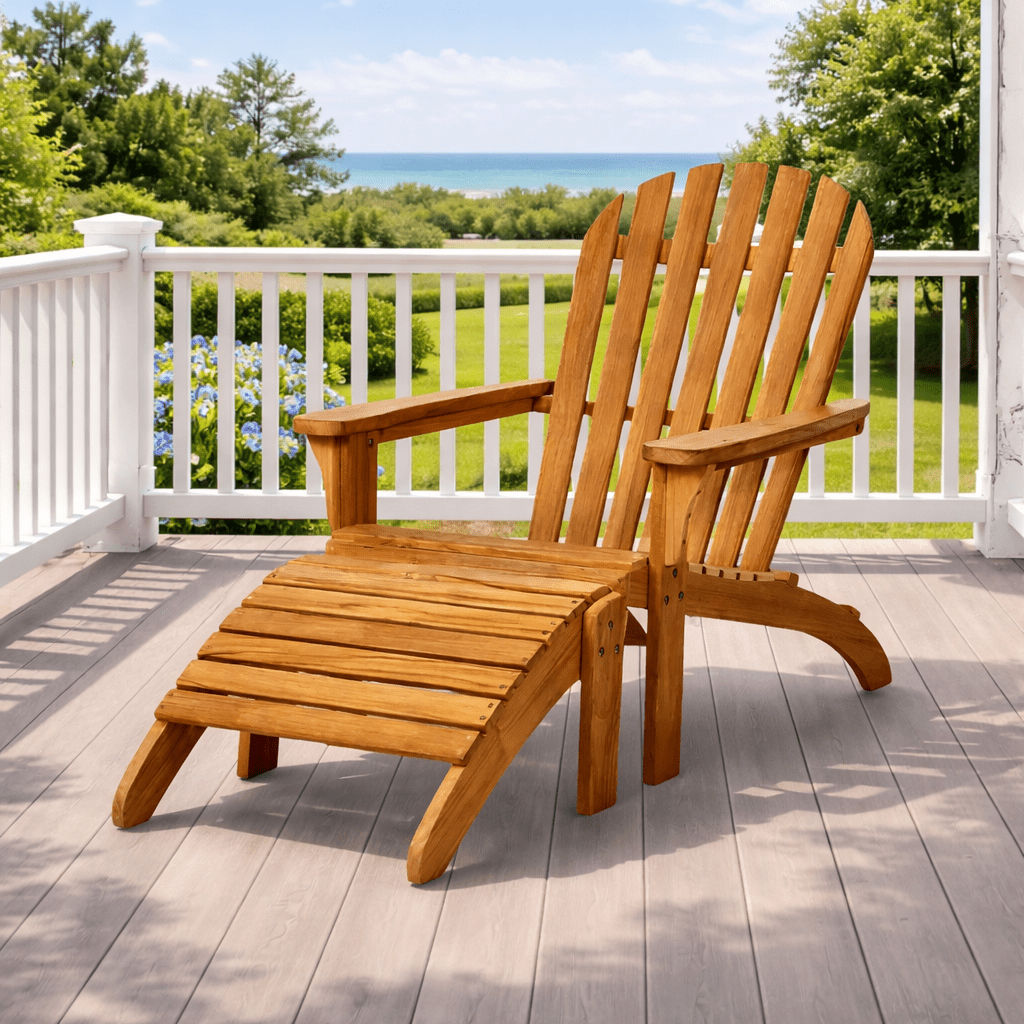
Adirondack chairs also fit naturally into informal mountain settings. They work well in pairs at a scenic edge, around a separate gathering area, or in a quiet location away from the primary dining patio.
For families who spend summers grilling outdoors, a six-person dining set is a practical starting point. Larger homes that routinely host extended family may benefit from eight- or ten-person seating, but everyday use still matters. An oversized table that sits mostly empty can dominate valuable deck space.
That is why expandable dining deserves special consideration in mountain homes. The table can remain appropriately scaled for ordinary weekends and expand when friends arrive or several generations gather for a holiday.
A mountain fire area works best as its own room. Pair a teak fire pit table with lounge chairs or deep seating and keep the configuration conversational rather than trying to make the same furniture serve simultaneously as formal dining and fireside seating.
Side tables are also more important than they appear. Drinks, phones, books, and small plates need somewhere to go, especially when people settle outside for an entire evening. A few strategically placed tables often improve usability more than adding another large furniture piece.
Compact mountain properties benefit from restraint. A loveseat with two chairs can create a complete conversation area without consuming the footprint of a large sectional. A smaller dining table or a pair of Adirondack chairs may be enough for a secondary deck.
Measure not only the furniture but also the usable walking space around it. Doors, stairs, grills, railings, hot tubs, and snow-management routes can reduce the functional footprint of a mountain deck considerably.
Mountain architecture ranges from log and timber homes to stone-heavy lodges, refined ski chalets, and contemporary residences built around glass, steel, and dramatic views. Natural teak is versatile in this setting because it adds warmth without requiring the outdoor space to follow one particular architectural style.
Traditional mountain homes already contain strong natural textures. Teak works comfortably beside timber siding, stone fireplaces, masonry patios, and landscaped settings because it reads as genuine wood rather than a synthetic imitation of one.
In these homes, simple furniture silhouettes are often preferable to excessively ornate designs. Let the architecture, stonework, surrounding trees, and view provide much of the visual detail.
Modern mountain homes often combine expansive glazing with dark metal, stone, and clean structural lines. Natural teak can soften that palette without undermining its contemporary character.
For these properties, consider cleaner-lined lounge sets, substantial dining tables, and restrained furniture groupings. The contrast between warm wood and cooler architectural materials can help the patio feel connected to both the house and the surrounding landscape.
The choice between maintaining teak's warmer original appearance and allowing a silver-gray patina is partly a design decision. Weathered teak can sit naturally beside gray stone, weathered timber, muted siding, and mountain vegetation.
Homeowners who prefer the warmer teak color can maintain it accordingly. The important point is to decide intentionally rather than assuming the natural gray color indicates that something has gone wrong.
One of the easiest mistakes in a spectacular setting is making the furniture itself too dominant. In mountain design, the strongest outdoor room often uses furniture to frame the experience rather than compete with it.
Keep important sightlines open. Position lower seating where appropriate, avoid crowding scenic edges, and use a limited number of well-defined furniture groups. The mountains should still be the most interesting thing on the deck.
 The most common planning error is evaluating furniture as though the deck exists only during warm weather. Mountain furniture may remain exposed long after the last outdoor dinner and well before the first gathering of spring.
Ask what the frame requires during the off-season before purchasing it. Grade A teak's ability to remain outdoors year-round can simplify that decision considerably.
Snow receives most of the attention in mountain climates, but exposed high-elevation patios also demand thoughtful sun planning. Consider the frame material, cushions, shade, and orientation rather than assuming cool air means mild sun exposure.
Teak is designed for outdoor sun exposure, while Sunbrella cushions included with most TeakHQ patio seating provide weather-, fade-, UV-, and water-resistant performance. Product details should still be checked because not every seating piece includes cushions.
A large vacation home does not necessarily need a giant dining table and sectional occupying the deck every day. Designing for the busiest holiday weekend can leave the outdoor space cramped during the other weeks of the year.
Instead, size the permanent layout around normal occupancy and add flexibility through extendable tables, movable chairs, benches, and ottomans.
Exposed decks can experience wind, and mountain properties often have stairs, railings, elevation changes, and multiple exterior doors competing for usable space. Lightweight furniture may require more management, but weight alone is not the entire issue.
Map the walking paths first. A substantial teak sofa in the right location is useful; the same sofa blocking the route from the kitchen to the grill is an everyday annoyance.
Outdoor cushions and solid teak frames have different ownership requirements. Even weather-resistant cushions should not automatically be treated as though months under snow are equivalent to ordinary outdoor use.
If the property closes for winter, create a simple dry-storage plan for cushions and accessories. Leaving the teak frames outdoors while storing soft goods can be much easier than trying to move an entire premium furniture collection every season.
Natural teak develops a silver-gray patina when left untreated outdoors. That color change is expected. Homeowners sometimes create unnecessary maintenance work because they assume the original golden-brown appearance must be preserved for the furniture to remain durable.
Choose your preferred appearance first. Maintain the warmer color if you enjoy it, or allow the furniture to weather naturally if the gray patina suits the home.
 Mountain teak care should be driven by actual exposure rather than an arbitrary maintenance calendar. A covered deck and an open terrace may be only a few yards apart but accumulate very different amounts of sun, moisture, pollen, leaves, and snow.
Inspect and clean outdoor furniture as needed, particularly after long periods of non-use. Forested properties may collect pine needles, pollen, leaves, dust, and other organic material more quickly than open patios.
Do not allow debris to remain trapped unnecessarily around furniture surfaces or between cushions. A practical cleaning routine at the beginning and end of the primary outdoor season is a useful baseline, with additional cleaning whenever conditions require it.
Grade A teak is designed for year-round outdoor use, so storing every teak frame indoors is not required for durability. That can be a significant convenience when a home has a large dining or lounge collection.
Still, year-round outdoor suitability should not be interpreted as a reason to ignore the furniture all winter. Keep the area reasonably maintained and deal with unusual accumulations or debris as part of normal property care.
Most TeakHQ patio seating includes Sunbrella cushions, but inclusion varies by product. Many dining chairs and loungers do not include cushions, although cushions are often available separately.
For a property that sees extended winter conditions, dry cushion storage is a sensible seasonal practice. A teak deck box can help organize outdoor accessories during active months, while longer off-season storage should be chosen according to the property's conditions and the items being stored.
Leaving teak unfinished is a legitimate low-intervention approach. The wood will gradually develop its characteristic silver-gray patina, and no artificial stain is required for durability.
If you prefer the original teak color, appropriate teak care products can become part of your maintenance routine. Make this decision based on appearance rather than assuming sealing or oiling is mandatory.
Protective covers can reduce exposure to dirt and organic debris and may make seasonal reopening easier, but TeakHQ's Grade A teak does not require a cover simply to be suitable for year-round outdoor use.
That distinction is useful for second-home owners: covers can be an optional housekeeping strategy rather than a prerequisite for owning teak outdoors.
The best mountain patio is not necessarily the one with the most furniture. Start with the view, normal household size, entertaining patterns, exposure, and the way the property changes between seasons. Then choose durable pieces that create purposeful dining, conversation, and relaxation zones. Premium Grade A teak is especially well suited to homeowners who want genuine wood, long-term outdoor performance, and the freedom to either maintain its warm natural color or let it weather gracefully with the landscape.
Look for materials that can handle sun, moisture, snow, and substantial temperature changes. Quality aluminum and poly lumber can both be practical choices, while premium Grade A teak is particularly appealing for homeowners who want genuine wood, natural weather resistance, substantial construction, and long-term durability.
It depends on the material. TeakHQ's Grade A teak is designed for year-round outdoor use and can withstand rain, sun, and temperature fluctuations, so the teak frames do not require indoor winter storage for durability. Cushions and accessories should be managed separately according to conditions.
Yes. Grade A teak's natural oils and dense grain contribute to moisture and rot resistance, and TeakHQ's teak furniture is designed for year-round outdoor use. Normal cleaning and property maintenance are still appropriate during periods of snow and prolonged non-use.
Teak is designed to withstand outdoor sun exposure. Unfinished teak will naturally change appearance as it weathers, eventually developing a silver-gray patina. That color change is normal and does not mean the teak must be sealed for durability.
Choose furniture around the sightline and deck dimensions. Deep seating works well on expansive decks, while sofas, club chairs, swivel chairs, and Adirondack chairs can provide greater flexibility on narrower spaces. Avoid allowing oversized furniture to block views or important walking routes.
A sectional is useful for a large, dedicated conversation area. Separate sofas and chairs are often better when the deck is narrow, circulation is complicated, or guests need to alternate between facing one another and enjoying the view.
Size the table around normal occupancy rather than the largest gathering you might host all year. If guest counts vary significantly, extendable dining tables can provide everyday space efficiency with additional capacity when family and friends visit.
No. Teak does not require sealing for durability. It can be left untreated to develop a silver-gray patina, or maintained to preserve more of its original warm color if that is your aesthetic preference.
Seasonal dry storage is a sensible approach when cushions will otherwise face extended snow and months of non-use. Most TeakHQ patio seating includes weather-, fade-, UV-, and water-resistant Sunbrella cushions, but cushion inclusion varies by product.
It can be a strong fit when durability and simplified seasonal ownership matter. Quality teak can last for decades, the wood can remain outdoors year-round, and homeowners can choose between maintaining its original color or allowing it to weather naturally.


