
FREE SHIPPING
within mainland USA
within mainland USA
Home ▸ Teak Outdoor Furniture ▸ By Location ▸ Salt Lake City, Utah
Outdoor furniture in Salt Lake City has to handle a wider seasonal range than furniture in many warm-weather markets: hot, dry summer sun, cold winters, snow, and substantial temperature swings. Along the Wasatch Front, patios also serve as gathering spaces for outdoor dinners, backyard barbecues, mountain-view evenings, and shoulder-season entertaining. That combination rewards furniture chosen for long-term outdoor exposure rather than a single season. Premium Grade A teak is particularly well suited to homeowners who want natural materials, substantial construction, and flexible maintenance.

Salt Lake City is not a place where outdoor furniture faces one dominant weather problem. The challenge is the transition between seasons. The Salt Lake Valley has a semi-arid, four-season climate: summers tend to be hot and dry, while winter brings freezing temperatures and snow. The Wasatch Mountains also create meaningful local variation, with foothill and canyon-adjacent properties experiencing conditions that can differ from the valley floor.
Many homeowners naturally focus on July and August when choosing patio furniture. That makes sense: exposed decks and west-facing patios can receive hours of strong summer sun, and lightweight or lower-quality materials may show fading, drying, or finish deterioration over time.
But buying only for summer misses what makes the Salt Lake market different. The same furniture may remain outdoors through rain, snow, freezing nights, spring moisture, and rapid shoulder-season weather changes. For permanent outdoor spaces, the better question is not simply “Will this work in the sun?” but “Am I comfortable leaving this material outside through the entire annual cycle?”
Snow itself does not automatically make outdoor furniture unsuitable for year-round use. The more important issue is how a material responds as snow accumulates, melts, dries, freezes again, and is followed by warmer weather.
Furniture built from materials prone to rot, warping, finish failure, or moisture damage requires more intervention. Premium outdoor materials that tolerate both moisture and temperature fluctuations simplify ownership considerably, particularly on large patios where moving an entire furniture collection indoors every winter is unrealistic.
A homeowner in a sheltered part of Murray may have a different patio environment from someone higher on the east bench or near Cottonwood Heights. Elevation, slope exposure, shade, wind, and proximity to the Wasatch can all affect how long snow remains, how quickly furniture dries, and how exposed a patio is to weather.
This is one reason we would evaluate the actual placement of the furniture before choosing a configuration. A sunny south-facing terrace may need more attention to shade and cushion management; a shaded foothill patio may deserve more emphasis on drainage, airflow, and clearing accumulated snow or organic debris.
Salt Lake homeowners often think first about temperature, but routine surface debris can have a greater effect on day-to-day ownership. Dry weather can leave furniture dusty, while wind, landscaping debris, pollen, and occasional wildfire ash can make exposed surfaces look dirty long before the furniture itself needs significant maintenance.
That favors outdoor furniture with straightforward cleaning requirements and argues against highly complicated surfaces that trap debris in numerous crevices. It also makes a practical case for covers or cushion storage when homeowners want a patio ready to use with minimal cleanup.
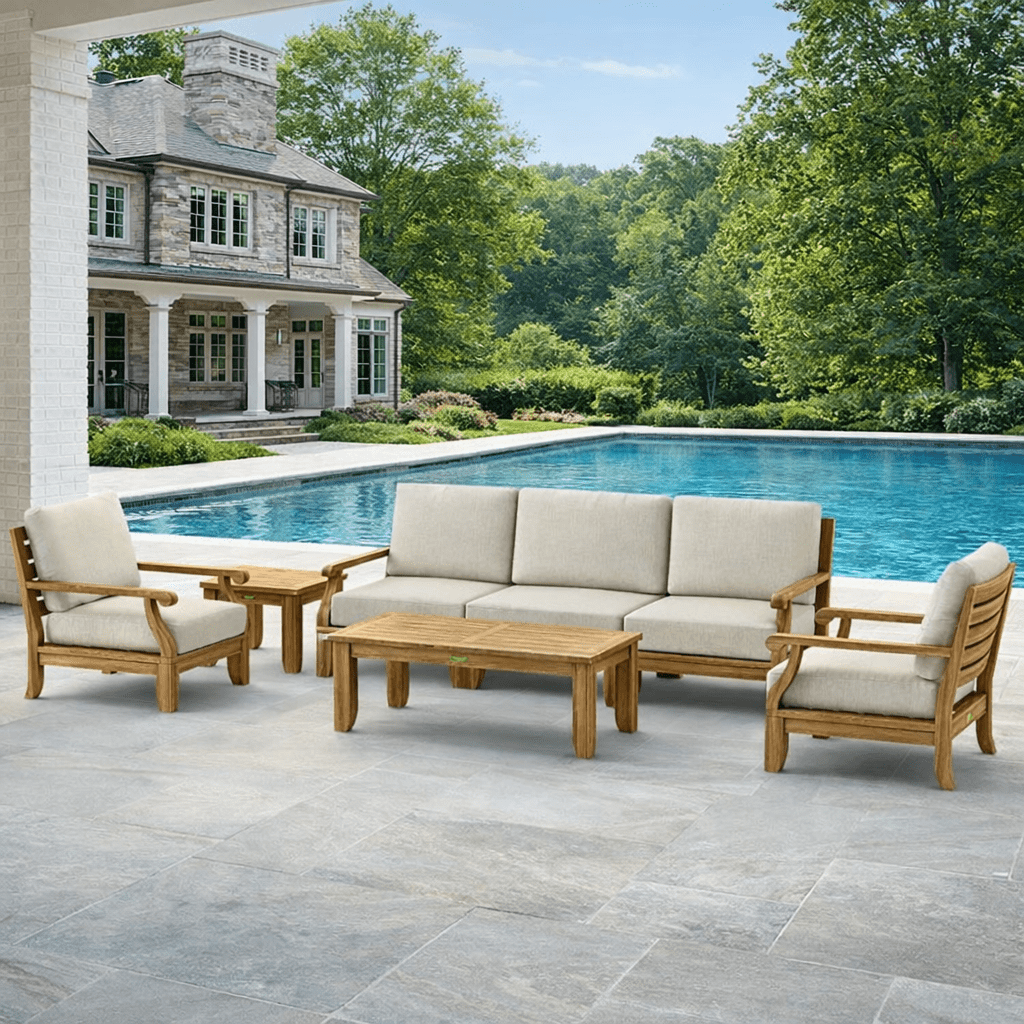 The strongest argument for premium Grade A teak in Salt Lake City is not that it solves one unusual local problem. It is that the same material is well suited to several very different conditions. Teak’s naturally high oil content and dense grain structure help it resist moisture, rotting, insects, and warping, while the wood is designed to withstand rain, sun exposure, and temperature fluctuations.
For homeowners who intend to furnish a permanent patio rather than assemble and disassemble an outdoor room every year, that versatility matters. Quality teak can remain outdoors year-round, so winter does not automatically require moving heavy dining tables, sofas, or benches into indoor storage.
Some outdoor woods rely heavily on surface coatings for protection. Grade A teak does not require artificial stain for durability. Its natural oils are part of the reason teak has become such a long-standing choice for outdoor furniture.
This is useful in Utah because finishes themselves can become another maintenance obligation when exposed to strong summer sun and seasonal weather. Teak gives homeowners two legitimate ownership approaches: leave it unfinished and allow it to develop a silver-gray patina, or use appropriate teak care products when preserving more of the original golden-brown appearance is important.
Salt Lake furniture experiences repeated temperature changes over the course of a year. Premium Grade A teak's dense structure and resistance to warping make it a strong fit for that environment. That does not mean the wood is completely unaffected by weather—real outdoor wood naturally changes in appearance—but it is intended for outdoor exposure rather than dependent on being sheltered every time conditions change.
For a homeowner investing in a large teak outdoor dining area or substantial lounge collection, structural dependability matters more than preserving a showroom-new surface indefinitely.
Teak generally costs more initially than lower-priced outdoor wood, lightweight metal sets, or mass-market patio furniture. The appropriate comparison is therefore not purchase price alone. Premium teak furniture can last for decades, turning the decision into a longer-term ownership calculation.
Aluminum remains a legitimate premium choice for homeowners who prefer a lighter, distinctly modern material. Poly lumber appeals to buyers prioritizing synthetic construction and low maintenance. Teak is especially compelling when natural material, weight, architectural presence, and long-term durability are higher priorities.
| Salt Lake City Challenge | Why Premium Grade A Teak Performs Well |
|---|---|
| Hot summer sun | Designed to withstand outdoor sun exposure; unfinished teak can weather naturally over time. |
| Snow and winter moisture | Natural oils and dense grain help resist moisture and rotting. |
| Temperature fluctuations | Dense Grade A teak resists warping and is designed for year-round outdoor use. |
| Seasonal wet-dry cycles | Outdoor-grade teak tolerates rain and changing weather without requiring a protective finish for durability. |
| Dry, dusty periods | Solid teak surfaces are straightforward to clean as routine dust accumulates. |
| Long off-season | Teak furniture can remain outdoors year-round rather than requiring indoor winter storage. |
We would start with the way the patio is actually used rather than the size of the furniture catalog. Salt Lake homes often benefit from creating distinct outdoor zones: one for eating, one for conversation, and—when space allows—one focused on a view, fire feature, garden, or quieter seating. That approach works particularly well on larger suburban lots and foothill properties where the patio functions as an outdoor extension of the house.
If a household regularly hosts family, neighbors, or friends, we would give the primary dining area more capacity than the number of people who live in the home. A six-person household does not necessarily need a six-person maximum table. Guest patterns matter more than household size.
This is where an extendable teak dining table can be especially useful. It avoids permanently filling the patio with an oversized table while preserving the ability to accommodate larger dinners, weekend guests, and celebrations.
A common planning mistake is treating outdoor dining as the complete patio. Once dinner ends, people naturally want a more relaxed place to continue talking. On patios with enough square footage, we would usually pair dining furniture with a separate teak patio seating group.
A sofa or loveseat with club chairs works well when flexibility matters. A sectional makes more sense when the space has a defined corner, a large uninterrupted wall, or a view orientation that naturally determines where everyone should face.
On east-bench and foothill properties, the mountain or valley view should influence furniture placement as much as the house itself. This sounds obvious, yet it is common to see every chair arranged squarely around a table while the best sightline sits behind half the guests.
Our practical rule would be to stand in the patio before ordering anything and identify the direction people will naturally want to look at 7:30 on a summer evening. That direction should help determine the orientation of the sofa, swivel chairs, dining table, or secondary bench. In a mountain city, the view is effectively one of the walls of the outdoor room.
Salt Lake's most comfortable outdoor evenings are not limited to peak summer. A protected patio, comfortable deep seating, and a well-positioned fire feature can make spring and fall significantly more usable.
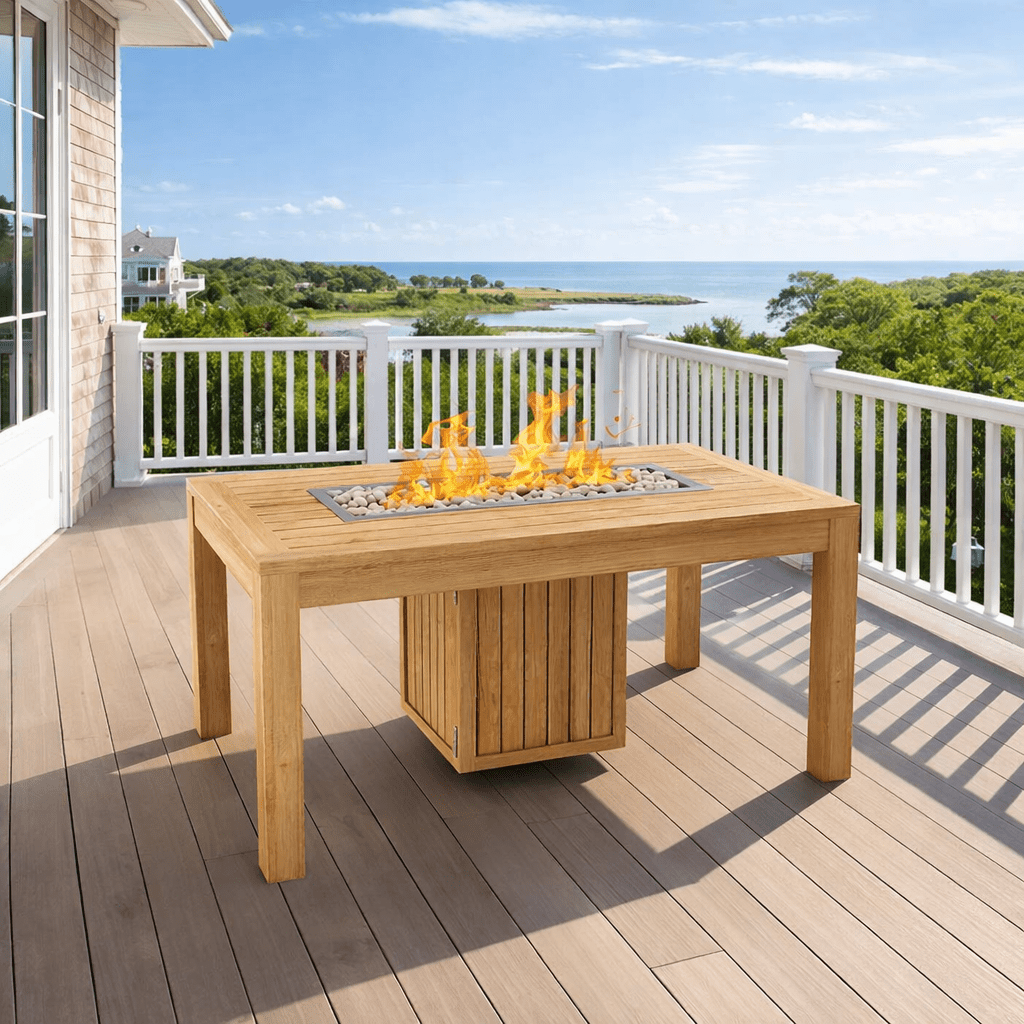
A teak fire pit table can therefore be more functional here than it would be in a climate where evening warmth is rarely needed. We would treat it as part of the seating plan rather than an accessory added after every chair has already been positioned.
Start with the activity that matters most on your patio. Frequent hosts should look first at dining sets or extendable tables; homeowners who spend more time outside after dinner may get greater value from deep seating or a sectional. Fire pit tables make particular sense for extending cool-weather use, while benches and deck boxes work well as secondary pieces that add seating, storage, or a quieter destination elsewhere in the yard.
Outdoor living along the Wasatch Front is strongly seasonal without being confined to a single season. Summer invites long dinners and backyard gatherings, while pleasant spring and fall periods reward patios that can adapt to cooler evenings. Winter changes how the space is maintained, but permanent outdoor furniture can still remain part of the landscape rather than disappearing into storage for several months.
In many Salt Lake-area homes, the most useful outdoor room is still the simplest: a table near the kitchen or grill with enough seating for both the household and guests. The region's dry summer weather makes outdoor dinners particularly practical, and larger suburban yards often provide room to separate dining from lounging rather than forcing both activities into one small footprint.
For regular entertaining, we would prioritize circulation around the table just as carefully as the table itself. Leave enough room for occupied chairs to pull back without blocking the route between the house, grill, and yard.
Salt Lake's proximity to the Wasatch makes outdoor recreation part of the identity of many households. A patio may become the place to sit after hiking, biking, skiing, or a day in the canyons rather than a formal entertaining space used only for parties.
For these homes, comfortable lounge seating can be more valuable than maximizing dining capacity. Deep seating, easy-access side tables, and a layout that lets people relax without rearranging furniture every time they use the space usually deliver more everyday value.
The difference between afternoon heat and a comfortable evening is part of what makes Salt Lake outdoor living appealing. It also means furniture should not be designed exclusively around daytime sunbathing.
A conversation group surrounding a coffee table or fire feature often sees more use than rows of loungers. Where a pool is present, chaise lounges can certainly be appropriate, but for the broader Salt Lake market we would generally rank versatile dining and conversation furniture ahead of dedicated pool furniture.
One of the best ways to improve the value of a premium patio is to design for April, May, September, and October—not simply July. Shelter from wind, good sun orientation, deeper seating, and a fire feature can make an outdoor space inviting during periods when a poorly planned patio sits unused.
This is a different design mindset from hot-climate markets where shade and cooling dominate almost every decision.
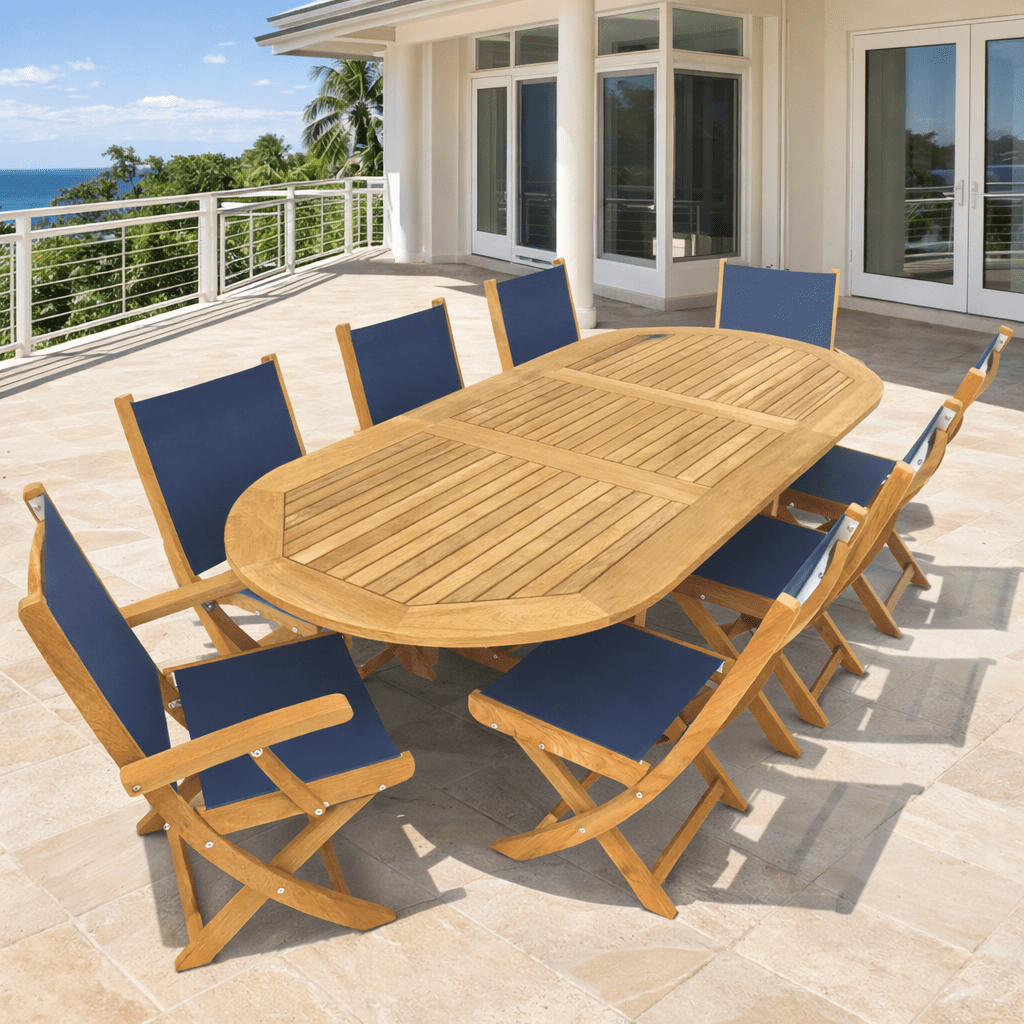 For a conventional backyard patio in Holladay, Sandy, Draper, South Jordan, or similar Wasatch Front neighborhoods, a six- or eight-person teak outdoor dining set is a practical starting point. It provides useful everyday capacity without turning the patio into a banquet space.
If large gatherings happen only occasionally, an extendable table usually makes more sense than permanently buying for the largest guest count of the year. The everyday patio stays more open, while additional seating capacity is available when needed.
For foothill and east-bench homes where the patio looks toward the mountains or across the valley, orient lounge furniture around the sightline rather than automatically facing the house. Sofas, loveseats, club chairs, and swivel chairs can create a comfortable conversation area without sacrificing the view.
Swivel seating is particularly useful when a patio has competing focal points—for example, a house-mounted television in one direction and mountain or sunset views in another. Instead of forcing the entire layout to choose one orientation, occupants can turn the chair as needed.
Large teak outdoor sectionals work best on patios with enough uninterrupted space to support them. They are especially effective beneath a covered patio or pergola where the architecture already creates a clear outdoor room.
We would not automatically recommend a sectional merely because the patio is large. A sofa plus movable club chairs creates more flexible conversation patterns and is easier to adapt for parties. A sectional is strongest when its footprint matches the architecture and the homeowners genuinely prefer a more permanent seating arrangement.
Salt Lake's seasonal climate gives fire-focused seating more practical value than it has in many warm regions. Pair a fire pit table with club chairs, a loveseat, or a sofa while maintaining comfortable circulation around the group.
The mistake to avoid is putting the fire feature in whatever space remains after the dining and lounge zones are complete. If evening use is important, design that zone early enough that it gets a desirable location rather than an awkward leftover corner.
A teak garden bench can make good use of landscaped portions of a larger property that are too removed from the house for a full furniture group. Consider a garden edge, a shaded corner, a view toward the Wasatch, or a quieter part of the yard.
These secondary seating destinations can make an expansive yard feel intentionally designed rather than concentrating every outdoor function onto one slab of concrete behind the house.
Salt Lake City's residential architecture ranges from historic neighborhoods near the urban core to mid-century homes, newer suburban construction, contemporary foothill properties, and mountain-influenced designs closer to the canyons. Teak works across those settings because natural wood can read as either traditional or contemporary depending on the furniture lines and surrounding materials.
On properties near the east bench, Cottonwood Heights, or Draper foothills, natural materials generally make an easy visual transition between architecture, landscaping, and the mountain setting. Teak can provide warmth against stone, concrete, stucco, steel, or large expanses of glass without requiring the patio to look rustic.
For contemporary architecture, choose simpler silhouettes and let the grain of the wood provide texture. For more traditional homes, classic teak dining chairs, benches, and substantial tables can feel appropriately established rather than trendy.
Salt Lake neighborhoods such as the Avenues contain older homes and a mix of architectural character not found in newer southern-valley subdivisions. In these settings, oversized resort furniture can sometimes overpower a smaller terrace or garden.
A modest dining set, loveseat-and-chair arrangement, or garden bench often fits the scale better. The objective should be to preserve circulation and landscape rather than covering every available foot of patio with furniture.
Newer homes in the southern and western portions of the metro commonly offer outdoor spaces that can accommodate multiple functions. Where the footprint allows it, visually separate dining and conversation areas rather than buying one oversized set intended to do everything.
Repeating teak across both zones can create continuity even when the furniture styles are not identical. Dining furniture may be more upright and traditional, while a lounge group can be deeper and more relaxed.
A memorable Salt Lake patio does not need overt “mountain lodge” styling to feel regional. In many homes, the strongest local design element already exists beyond the property line: the Wasatch skyline.
Keep tall furnishings, umbrellas, and landscaping from unnecessarily blocking that view. Low-profile lounge furniture and carefully placed seating can make the surrounding landscape feel like part of the outdoor room.
 A patio set that performs adequately during dry summer weather may become inconvenient once snow, moisture, freezing temperatures, and repeated seasonal changes arrive. Before purchasing, decide whether the furniture will stay outside all year or be moved into storage.
Premium Grade A teak is designed for year-round outdoor use and tolerates rain, sun, and temperature fluctuations, making it appropriate when permanent placement is the goal.
Large Utah homes do not automatically mean every patio needs large furniture. The relevant measurement is the usable outdoor room after accounting for doors, grill clearance, walkways, steps, and landscaping.
Measure furniture in its occupied position, including chairs pulled away from the table. A set that technically fits but interrupts movement between the kitchen and backyard will feel wrong every day.
Mountain and valley views are valuable design assets, yet furniture is often arranged by symmetry rather than experience. If half the chairs face a wall while the strongest view sits behind them, the patio has been planned around the floor plan instead of the people using it.
Use sofas, club chairs, benches, or swivel seating to direct attention toward the view while preserving conversation.
Teak frames can remain outdoors year-round, but cushion management is a separate issue. Many TeakHQ patio seating pieces include weather-resistant Sunbrella cushions, yet keeping cushions dry and protected when not in use can reduce cleaning and keep the patio ready for guests.
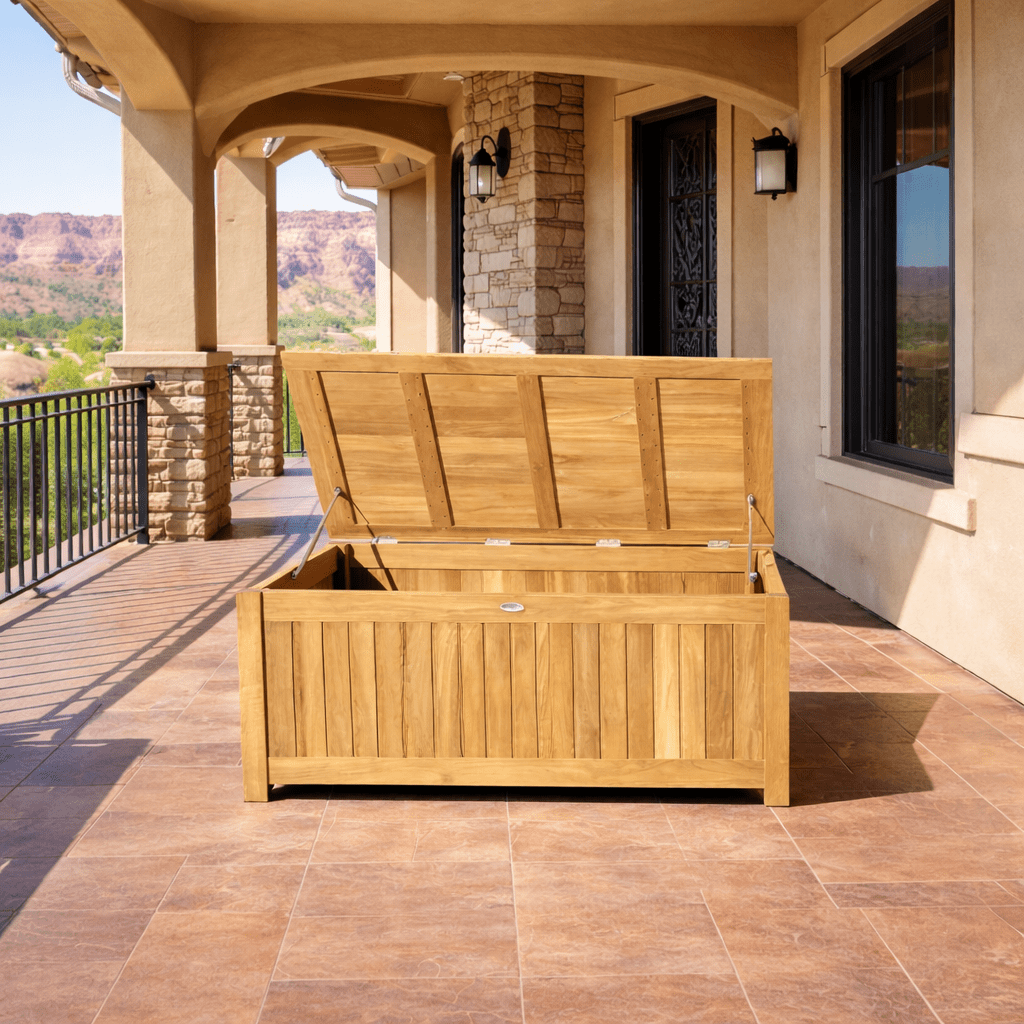
A deck box or other protected storage location is particularly useful during extended winter weather or periods when the patio will not be used.
Designing exclusively for the hottest part of summer can waste some of the most pleasant outdoor periods of the year. Shade is valuable in July, but spring and fall may benefit from sunshine, protection from wind, deeper seating, and warmth.
A flexible layout—and, where appropriate, a fire feature—can make the patio useful across a much larger portion of the calendar.
 Salt Lake's dry periods can leave outdoor furniture coated with dust, pollen, or landscaping debris even when there has been little rain. Routine cleaning should therefore be based on condition rather than a rigid calendar.
Brush away loose debris and clean the teak as needed using appropriate teak-care methods and products. Avoid allowing leaves, dirt, or other organic material to remain packed against furniture for long periods, particularly in shaded or damp areas.
Natural teak does not need to be stained or sealed for durability. If left untreated, it gradually weathers to a silver-gray patina. That is a normal aesthetic change rather than evidence that the furniture has failed.
Homeowners who prefer the warmer original teak color can choose to maintain it using appropriate teak products. The important decision is aesthetic: decide which appearance you prefer before creating an unnecessary maintenance schedule.
Premium Grade A teak is designed for year-round outdoor use, so owners do not need indoor storage simply because winter arrives. That can be a substantial practical advantage with heavy dining tables, sofas, benches, and other architectural-scale pieces.
Clear excessive debris or accumulation as necessary and make sure the furniture is not placed where drainage problems leave it sitting in persistent standing moisture. If using a protective cover, follow the cover manufacturer's instructions and avoid creating a poorly ventilated moisture trap.
Furniture frames and cushions have different care needs. Even weather-resistant outdoor fabrics benefit from being kept clean and dry during extended periods of nonuse.
A teak deck box, garage shelving, or another protected storage location can make seasonal cushion management much easier. This is especially useful for homeowners who want to start using the patio quickly when an unexpectedly warm spring day arrives.
Salt Lake's overall climate is relatively dry, but individual patios can still create damp microclimates. Snow may remain longer on a shaded north-facing patio, irrigation can repeatedly wet one furniture leg, and leaf piles can hold moisture against wood.
The practical solution is less about adding chemical treatments and more about good housekeeping: maintain drainage, remove trapped debris, and allow furniture surfaces to dry normally.
The strongest Salt Lake patio is not simply designed for the hottest afternoon of the year. It works for summer dinners, cool mountain evenings, shoulder-season gatherings, and the reality of a snowy winter. Explore TeakHQ's Grade A teak dining, lounge, table, bench, and storage collections to build an outdoor space around the way your household actually uses it—and around the seasons it will experience.
The strongest choices are materials designed to handle both hot summer sun and winter weather. Premium teak and quality aluminum can both be appropriate. Grade A teak is especially attractive for buyers who prefer natural wood, substantial weight, long service life, and the ability to leave furniture outdoors year-round.
Yes. Premium Grade A teak is designed for year-round outdoor use and can withstand rain, sun exposure, temperature fluctuations, and winter weather. Indoor seasonal storage is not required for the teak furniture frame.
A cover is optional for Grade A teak rather than necessary for its basic durability. Covers can reduce cleaning and debris accumulation, but they should be used according to the cover manufacturer's directions so moisture is not unnecessarily trapped against the furniture.
Real outdoor wood naturally responds to its environment, but Grade A teak's dense grain structure and natural oils make it resistant to warping and well suited to temperature fluctuations. It is specifically designed for outdoor exposure rather than climate-controlled storage.
For frequent gatherings, start with a six- to eight-person dining area and consider an extendable dining table if guest counts vary. On larger patios, add a separate sofa-and-chair or sectional conversation area rather than trying to make one oversized dining set serve every purpose.
It can be. Salt Lake's cooler evenings and spring and fall weather make a fire-focused conversation area more useful than it may be in consistently warm climates. Plan the fire area as part of the original furniture layout so it receives adequate space and comfortable seating.
No. Grade A teak does not require sealing or artificial stain for durability. You can leave it untreated and allow it to weather naturally, or use appropriate teak-care products if you prefer to maintain more of its original golden-brown appearance.
Yes, unfinished teak naturally develops a silver-gray patina as it weathers outdoors. This is an expected cosmetic change. Homeowners who prefer the original teak color can choose a maintenance routine intended to preserve that appearance.
A sectional works well when the patio has a clearly defined corner or permanent orientation. A sofa paired with movable club or swivel chairs is usually more flexible for entertaining, changing views, and rearranging seating around a fire feature.
Even when the teak frame remains outdoors, cushions can be stored separately during long periods of nonuse. A dry garage, protected storage area, or deck box can reduce cleaning and make spring setup easier.


