
FREE SHIPPING
within mainland USA
within mainland USA
Home ▸ Teak Outdoor Furniture ▸ By Location ▸ Southern California
Southern California rewards a different approach to outdoor furniture because a patio near the Pacific faces very different conditions from a sunny inland backyard. Strong sun, long dry seasons, coastal moisture and salt exposure, winter rain, pools, and frequent outdoor entertaining all influence what works well over time. For homeowners investing in a permanent outdoor space rather than seasonal furniture, premium Grade A teak is worth considering because its natural oils, dense grain, weather resistance, and maintenance flexibility align particularly well with these conditions.

Southern California is not one outdoor-furniture climate. A coastal deck in Malibu or Newport Beach can experience marine moisture, salt-laden air, cool mornings, and strong afternoon sun, while an inland patio may be much hotter, drier, and more exposed. Southern California broadly follows a Mediterranean pattern of dry summers and wetter winters, but its coast, valleys, foothills, and inland communities create meaningful microclimates. The first question when choosing furniture here should therefore be less “What works in Southern California?” and more “What will this particular patio ask the furniture to endure?”
A useful Southern California furniture plan starts by identifying whether the space is ocean-influenced or primarily inland. Near the coast, moisture and airborne salt can leave residue on furniture, cushions, and hardware. Farther inland, prolonged direct sun and hotter surfaces become more prominent concerns. Premium materials can work in both settings, but cleaning routines, cushion management, shade, and furniture placement should reflect the actual microclimate rather than a regional average.
Because outdoor spaces can remain usable through much of the year, Southern California furniture often accumulates far more exposure than furniture that spends several months stored for winter. Sunlight affects finishes, fabrics, and the appearance of many outdoor materials. Teak is designed for outdoor sun exposure and can be allowed to weather naturally rather than relying on an artificial stain for durability. For upholstered seating, fabric quality matters separately; most TeakHQ lounge seating with included cushions uses Sunbrella fabric, which is designed to resist UV exposure and fading.
Oceanfront and near-coastal properties deserve special attention even when the furniture material itself handles outdoor moisture well. Salt can collect on surfaces, cushions, joints, and hardware, so occasional rinsing and cleaning are sensible ownership habits. Grade A teak's natural oils and dense grain make it resistant to moisture, rot, and warping, but “weather resistant” should not be interpreted as “never needs cleaning.” Coastal furniture usually benefits more from simple routine care than from elaborate refinishing.
The transition from a long dry season to winter rain is another reason outdoor furniture materials matter. Furniture may spend months in strong sun and dry air before being exposed to repeated moisture. A material intended for year-round outdoor use is preferable to one that depends on constantly maintaining a surface coating. Grade A teak is designed to handle rain, sun, and temperature fluctuations and can remain outside year-round.
Santa Ana wind events are a Southern California consideration that is easy to overlook when shopping. The practical issue is not simply choosing a “wind-resistant” furniture material—TeakHQ makes no specific wind-rating claim—but planning the entire outdoor room. Teak's heavier, sturdier feel can be appealing compared with lightweight furniture, while umbrellas, loose cushions, decorative objects, and covers still need appropriate attention when strong winds are expected.
Once the environmental demands are separated from the marketing claims, Grade A teak has an unusually strong Southern California profile. It combines a natural appearance with the ability to live outdoors through sun, rain, moisture, and temperature changes. Just as important, owners can choose between preserving more of teak's original warm tone or allowing it to develop the silver-gray patina common to naturally weathered teak.
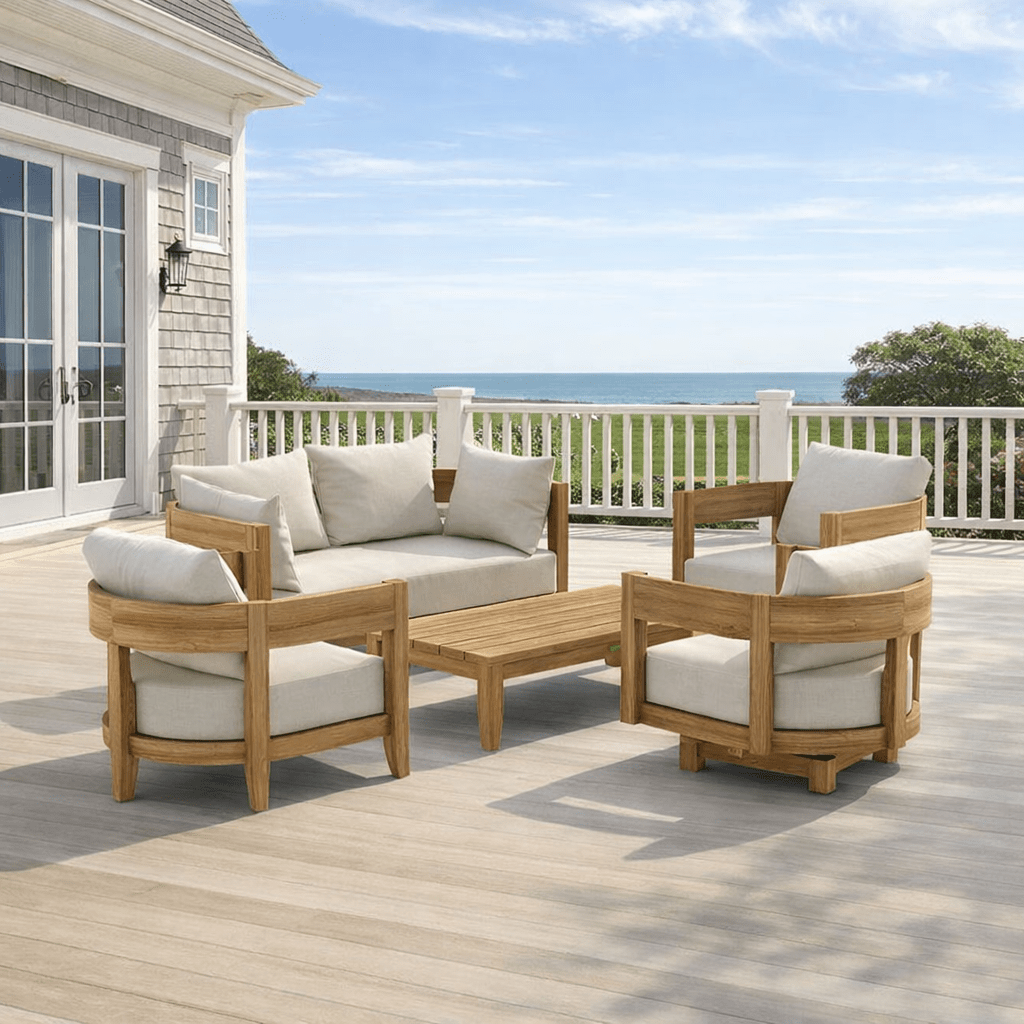 Premium Grade A teak naturally contains oils and has a dense grain structure. Those characteristics contribute to its resistance to moisture, rotting, insects, and warping without requiring an artificial stain for durability. That matters in Southern California because one piece of furniture may encounter dry heat, morning coastal moisture, irrigation overspray, poolside use, and winter rain during the same year.
Many shoppers assume outdoor wood must remain sealed beneath a protective painted or stained surface. Teak works differently. It can be left unfinished outdoors and will gradually weather from its original golden-brown appearance toward a silver-gray patina. That color change is normal weathering rather than an indication that the furniture has stopped functioning as outdoor furniture. Owners who prefer the original color can choose teak care products or sealing treatments for appearance.
Coastal decks, pool patios, outdoor showers, and homes with frequent irrigation put outdoor furniture into repeated contact with moisture. Teak's natural moisture and rot resistance is particularly useful in these spaces. This does not eliminate the need to keep cushions clean and allow wet textiles to dry, but it means the underlying Grade A teak was selected for outdoor use rather than merely adapted from an indoor wood product.
Repeated wet-dry and temperature cycles can be hard on lesser outdoor woods. Premium teak is valued in part for resistance to warping and for the structural stability associated with its dense grain. TeakHQ's positioning is therefore less about getting through one Southern California summer and more about choosing furniture intended to remain part of a finished outdoor space for decades rather than seasons.
This may be teak's most practical Southern California advantage. Homeowners can choose a maintained golden appearance or accept the natural silver-gray patina. Covers and sealers are optional rather than required for the wood's basic outdoor durability. That flexibility is useful for second homes, large properties, and frequently used patios where owners may prefer furniture that does not create another intensive finishing schedule.
| Southern California Challenge | Why Premium Grade A Teak Performs Well |
|---|---|
| Strong sun exposure | Designed for outdoor sun and can weather naturally without an artificial stain. |
| Coastal moisture | Natural oils and dense grain contribute to moisture and rot resistance. |
| Salt-laden coastal air | Teak is well suited to outdoor moisture; routine rinsing helps remove deposited salt from furniture, fabric, and hardware. |
| Winter rain | Grade A teak is designed for year-round outdoor use and rain exposure. |
| Hot, dry inland weather | Teak withstands sun exposure and temperature fluctuations without requiring paint for durability. |
| Poolside use | Moisture resistance makes teak a practical material around frequently wet outdoor areas. |
| Wet-dry cycles | Dense Grade A teak resists moisture, rot, and warping. |
| Long outdoor seasons | Teak's decades-long potential life makes sense for furniture used far beyond a short summer season. |
We would start with your patio's job, not with a furniture catalog. A Southern California property may have several outdoor zones—dining near the kitchen, a pool terrace, a shaded conversation area, and a small view-oriented space—and forcing one oversized matching set into every function usually produces a less useful backyard. The strongest plans give each area a purpose and connect them through material and proportion.
For homeowners who regularly host family dinners, weekend guests, or backyard gatherings, we would usually make teak outdoor dining furniture the anchor. Six seats may be right for daily family use, while eight- or ten-plus-person arrangements make more sense when the patio routinely replaces the indoor dining room. The memorable planning rule is simple: size for the gathering you actually host repeatedly, not the largest party you can imagine once a year.
Southern California has both large estate patios and compact coastal spaces where every square foot matters. On a terrace that serves four people most days but occasionally hosts eight, extendable teak dining tables can be more useful than permanently dedicating the patio to a table sized for the largest possible gathering. Expansion allows the open space itself to remain part of the design.
Where room permits, we would avoid making the dining table the only place people can sit. A separate group of teak patio seating creates a natural transition from dinner into coffee, drinks, conversation, or watching a game outdoors. On larger properties, the lounge zone often works best slightly away from the cooking traffic and closer to a view, pool, fire feature, or garden.
Poolside seating should be planned differently from conversation seating. If people genuinely swim and sunbathe, dedicated teak chaise loungers generally work better along the water than trying to make sofas perform every function. Leave enough circulation room that guests do not have to weave between furniture and the pool edge.
One of the easiest mistakes in Southern California is filling every available patio area with seating before deciding where people will actually be comfortable during the brightest part of the afternoon. Map the sun first. A slightly smaller, well-shaded seating arrangement often gets more use than a larger group placed in an exposed location simply because that location had the most empty square footage.
Start with the part of your outdoor space that receives the most real use. Frequent hosts will usually get the greatest value from dining or expandable dining furniture; pool-focused properties should prioritize loungers; and homes built around relaxed evenings may begin with deep seating or a sectional. Larger properties often benefit from combining two or three distinct collections rather than trying to make one furniture group serve the entire backyard.
The region's long outdoor season changes furniture from an occasional accessory into something closer to another room of the house. Patios may handle breakfast, work-from-home breaks, pool afternoons, dinner, and evening conversation on the same day. That amount of use favors layouts that are comfortable enough for everyday life and flexible enough for guests rather than spaces designed mainly to look finished from inside the house.
Many Southern California homes are organized around easy movement between interior rooms and outdoor patios, courtyards, decks, or pools. Furniture works best when that circulation is preserved. Rather than lining every edge with seating, identify the doors and paths people naturally use and keep those routes generous. Outdoor furniture should define rooms without turning the patio into an obstacle course.
In climates with short outdoor seasons, a four-seat patio table may be enough. Here, outdoor dinner can be a normal part of family life rather than an occasional event. Households that entertain should think beyond the number of people who live in the home and consider how often friends, children, grandchildren, or weekend guests join them. That can make a six-, eight-, or expandable table a more practical long-term choice.
A resort-style backyard rarely works best as one large furniture group. Loungers support swimming and sun; deep seating supports conversation; dining belongs near food preparation; side tables support drinks and personal items. Separating those functions creates a backyard that feels larger because several activities can happen at once without competing for the same seats.
Sunny afternoons may get the attention in photographs, but Southern California patios are often especially appealing in the evening. Comfortable deep seating, coffee tables, side tables, and appropriately placed fire features can extend a dinner into a longer gathering. This is a good example of why furniture selection should be based on how the household uses the space after 6 p.m., not just how the pool looks at noon.
For coastal second homes and vacation properties, a useful furnishing strategy is to reduce the number of materials and maintenance routines. Grade A teak can be left outdoors and allowed to weather naturally, avoiding the need to preserve a stained appearance for durability. Cushions and accessories still deserve sensible care, but the wood itself does not require a complicated seasonal refinishing program.
The right category depends more on the space than the ZIP code. A Malibu deck, Pasadena courtyard, Rancho Santa Fe pool terrace, and San Diego backyard may all suit teak, yet they call for different furniture configurations. Think in outdoor rooms first and individual products second.
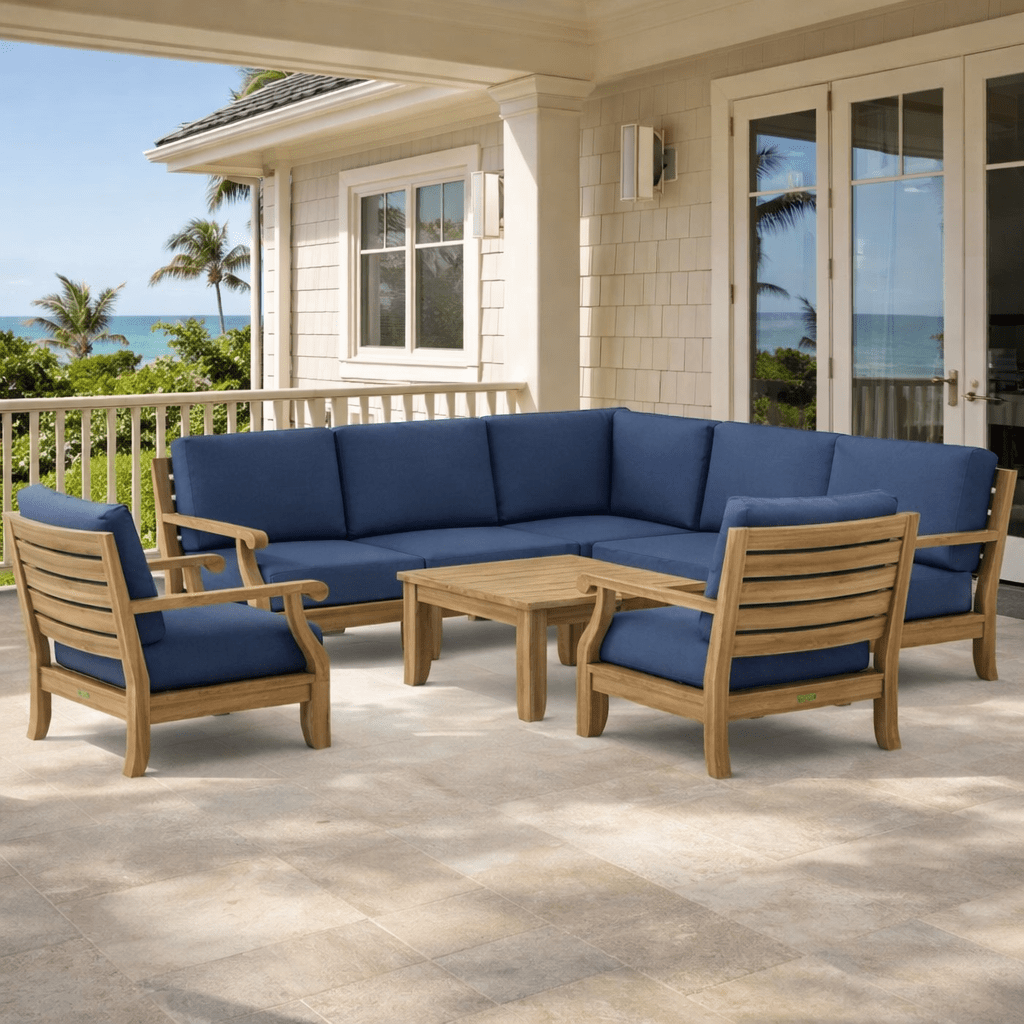 For a primary covered patio or large conversation area, sofas, club chairs, and teak sectional sets create the closest outdoor equivalent to an indoor living room. Sectionals are especially useful where a defined corner or broad patio can support their footprint. On narrower decks, separate chairs and a loveseat can preserve sight lines and circulation more effectively.
Outdoor dining works best when serving is easy. Place the main dining table reasonably close to the kitchen, grill, or outdoor cooking zone rather than automatically choosing the farthest scenic corner. The view can be enjoyed from lounge seating; meals become noticeably less convenient when every plate and serving piece must travel across the entire yard.
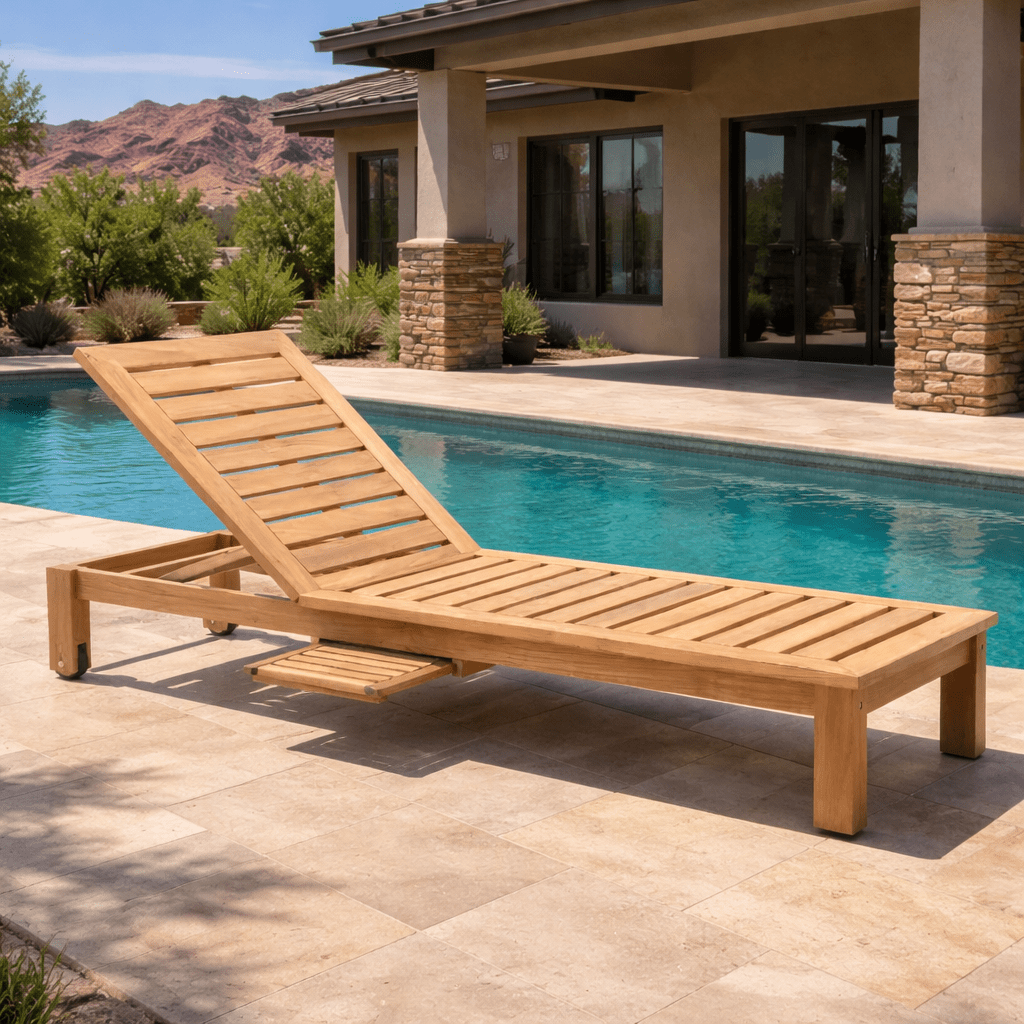 For pools in Orange County, San Diego, Los Angeles, and inland estate communities, chaise loungers make sense when there is enough uninterrupted deck area to use them properly. Pair them with small side tables rather than relying on one central coffee table. That gives each person somewhere to place a drink, book, or phone without pulling furniture into circulation paths.
Where local rules, placement, and conditions make a fire feature appropriate, a teak fire pit table can turn an ordinary lounge area into a distinct evening destination. We would treat it as a furniture and circulation decision first: leave comfortable spacing around the table and avoid crowding it into the same zone used for active cooking or pool traffic.
Shade should be planned with the same seriousness as seating. An exposed pool deck or south- and west-facing patio may benefit from a teak umbrella or another appropriate shade solution. Because Southern California can experience strong wind events, umbrellas should always be managed according to actual conditions rather than left open automatically whenever the furniture remains outside.
Southern California outdoor spaces span Spanish Revival courtyards, midcentury homes, contemporary coastal architecture, Mediterranean-influenced estates, Craftsman properties, and modern resort-style backyards. Teak works across those settings because natural wood can play different visual roles: warm contrast against concrete and glass, a quiet companion to stucco and tile, or an organic material among drought-conscious and Mediterranean-style landscaping.
In courtyards with stucco walls, terracotta, stone, tile, and established planting, teak usually looks most convincing when the furniture is allowed to remain visually simple. The wood already contributes warmth and texture. Overdecorating the furniture can compete with architectural details that should remain the focus.
Modern Southern California architecture often combines broad glazing, horizontal forms, concrete, stone, and strong indoor-outdoor relationships. Teak introduces natural warmth without requiring a traditional furniture silhouette. Cleaner-lined lounge seating, sectionals, rectangular dining tables, and restrained cushion colors can complement this architecture without making the patio feel overly rustic.
On a view deck, the most valuable design feature may be the horizon itself. Lower-profile seating and carefully positioned loungers can preserve that visual connection better than filling the perimeter with tall-backed pieces. The goal is not to maximize seat count; it is to maximize useful seats without sacrificing the reason the terrace exists.
Compact spaces benefit from proportion more than abundance. A round or smaller dining table, two comfortable lounge chairs, or a loveseat-and-chair grouping may create a better outdoor room than a large sectional squeezed wall-to-wall. In these settings, the luxury is often empty circulation space.
For larger properties, repeating teak across several zones can visually connect the backyard without making each zone identical. A dining set near the outdoor kitchen, loungers around the pool, and deep seating near a fire or view area can share the same natural material while serving completely different purposes.
 The region is too varied for one climate assumption. Coastal exposure, inland heat, patio orientation, shade, elevation, irrigation, and pool proximity all matter. A homeowner five minutes from the coast may prioritize routine salt removal, while an inland homeowner may care much more about sun exposure and shade. Grade A teak works across a broad range of outdoor conditions, but the rest of the furniture plan should still respond to the specific site.
A beautiful lounge area that becomes uncomfortable every afternoon will not earn much use. Before deciding where the largest furniture grouping goes, observe the patio through the hours when you actually expect to use it. Shade structures and umbrellas can often make a smaller area far more valuable than a larger exposed area.
Buying a four-seat table because four people live in the home can be a mistake when eight people routinely gather there. The opposite mistake also occurs: permanently consuming a modest patio with a huge table for rare parties. Extendable furniture can solve the second problem, while larger fixed dining sets make sense when bigger gatherings are normal rather than exceptional.
Teak and outdoor cushions have different care requirements. Premium Grade A teak may remain outdoors year-round, but fabric still benefits from being kept clean and allowed to dry properly. Most TeakHQ lounge seating with included cushions uses weather-, fade-, UV-, and water-resistant Sunbrella fabric, but water resistance does not mean wet cushions should be ignored indefinitely.
Near the ocean, salt and grime can accumulate even on premium outdoor furniture. Buying a durable material is not a reason to skip basic cleaning. Periodic rinsing and gentle cleaning help keep teak, fabric, and hardware looking cared for without turning ownership into a refinishing project.
This may be the most expensive layout mistake. Southern California homes often gain value from visual openness between the interior, patio, landscape, pool, and view. Furniture should create destinations while preserving circulation. Leave enough negative space that the architecture and landscape still have room to breathe.
Teak care here should be driven by exposure rather than by an arbitrary calendar. A sheltered Pasadena courtyard and an ocean-facing deck in Laguna Beach will not accumulate the same residue, even if both contain identical furniture. Start with simple cleaning, add appearance treatments only when you want them, and spend more maintenance effort on the conditions your particular patio actually creates.
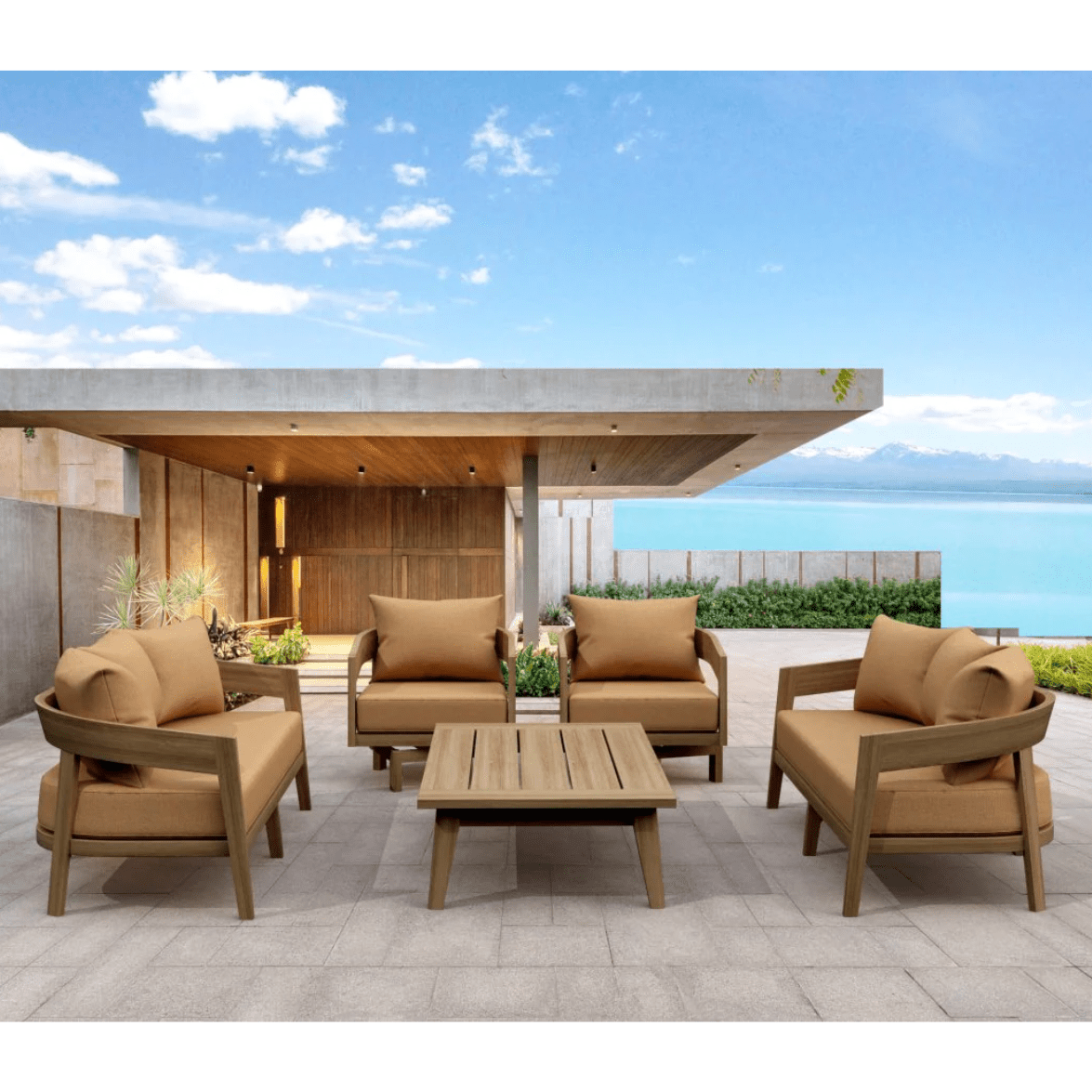 Remove normal dirt, pollen, leaves, dust, and other surface debris as needed. Homes near busy roads, beaches, landscaping, or areas affected by windblown debris may need cleaning more often than protected patios. There is little benefit in creating an unnecessarily aggressive maintenance schedule when routine cleaning is sufficient.
For homes close enough to the ocean to receive salt residue, periodically rinse exposed furniture and follow appropriate cleaning practices for cushions and hardware. Teak's natural moisture resistance makes it well suited to coastal outdoor use, but removing accumulated deposits is still sensible care.
After winter rain, pool splash, or cleaning, avoid creating unnecessary prolonged dampness around cushions and tightly covered furniture. Teak itself resists moisture and rot, but textiles and trapped surface debris have their own maintenance needs. Allowing airflow around furniture is particularly useful in shaded or marine-influenced spaces.
Untreated teak naturally changes toward silver-gray as it weathers. That is an aesthetic choice rather than a requirement to “restore” the furniture. If you like the patina, routine cleaning may be all the wood care you want. If preserving more of the original teak color matters to you, appropriate teak care products can become part of your appearance-maintenance plan.
TeakHQ's Grade A teak does not require a protective cover for basic outdoor durability. A cover can nevertheless be useful when the goal is reducing dust, leaves, pollen, or cleaning frequency. If covers are used, manage them sensibly and avoid trapping unnecessary moisture beneath dirty or wet surfaces.
For most low-elevation Southern California properties, the furniture plan does not need to revolve around moving teak indoors for a long winter season. Grade A teak is designed for year-round outdoor use. Owners may still store or protect cushions and accessories according to weather and usage, but the wood furniture itself can remain part of the outdoor room through seasonal changes.
The strongest Southern California patio is not the one with the most furniture. It is the one that makes everyday outdoor life easy—comfortable dining where serving makes sense, lounge seating where people naturally gather, shade where the sun demands it, and pool furniture where it will actually be used. Premium Grade A teak is especially compelling when you want those spaces furnished with a natural material designed for years of outdoor exposure while giving you the choice to maintain its original color or simply let it weather naturally.
There is no single best material for every property. Premium teak, quality aluminum, and some synthetic materials can all be legitimate choices. Grade A teak is particularly attractive for homeowners who want real wood, natural weather resistance, substantial construction, long life, and the option to leave the furniture outdoors without maintaining a painted finish.
Choose furniture specifically intended for outdoor moisture and long-term exposure, then plan to clean salt residue periodically. Grade A teak is a strong coastal option because its natural oils and dense grain contribute to resistance to moisture, rot, and warping. Fabrics and hardware still deserve routine cleaning in salt-laden environments.
Yes. TeakHQ's Grade A teak furniture is designed for year-round outdoor use and to withstand rain, sun exposure, and temperature fluctuations. Protective covers are optional rather than required for the wood's basic durability.
Teak is designed for outdoor sun exposure. Untreated teak will naturally change in appearance and eventually develop a silver-gray patina, but that weathering is expected. If preserving a warmer teak color is important, owners can use appropriate sealing or care products.
Yes. Untreated teak naturally develops a silver-gray patina with outdoor weathering, whether it is used near the coast or farther inland. The gray appearance can be embraced as the finished look or managed with appropriate teak care products if you prefer more of the original color.
Grade A teak itself does not require a cover for outdoor durability, so covering is optional. Covers can reduce debris and cleaning, but cushions and other materials may have different care needs. If you use covers, avoid trapping unnecessary moisture beneath them.
Start with the way the pool is actually used. Chaise loungers are practical for swimming and sunbathing, while a separate deep-seating area is better for conversation. Side tables beside individual loungers and adequate clear circulation around the pool usually make the space more functional.
Neither material is automatically better. Aluminum is lighter and can create a more explicitly modern look. Teak is natural wood, feels warmer and more substantial, and offers the appearance and weathering characteristics many homeowners prefer. The better choice depends on your design goals and how much you value a natural material.
Choose for your recurring gathering size rather than household size alone. If four people live in the home but six to eight regularly eat outdoors, size for that pattern. An extendable teak dining table is particularly useful when everyday and entertaining needs differ significantly.
There is no universal schedule because exposure varies by distance from the water, wind, shelter, and patio orientation. Inspect the furniture periodically and clean or rinse it when salt, grime, pollen, or other deposits become noticeable. A highly exposed oceanfront deck will generally need attention more often than a protected inland courtyard.


