
FREE SHIPPING
within mainland USA
within mainland USA
Home ▸ Teak Outdoor Furniture ▸ By Location ▸ Tampa Bay, Florida
Tampa Bay outdoor spaces contend with a demanding combination of humidity, frequent rain, strong sun, coastal exposure, and tropical storm season—all while serving as extensions of the home for much of the year. From waterfront patios and screened lanais to pool decks and outdoor kitchens, furniture here needs to be chosen for frequent use as well as the environment. Premium Grade A teak is a particularly strong option because it combines natural weather resistance with the substantial, architectural look that suits both coastal and upscale residential settings.

Outdoor furniture in Tampa Bay faces a combination that deserves more attention than simply choosing something labeled “outdoor.” Heat, humidity, intense sun, frequent warm-season rain, coastal exposure, and storm season can all affect how furniture looks, feels, and ages. The practical question is not whether furniture can sit outside; it is whether you will still be comfortable owning it after years of exposure.
Humidity is one of the defining considerations for Tampa Bay patio furniture. Furniture may repeatedly become damp from rain, condensation, pool use, or humid air and then dry again. That makes moisture performance more important here than it would be in a dry inland climate.
For wood furniture, species matters enormously. Premium Grade A teak contains natural oils and has a dense grain structure that makes it resistant to moisture, rot, insects, and warping. Other premium materials can also work well, but homeowners choosing natural wood should distinguish genuine Grade A teak from woods selected primarily for appearance or initial price.
Tampa Bay furniture often experiences strong sunshine and rain within the same season—and sometimes within a very short span. Materials therefore need to tolerate both sun exposure and repeated wetting rather than performing well under only one condition.
Think beyond the frame, too. Cushions, covers, drainage, and placement all influence the ownership experience. TeakHQ's cushioned lounge furniture commonly uses weather-resistant, fade-resistant, UV-resistant and water-resistant Sunbrella fabric, but even outdoor fabric benefits from being allowed to dry rather than remaining continuously wet.
A waterfront home in Apollo Beach, Clearwater Beach, or coastal Pinellas County presents a different furniture environment than a more protected property farther inland. The closer furniture sits to saltwater and salt-laden air, the more important routine cleaning becomes.
This is one reason “Tampa Bay weather” should not be treated as a single uniform condition. A covered lanai in Brandon and an exposed bayfront terrace may share the same regional climate, yet their furniture can experience very different levels of salt, wind, rain, and direct sunlight.
Premium outdoor furniture should not be selected on the assumption that any piece can simply remain wherever it sits during severe weather. Tampa Bay homeowners should have a storm plan for furniture, cushions, umbrellas, and accessories. Teak's heavier, sturdier feel can be appealing for everyday use, but it does not eliminate the need to secure or relocate outdoor items when dangerous winds are expected.
Grade A teak is especially compelling in Tampa Bay because its useful properties line up unusually well with the region's biggest ownership challenges. Its value is not that it requires zero attention; it is that the wood itself is naturally suited to long-term outdoor exposure without depending on paint or an artificial stain for durability.
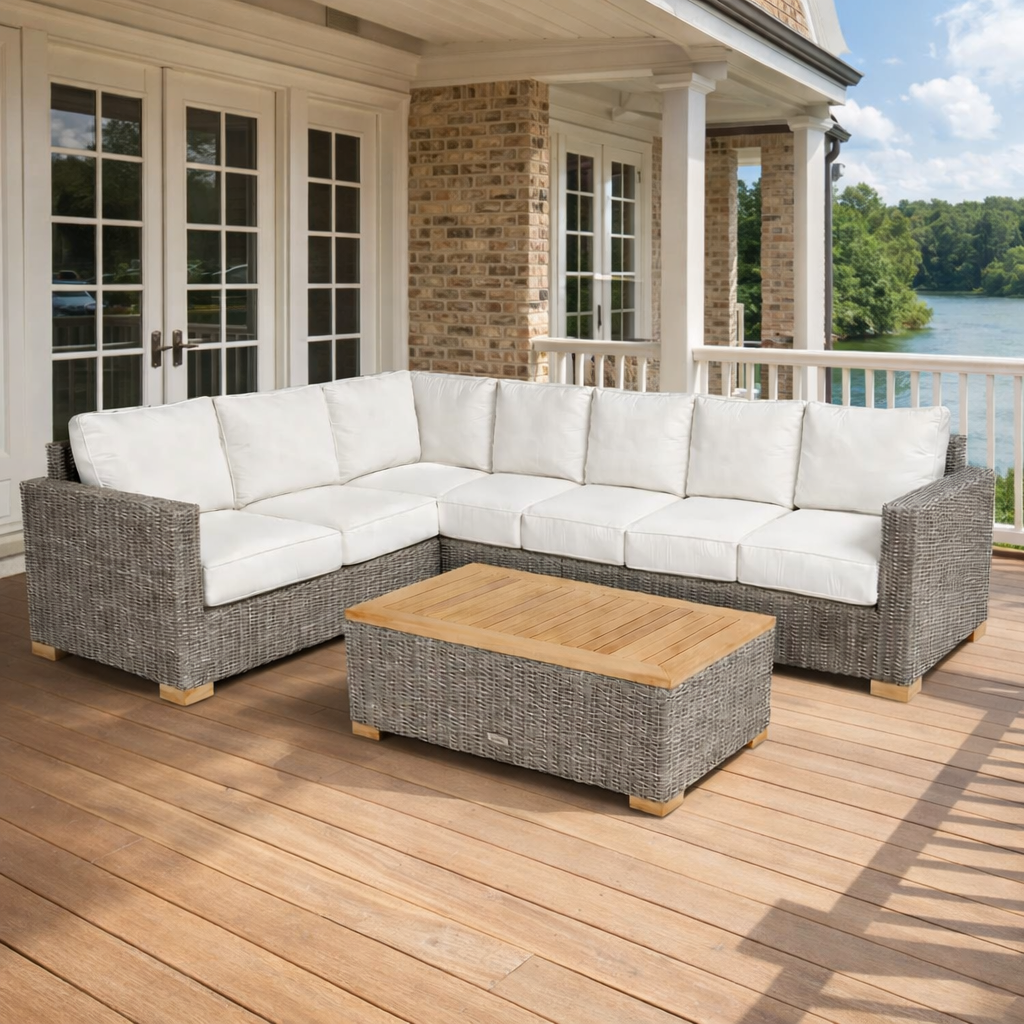 Premium Grade A teak is naturally high in oils and has a dense grain structure. Those characteristics contribute to its resistance to moisture, rotting, insects, and warping—important qualities where furniture may encounter rain, humidity, wet bathing suits, and poolside use throughout much of the year.
This does not mean a teak patio should be ignored indefinitely. Organic debris and surface grime still need cleaning, particularly in shaded or damp locations. The advantage is that routine cleaning and cosmetic maintenance are different from relying on coatings to make the underlying wood suitable for outdoor use.
One of the most useful things Tampa Bay buyers can understand before purchasing teak is that weathering is expected. Natural teak exposed outdoors gradually develops a silver-gray patina unless its original color is maintained with optional care products.
That gives homeowners two legitimate approaches. You can embrace the weathered appearance—often an excellent match for Gulf Coast and coastal architecture—or maintain more of the original golden teak color. Neither approach requires painting the furniture to make the wood durable.
Outdoor wood in Florida repeatedly encounters changing moisture conditions. Grade A teak's dense structure and resistance to warping make it well suited to those cycles. This is particularly valuable for dining tables, chairs, sectionals, and other substantial pieces expected to remain outdoors year after year.
For buyers considering an $8,000–$20,000 outdoor space, this is where lifetime thinking becomes useful. Teak carries a higher initial cost than many alternatives, but quality teak furniture can last for decades. Instead of evaluating furniture only by today's purchase price, evaluate how often you realistically want to replace an entire patio.
Teak can be left untreated and allowed to weather naturally. Owners who prefer its original appearance can use appropriate teak care products to help maintain that color. Protective covers are optional rather than required for the wood's basic outdoor suitability.
That flexibility is particularly useful in Tampa Bay because homeowners use outdoor spaces differently. A meticulously maintained covered lanai may justify a more involved appearance-care routine, while a waterfront or rental property may benefit from allowing teak to weather naturally and concentrating maintenance on cleaning.
| Tampa Bay Challenge | Why Premium Grade A Teak Performs Well |
|---|---|
| High humidity | Natural oils and dense grain support moisture resistance. |
| Frequent rain | Teak is designed for outdoor exposure and resists rot. |
| Strong sun | It can remain outdoors and naturally weather to a silver-gray patina. |
| Wet-dry cycles | Grade A teak is resistant to warping and temperature fluctuations. |
| Coastal exposure | Natural weather resistance makes teak practical for coastal settings; routine salt cleaning remains wise. |
| Poolside moisture | Teak's moisture resistance suits frequently wet outdoor environments. |
| Long outdoor season | Quality teak is designed for year-round outdoor use and can last decades. |
We would begin with how the space is actually used, not with a furniture catalog. Tampa Bay homes often have multiple outdoor zones—a covered lanai, pool deck, grilling area, open patio, dock or waterfront edge—and each should have a clear job. The most successful layouts make those zones work together without filling every available square foot with furniture.
For many Tampa Bay properties, we would make the lanai or covered patio the dependable everyday living area. Start with either teak outdoor dining sets or a comfortable lounge arrangement depending on whether meals or relaxation dominate your outdoor routine.
Do not automatically put the largest furniture under cover. Instead, protect the zone you use most often. A family that eats outside four nights a week may benefit more from covered dining than covered chaise lounges; a couple that primarily entertains around a television and outdoor kitchen may make deep seating the priority.
A common planning mistake is treating the entire pool deck as one large patio. We prefer distinct zones. Keep teak chaise loungers in the best sun or pool-watching position, then place conversation seating farther from splash traffic.
Leave generous pathways between doors, the outdoor kitchen, pool steps, and seating. The memorable Tampa Bay planning rule is simple: furnish the dry path first. Watch where people naturally walk from the house to the pool, grill, and dock before deciding where furniture belongs. A beautiful sectional that interrupts wet-foot traffic will annoy you far more often than its appearance will impress you.
Waterfront properties deserve a slightly different approach. Resist the instinct to line every chair directly toward the water. A better arrangement often angles lounge seating so guests can see both one another and the view.
For larger patios, teak sectional sets can establish a substantial conversation zone, while swivel chairs are useful where people naturally alternate between the pool, television, sunset, or conversation.
Choose dining capacity based on the gathering you host repeatedly—not the largest party you can imagine. Six to eight seats may serve many households better every day, while an extendable teak dining table can provide extra capacity when family, neighbors, or seasonal guests arrive.
Large waterfront and estate properties may justify permanent seating for ten or more, especially when outdoor dining is a central part of entertaining. Smaller patios and condos benefit from keeping circulation space instead of maximizing chair count.
Start with the activity that defines your outdoor space. Pool-centered properties should usually prioritize loungers and lounge seating; frequent hosts may begin with dining or an expandable table; waterfront patios and large lanais often benefit from a sectional or multi-piece conversation set. Once that primary zone is established, add supporting pieces rather than trying to furnish the entire property at once.
Tampa Bay's outdoor spaces frequently operate as real living areas rather than occasional-use patios. Covered lanais, pools, outdoor kitchens, docks, screened enclosures, and shaded seating areas allow homeowners to move between cooking, dining, swimming, watching sports, and relaxing without treating each activity as a separate event.
The classic Tampa Bay backyard often works best as a sequence: kitchen or grill, shaded dining, conversation seating, then poolside lounging. Furniture should reinforce that movement instead of creating one oversized seating cluster.
This is also why matching every piece is less important than coordinating zones. A teak dining set can anchor the covered patio while chaise lounges serve the pool and a separate sofa-and-chair arrangement handles evening conversation.
Bayfront, canal-front, and Gulf-adjacent homes add another dimension: people gather around the view. Furniture placement should account for sunsets, docks, boating access, breezes, and the transition from water activities back to the house.
Side tables become disproportionately useful in these spaces. Guests arriving from the pool or dock need convenient places for drinks, towels, phones, and sunglasses without walking back to the main dining area.
Tampa Bay's hottest, wettest periods can make shade and rain protection especially valuable, while the milder part of the year often becomes prime outdoor entertaining season. That reverses the rhythm familiar to homeowners in northern climates: winter does not necessarily mean packing away the patio.
When planning capacity, consider seasonal visitors as well as the immediate household. Flexible chairs, extendable tables, and separate lounge zones can accommodate guests without making the patio feel oversized during everyday use.
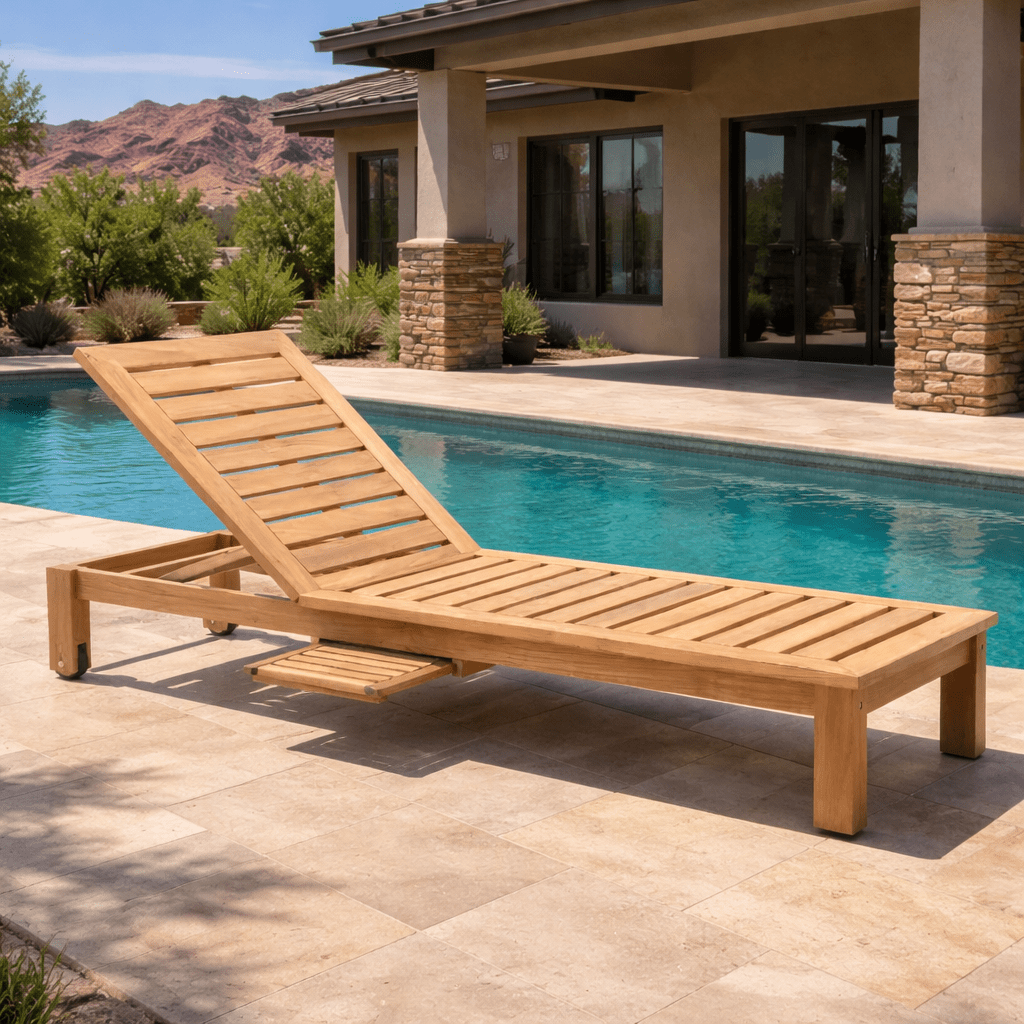 The right furniture mix depends less on ZIP code than on where your home sits within Tampa Bay and how the property is organized. A pool-centered suburban backyard, a St. Petersburg waterfront home, and a condo terrace may share the same humid climate while requiring very different furniture plans.
For a covered lanai, start with the furniture used most frequently. Multi-piece teak lounge sets make sense when the area functions as an outdoor living room, while dining furniture is the better anchor when the patio connects directly to the kitchen and meals are the priority.
Coffee tables and side tables complete lounge zones without consuming excessive floor space. On narrower lanais, individual club or swivel chairs may preserve better circulation than a large sectional.
Chaise lounges are the obvious starting point, but placement matters. Allow room to adjust and walk around them without encroaching on pool circulation. A small side table between loungers can be more useful than squeezing in another chair.
If the pool deck is large, create a second shaded conversation area rather than simply multiplying loungers. That makes the space work for guests who want to socialize without sitting in direct sun.
Tampa Bay outdoor kitchens often become gathering points before food ever reaches the table. Dining furniture should therefore be close enough for easy serving but far enough away that chairs do not obstruct cooking traffic.
For households that entertain, six- to eight-person sets are versatile starting points. Larger families and frequent hosts can move into 10+ seating, while bar or counter-height furniture can complement an outdoor kitchen without replacing a proper dining area.
Waterfront furniture benefits from substantial construction and uncomplicated materials. Teak's natural wood appearance also pairs naturally with docks, stone, pavers, tropical landscaping, and coastal architecture.
Consider swivel seating where the view competes with conversation. A chair that turns toward the bay, pool, television, or other guests can solve a surprisingly common waterfront layout problem without requiring a larger furniture footprint.
Tampa Bay does not have a single architectural vocabulary. Traditional Florida homes, Mediterranean influences, contemporary waterfront construction, bungalows, coastal renovations, condos, and newer suburban properties all appear across the region. Teak works particularly well in this varied environment because natural wood can provide warmth without forcing the patio toward either a strongly traditional or aggressively modern look.
Natural teak is an intuitive fit with Gulf Coast design because it introduces warmth alongside stone, stucco, glass, pavers, white finishes, and tropical planting. Letting teak weather toward silver-gray can create a particularly relaxed coastal appearance.
For contemporary waterfront architecture, cleaner furniture profiles can prevent natural wood from reading as overly traditional. The contrast between teak and modern hard surfaces often works better than trying to match every exterior material exactly.
Screened lanais often have more visual structure than an open patio, so furniture scale deserves attention. Large sectionals work well in generous rooms, but smaller sofas, club chairs, and swivel chairs can make compact screened areas feel more open and adaptable.
Use the architecture as your guide: align major tables and sofas with the dominant lines of the house, pool, or enclosure rather than placing furniture at arbitrary angles.
Teak's natural grain provides useful contrast against palms, dense green planting, water, pale pool decking, and stone. In lush landscapes, simpler furniture arrangements often work best because the surroundings already provide substantial visual texture.
The goal is not to create a themed “tropical” patio. A restrained combination of natural teak, appropriate outdoor textiles, greenery, and a few coordinated materials generally ages better than a heavily themed design.
 Shoppers often focus on Florida sunshine while underestimating humidity and repeated rain. A material can look excellent in direct sun yet become frustrating if prolonged moisture creates constant maintenance concerns. Grade A teak addresses the underlying wood question through natural moisture and rot resistance, although normal surface cleaning remains important.
Oversized furniture can turn an impressive pool deck into an obstacle course. Before buying, map the routes between the house, grill, pool steps, bathroom, and dock. Furniture should define gathering zones without occupying those routes.
A protected inland lanai does not experience the same exposure as furniture beside open water. Waterfront owners should plan for more frequent removal of salt and surface deposits rather than assuming that a weather-resistant material eliminates cleaning altogether.
Water-resistant outdoor fabric is not the same thing as never needing to think about cushions. Heavy rain and storm periods make quick storage valuable. If your seating uses cushions, decide where those cushions will go before purchasing a large lounge collection.
Buying a massive dining table because you occasionally host twelve people can leave the patio cramped the other 350 days of the year. An extendable table or secondary flexible seating often provides a better balance between everyday comfort and occasional entertaining.
Furniture selection should include a severe-weather plan. Know which cushions and accessories can move inside, where umbrellas will go, and how larger pieces will be handled when a tropical storm or hurricane threatens. Teak's substantial construction is useful in normal conditions, but no outdoor furniture should be treated as hurricane-proof.
 Tampa Bay teak care is less about protecting the wood from ordinary outdoor existence and more about managing what accumulates on it. Humidity, pollen, organic debris, pool use, salt exposure, and frequent rain make periodic cleaning more valuable than an elaborate seasonal refinishing ritual.
There is no useful universal cleaning calendar for every Tampa Bay property. An uncovered waterfront table beneath trees may need attention much more frequently than furniture inside a screened lanai. Clean when dirt, salt, pollen, or organic material begins accumulating rather than waiting for an arbitrary annual date.
Pay particular attention to shaded areas and places where leaves or debris remain against the wood. Keeping surfaces reasonably clean and allowing wet furniture to dry helps reduce conditions that encourage surface mold and mildew.
For waterfront furniture, periodically remove salt deposits rather than allowing them to accumulate. Poolside pieces likewise benefit from routine cleaning when they receive frequent splashes, sunscreen residue, food, or other contaminants.
This is an important distinction: teak's moisture resistance reduces concern about the wood itself, but it does not make dirt, salt, or residue desirable.
Untreated teak naturally develops a silver-gray patina. If you like that appearance, you can allow the furniture to weather naturally. If maintaining the warmer original teak color matters to you, appropriate teak care products can become part of your appearance-maintenance routine.
Make that decision before chasing every early color change. Weathering is not automatically evidence that the furniture is failing.
Teak does not require a cover simply to be outdoor furniture. Covers can nevertheless reduce cleaning and help keep furniture ready for use, especially beneath trees or during periods when a property is vacant.
In Tampa Bay's humid environment, avoid turning a cover into a moisture trap. Furniture and cushions should have an opportunity to dry, and covers should be used according to their design rather than wrapped around damp furniture indefinitely.
Traditional cold-weather winterization is generally not the main Tampa Bay concern. Storm preparation is more relevant. Have a practical plan for cushions, umbrellas, accessories, and movable pieces before severe weather approaches.
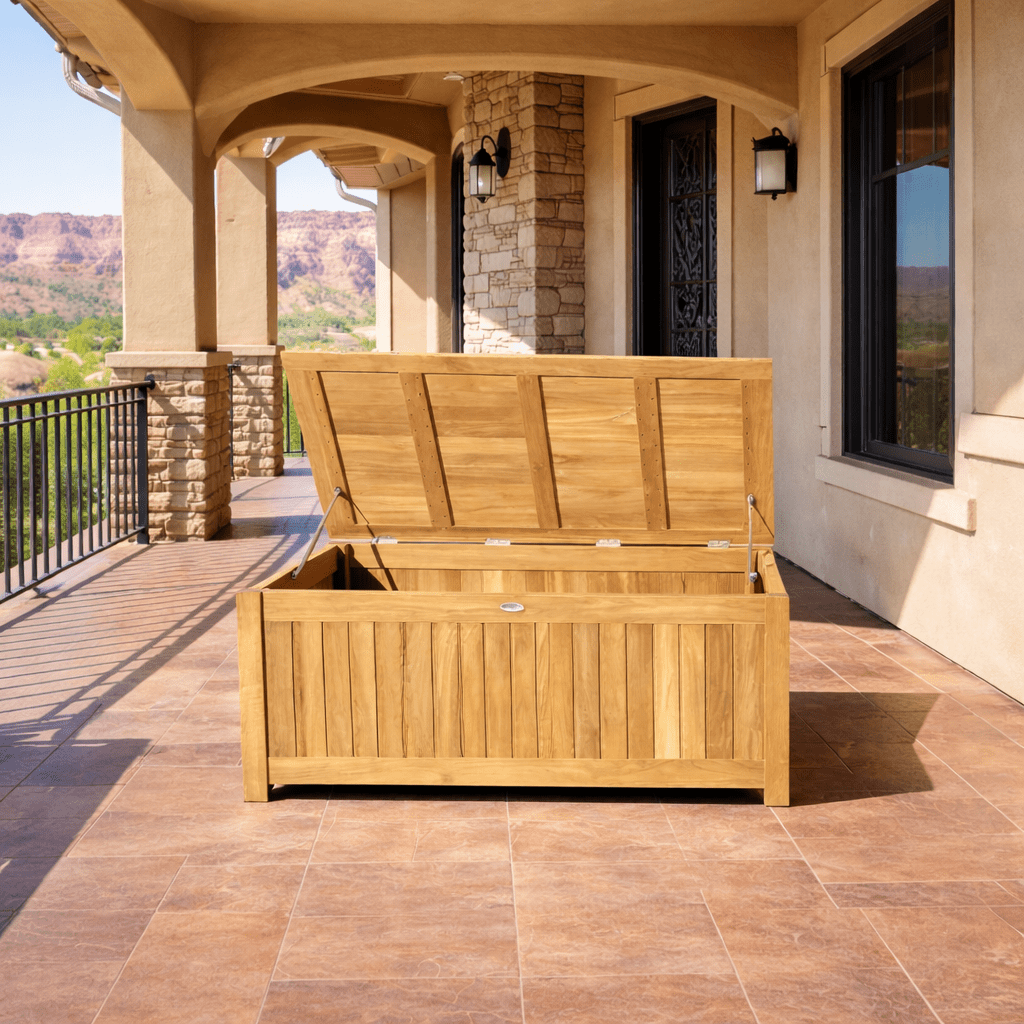
For second homes and seasonal residences, a teak deck box or other appropriate protected storage can simplify everyday organization, although storm-specific storage decisions should always prioritize safety and local guidance.
The best Tampa Bay patio is not simply filled with weather-resistant furniture. It is planned around shade, water, circulation, entertaining, storage, and the way people actually move between the home, lanai, pool, kitchen, and waterfront. Premium Grade A teak gives homeowners a durable natural material that can support that lifestyle for decades while fitting comfortably into coastal, contemporary, traditional, and resort-style settings.
Look for materials specifically suited to repeated moisture and outdoor exposure. Premium Grade A teak is a strong natural-wood option because its natural oils and dense grain make it resistant to moisture, rot, insects, and warping. Quality aluminum and synthetic materials can also be appropriate depending on the look and maintenance profile you prefer.
Yes. Grade A teak's natural weather and moisture resistance makes it well suited to waterfront outdoor spaces. Homes with significant salt exposure should still clean furniture periodically to remove salt and surface deposits.
Furniture designed for year-round outdoor exposure can remain outside during ordinary weather. Premium Grade A teak is designed for year-round outdoor use. Severe tropical weather is different: furniture, umbrellas, cushions, and accessories should be secured or relocated as appropriate when storms threaten.
Prioritize moisture-resistant materials, practical circulation, and furniture that matches how the pool is used. Chaise loungers work well for sun areas, while shaded lounge seating gives swimmers and guests a comfortable place to gather away from direct sun.
No. Grade A teak does not require sealing for basic outdoor durability. It can remain untreated and naturally develop a silver-gray patina. Owners who prefer the original warmer teak color can choose appropriate appearance-maintenance products.
Yes. Natural teak exposed outdoors gradually weathers to a silver-gray patina unless its original color is maintained. The color change is a normal part of teak weathering rather than, by itself, an indication that the wood has deteriorated.
Use outdoor fabrics intended for weather exposure and give wet cushions an opportunity to dry. For extended rain, severe storms, or periods when the furniture will not be used, convenient protected storage can reduce cleaning and keep cushions ready for use.
Neither material is automatically right for every homeowner. Teak offers real natural wood, a warmer appearance, and a heavier, more architectural feel. Aluminum is lighter and can create a more distinctly modern look. Buyers who value natural material and long-term wood furniture often prefer teak.
Clean according to exposure rather than following one fixed schedule. Waterfront furniture, uncovered patios, shaded areas, and furniture beneath trees may need more frequent cleaning because of salt, pollen, leaves, humidity, and other surface deposits.
Choose for your normal household and recurring gatherings rather than your largest occasional party. Six- to eight-person sets work well for many entertaining spaces, while extendable dining tables provide additional capacity without permanently consuming as much patio space.


