
FREE SHIPPING
within mainland USA
within mainland USA
Home ▸ Teak Outdoor Furniture ▸ By Location ▸ Texas Hill Country
Outdoor spaces in the Texas Hill Country are often designed around the land itself: limestone terraces, covered patios, swimming pools, outdoor kitchens, long-distance views, and shady areas beneath mature oaks. Furniture here also faces a demanding mix of strong sun, summer heat, dry stretches, sudden heavy rain, seasonal pollen, and occasional cold snaps. Those conditions reward materials chosen for long-term outdoor exposure rather than appearance alone. Premium Grade A teak is one of the strongest options for homeowners who want natural furniture that fits both the climate and the relaxed architectural character of the region.

The Texas Hill Country sits in an interesting outdoor-furniture environment. It is not as persistently humid as the Gulf Coast, nor as consistently dry as far West Texas. Instead, homeowners deal with strong summer sun and heat, periods of drought, thunderstorms that can deliver substantial rain quickly, changing humidity, wind, pollen and organic debris, and occasional winter freezes. That variability matters because outdoor furniture may spend weeks in hot, dry conditions and then suddenly be exposed to repeated moisture.
If we were evaluating furniture for an exposed patio near Fredericksburg, Kerrville, or Blanco, direct sun would be one of our first considerations. A patio facing west can experience much more demanding afternoon exposure than the same furniture beneath a deep porch roof. That makes material selection only half of the decision; placement and shade matter too.
Premium outdoor furniture should be selected with repeated sun exposure and temperature changes in mind. Grade A teak is designed for year-round outdoor use and can withstand sun exposure and temperature fluctuations. Its natural color will gradually weather toward a silver-gray patina if left untreated, which is normal rather than a sign that the wood is failing.
One of the more useful ways to think about Hill Country weather is not simply “hot and dry.” The region can move between dry stretches and substantial rainfall. On sloped properties, ranches, river lots, and limestone terraces, a storm can also put water where the patio rarely sees it during normal weather.
Furniture therefore needs to tolerate both outdoor dryness and recurring moisture. Drainage around the furniture is still important: even a weather-resistant material should not be placed where irrigation, roof runoff, or poor patio grading creates unnecessary standing water.
The local Ashe juniper population makes winter cedar pollen especially noticeable, followed by oak and other plant debris later in the year. For furniture owners, the practical issue is less about structural damage than cleaning frequency. Tables, chair arms, cushions, and horizontal surfaces may need more frequent wiping or rinsing during heavy pollen periods.
This is one reason we would separate the decision about the furniture frame from the decision about cushions and accessories. A durable outdoor frame can remain outside while loose cushions can be managed according to weather, pollen, and how often the space is being used.
A shaded courtyard in Boerne, a pool deck in Horseshoe Bay, and an open ranch patio outside Fredericksburg are all in the Hill Country, but they are not the same furniture environment. The pool deck gets more water and sun. The courtyard may stay shaded longer after rain. The ranch patio may have more wind, dust, and organic debris.
That is a memorable but important Hill Country buying rule: choose furniture for the microclimate of your patio, not merely the climate of your ZIP code. Orientation, roof depth, trees, irrigation, slope, and proximity to a pool can matter almost as much as the broader regional climate.
Several premium materials can work here. Quality aluminum is practical when low weight and a more contemporary appearance are priorities, while synthetic poly furniture can appeal to homeowners prioritizing a manufactured, low-maintenance material. Premium Grade A teak becomes especially compelling when the goal is a natural material with substantial weight, long outdoor service life, and an appearance that fits comfortably beside stone, wood, steel, native landscaping, and Hill Country architecture.
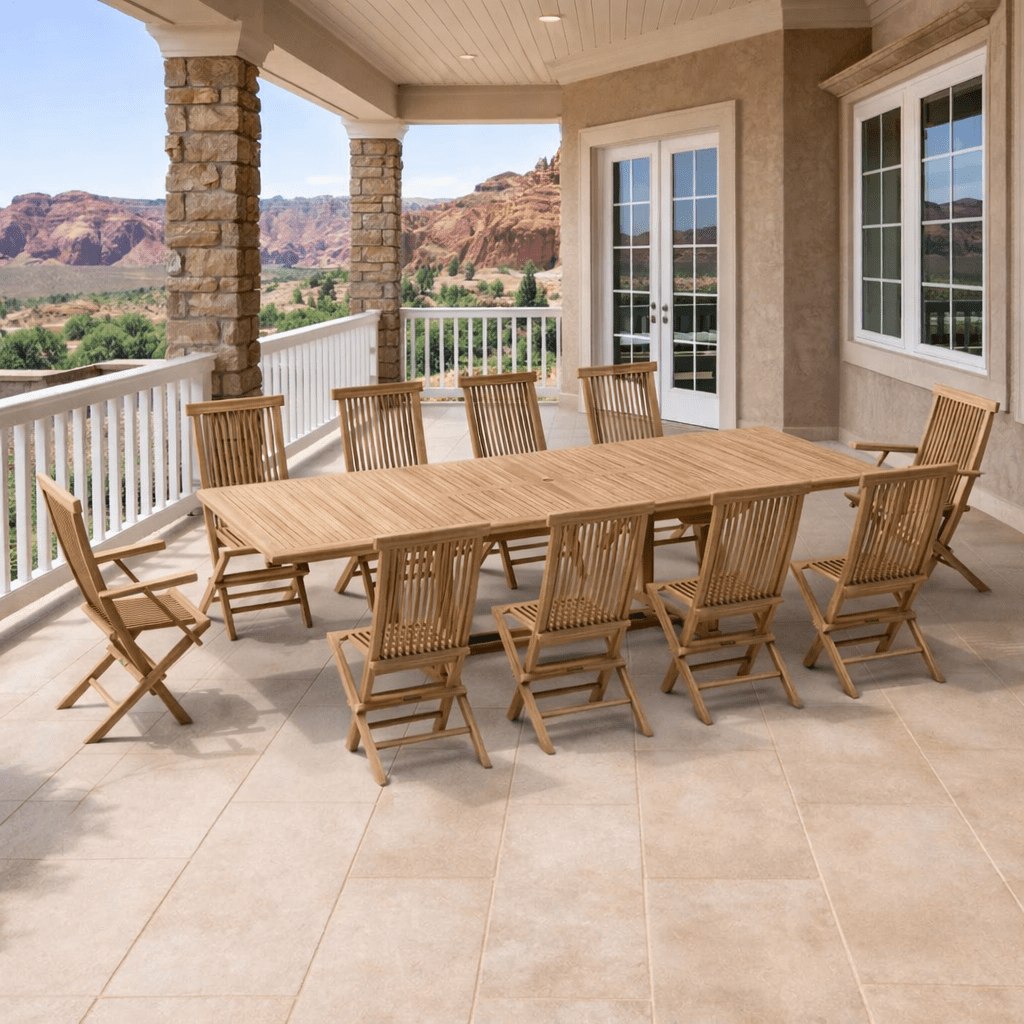 Grade A teak's naturally high oil content and dense grain structure are central to its outdoor performance. The wood is naturally resistant to moisture, rotting, insects, and warping, characteristics that become valuable when furniture repeatedly moves between hot dry weather and periods of rain.
This does not mean owners should ignore placement or cleaning. It means the material itself is well suited to an outdoor life without depending on paint or an artificial stain for durability.
Teak furniture sold by TeakHQ is designed for year-round outdoor use and can withstand rain, sun exposure, and temperature fluctuations. That makes it especially practical for substantial furniture pieces that homeowners do not want to move in and out of storage every time the forecast changes.
Protective covers can still be useful for reducing cleaning, keeping furniture ready for use, or shielding cushions and surfaces from pollen and debris, but teak does not require a cover simply to survive normal outdoor exposure.
Unfinished natural teak gradually develops a silver-gray patina outdoors. Some Hill Country homeowners prefer that softer appearance because it works especially well with native limestone, weathered steel, stone walls, and naturalistic landscaping. Others prefer teak's warmer original color.
Both approaches are legitimate. Teak can be allowed to age naturally, or owners can use appropriate teak care products when they want to preserve or restore more of the original appearance. The useful distinction is between cosmetic care and structural necessity: teak does not need artificial stain for durability.
Many Hill Country properties have large, visually open patios where very lightweight furniture can feel underscaled against broad views, substantial stonework, and large homes. Teak's heavier, sturdier feel can make it visually and physically appropriate for those spaces.
That does not make teak universally preferable to aluminum. If furniture must be moved frequently, a lighter material may be convenient. But for a permanent dining terrace or conversation area, substantial furniture often feels more integrated with the architecture.
| Texas Hill Country Challenge | Why Premium Grade A Teak Performs Well |
|---|---|
| Strong sun | Designed for outdoor sun exposure and can weather naturally to a silver-gray patina. |
| Summer heat | Natural teak is designed for year-round outdoor use and temperature fluctuations. |
| Sudden rainfall | Natural oils and dense grain contribute to moisture and rot resistance. |
| Wet-to-dry cycles | Grade A teak is naturally resistant to warping and outdoor weather exposure. |
| Occasional freezes | Designed to remain outdoors through changing temperatures. |
| Insects | Teak is naturally resistant to insects. |
| Pollen and debris | Frames can be cleaned as needed without requiring painted or stained finishes. |
We would begin with the way the property is actually used rather than immediately choosing a furniture style. Hill Country outdoor spaces frequently contain several distinct zones: dining near the kitchen, a covered lounge area, an exposed pool deck, and a secondary seating area positioned toward a view, fire feature, garden, or sunset.
For a larger Hill Country home, ranch property, or weekend house, we would usually make outdoor dining the anchor. Barbecues, family visits, holiday weekends, and casual dinners often involve enough people that a tiny four-seat table becomes the limiting factor in an otherwise generous patio.
A six- or eight-person table works well for many households, while frequent hosts should consider larger teak outdoor dining sets. If the patio needs to work equally well for an ordinary Tuesday dinner and a gathering of ten, an extendable teak dining table can be more useful than permanently dedicating space to the largest possible table.
After dining, we would establish a separate sitting area rather than surrounding the entire patio with disconnected chairs. A sofa or sectional facing a fireplace, pool, sunset view, or one another creates an outdoor room instead of merely adding seats.
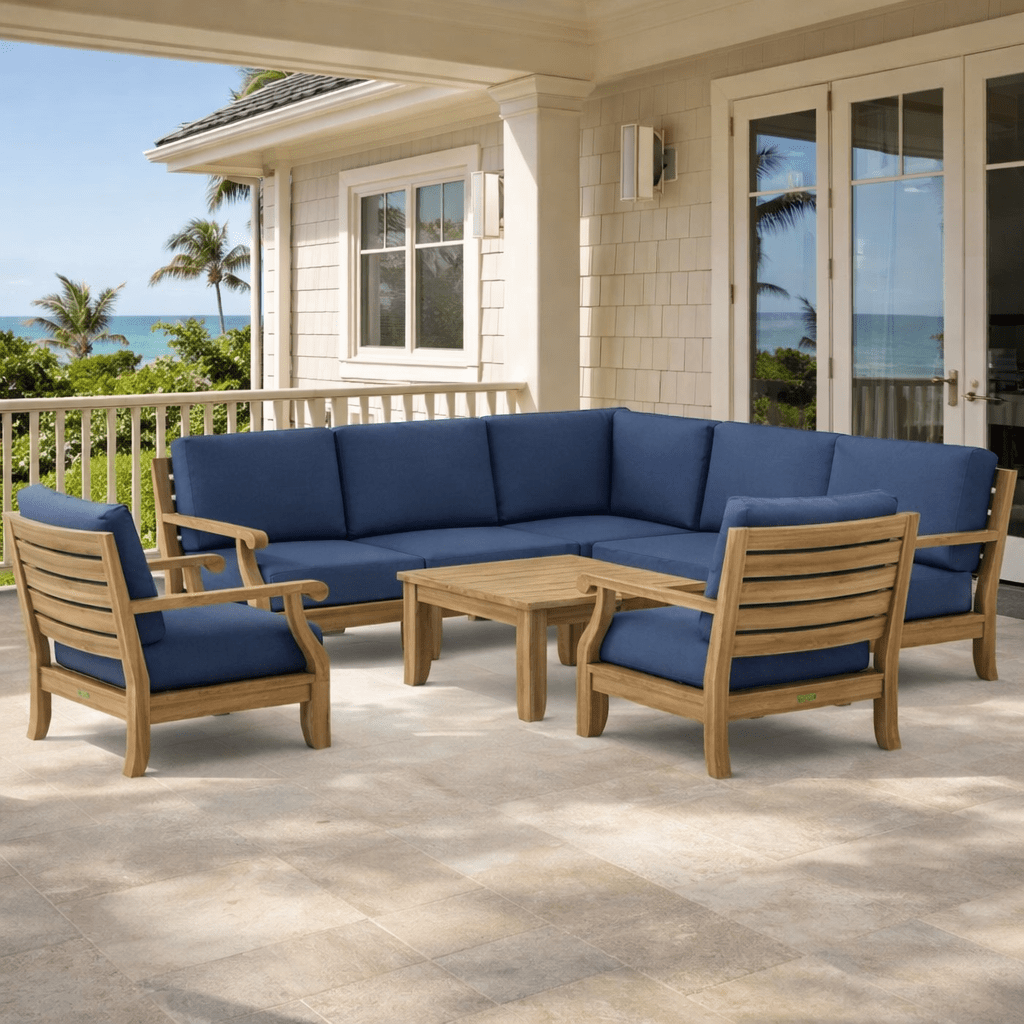
For covered patios, generous teak patio seating is particularly useful because this is often where people stay after dinner. Most—but not all—TeakHQ patio seating includes Sunbrella cushions, so individual product details should be checked when cushion inclusion matters.
This is where Hill Country layouts differ from many suburban patios. On a property with long views, pointing every chair inward can waste the property's best feature. Swivel chairs can solve that conflict: guests can face the conversation when entertaining and turn toward the landscape when the group becomes quieter.
On a wide terrace, we would avoid pushing every piece against the home's exterior wall. A floating arrangement often gives the patio more structure while preserving walking paths between the kitchen, pool, lawn, and secondary seating areas.
A pool should generally be treated as its own furniture zone rather than as an extension of the dining table. Reserve the clearest sunny section of the deck for loungers, keep circulation paths open, and place dining or cushioned lounge seating where shade is easier to provide.
This also keeps wet swimmers from constantly crossing through the main conversation space and allows each zone to function independently.
Begin with the activity that defines your outdoor space most often. Frequent hosts should start with dining sets or extendable tables; large covered patios usually benefit from deep seating or a sectional; pool-focused homes should prioritize loungers; and view-oriented patios are good candidates for swivel seating. After the primary zone is established, add supporting pieces rather than trying to furnish every corner at once. That usually produces a more intentional layout and makes it easier to preserve circulation, shade, and views.
Outdoor living here tends to revolve around the property rather than a single patio slab. Ranches, lake-area homes, wooded lots, custom estates, and weekend properties often create several reasons to move outside during the same visit: cooking, swimming, watching a game, gathering around a fire, eating dinner, or simply sitting where the view is best.
In many Hill Country homes, the grill or outdoor kitchen is not an accessory tucked into a corner. It becomes part of the social space. People gather near the cook, children move between the yard and patio, and dinner may stretch into a long evening outside.
That makes proximity important. Dining should be close enough to the cooking area that carrying food is easy, but not so close that every seated guest occupies the circulation path around the grill. A serving surface, cart, or buffet position between the two zones can make large gatherings function much better.
Second homes near Fredericksburg, lake-area properties around Horseshoe Bay and Canyon Lake, and ranch homes can have an unusual furniture problem: the number of people using the patio may change dramatically from one weekend to the next.
Instead of furnishing everything for the absolute maximum guest count, we generally prefer a strong everyday layout with flexible capacity. Extendable tables, additional dining chairs, benches, and movable accent seating can absorb guests without making the patio feel like an event venue when only two or four people are home.
For a pool-centered property, summer use often divides naturally into wet and dry zones. Chaise lounges belong nearest the pool, dining usually works better closer to the house or outdoor kitchen, and cushioned conversation furniture benefits from a covered or partially protected setting when available.
The result is not only more comfortable; it also reduces traffic conflicts. Someone carrying a plate from the grill should not have to navigate between wet loungers and the pool edge.
The most comfortable outdoor location in the middle of a sunny afternoon may not be the best place after sunset. A shaded dining area can give way to a more exposed conversation space once the heat drops.
This is one reason teak fire pit tables can make sense as part of a separate evening zone. The goal is not to force every activity into one giant furniture grouping, but to let different parts of the patio become useful at different times of day.
 The right furniture mix depends less on the size of the house than on how the outdoor space is divided. A large property can still need compact furniture on a narrow porch, while a modest home may have a wide pool terrace capable of supporting multiple outdoor rooms. Measure each usable zone independently and furnish the activity that belongs there.
Covered patios are natural locations for sofas, club chairs, swivel chairs, and sectionals. They create the outdoor equivalent of a family room and work well for conversation, reading, coffee, or watching television.
On especially wide patios, teak outdoor sectionals can define the seating zone without requiring many individual chairs. On narrower porches, a sofa with two chairs may preserve circulation better than an L-shaped sectional.
Choose the dining table for the number of people you host regularly, then solve occasional overflow separately. A permanently oversized table can consume the prime portion of a terrace and make everyday meals feel awkward.
For households that genuinely entertain eight, ten, or more people often, however, a large dining set is worth prioritizing. Hill Country properties with generous terraces and outdoor kitchens are among the environments where a substantial outdoor table can look appropriately scaled rather than oversized.
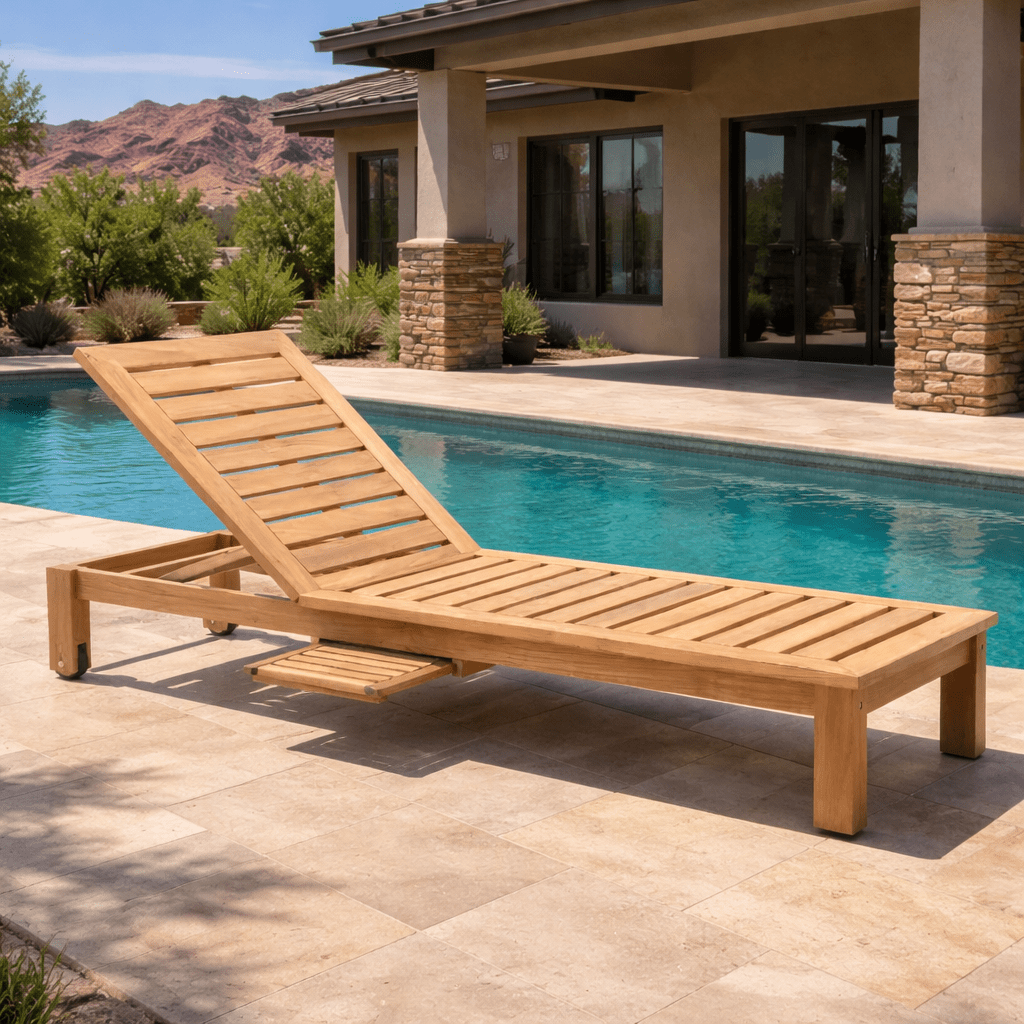
Pool furniture works best when it supports the actual behavior around the pool. Start with teak chaise loungers for people who want to recline, then provide a side table for drinks, towels, or a book. Add a separate upright seating area only when the deck has room to maintain comfortable circulation.
Teak's natural appearance also transitions well between stone decking, water, planting beds, and the more architectural furniture under a covered patio.
A fixed sofa is excellent when there is one obvious focal point. It is less ideal when the reason for sitting outside changes from conversation to sunset to pool activity to a distant view.
Swivel chairs provide flexibility without requiring people to drag furniture around the patio. This is especially useful on elevated Hill Country sites where the landscape itself is part of the room.
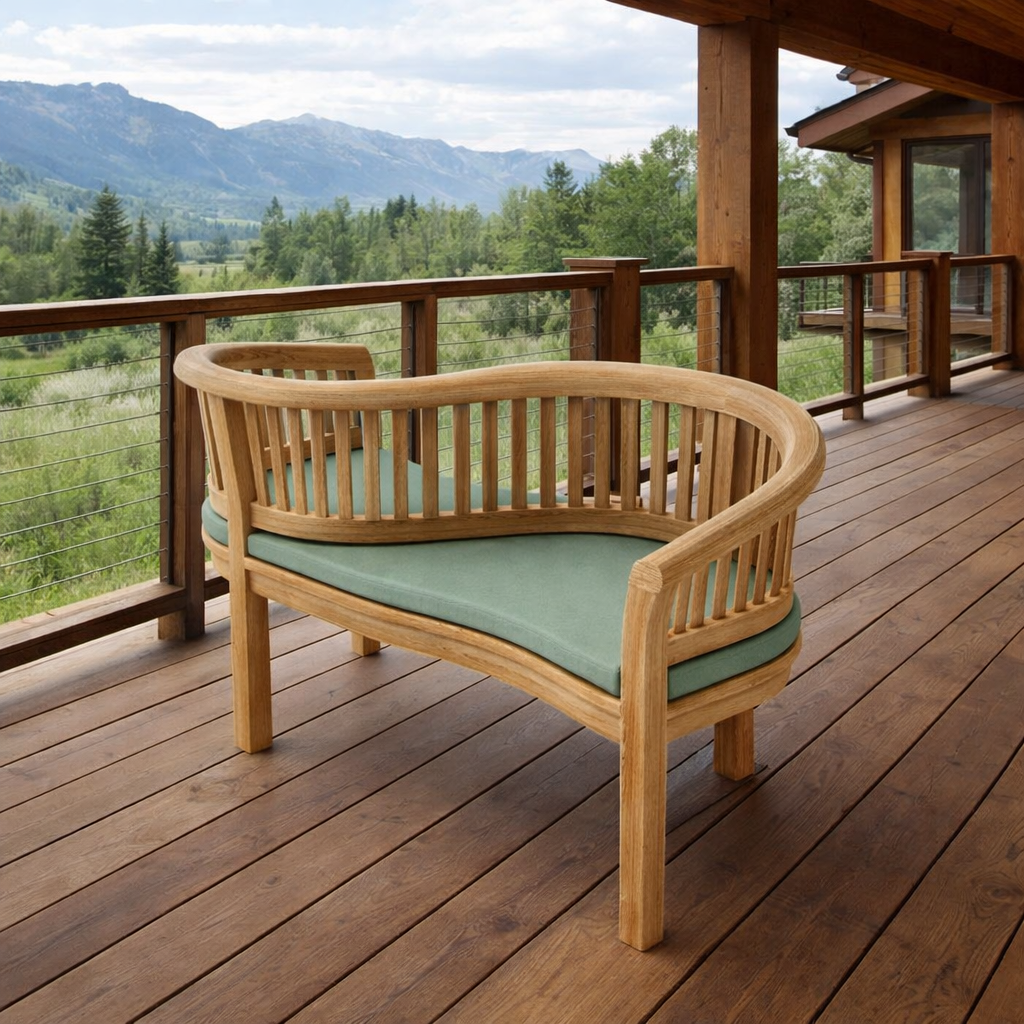
Not every seating area needs to become a complete furniture collection. A single teak garden bench beneath trees, beside a path, or at a viewpoint can make a large property feel more intentionally usable.
These secondary destinations often become some of the most appealing places on an acreage property precisely because they are separated from the main patio.
The most convincing Hill Country outdoor spaces usually take cues from the landscape and the house rather than importing an unrelated patio style. Limestone, timber, metal roofs, weathered steel, stucco, large glass openings, native plantings, and mature oaks all create a setting where furniture should feel substantial but not visually heavy.
Natural teak is particularly easy to pair with Hill Country limestone because both materials bring warmth and texture without requiring exact color matching. New teak creates a warmer golden contrast; weathered silver-gray teak creates a quieter, more natural transition.
That flexibility is useful on homes combining several materials—stone walls, steel details, wood ceilings, concrete floors, and dark window frames—because the furniture does not need to imitate any one of them.
Contemporary Hill Country architecture frequently simplifies traditional regional materials into cleaner forms. For these houses, the furniture can do the same. Straight-lined teak dining tables, substantial lounge seating, and simple sectional layouts complement modern ranch and farmhouse architecture without making the patio feel themed.
Homeowners do not need to choose rustic-looking furniture simply because the property is rural. The natural material can provide the regional connection while the furniture profile remains clean and contemporary.
Courtyard-style homes create a different scale. The space may be visually enclosed by the house, pool, walls, or landscaping, so furniture dimensions become more important than the size of the property overall.
In these areas, preserve negative space. A smaller deep-seating grouping and a four- to six-person dining table may feel more luxurious than filling every edge with furniture.
On view properties, the most expensive mistake can be visual rather than structural: buying furniture so tall, dense, or widely distributed that the landscape disappears behind it.
Before ordering, sit at the expected eye level and look across the proposed furniture location. Preserve important sightlines from both the patio and the interior rooms behind it. Furniture should support the view, not become the view.
 “Texas weather” is too broad a specification. A shaded porch in Wimberley behaves differently from an exposed pool terrace in Horseshoe Bay or a west-facing ranch patio near Fredericksburg.
Evaluate hours of direct sun, shade, roof runoff, irrigation, wind exposure, nearby trees, and pool splash before deciding what belongs there. Grade A teak is versatile across these conditions, but the best layout and care routine still depend on the specific location.
A beautiful west-facing terrace can become uncomfortable during the hottest part of the day. Furniture alone cannot correct poor solar planning.
Use covered areas, umbrellas, pergolas, or other appropriate shade where needed, then position the highest-use seating accordingly. Teak can withstand sun exposure, but shade improves human comfort and can reduce exposure for cushions and other patio accessories.
Homeowners with large families sometimes size every outdoor area for the biggest gathering they can imagine. The result can be a patio that feels crowded the other 350 days of the year.
Build the main layout around regular use, then add flexible capacity through extendable tables, movable chairs, benches, and secondary seating. This is particularly effective for second homes where occupancy changes dramatically from weekend to weekend.
Heavy rainfall does not affect every part of a patio equally. Roof valleys, downspouts, sloped paving, retaining walls, and low spots can direct a surprising amount of water toward one small area.
Teak's moisture and rot resistance make it an excellent outdoor material, but there is little benefit in deliberately placing any premium furniture in recurring standing water. Watch the patio during a heavy storm before finalizing permanent furniture locations.
During cedar and oak pollen periods, outdoor surfaces can become dirty quickly. That does not necessarily mean the furniture finish is deteriorating.
Plan on cleaning horizontal surfaces more frequently when pollen is heavy, and manage cushions separately when practical. Choosing an outdoor material that can remain outside simplifies the process because seasonal surface cleaning does not have to become seasonal furniture storage.
 There is no reason to create an unnecessarily complicated maintenance calendar. Instead, clean according to exposure. Furniture beneath trees may collect pollen, leaves, and organic debris faster than furniture on an open stone terrace. Poolside pieces may need attention for splashes and general summer use.
A light cleaning when surfaces become dirty and a more thorough seasonal cleaning are generally more useful than repeatedly treating clean teak simply because a date appears on the calendar.
Natural unfinished teak can be left untreated and will gradually weather to a silver-gray patina. Many Hill Country properties wear this look extremely well, particularly homes with native stone, weathered steel, rustic-modern architecture, or naturalistic landscaping.
If you prefer the warmer original teak appearance, use appropriate care products according to their directions. TeakHQ offers teak cleaners and sealers for owners who choose that maintenance approach. Treatments are an appearance choice rather than a requirement for the wood's basic durability.
Do not assume the furniture frame and cushion need identical treatment. Most TeakHQ patio seating includes weather-resistant Sunbrella cushions, but cushion inclusion varies by product.
During periods of heavy rain, pollen, storms, or extended non-use, storing or protecting loose cushions can reduce cleaning and keep the seating ready for guests. Always check the individual product specifications and cushion-care instructions.
Protective covers are optional for teak rather than structurally required. They can nevertheless be useful beneath messy trees, at vacation properties that may sit unused for extended periods, or where owners simply want to reduce cleaning before a weekend visit.
If using covers, follow the cover manufacturer's directions and avoid creating unnecessary trapped moisture around cushions or furniture.
Hill Country cold fronts and occasional freezes do not mean Grade A teak furniture must automatically be moved indoors. TeakHQ's teak furniture is designed for year-round outdoor use and temperature fluctuations.
Loose accessories and cushions may still be stored according to their own care needs, but substantial teak tables and seating can remain part of the patio throughout the year.
The best Texas Hill Country patio is not simply filled with durable furniture. It is organized around how the property is actually used: where afternoon shade falls, where guests gather, which direction the view faces, how people move between the kitchen and pool, and how many seats are needed on an ordinary weekend. Start with those decisions first. Then choose premium Grade A teak furniture that fits the space, the architecture, and the level of long-term ownership you expect from the property.
Several premium materials can work well, including quality aluminum and Grade A teak. Teak is especially attractive for Hill Country homes because it is naturally resistant to moisture, rot, insects, and warping; handles sun, rain, and temperature changes; and has a natural appearance that pairs well with stone, wood, and ranch-style architecture.
That depends on the material. Premium Grade A teak sold by TeakHQ is designed for year-round outdoor use and can withstand rain, sun exposure, and temperature fluctuations. Cushions and accessories may have separate care requirements.
No. Protective covers are optional rather than required for Grade A teak's durability. A cover can still be useful for reducing pollen, leaves, dirt, and cleanup after storms or during periods when a property is not being used.
Begin with dedicated loungers positioned around the usable sunny portion of the pool deck, then keep dining and deep seating in separate zones when space permits. Teak chaise loungers are a natural fit because teak is designed for outdoor exposure and has a substantial, natural appearance beside stone and landscaping.
Create distinct zones rather than lining furniture around the perimeter. A practical plan often combines an outdoor dining area near the kitchen with a separate sofa, sectional, or club-chair conversation space. Preserve clear routes to the pool, yard, grill, and interior doors.
Outdoor teak naturally weathers from its original warm color to a silver-gray patina over time when left untreated. This is normal aging. Homeowners who prefer the original appearance can choose appropriate teak care products instead of allowing the wood to weather naturally.
Clean surfaces as pollen accumulates rather than allowing heavy deposits to remain indefinitely. During particularly dusty or pollen-heavy periods, tables and chair arms may need more frequent wiping or rinsing. Loose cushions can also be stored or protected when the patio will not be used for a while.
Usually not. Size the table around your normal household and frequent guest count while maintaining comfortable circulation. If you occasionally host much larger groups, an extendable teak dining table can provide extra capacity without permanently occupying the entire patio.
Neither material is automatically better for every buyer. Aluminum is lighter and often has a more distinctly modern appearance. Teak is natural, warmer in character, heavier, and has a more substantial architectural feel. Teak often makes particular sense when the furniture will remain in a permanent outdoor setting and needs to complement stone, timber, and natural landscaping.
Quality teak furniture is a long-term purchase that can last for decades with appropriate use and care. Its higher initial price should therefore be considered in terms of long-term ownership rather than compared only with the purchase price of furniture designed for shorter service lives.


