
FREE SHIPPING
within mainland USA
within mainland USA
Home ▸ Teak Outdoor Furniture ▸ By Location ▸ Washington DC
Washington homeowners ask a lot of outdoor furniture: hot, humid summers give way to wet transitional seasons and winter freezes, while many patios, rear gardens, and roof decks have limited space to waste. Historic rowhouses create different furnishing challenges than detached homes in Upper Northwest or larger properties beyond the District. Premium Grade A teak is particularly well suited to this four-season environment because it combines natural weather resistance with the warmth and architectural character that work comfortably across both traditional and contemporary DC homes.

Washington sits in an outdoor-furniture environment that rewards versatility more than specialization. A patio set here does not face relentless desert sun or coastal salt spray, but it does experience a broader combination of conditions: hot and humid summer weather, substantial rainfall, thunderstorms, winter cold, occasional snow and ice, and repeated seasonal temperature changes. Official climate records for the Washington area reflect both summer heat and meaningful winter snowfall, making year-round material performance more important than it is in milder climates. :contentReference[oaicite:0]{index=0}
Summer is when DC patios receive their heaviest use, but it is also when heat, humidity, thunderstorms, and moisture become part of the ownership equation. Outdoor furniture that absorbs moisture easily, depends heavily on protective finishes, or requires constant sheltering can become inconvenient precisely when the outdoor space is used most.
This matters especially in enclosed rear gardens and partially shaded patios. A Capitol Hill courtyard surrounded by masonry and mature landscaping can remain damp longer after a storm than an exposed suburban deck. When comparing materials, pay attention not only to whether the furniture can get wet, but also to whether repeated wet-and-dry cycles create a maintenance burden.
Washington is not a warm-weather-only furniture market. Temperatures move through freezing during winter, and measurable snowfall is a normal part of the climate. That makes temperature fluctuation and moisture exposure legitimate considerations for furniture intended to remain outdoors throughout the year. :contentReference[oaicite:1]{index=1}
For premium furniture, the practical question is usually not whether you can move everything indoors every winter; it is whether you need to. Homeowners with small rowhouses, basement apartments, or limited garages often have nowhere sensible to store a complete outdoor dining or lounge collection. Furniture designed for year-round outdoor use has a meaningful advantage in that setting.
A roof deck and a shaded rear garden may be only a few stories apart, yet they behave like different furniture environments. Roof decks generally receive more direct sun, wind, and rapid weather changes. Rear gardens are often more sheltered but can collect leaves, pollen, and moisture beneath trees or beside masonry walls.
That distinction should influence layout and maintenance. On a roof deck, prioritize sturdy furniture and enough clearance around circulation paths. In a garden, prioritize easy cleaning and avoid placing furniture where water routinely collects beneath the legs.
Washington's climate is influenced by the broader Mid-Atlantic, but homeowners should not automatically apply waterfront furniture advice to the city. Persistent coastal salt spray is not the primary issue here. Humidity, precipitation, temperature swings, shade, and urban space constraints are usually more relevant. Likewise, homes farther west toward higher elevations can experience different winter conditions, while large outer-suburban lots permit layouts that simply do not translate to a Georgetown or Capitol Hill rowhouse.
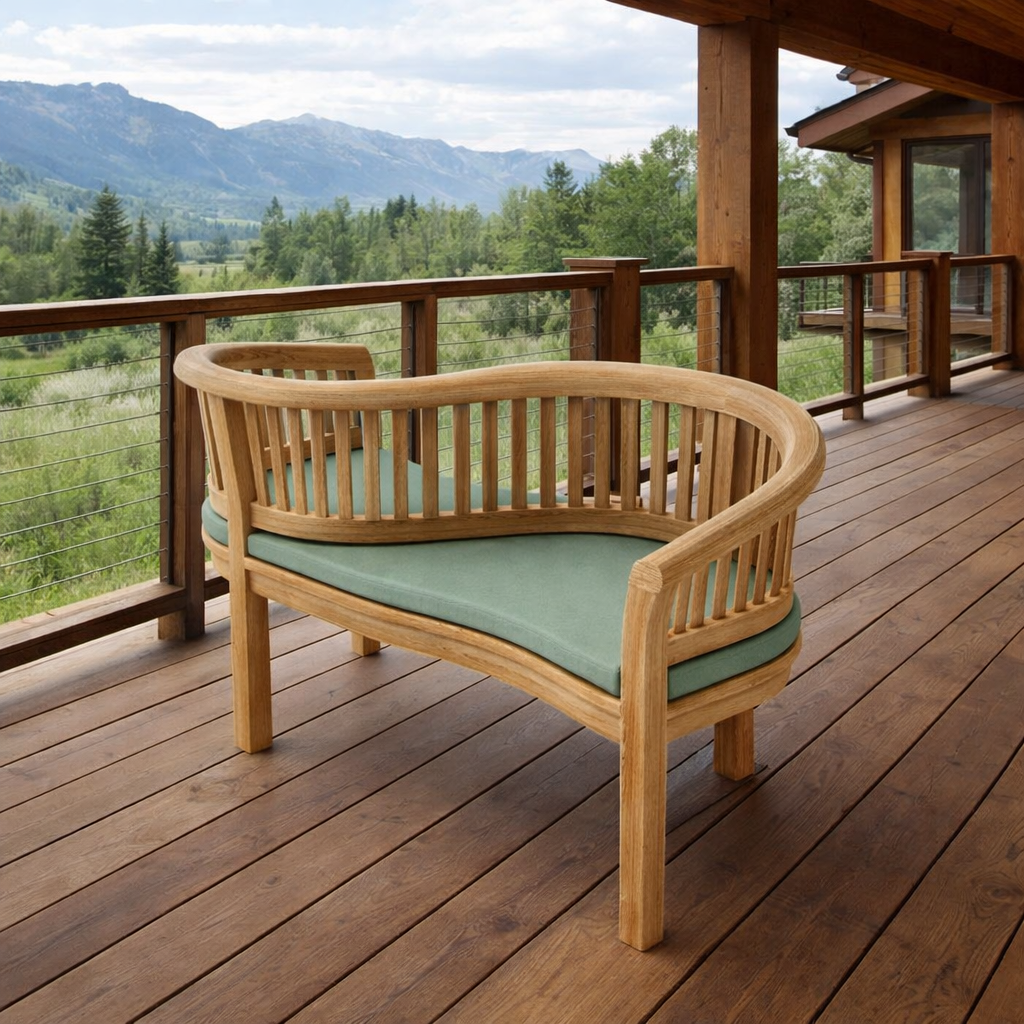 Grade A teak is naturally dense and high in oils, which contributes to its resistance to moisture, rot, insects, and warping. In Washington, that combination is valuable because outdoor furniture routinely moves between humid air, rain, drying sun, and cooler weather rather than experiencing one consistent climate.
It also changes the ownership experience. Premium teak does not require artificial stain for durability, and it can be left outdoors year-round. Owners may choose to maintain its original golden-brown appearance or allow it to weather naturally to a silver-gray patina.
Washington's seasonal temperature swings make dimensional stability important. Teak's dense grain and natural characteristics make it well suited to repeated changes in temperature and moisture. It is designed to withstand rain, sun exposure, and temperature fluctuations, which is useful when winter storage is impractical.
This does not mean every part of an outdoor setup should be treated identically. Cushions still deserve more attention than teak frames. Many TeakHQ lounge pieces include weather-resistant Sunbrella cushions, while other products offer cushions separately. During extended periods of non-use, storing soft goods under cover can reduce cleaning and keep the space easier to reopen.
Exposed DC roof decks can receive substantial summer sun. Teak is designed for outdoor sun exposure, although its appearance changes naturally with time. Untreated teak gradually develops a silver-gray patina rather than retaining its original honey-brown color indefinitely.
That is an aesthetic choice rather than a sign that the furniture has reached the end of its useful life. Homeowners who like weathered wood can allow the transition to occur naturally. Those who prefer the newer teak appearance can use appropriate teak care products as part of an optional maintenance routine.
For an $8,000–$20,000 outdoor project, initial price should not be the only comparison. Grade A teak furniture is intended to last for decades rather than a few seasons. That makes it especially relevant for homeowners furnishing a permanent residence, renovating a high-value property, or trying to avoid repeating the same patio purchase every several years.
Aluminum can also be a legitimate premium choice, particularly when a light, modern appearance is the priority. Poly lumber can appeal to buyers who prioritize synthetic low-maintenance materials. Teak makes more sense when the homeowner specifically wants real wood, a heavier architectural feel, long service life, and the ability to choose between maintained natural color and a weathered patina.
| Washington DC Challenge | Why Premium Grade A Teak Performs Well |
|---|---|
| Summer humidity | Natural oils and dense grain support moisture and rot resistance. |
| Frequent rain | Designed for outdoor exposure without requiring paint or artificial stain for durability. |
| Winter cold | Suitable for year-round outdoor use and temperature fluctuations. |
| Wet/dry cycles | Dense Grade A teak resists warping and moisture-related deterioration. |
| Direct summer sun | Designed for sun exposure and can naturally weather to a silver-gray patina. |
| Limited winter storage | Teak frames do not need to be moved indoors for seasonal protection. |
| Leaves and pollen | Solid wood surfaces can be periodically cleaned as outdoor debris accumulates. |
The first question we would ask is not, “Which collection do you like?” It would be, “What does this space need to do on an ordinary Tuesday and on the biggest gathering you host all year?” In Washington, that distinction often determines the right furniture far more than patio square footage alone.
On a narrow rowhouse patio, a table that technically fits can still be the wrong table. Dining chairs need room to pull back, guests need a path between the house and garden, and doors or basement stairs may consume more usable space than the dimensions suggest.
This is one of the most important DC-specific planning principles: the usable size of a patio is the space that remains after movement is accounted for. We would rather place a comfortable six-person teak dining set with good circulation than force eight seats into a space that becomes frustrating every time people sit down.
For homeowners who entertain regularly but do not need a large table every day, an extendable teak dining table is particularly useful. Keep the smaller footprint for normal family meals and open the table when friends, relatives, or neighbors arrive.
That approach is often better than permanently dedicating most of a compact courtyard to maximum seating capacity. It also makes sense for larger Upper Northwest homes where the outdoor space may alternate between quiet family dinners and considerably larger gatherings.
Where space permits, we would separate dining from lounging. A multi-piece lounge set with a coffee table creates a place to sit before dinner, continue a conversation after the table is cleared, or use the patio without formally “setting up” for a meal.
On smaller properties, two club chairs with a compact table can accomplish the same job without consuming the footprint of a full sofa group. On larger terraces, a sectional can establish a distinct outdoor room.
Washington's historic residential fabric includes many rowhouses, porches, bays, small yards, and alley-oriented rear spaces; Capitol Hill in particular contains extensive rows of nineteenth-century homes and alley development. :contentReference[oaicite:2]{index=2} Rather than placing every piece of furniture on one patio, we often prefer to create a second destination—a bench beneath a tree, a pair of chairs at the rear of the garden, or a small seating area away from the dining table.
This makes even a modest garden feel larger because people have a reason to move through it rather than viewing the yard as leftover space behind the primary patio.
Begin with the activity that will happen most often. If meals anchor your outdoor life, start with dining and decide whether everyday capacity or expandable capacity matters more. If the patio is primarily for conversation, cocktails, and evening gatherings, begin with lounge seating instead. Compact city properties generally benefit from pieces that earn their footprint every week, while larger detached homes can support separate dining, conversation, and garden zones.
Outdoor life in Washington tends to follow the seasons rather than stop when summer ends. Spring and fall can be particularly appealing for patio dining, while hot summer days often shift entertaining toward shaded spaces and evenings. The result is an outdoor room that may serve very different purposes from April through October and then remain exposed to winter weather after active use slows.
DC entertaining often rewards flexibility. A rear patio that seats four comfortably every day may occasionally need to accommodate eight. Extra chairs, expandable tables, benches, and movable accent seating are therefore more valuable than a permanently oversized arrangement.
The best plan is usually to design around normal use and create a deliberate strategy for overflow. That produces a patio that feels generous 90% of the time instead of crowded 100% of the time.
Homeowners sometimes design outdoor spaces primarily around July, but Washington's milder shoulder seasons deserve equal attention. Comfortable dining and lounge seating can make spring lunches and crisp fall evenings some of the most enjoyable uses of the space.
This is one reason substantial wood furniture feels at home here. It creates a permanent outdoor-room atmosphere rather than the visual impression of temporary summer furniture that appears in May and disappears in September.
Roof decks can be outstanding outdoor rooms, but they punish poor space planning. Long circulation paths, stair access, grills, planters, mechanical equipment, and railings all compete for usable square footage.
Measure the clear furnishing zone rather than the deck's total dimensions. Then preserve an obvious path from the stairs to every major activity area. Before placing large or heavy furniture on any elevated structure, confirm the deck's applicable structural and building requirements.
In neighborhoods such as Georgetown, Capitol Hill, Cleveland Park, and Upper Northwest, outdoor spaces often sit beside mature landscaping, masonry, historic architecture, or established gardens. Natural teak can complement those materials without requiring the space to adopt an overtly rustic or contemporary look.
That versatility matters in Washington because the city's housing is architecturally diverse. The same wood can sit comfortably beside old brick, painted masonry, a traditional porch, or a modern rear addition.
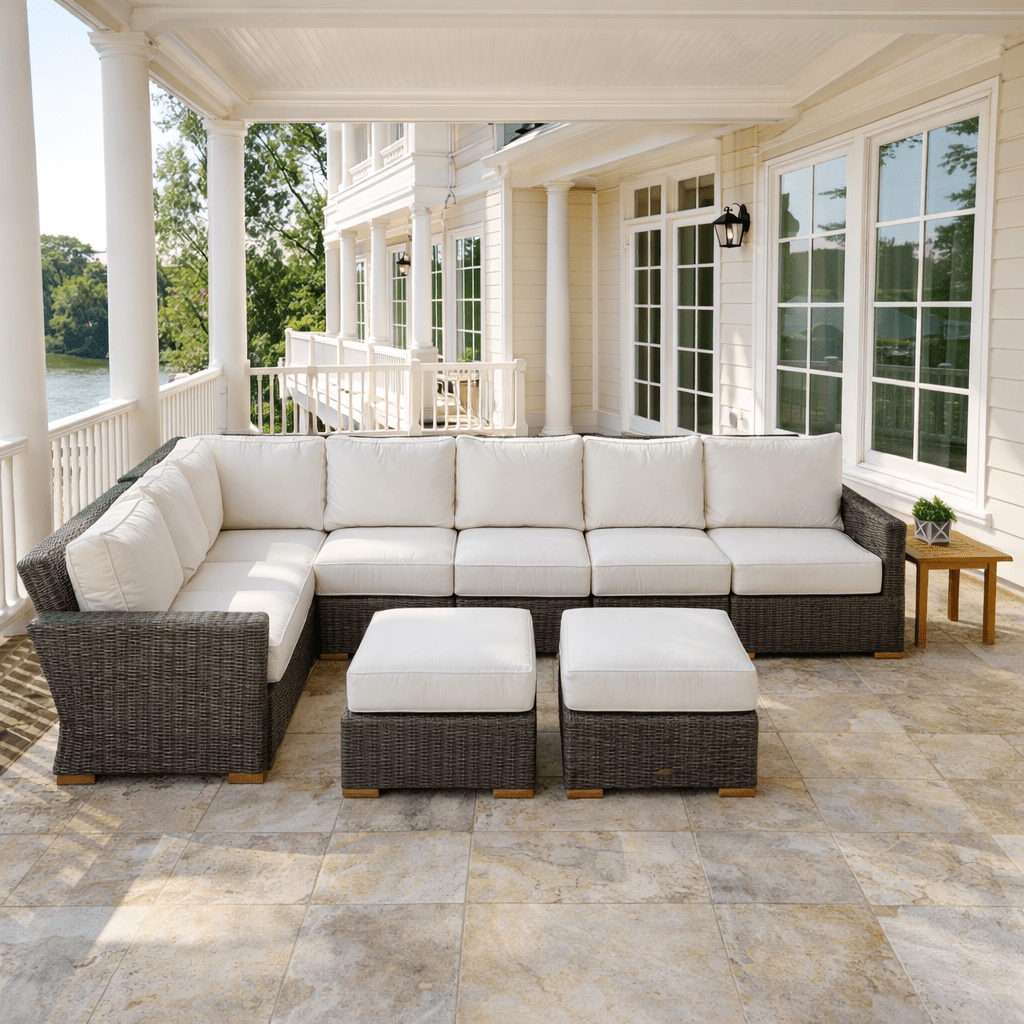 For a narrow rear patio, start with function rather than symmetry. A rectangular or oval dining table generally uses a narrow footprint efficiently, while an extendable model gives you occasional capacity without dominating the space every day.
If relaxation is more important than formal dining, two teak club chairs and a small table can create a surprisingly complete outdoor room. The advantage is flexibility: individual chairs can be angled toward each other, moved when guests arrive, or incorporated into a larger seating arrangement.
On larger properties, we would create separate zones. Place dining closer to the kitchen or outdoor cooking area, then establish lounge seating far enough away that people naturally move between the two.
A teak sectional can anchor the conversation area where space permits. Pairing it with a coffee table and occasional chairs creates a more adaptable layout than relying on one long sofa alone.
Roof decks benefit from fewer, better-chosen pieces. Avoid filling every perimeter with furniture simply because the deck appears large when empty. Once people, plants, shade structures, and serving areas arrive, visual and physical congestion builds quickly.
A four- to six-person dining arrangement plus one compact conversation group can often outperform a much larger furniture plan. Side tables are especially useful because they provide function without requiring another large central footprint.
A teak garden bench works particularly well where the property has a landscaped rear garden, side path, mature tree, or quieter area separated from the main patio. It does not need to become another “furniture set.” One well-placed bench can turn an unused corner into a destination.
For traditional DC homes, this is also one of the easiest ways to introduce outdoor seating without visually competing with the architecture.
Washington's residential character is unusually varied. Historic neighborhoods include Federal-era townhouses, Italianate and Victorian rowhouses, Queen Anne influences, porches, projecting bays, and later Arts-and-Crafts and Classical Revival homes. The District's own planning guidance notes the importance of porches, bays, towers, and other building projections to the city's residential character. :contentReference[oaicite:3]{index=3}
Natural teak works especially well beside brick because the materials have different textures without fighting each other visually. Warm teak can soften a masonry courtyard, while weathered silver-gray teak produces a quieter, more established appearance.
For historic properties, we generally favor furniture with enough visual presence to feel intentional but not so much ornamentation that it competes with the house itself.
A common misconception is that traditional architecture requires traditional-looking furniture. It often does not. Simple teak dining tables, clean-lined lounge seating, and restrained cushions can work exceptionally well against ornate nineteenth-century architecture because the furniture provides contrast rather than imitation.
That approach is particularly useful when a historic rowhouse has a contemporary rear addition or renovated garden.
On newer townhomes, condos, roof decks, and glass-heavy additions, teak introduces a natural counterpoint to metal railings, concrete, masonry, and large windows. Homeowners who find all-metal furniture too cool or visually lightweight may prefer teak's heavier, warmer presence.
The objective is not to make the space look rustic. Premium teak can read as distinctly modern when the silhouettes and surrounding materials are simple.
In leafy residential neighborhoods, teak's natural wood character feels at home among boxwoods, flowering plants, mature trees, stone paths, and brick walls. Planters and benches can extend the material beyond the primary patio without requiring every element in the garden to match.
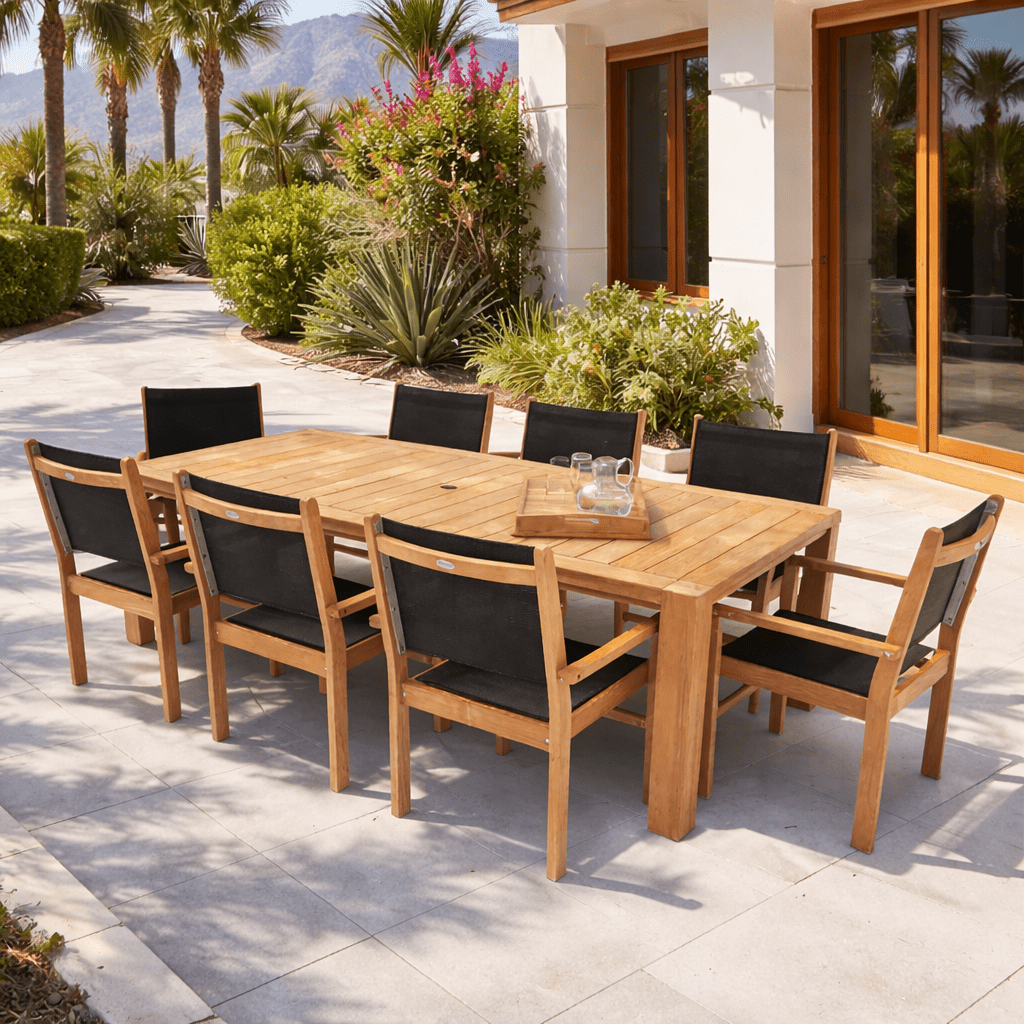 The biggest table that physically fits is rarely the best table for a narrow patio. Once chairs are occupied, guests need additional clearance behind them, and rowhouse yards frequently have only one path connecting the rear door, stairs, gate, and garden.
Measure chair movement and walking space before ordering. If large dinners are occasional, an extendable table is usually a smarter answer than permanently sacrificing circulation.
Roof decks look spacious when empty, but railings, access stairs, planters, shade, cooking equipment, and circulation quickly consume usable area. Oversized deep seating can turn a premium terrace into an obstacle course.
Use fewer pieces, maintain clear travel lanes, and confirm structural considerations before installing substantial furniture or other heavy outdoor elements.
Lightweight seasonal furniture may seem adequate in June but becomes less appealing when the homeowner has to decide what to do with it all winter. Washington's four-season climate makes year-round suitability especially useful for households without large storage areas.
Grade A teak is designed to remain outdoors year-round, so the wood furniture itself does not need a seasonal migration into the basement or garage.
A shaded Georgetown garden, tree-covered Cleveland Park patio, and sunny roof deck can experience the same storm very differently. Furniture placed against walls, beneath dense plantings, or over areas with poor drainage may stay wet longer.
Teak's moisture resistance is an advantage, but good placement still matters. Allow air circulation, keep organic debris from accumulating, and correct standing-water problems rather than relying on the furniture material to compensate for a poor site.
Untreated teak naturally moves from its original warm color toward silver-gray as it weathers. Buyers who are not expecting that transition sometimes assume something has gone wrong.
Decide which appearance you want before the first season. If you like the natural patina, the simplest course is to allow it to develop. If you want to preserve the newer teak color, plan for optional appearance-focused maintenance.
 There is no single cleaning calendar that fits every DC property. A roof deck with little tree cover may accumulate dust and urban grime, while a shaded garden can collect pollen, leaves, seed pods, and organic debris much faster.
Inspect the furniture periodically and clean when buildup becomes visible rather than maintaining it according to an arbitrary monthly schedule. Areas beneath tables, between slats, and around furniture legs deserve attention because debris tends to remain there after open surfaces look clean.
Teak is resistant to moisture and rot, but keeping the surrounding space clean and well drained still improves the ownership experience. Remove leaves and debris that remain wet against furniture, and avoid positioning pieces where irrigation or roof runoff repeatedly creates standing water.
If surface mildew develops in a persistently damp setting, address the environmental cause as well as cleaning the furniture. More airflow, less trapped organic debris, and better drainage can be more important than simply cleaning more often.
The teak frames can remain outside, but cushions and other soft accessories benefit from more deliberate off-season management. Many TeakHQ lounge products use Sunbrella cushions that are weather-, fade-, UV-, and water-resistant, but storing dry cushions during long periods of non-use reduces exposure and spring cleaning.
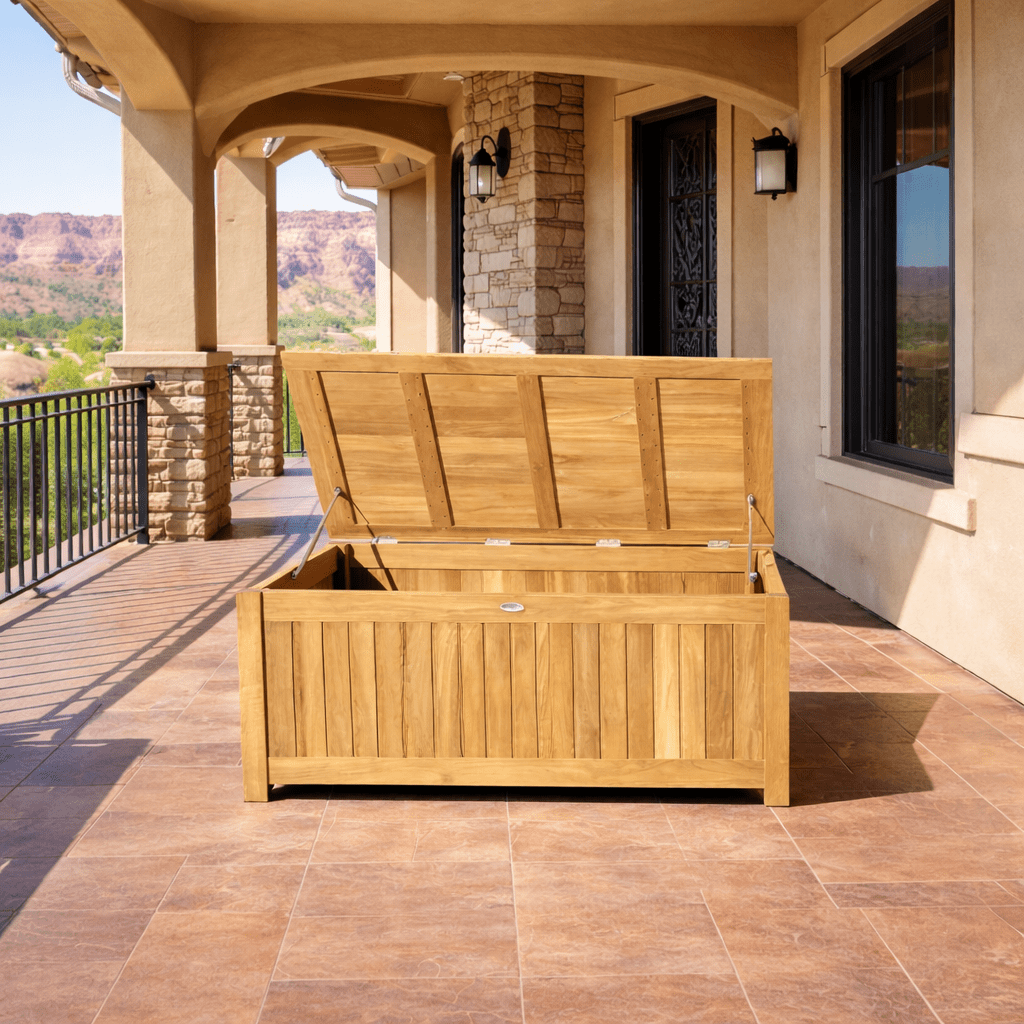
A teak deck box can be useful where appropriate, provided the specific storage solution and cushion dimensions are compatible. Indoor or protected storage is another option.
Protective covers are optional for teak rather than a durability requirement. Some owners like them because they reduce debris and cleaning, particularly beneath trees. Others prefer to leave the teak exposed and let it weather naturally.
If you use covers, follow the cover manufacturer's directions and avoid putting wet cushions away for extended periods. A cover should simplify ownership, not become another place for moisture and debris to remain unnoticed.
Unlike a Chesapeake Bay or Atlantic waterfront property, a Washington patio does not normally experience persistent airborne salt spray. Salt therefore should not dominate your furniture decision here.
The more realistic salt exposure is incidental—for example, splash or residue associated with winter deicing products. If salt gets onto furniture, cleaning it away is sensible. For most DC homes, however, pollen, leaves, rain, humidity, and ordinary urban grime deserve more maintenance attention.
Teak does not need artificial stain, paint, or sealer for durability. Left untreated, it naturally develops a silver-gray patina. Owners who prefer the original teak color can choose an appropriate maintenance routine instead.
The important point is that maintenance can be driven largely by the appearance you want rather than by a requirement to repeatedly coat the wood merely to keep it outdoors.
The best outdoor furniture plan for Washington DC should work on a humid August evening, a crisp October dinner, and through the months when the furniture may remain outside with little use. Start with the way your property actually functions—its circulation, exposure, available space, household size, and entertaining patterns—then choose the furniture configuration that supports those needs. Premium Grade A teak is an especially strong fit when you want real wood, year-round outdoor capability, flexible maintenance, and furniture intended to remain part of the property for decades.
Look for materials that tolerate humidity, rain, summer sun, winter cold, and repeated temperature changes. Premium Grade A teak is a strong option because its natural oils and dense grain make it resistant to moisture, rot, insects, and warping while allowing year-round outdoor use.
It depends on the material. TeakHQ's Grade A teak furniture is designed for year-round outdoor use and can remain outside through rain, snow, sun, and temperature fluctuations. Cushions and soft accessories may still be worth storing during long periods of non-use.
Prioritize circulation before seating capacity. Compact dining sets, extendable tables, club chairs, loveseats, benches, and small accent tables can provide useful seating without blocking the route between the house, garden, gate, and stairs.
Choose sturdy furniture with a disciplined footprint and preserve clear circulation from the stair or access point. Dining sets, compact lounge groups, club chairs, and side tables generally make more sense than filling the entire deck with oversized seating. Structural requirements should also be confirmed before placing substantial loads on an elevated deck.
No. Grade A teak does not require a protective cover for durability. Covers are optional and can be useful for reducing pollen, leaves, and other debris if that makes maintenance easier for your particular property.
Yes. Unfinished teak naturally weathers to a silver-gray patina when exposed outdoors. That color change is expected. If you prefer the original warmer teak color, you can use appropriate teak care products and follow an appearance-maintenance routine.
Both can be legitimate premium choices. Aluminum is lighter and often has a more contemporary appearance. Teak is natural wood, warmer visually, heavier, and intended for decades of use. The better choice depends on whether you prioritize lightweight modern furniture or the feel and longevity of real wood.
For many city properties, an extendable table is the more versatile choice. It preserves everyday circulation on a smaller patio while providing additional seating when guests arrive. Permanent large tables make more sense where the patio has enough room to maintain comfortable chair and walking clearance at all times.
Keep leaves and organic debris from accumulating, clean the furniture when visible buildup develops, and avoid placing it where standing water persists. Teak's natural moisture resistance reduces the need for intensive protective treatment, but good drainage and airflow still make any outdoor space easier to maintain.
Premium Grade A teak furniture can last for decades when used outdoors. Its higher upfront price should therefore be evaluated as a long-term purchase rather than compared only with the initial cost of furniture intended for a much shorter service life.


